


2 Killed in Karbala as Iraq Protesters Battle for Baghdad Bridges

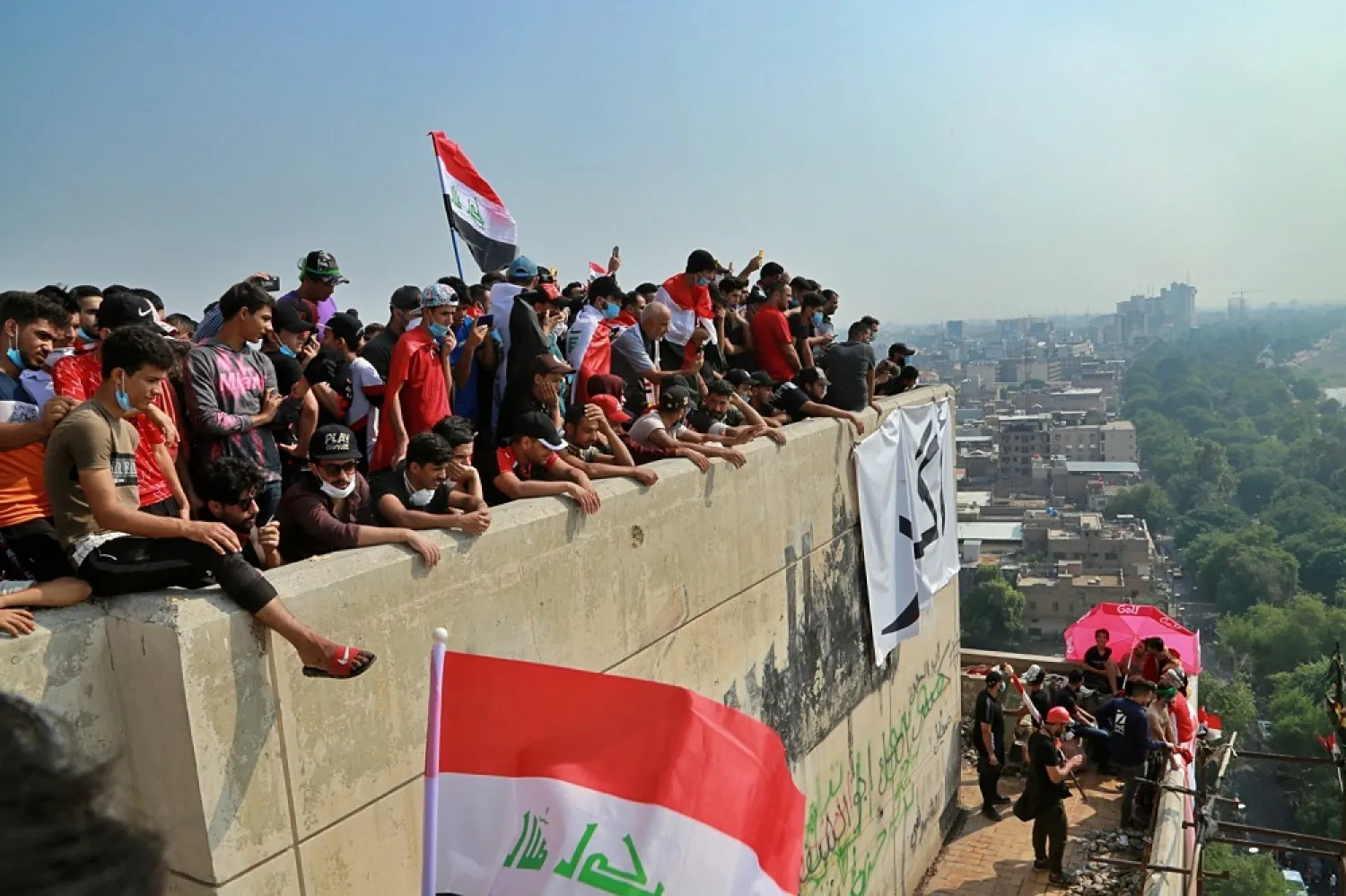
Iraqi anti-government protesters stand on a building near Tahrir Square in Baghdad on Oct. 31, 2019. (AP)
TT

2 Killed in Karbala as Iraq Protesters Battle for Baghdad Bridges

Iraqi anti-government protesters stand on a building near Tahrir Square in Baghdad on Oct. 31, 2019. (AP)

Iraqi security forces fired tear gas and live rounds into the air to disperse protesters in central Baghdad on Wednesday, killing one person, as the biggest wave of anti-government demonstrations in decades spread out across the capital.

The shootings took place on or near three of Baghdad’s main bridges - Ahrar, Shuhada, and Bab al-Muadham - which have become focal points of the protests.

Chaotic scenes unfolded as the din of gunshots and stun grenades rocked the streets where groups of anxious young men - some heavily bandaged - ran from security forces, Reuters correspondents said. Tuk-tuks whizzed by ferrying protesters, some of them wounded.

Armored police vehicles blocked their path, turning most away. Policemen dragged a driver out of his tuk-tuk and beat him and a fellow rider with sticks before arresting them.

The fatality was a doctor, shot dead near Ahrar Bridge, security and medical sources said. At least 42 people sustained tear gas-related injuries. At least 18 people were arrested, security sources said.

Two more protesters were killed in renewed clashes in the city of Karbala, a flashpoint in weeks of demonstrations, a protester and a medic said Wednesday.

They said the two were killed in overnight clashes near the provincial headquarters in the city. They spoke to The Associated Press on condition of anonymity for fear of repercussions.

More than 260 Iraqis have been killed since the start of October in the largest demonstrations since the fall of Saddam Hussein in 2003. Protesters are demanding the overthrow of a political class seen as corrupt and beholden to foreign interests.

Protesters had begun trying to block bridges earlier this week as part of efforts to bring the country to a standstill, with thousands joining anti-government demonstrations in the capital and southern provinces. Security forces killed at least five people on Monday during one such attempt.

On Wednesday, the usually bustling surrounding streets were empty, with most shops shuttered.

“We are peacefully protesting,” said Abu Zahra, 50. “We are here to block the bridges. If we don’t, security forces are going to retake all the bridges and Tahrir Square, and end our protest. We are defending our brothers in Tahrir.”

Thousands of people had been gathering for weeks in central Tahrir Square. Clashes over two other bridges near the square have taken place regularly, bringing the total of blocked bridges to five.

“Blocking roads and bridges is illegal sabotage. Security forces have strict orders not to use live ammunition against protests and they are adhering to the rules of engagement but this could change,” the prime minister’s spokesman said.

In the 24 hours to late Tuesday, security forces shot dead at least 13 protesters.

Thousands have also demonstrated in Iraq’s impoverished south.

Civil disobedience

Since defeating ISIS in 2017, Iraq has enjoyed two years of comparative stability. But despite its oil wealth, many people live in poverty with limited access to clean water, electricity, healthcare or education.

The root cause of grievances is the sectarian power-sharing system of governance introduced after the 2003 US-led invasion. Many see political elites as subservient to one or another of Baghdad’s main allies, the United States and Iran, who use Iraq as a proxy in a struggle for regional influence.

Protesters are now escalating their tactics, saying civil disobedience is their only recourse and calling for strikes as the government of Prime Minister Adel Abdul Mahdi, in office for a year, has found no response to the protests.

Protesters on Wednesday also blocked the entrance to the southern Nassiriya oil refinery, security and oil sources said. They stopped tankers that transport fuel to gas stations from entering the refinery, causing fuel shortages.

Security forces forcibly dispersed a sit-in overnight in oil-producing Basra but no deaths were reported, security sources said.

Thousands have been blocking all roads leading to Iraq’s main Gulf port Umm Qasr, near Basra. Operations at the port, which receives most of Iraq’s imports of grain, vegetable oils and sugar, have been at a complete standstill for a week.

Economic damage

The Umm Qasr blockade has cost the country more than $6 billion so far, Abdul Mahdi’s spokesman said.

There were clashes there overnight as the families of protesters killed in previous attempts to disperse the sit-in threw rocks at security forces stationed near Basra port. No deaths occurred, security sources said

Dozens have been arrested in Basra and Nassiriya.

In a televised address on Tuesday, Abdul Mahdi said the protests were having an economic impact the country could not afford, and asked demonstrators to refrain from further damaging public and private property.

“He accuses us of sabotaging the Iraqi economy? What Iraqi economy? All we have is oil, and they’re stealing it all anyway,” said protester Ayman Abdullah, 38, an engineer.

Oil sales account for over 95 percent of Iraq’s revenues.

Internet remained blocked across much of Iraq on Wednesday, having been completely shutdown late on Monday and briefly restored for less than four hours on Tuesday morning.

The US Embassy in Baghdad condemned the deadly violence against unarmed demonstrators and urged Iraq’s leaders to engage urgently with the protesters.

"We deplore the killing and kidnapping (of) unarmed protesters, threats to freedom of expression, and the cycle of violence taking place. Iraqis must be free to make their own choices about the future of the nation," it said in a statement.



Rescue Teams Search for Survivors in Building Collapse that Killed at Least 2 in Northern Lebanon

A Lebanese flag is pictured, in the aftermath of a massive explosion, in Beirut's damaged port area, Lebanon August 17, 2020. REUTERS/Hannah McKay
TT

Rescue Teams Search for Survivors in Building Collapse that Killed at Least 2 in Northern Lebanon

A Lebanese flag is pictured, in the aftermath of a massive explosion, in Beirut's damaged port area, Lebanon August 17, 2020. REUTERS/Hannah McKay

At least two people were killed and four rescued from the rubble of a multistory apartment building that collapsed Sunday in the city of Tripoli in northern Lebanon, state media reported.

Rescue teams were continuing to dig through the rubble. It was not immediately clear how many people were in the building when it fell.

The bodies pulled out were of a child and a woman, the state-run National News Agency reported.

Dozens of people crowded around the site of the crater left by the collapsed building, with some shooting in the air.

The building was in the neighborhood of Bab Tabbaneh, one of the poorest areas in Lebanon’s second largest city, where residents have long complained of government neglect and shoddy infrastructure. Building collapses are not uncommon in Tripoli due to poor building standards, according to The AP news.

Lebanon’s Health Ministry announced that those injured in the collapse would receive treatment at the state’s expense.

The national syndicate for property owners in a statement called the collapse the result of “blatant negligence and shortcomings of the Lebanese state toward the safety of citizens and their housing security,” and said it is “not an isolated incident.”

The syndicate called for the government to launch a comprehensive national survey of buildings at risk of collapse.


Israel to Take More West Bank Powers and Relax Settler Land Buys

A view of Israeli settlement of Maale Adumim, in the West Bank, Sunday, June 18, 2023. (AP)
TT

Israel to Take More West Bank Powers and Relax Settler Land Buys

A view of Israeli settlement of Maale Adumim, in the West Bank, Sunday, June 18, 2023. (AP)

Israel's security cabinet approved a series of steps on Sunday that would make it easier for settlers in the occupied West Bank to buy land while granting Israeli authorities more enforcement powers over Palestinians, Israeli media reported.

The West Bank is among the territories that the Palestinians seek for a future independent state. Much of it is under Israeli military control, with limited Palestinian self-rule in some areas run by the Western-backed Palestinian Authority (PA).

Citing statements by Finance Minister Bezalel Smotrich and Defense Minister Israel Katz, Israeli news sites Ynet and Haaretz said the measures included scrapping decades-old regulations that prevent Jewish private citizens buying land in the West Bank, The AP news reported.

They were also reported to include allowing Israeli authorities to administer some religious sites, and expand supervision and enforcement in areas under PA administration in matters of environmental hazards, water offences and damage to archaeological sites.

Palestinian President Mahmoud Abbas said the new measures were dangerous, illegal and tantamount to de-facto annexation.

The Israeli ministers did not immediately respond to requests for comment.

The new measures come three days before Prime Minister Benjamin Netanyahu is scheduled to meet in Washington with US President Donald Trump.

Trump has ruled out Israeli annexation of the West Bank but his administration has not sought to curb Israel's accelerated settlement building, which the Palestinians say denies them a potential state by eating away at its territory.

Netanyahu, who is facing an election later this year, deems the establishment of any Palestinian state a security threat.

His ruling coalition includes many pro-settler members who want Israel to annex the West Bank, land captured in the 1967 Middle East war to which Israel cites biblical and historical ties.

The United Nations' highest court said in a non-binding advisory opinion in 2024 that Israel's occupation of Palestinian territories and settlements there is illegal and should be ended as soon as possible. Israel disputes this view.


Arab League Condemns Attack on Aid Convoys in Sudan

A general view shows the opening session of the meeting of Arab foreign ministers at the Arab League Headquarters (Reuters)
TT

Arab League Condemns Attack on Aid Convoys in Sudan

A general view shows the opening session of the meeting of Arab foreign ministers at the Arab League Headquarters (Reuters)

Arab League Secretary-General Ahmed Aboul Gheit strongly condemned the attack by the Rapid Support Forces on humanitarian aid convoys and relief workers in North Kordofan State, Sudan.

In a statement reported by SPA, secretary-general's spokesperson Jamal Rushdi quoted Aboul Gheit as saying the attack constitutes a war crime under international humanitarian law, which prohibits the deliberate targeting of civilians and depriving them of their means of survival.

Aboul Gheit stressed the need to hold those responsible accountable, end impunity, and ensure the full protection of civilians, humanitarian workers, and relief facilities in Sudan.