


EU Agrees Sanctions on Turkey over Cyprus Drilling, to Add Names Later

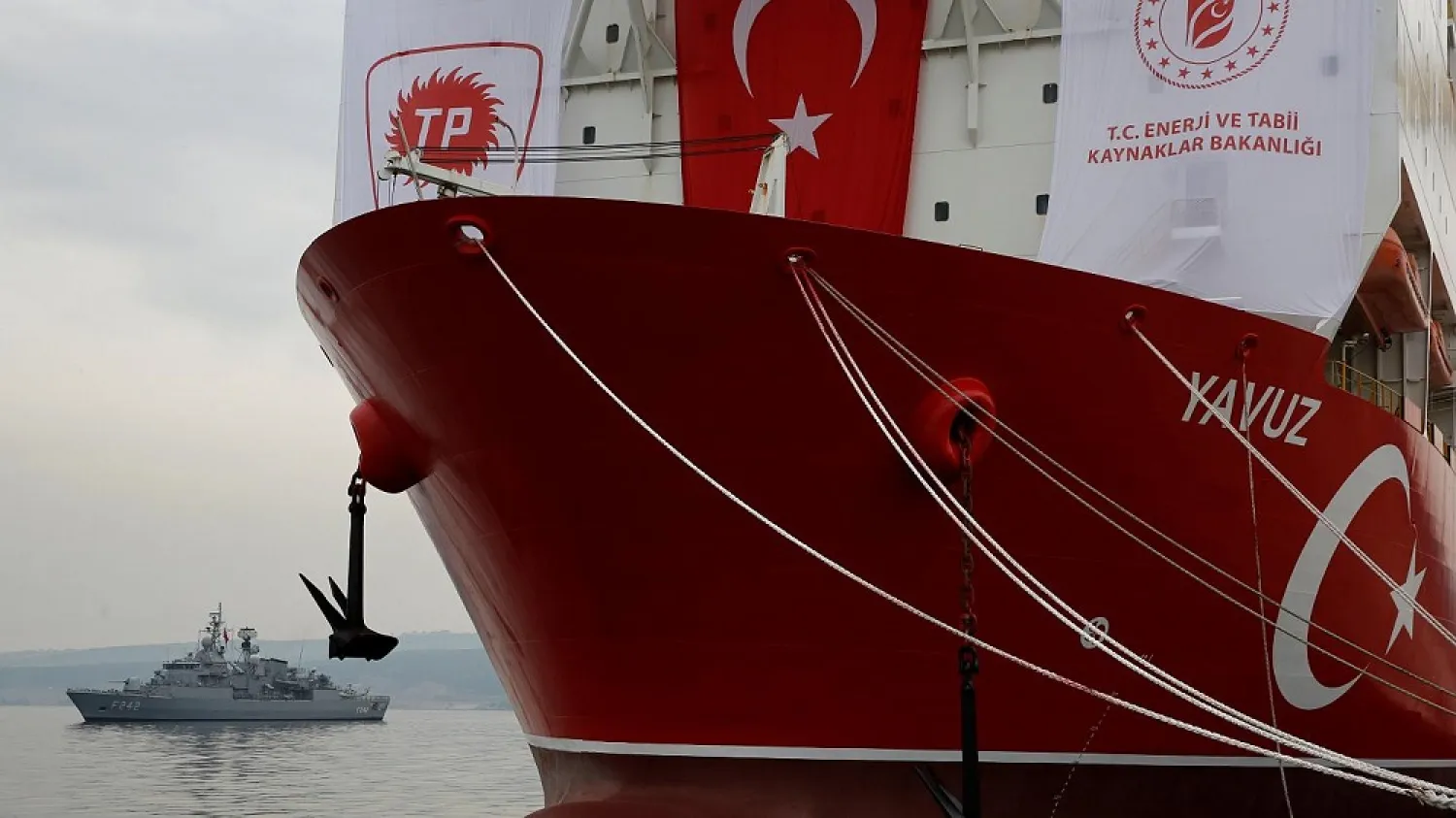
Turkish Navy frigate TCG Fatih is seen next to Turkish drilling vessel Yavuz at Dilovasi port in the western city of Kocaeli, Turkey, June 20, 2019. (Reuters)
TT

EU Agrees Sanctions on Turkey over Cyprus Drilling, to Add Names Later

Turkish Navy frigate TCG Fatih is seen next to Turkish drilling vessel Yavuz at Dilovasi port in the western city of Kocaeli, Turkey, June 20, 2019. (Reuters)

European Union foreign ministers agreed on Monday economic sanctions over Turkey’s drilling off the coast of Cyprus, setting up the legal framework for travel bans and asset freezes but leaving names until a later date.

The decision, reflecting a broader deterioration in EU ties with Turkey, aims to punish Ankara for violating Cyprus’ maritime economic zone by drilling off the divided island. It follows a separate decision to stop new arms sales by EU governments to Turkey over Ankara’s October 9 incursion into Syria.

Turkey, which is a formal candidate to join the EU, says it is operating in waters on its own continental shelf or areas where Turkish Cypriots have rights.

EU ministers said in a statement that Monday’s decision: “will make it possible to sanction individuals or entities responsible for or involved in unauthorized drilling activities of hydrocarbons in the Eastern Mediterranean.”

Two EU diplomats said the staggered approach gives Turkey a chance to end what the EU says are “illegal” drilling activities before any measures enter into force.

If sanctions are imposed, the asset freezes and travel bans are likely to target the Turkish military and captains of the drilling ships, the diplomats said.

Cyprus was divided in 1974 after a Turkish invasion triggered by a brief Greek-inspired coup. Several peacemaking efforts have failed and the discovery of offshore resources has complicated the negotiations.

EU ties with NATO-ally Turkey have meanwhile worsened after years of stalemate on Ankara’s bid to join the world’s biggest trading bloc.

With Turkish President Recep Tayyip Erdogan’s crackdown on dissidents and his sweeping new presidential powers that the EU says lack checks and balances, many EU states say Turkey no longer meets the democratic criteria to be a candidate, let alone an EU member.



Israel Says to Boost Production of Arrow Missile Interceptors

Emergency personnel carry a body at the site of a projectile impact, as the US-Israeli conflict with Iran continues, in Haifa, Israel, April 6, 2026. REUTERS/Shir Torem
TT

Israel Says to Boost Production of Arrow Missile Interceptors

Emergency personnel carry a body at the site of a projectile impact, as the US-Israeli conflict with Iran continues, in Haifa, Israel, April 6, 2026. REUTERS/Shir Torem

Israel's defense ministry on Monday said it plans to accelerate production of Arrow missile interceptors, as it fights a war with Iran.

The announcement came after questions emerged in the international media over how long Israel's interceptor stocks would last, with some analysts pointing to shortages of Arrow interceptors in particular.

Israel has a multi-layered air defense array, with a variety of systems intercepting threats at different altitudes.

The top tier consists of the anti-ballistic missile Arrow systems, with Arrow 2 operating both within the Earth's atmosphere and in space and Arrow 3 intercepting above the Earth's atmosphere.

"The Ministerial Committee for Procurement has approved the Israel Ministry of Defense (IMOD) plan for a major additional acceleration of Arrow interceptor production," AFP quoted a defense ministry statement as saying.

It added that the plan would enable "a significant increase in both the production rate and stockpile of Arrow interceptors as part of preparations for the evolving campaign".

Defense Minister Israel Katz was quoted in the statement as saying that "Israel has sufficient interceptors to protect its citizens, and this initiative is designed to ensure continued freedom of action and the sustained operational endurance we require."

Each Arrow 2 interceptor costs an estimated $1.5 million, with Arrow 3s around $2 million.


Iran Says US Airman Rescue May Have Been Cover to ‘Steal Enriched Uranium’

A still image purporting to show smoke rising from the site of the US aircraft destroyed during the US mission to find a stranded airman in Iran, the Revolutionary Guards said according to Iranian media, amid the US-Israeli conflict with Iran, in Isfahan, Iran, released on April 5, 2026. (Social Media/via Reuters)
TT

Iran Says US Airman Rescue May Have Been Cover to ‘Steal Enriched Uranium’

A still image purporting to show smoke rising from the site of the US aircraft destroyed during the US mission to find a stranded airman in Iran, the Revolutionary Guards said according to Iranian media, amid the US-Israeli conflict with Iran, in Isfahan, Iran, released on April 5, 2026. (Social Media/via Reuters)

Iran's foreign ministry said on Monday that a US operation to rescue a downed airman may have been a cover to "steal enriched uranium" from the country.

On Sunday, President Donald Trump said the US recovered a second crew member of an F-15E that went down over Iran on Friday in what he called a "daring" search and rescue operation.

Iran's military has called it "a deception and escape mission", insisting it was "completely foiled".

On Monday, Iran's foreign ministry spokesman Esmaeil Baqaei said there were "many questions and uncertainties" about the operation.

"The area where the American pilot was claimed to be present in Kohgiluyeh and Boyer-Ahmad Province is a long way from the area where they attempted to land or wanted to land their forces in central Iran," Baqaei said.

"The possibility that this was a deception operation to steal enriched uranium should not be ignored at all."

He added that the operation was "a disaster" for the United States.

Iran's military said several US aircraft had to "make emergency landings" in southern Isfahan province after being hit during the mission, with the US "forced to heavily bombard the downed aircraft" as a result.


Iran Guards Say Preparing Plan for New Order in Strait of Hormuz

A woman holds Iran’s national flag while standing near a billboard with a sentence reading ‘The Strait of Hormuz remains closed’ at the Enqelab Square in Tehran, on April 5, 2026. (Photo by AFP)
TT

Iran Guards Say Preparing Plan for New Order in Strait of Hormuz

A woman holds Iran’s national flag while standing near a billboard with a sentence reading ‘The Strait of Hormuz remains closed’ at the Enqelab Square in Tehran, on April 5, 2026. (Photo by AFP)

Iran's Revolutionary Guards said they are completing preparations to enforce new operating conditions in the Strait of Hormuz, which has been all but shut since the war with the United States and Israel began.

The Guards naval forces said in a post on X Sunday that the IRGC naval force is completing operational preparations for the Iranian authorities' “declared_plan” for the new Arabian Gulf order.

They warned conditions in the strait "will never return to its former status, especially for the US and Israel."

Their statement came after US President Donald Trump renewed threats to strike Iran's power plants and bridges if the vital shipping route is not reopened.

Iran has allowed only limited traffic through the waterway since the war began on February 28, disrupting the flow of roughly 20 percent of global oil and gas.

Oman's state news agency said on Sunday that Iran and Oman had held talks on easing passage through the strait, which remains effectively closed due to the conflict.

Iranian lawmakers have in recent weeks proposed imposing tolls and taxes on vessels passing through the waterway.