


Greek Minister: Turkey Needs to End 'Blackmail' for Migrant Aid

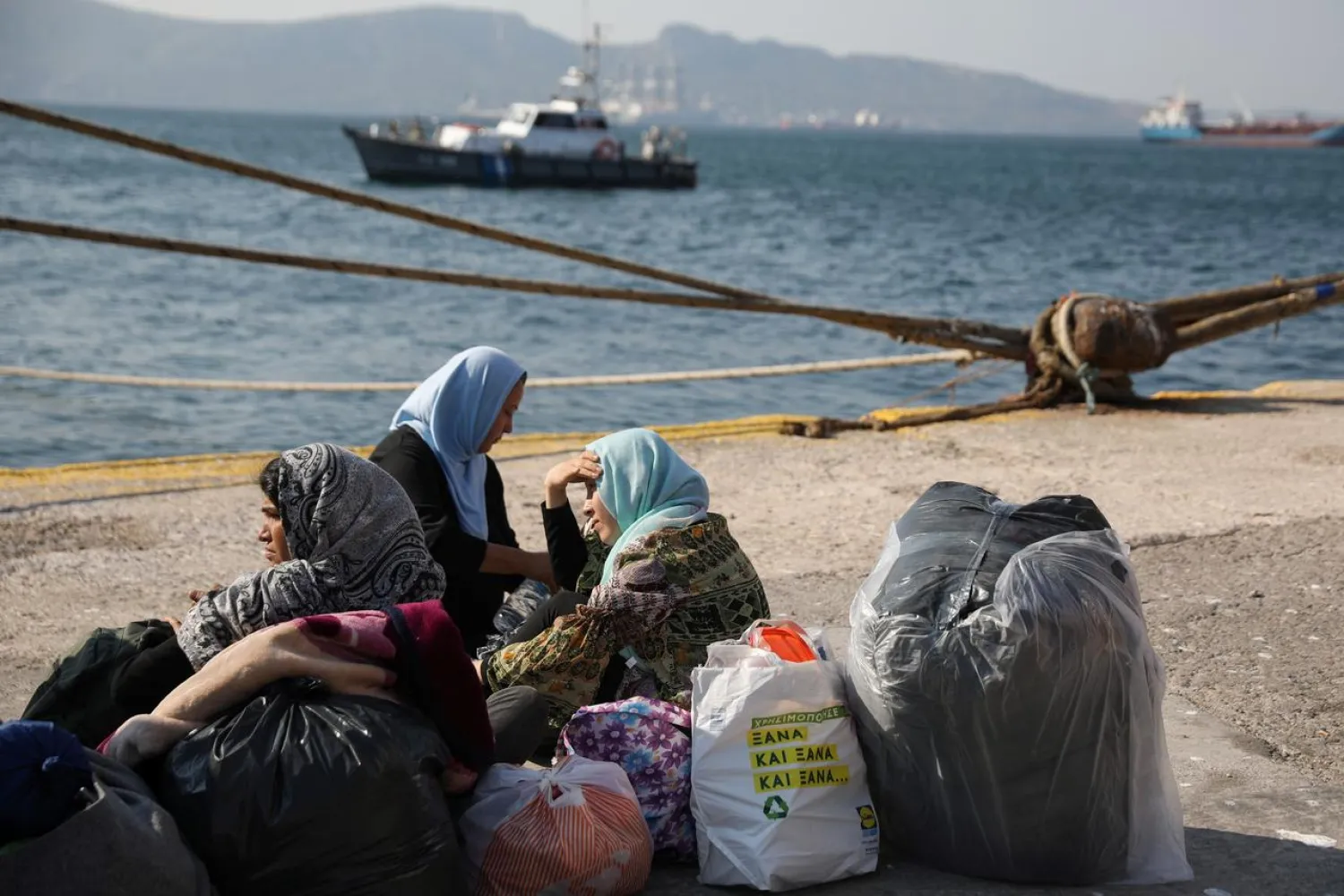
Refugees and migrants wait to be transferred to camps on the mainland, at the port of Elefsina near Athens Greece, October 22, 2019. REUTERS/Costas Baltas
TT

Greek Minister: Turkey Needs to End 'Blackmail' for Migrant Aid

Refugees and migrants wait to be transferred to camps on the mainland, at the port of Elefsina near Athens Greece, October 22, 2019. REUTERS/Costas Baltas

Greece's migration minister said that Turkey needs to stop "blackmail" if it wants more EU aid, saying its loaded language had prompted a spike in movement toward Greek shores.

Speaking to AFP on a visit to Washington, Giorgos Koumoutsakos voiced alarm over threats by President Recep Tayyip Erdogan and other Turkish officials to "open the gates" to Europe if it does not provide more support.

When Turkey "keeps repeating that we're going to open the floodgates, what they (migrants) do is they move closer to the floodgates waiting for them to open," said Koumoutsakos, citing a 240 percent increase in migrant arrivals on Greek shores since May.

Koumoutsakos said that Greece nonetheless wanted the European Union to "positively consider" Turkey's request for assistance beyond the six billion euros ($6.6 billion) committed in 2016 to stop migrants.

"But the fact that Turkey asked for this money by blackmail or threats does not create the necessary political climate for the Europeans to decide to give the money," he said.

"Europe cannot act under threats or blackmail. As Europeans should understand the situation that the Turks are faced with, Ankara should on its part realize that this is not the way to deal with Europe," he said.

Conservative Prime Minister Kyriakos Mitsotakis, who took power in July elections, has pledged a tougher approach on migration than the previous leftist government, which allowed refugees from Syria and other troubled countries to land.

Greece on Wednesday said it would overhaul its overcrowded camps on its islands facing Turkey, with asylum-seekers now to be locked up until they are either granted refugee status or rejected and sent back to Turkey.

Some 3.6 million Syrian refugees are living in Turkey after a brutal civil war engulfed their country, and Greece is the key transit point into the European Union.

Greece's tightening controls have been criticized by human rights groups as inhumane.

Koumoutsakos defended the steps, saying that ordinary Greeks on islands had migration fatigue and that, in contrast with the previous government of Alexis Tsipras, "we are looking not only at the humanitarian aspect, but the security aspect."

Koumoutsakos said he discussed Greece's stance with US lawmakers as well as Chad Wolf, the acting secretary of homeland security.

Immigration is a signature issue for President Donald Trump, who has vowed to build a wall on the Mexican border and whose administration has tried to discourage the arrival of migrants from violence-ravaged Central America by separating parents from their children.

Koumoutsakos said that Greece was seeking "enhanced cooperation" with the United States, including on border control, but that the two countries' situations were dissimilar.

Turkey -- angered by criticism of its assault on Kurdish fighters in Syria -- has also threatened to send fighters from ISIS captured in Syria back to their European countries of origin even if their governments do not want them.

Interior Minister Suleyman Soylu has said that Turkey cannot be "a hotel" for the extremists.


Russia: Man Suspected of Shooting Top General Detained in Dubai

An investigator works outside a residential building where the assassination attempt on Russian Lieutenant General Vladimir Alexeyev took place in Moscow, Russia February 6, 2026. REUTERS/Anastasia Barashkova
TT

Russia: Man Suspected of Shooting Top General Detained in Dubai

An investigator works outside a residential building where the assassination attempt on Russian Lieutenant General Vladimir Alexeyev took place in Moscow, Russia February 6, 2026. REUTERS/Anastasia Barashkova

Russia's Federal Security Service (FSB) said on Sunday that the man suspected of shooting top Russian military intelligence officer Vladimir Alexeyev in Moscow has been detained in Dubai and handed over to Russia.

Lieutenant General Vladimir Alexeyev, deputy head of the GRU, ⁠Russia's military intelligence arm, was shot several times in an apartment block in Moscow on Friday, investigators said. He underwent surgery after the shooting, Russian media ⁠said.

The FSB said a Russian citizen named Lyubomir Korba was detained in Dubai on suspicion of carrying out the shooting.

Russian Foreign Minister Sergei Lavrov accused Ukraine of being behind the assassination attempt, which he said was designed to sabotage peace talks. ⁠Ukraine said it had nothing to do with the shooting.

Alexeyev's boss, Admiral Igor Kostyukov, the head of the GRU, has been leading Russia's delegation in negotiations with Ukraine in Abu Dhabi on security-related aspects of a potential peace deal.


Factory Explosion Kills 8 in Northern China

Employees work on an electric vehicle (EV) production line at the Volkswagen Anhui factory in Hefei, Anhui province, China, February 4, 2026. REUTERS/Florence Lo
TT

Factory Explosion Kills 8 in Northern China

Employees work on an electric vehicle (EV) production line at the Volkswagen Anhui factory in Hefei, Anhui province, China, February 4, 2026. REUTERS/Florence Lo

An explosion at a biotech factory in northern China has killed eight people, Chinese state media reported Sunday, increasing the total number of fatalities by one.

State news agency Xinhua had previously reported that seven people died and one person was missing after the Saturday morning explosion at the Jiapeng biotech company in Shanxi province, citing local authorities.

Later, Xinhua said eight were dead, adding that the firm's legal representative had been taken into custody.

The company is located in Shanyin County, about 400 kilometers west of Beijing, AFP reported.

Xinhua said clean-up operations were ongoing, noting that reporters observed dark yellow smoke emanating from the site of the explosion.

Authorities have established a team to investigate the cause of the blast, the report added.

Industrial accidents are common in China due to lax safety standards.
In late January, an explosion at a steel factory in the neighboring province of Inner Mongolia left at least nine people dead.


Iran Warns Will Not Give Up Enrichment Despite US War Threat

Traffic moves through a street in Tehran on February 7, 2026. (Photo by ATTA KENARE / AFP)
TT

Iran Warns Will Not Give Up Enrichment Despite US War Threat

Traffic moves through a street in Tehran on February 7, 2026. (Photo by ATTA KENARE / AFP)

Iran will never surrender the right to enrich uranium, even if war "is imposed on us,” its foreign minister said Sunday, defying pressure from Washington.

"Iran has paid a very heavy price for its peaceful nuclear program and for uranium enrichment," Abbas Araghchi told a forum in Tehran.

"Why do we insist so much on enrichment and refuse to give it up even if a war is imposed on us? Because no one has the right to dictate our behavior," he said, two days after he met US envoy Steve Witkoff in Oman.

The foreign minister also declared that his country was not intimidated by the US naval deployment in the Gulf.

"Their military deployment in the region does not scare us," Araghchi said.
