


As Internet Slowly Returns, US Sanctions Telecom Minister

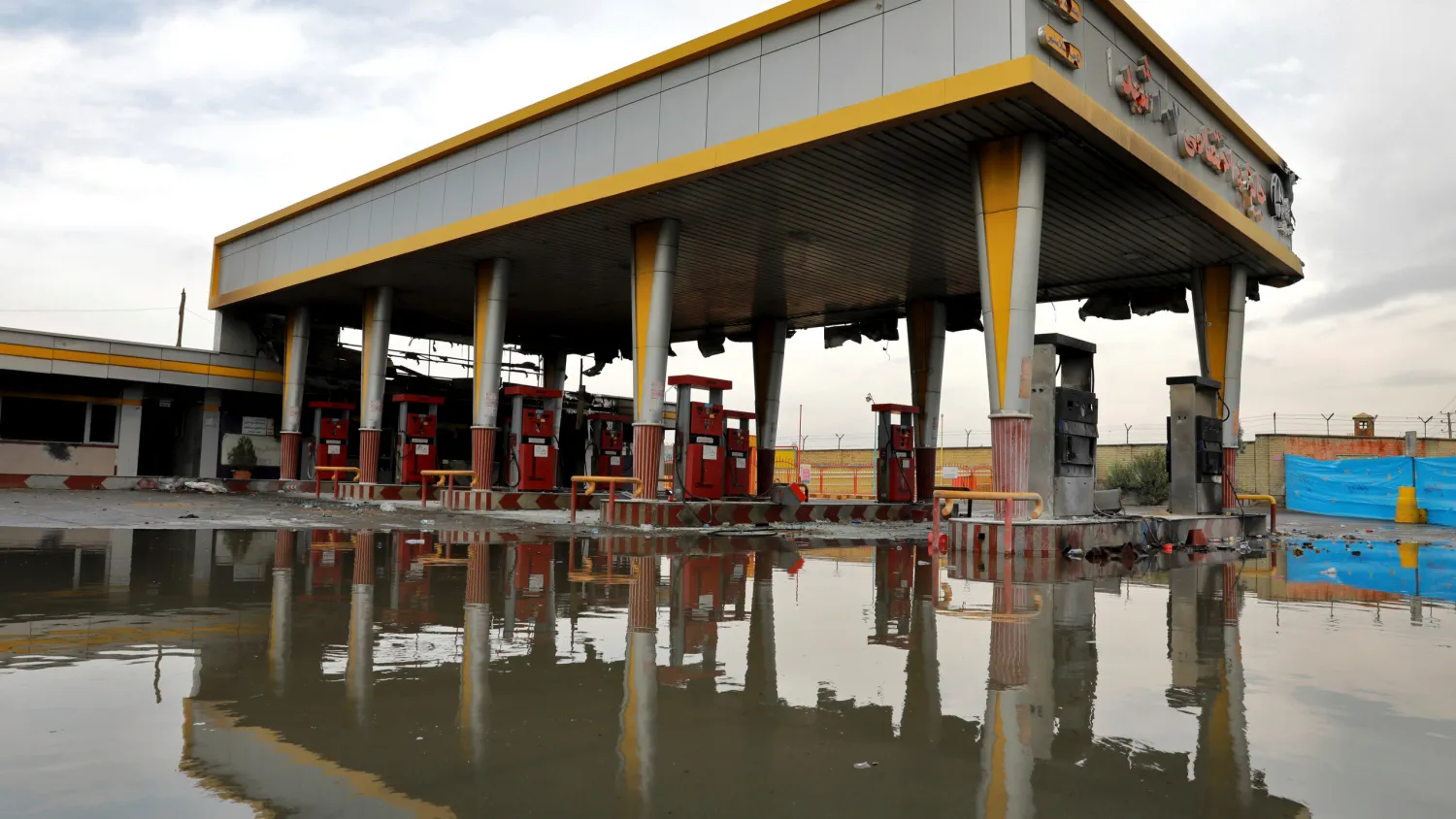
 In this Nov. 20, 2019, file photo, a gas station that was attacked during protests over rises in government-set gasoline prices is reflected in a puddle, in Tehran, Iran. (AP Photo/Ebrahim Noroozi, File)
In this Nov. 20, 2019, file photo, a gas station that was attacked during protests over rises in government-set gasoline prices is reflected in a puddle, in Tehran, Iran. (AP Photo/Ebrahim Noroozi, File)
TT

As Internet Slowly Returns, US Sanctions Telecom Minister

 In this Nov. 20, 2019, file photo, a gas station that was attacked during protests over rises in government-set gasoline prices is reflected in a puddle, in Tehran, Iran. (AP Photo/Ebrahim Noroozi, File)
In this Nov. 20, 2019, file photo, a gas station that was attacked during protests over rises in government-set gasoline prices is reflected in a puddle, in Tehran, Iran. (AP Photo/Ebrahim Noroozi, File)

The internet slowly trickled back on in Iran on Friday after a days long shutdown by authorities amid protests and unrest that followed government-set gasoline prices sharply rising, as America´s top diplomat urged demonstrators to send videos "documenting the regime´s crackdown."

Also, the US Treasury slapped on Friday punitive sanctions on Iran's communications minister, Mohammad Javad Azari Jahromi, after the Tehran regime blocked internet communications amid violent protests triggered by a petrol price hike.

"We are sanctioning Iran's Minister of Information and Communications Technology for restricting internet access, including to popular messaging applications that help tens of millions of Iranians stay connected to each other and the outside world," said Treasury Secretary Steven Mnuchin in a statement.

"Iran's leaders know that a free and open internet exposes their illegitimacy, so they seek to censor internet access to quell anti-regime protests," Mnuchin said.

A week after the gasoline hike, the loosening of the internet shutdown suggests Iran´s government believes it put down the demonstrations that rapidly turned violent, seeing gas stations, banks and stores burned to the ground.

Amnesty International said it believes the unrest and the crackdown killed at least 106 people. Iran disputes that figure without offering its own. A UN office earlier said it feared the unrest may have killed "a significant number of people."

Writing on Twitter in Farsi, Pompeo asked demonstrators to send the US videos of violence by authorities in the protests to a special channel of the encrypted message app Telegram, widely used among Iran´s 80 million people.

"I have asked the Iranian protestors to send us their videos, photos, and information documenting the regime´s crackdown on protestors," Pompeo followed up in another tweet in English. "The US will expose and sanction the abuses."

It´s unclear what further sanctions America can levy as it has already crippled Iran´s crucial oil exports and other industries since President Donald Trump unilaterally withdrew from Tehran´s nuclear deal with world powers in May 2018. The US also has sanctioned Iran´s Supreme Leader Ayatollah Ali Khamenei and other top-ranking officials.

That decision has led Iran to break the accord´s enrichment, stockpile, and centrifuge limits over months of wider tensions that have seen attacks across the Mideast that the US blames on Tehran. Iran denies being behind many of those assaults, though it claimed shooting down a US military surveillance drone and seizing several oil tankers.

Starting on Saturday, Iran shut down the internet across the country, limiting communications with the outside world. That made determining the scale and longevity of the protests incredibly difficult.

Since Thursday, that outage began to slightly lift. By Friday, internet connectivity stood at around 15% of normal levels, according to the monitoring group NetBlocks.

"Iranians need the real internet back so they can communicate and prosper," NetBlocks said.

That concern over the shutdown also was reflected in a statement Friday by UN human rights experts, who expressed their own alarm about the situation. They said authorities "may have used excessive force against those participating in the protests."

"A countrywide network shutdown of this kind clearly has a political purpose: to suppress the right of Iranians to access information and to communicate at a time of rising protest," the experts said. "Such an illegitimate step deprives Iranians not only of a fundamental freedom but also basic access to essential services."

On Friday, the streets of Tehran were quiet, though a heavy presence of anti-riot security forces and police stood guard on the streets.

Ebrahim Raisi, the head of Iran´s judiciary, warned in a speech in Tehran that consequences await violent demonstrators.

"Those who in recent days misused the atmosphere and the people´s demands and concerns, instigated riots in the society, created insecurity, made the hearts of women and children tremble, attacked public property and looted people´s belongings, they and their masters must know that a harsh punishment is awaiting them," Raisi said.

Already, a hard-line newspaper has suggested protest leaders could face executions by hanging. Raisi reportedly served on a so-called death panel during the mass executions of political prisoners in 1988 in Iran after the end of its long war with Iraq. Raisi has never publicly acknowledged his role in the executions, even during his failed presidential campaign in 2017.

Meanwhile, the deputy head of Tehran University told the semiofficial ILNA news agency he hoped students detained during campus protests over the fuel price hike will be released Saturday. Several dozen were believed to be held and some already have been released.

"We do not currently know which authority has detained the students," Tehran University Vice Chancellor Majid Sarsangi told ILNA.

Among those on the streets have been members of Iran´s paramilitary Revolutionary Guard, whose members and volunteers are answerable only to Khamenei himself. The acting commander of the force, Gen Ali Fadavi, boasted Friday that his force could "manage the riots within 48 hours," the semi-official Fars news agency close to the Guard said.

However, Fadavi offered a warning as well.

"The riots are not the last one and it definitely will happen again in the future," he said.


Russia: Man Suspected of Shooting Top General Detained in Dubai

An investigator works outside a residential building where the assassination attempt on Russian Lieutenant General Vladimir Alexeyev took place in Moscow, Russia February 6, 2026. REUTERS/Anastasia Barashkova
TT

Russia: Man Suspected of Shooting Top General Detained in Dubai

An investigator works outside a residential building where the assassination attempt on Russian Lieutenant General Vladimir Alexeyev took place in Moscow, Russia February 6, 2026. REUTERS/Anastasia Barashkova

Russia's Federal Security Service (FSB) said on Sunday that the man suspected of shooting top Russian military intelligence officer Vladimir Alexeyev in Moscow has been detained in Dubai and handed over to Russia.

Lieutenant General Vladimir Alexeyev, deputy head of the GRU, ⁠Russia's military intelligence arm, was shot several times in an apartment block in Moscow on Friday, investigators said. He underwent surgery after the shooting, Russian media ⁠said.

The FSB said a Russian citizen named Lyubomir Korba was detained in Dubai on suspicion of carrying out the shooting.

Russian Foreign Minister Sergei Lavrov accused Ukraine of being behind the assassination attempt, which he said was designed to sabotage peace talks. ⁠Ukraine said it had nothing to do with the shooting.

Alexeyev's boss, Admiral Igor Kostyukov, the head of the GRU, has been leading Russia's delegation in negotiations with Ukraine in Abu Dhabi on security-related aspects of a potential peace deal.


Factory Explosion Kills 8 in Northern China

Employees work on an electric vehicle (EV) production line at the Volkswagen Anhui factory in Hefei, Anhui province, China, February 4, 2026. REUTERS/Florence Lo
TT

Factory Explosion Kills 8 in Northern China

Employees work on an electric vehicle (EV) production line at the Volkswagen Anhui factory in Hefei, Anhui province, China, February 4, 2026. REUTERS/Florence Lo

An explosion at a biotech factory in northern China has killed eight people, Chinese state media reported Sunday, increasing the total number of fatalities by one.

State news agency Xinhua had previously reported that seven people died and one person was missing after the Saturday morning explosion at the Jiapeng biotech company in Shanxi province, citing local authorities.

Later, Xinhua said eight were dead, adding that the firm's legal representative had been taken into custody.

The company is located in Shanyin County, about 400 kilometers west of Beijing, AFP reported.

Xinhua said clean-up operations were ongoing, noting that reporters observed dark yellow smoke emanating from the site of the explosion.

Authorities have established a team to investigate the cause of the blast, the report added.

Industrial accidents are common in China due to lax safety standards.
In late January, an explosion at a steel factory in the neighboring province of Inner Mongolia left at least nine people dead.


Iran Warns Will Not Give Up Enrichment Despite US War Threat

Traffic moves through a street in Tehran on February 7, 2026. (Photo by ATTA KENARE / AFP)
TT

Iran Warns Will Not Give Up Enrichment Despite US War Threat

Traffic moves through a street in Tehran on February 7, 2026. (Photo by ATTA KENARE / AFP)

Iran will never surrender the right to enrich uranium, even if war "is imposed on us,” its foreign minister said Sunday, defying pressure from Washington.

"Iran has paid a very heavy price for its peaceful nuclear program and for uranium enrichment," Abbas Araghchi told a forum in Tehran.

"Why do we insist so much on enrichment and refuse to give it up even if a war is imposed on us? Because no one has the right to dictate our behavior," he said, two days after he met US envoy Steve Witkoff in Oman.

The foreign minister also declared that his country was not intimidated by the US naval deployment in the Gulf.

"Their military deployment in the region does not scare us," Araghchi said.
