


Parallel National Day Rallies by Lebanon Protesters, Leaders

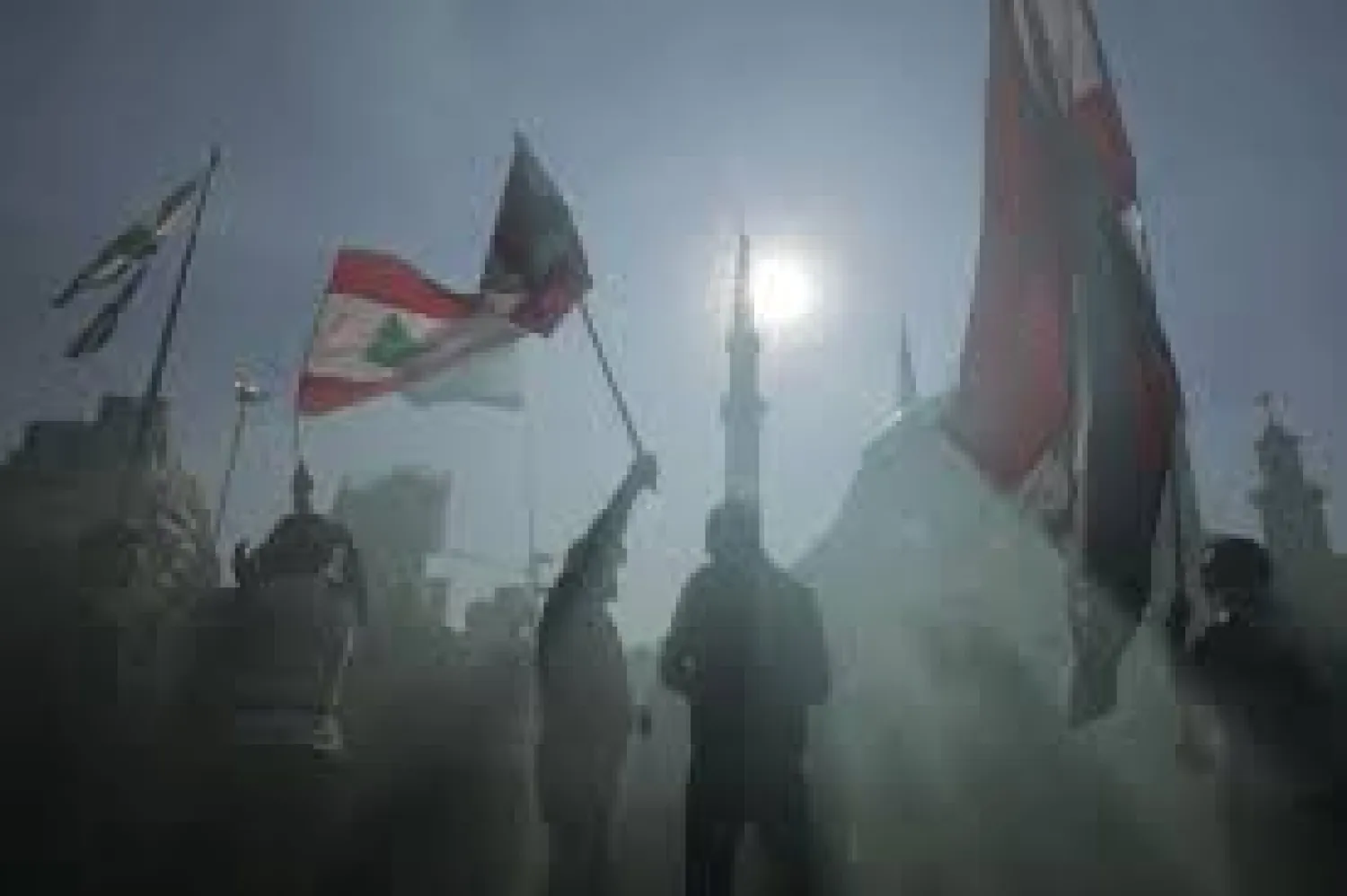
Anti-government protesters wave Lebanese national flags as gather during separate civil parade at the Martyr square, in downtown Beirut, Lebanon, Friday, Nov. 22, 2019. Protesters gathered for alternative independence celebrations, converging by early afternoon on Martyrs' Square in central Beirut, which used to be the traditional location of the official parade. Protesters have occupied the area, closing it off to traffic since mid-October. (AP Photo/Hassan Ammar)
TT

Parallel National Day Rallies by Lebanon Protesters, Leaders

Anti-government protesters wave Lebanese national flags as gather during separate civil parade at the Martyr square, in downtown Beirut, Lebanon, Friday, Nov. 22, 2019. Protesters gathered for alternative independence celebrations, converging by early afternoon on Martyrs' Square in central Beirut, which used to be the traditional location of the official parade. Protesters have occupied the area, closing it off to traffic since mid-October. (AP Photo/Hassan Ammar)

Lebanon´s protesters and top politicians held competing Independence Day celebrations Friday, reflecting the deepening rift that has beset the country grappling with its worst political and economic crises in decades.

The top leadership attended a truncated military parade which was relocated to the headquarters of the Defense Ministry from central Beirut, occupied by protesters.

The mood was somber at the brief parade as a little over a dozen regiments marched before the country´s president, parliament speaker and prime minister, who sat under a red canopy. The three only exchanged a few words and left separately. An official celebration at the presidential palace was cancelled. There were no foreign dignitaries in attendance and no display of tanks or equipment.

It was the first joint appearance by the three since the prime minister resigned three weeks ago, citing a deadlock with political rivals in meeting protesters demands. Since then, the politicians have continued bickering, deadlocked over a new government and showing little ability to adapt in the face of more than a month of nationwide protests demanding an end to business as usual.

Separately, the protesters later held a boisterous parade at Martyrs´ Square, near the waterfront boulevard where the formal celebration is traditionally held. The area has been occupied by protesters since mid-October and is closed off to traffic.

Industrialists, doctors, students, expatriates, musicians, and mothers marched down a main street leading to the square, organized in more than 40 groups, built as "regiments" by the protesters to mirror the military parade.

Lara Hayek, a university staffer, said they wanted to hold popular celebrations where the army does it every year.

"This year we decided that independence is also for the people. We started this revolution. It is a people´s revolution, a nation´s revolution. All the people want to express that."

The demonstrations began Oct. 17 against proposed taxes on WhatsApp calls but turned into a condemnation of the political elite who have run the country since the 1975-90 civil war. Protesters blame them for years of corruption and mismanagement.

Young people have been at the forefront of the leaderless protest movement, facing a plunging economy and high unemployment and left with few options other than emigrating. The protesters call for a new government and elections outside of the traditional sectarian-based power-sharing agreement.

The politicians "don´t want the country to change. They want it to stay the same and they want us to leave," said one protester who appeared in the square dressed as Charlie Chaplin and gave her name only as Joyce. "I am an actress. I don´t want to leave this country. I want to stay here, work and live in Lebanon."

She raised a banner that read: "You people have the power to make life free and beautiful."

A white banner was hung between two trees inviting protesters to "be creative" about how they want to commemorate independence. One person scribbled: "This is a popular Independence Day. Independence from a corrupt authority. November 22 with a different flavor."

During the celebrations, protesters planned to re-install a new large cardboard fist labelled "Revolution" in Martyr´s Square after a previous one was burned down overnight by unknown vandals.

Videos and photos circulating on social media showed the fist - which has been a symbol of the uprising - catching fire at dawn Friday. Protesters who were camped out in the square rushed to the site of the blaze. A single protester stood there, defiantly raising his fist in the air beside the charred emblem.

The top political leaders have been deadlocked over forming a new government since the Western-backed prime minister, Saad Hariri, resigned on Oct. 29.

Hariri said he has hit a dead-end with his partners in the government, dominated by the Iran-backed Hezbollah group, and has called for an apolitical emergency government. His rivals in the president´s party and its ally Hezbollah want to preserve their electoral wins and Hariri, as the face acceptable to the world.

The two sides have sparred publicly. Hariri said the party of President Michel Aoun is acting "irresponsibly" while Aoun´s group said the acting prime minister is holding the Cabinet hostage: "either me or no one else."

Late Thursday, Aoun said in a televised address that a consensus on forming a government remained far off because of "contradictions that control Lebanese politics." He didn´t elaborate.

Mahya Yaha, a senior analyst with Carnegie Middle East Center, said the political elite is acting "as it were business as usual," engaging in closed-door horse trading to form a new government while seeking to maintain power.

"Today, Lebanon´s politicians fear that the demographic and social tide is turning against them. And when the country´s political forces that have exercised power for a long time come to believe that their eclipse is inevitable, they will fight to preserve the privileges they have acquired, at whatever the cost," she wrote. "This could include resorting to violence in any form necessary."

Meanwhile, there is always the temptation of Lebanon factions turning to their foreign backers, Yaha said, which risks transforming the country into the focal point for a showdown between the United States, Iran, and Russia.

"This would be disastrous for the Lebanese," she wrote Friday.


Rescue Teams Search for Survivors in Building Collapse that Killed at Least 2 in Northern Lebanon

A Lebanese flag is pictured, in the aftermath of a massive explosion, in Beirut's damaged port area, Lebanon August 17, 2020. REUTERS/Hannah McKay
TT

Rescue Teams Search for Survivors in Building Collapse that Killed at Least 2 in Northern Lebanon

A Lebanese flag is pictured, in the aftermath of a massive explosion, in Beirut's damaged port area, Lebanon August 17, 2020. REUTERS/Hannah McKay

At least two people were killed and four rescued from the rubble of a multistory apartment building that collapsed Sunday in the city of Tripoli in northern Lebanon, state media reported.

Rescue teams were continuing to dig through the rubble. It was not immediately clear how many people were in the building when it fell.

The bodies pulled out were of a child and a woman, the state-run National News Agency reported.

Dozens of people crowded around the site of the crater left by the collapsed building, with some shooting in the air.

The building was in the neighborhood of Bab Tabbaneh, one of the poorest areas in Lebanon’s second largest city, where residents have long complained of government neglect and shoddy infrastructure. Building collapses are not uncommon in Tripoli due to poor building standards, according to The AP news.

Lebanon’s Health Ministry announced that those injured in the collapse would receive treatment at the state’s expense.

The national syndicate for property owners in a statement called the collapse the result of “blatant negligence and shortcomings of the Lebanese state toward the safety of citizens and their housing security,” and said it is “not an isolated incident.”

The syndicate called for the government to launch a comprehensive national survey of buildings at risk of collapse.


Israel to Take More West Bank Powers and Relax Settler Land Buys

A view of Israeli settlement of Maale Adumim, in the West Bank, Sunday, June 18, 2023. (AP)
TT

Israel to Take More West Bank Powers and Relax Settler Land Buys

A view of Israeli settlement of Maale Adumim, in the West Bank, Sunday, June 18, 2023. (AP)

Israel's security cabinet approved a series of steps on Sunday that would make it easier for settlers in the occupied West Bank to buy land while granting Israeli authorities more enforcement powers over Palestinians, Israeli media reported.

The West Bank is among the territories that the Palestinians seek for a future independent state. Much of it is under Israeli military control, with limited Palestinian self-rule in some areas run by the Western-backed Palestinian Authority (PA).

Citing statements by Finance Minister Bezalel Smotrich and Defense Minister Israel Katz, Israeli news sites Ynet and Haaretz said the measures included scrapping decades-old regulations that prevent Jewish private citizens buying land in the West Bank, The AP news reported.

They were also reported to include allowing Israeli authorities to administer some religious sites, and expand supervision and enforcement in areas under PA administration in matters of environmental hazards, water offences and damage to archaeological sites.

Palestinian President Mahmoud Abbas said the new measures were dangerous, illegal and tantamount to de-facto annexation.

The Israeli ministers did not immediately respond to requests for comment.

The new measures come three days before Prime Minister Benjamin Netanyahu is scheduled to meet in Washington with US President Donald Trump.

Trump has ruled out Israeli annexation of the West Bank but his administration has not sought to curb Israel's accelerated settlement building, which the Palestinians say denies them a potential state by eating away at its territory.

Netanyahu, who is facing an election later this year, deems the establishment of any Palestinian state a security threat.

His ruling coalition includes many pro-settler members who want Israel to annex the West Bank, land captured in the 1967 Middle East war to which Israel cites biblical and historical ties.

The United Nations' highest court said in a non-binding advisory opinion in 2024 that Israel's occupation of Palestinian territories and settlements there is illegal and should be ended as soon as possible. Israel disputes this view.


Arab League Condemns Attack on Aid Convoys in Sudan

A general view shows the opening session of the meeting of Arab foreign ministers at the Arab League Headquarters (Reuters)
TT

Arab League Condemns Attack on Aid Convoys in Sudan

A general view shows the opening session of the meeting of Arab foreign ministers at the Arab League Headquarters (Reuters)

Arab League Secretary-General Ahmed Aboul Gheit strongly condemned the attack by the Rapid Support Forces on humanitarian aid convoys and relief workers in North Kordofan State, Sudan.

In a statement reported by SPA, secretary-general's spokesperson Jamal Rushdi quoted Aboul Gheit as saying the attack constitutes a war crime under international humanitarian law, which prohibits the deliberate targeting of civilians and depriving them of their means of survival.

Aboul Gheit stressed the need to hold those responsible accountable, end impunity, and ensure the full protection of civilians, humanitarian workers, and relief facilities in Sudan.
