


All King Bibi's Men: Netanyahu's Inner Circle Key to Criminal Cases

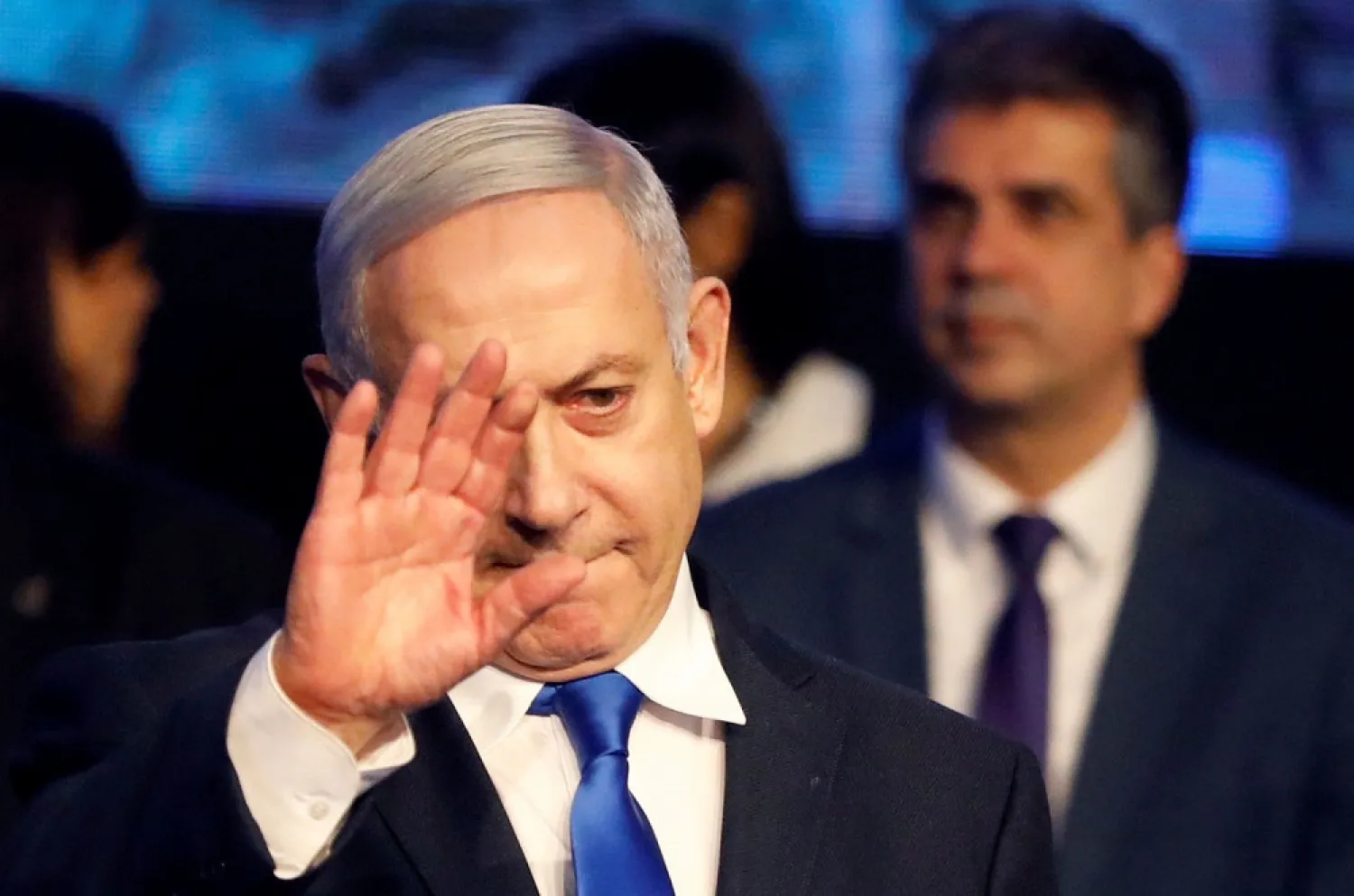
Israeli Prime Minister Benjamin Netanyahu. (Reuters file photo)
TT

All King Bibi's Men: Netanyahu's Inner Circle Key to Criminal Cases

Israeli Prime Minister Benjamin Netanyahu. (Reuters file photo)

Secret recordings, powerful media moguls, illicit gifts of cigars and champagne, betrayals by trusted aides. The three corruption cases against Israeli Prime Minister Benjamin Netanyahu have all the makings of a political thriller.

On Thursday, after more than three years of investigations, the most dominant Israeli politician of his generation was charged with bribery, fraud and breach of trust.

Investigators have not revealed the informants who provided the first tips about alleged corruption by the veteran conservative nicknamed “King Bibi.” But from there they methodically picked off members of the prime minister’s inner circle of hand-picked aides and senior officials as state witnesses against him. The mounting evidence was revealed in a series of tantalizing leaks that undercut what prosecutors allege was Netanyahu’s scheme to control his public image by trading regulatory favors to news companies for positive coverage.

The man who charged the prime minister was Israel’s Attorney General Avichai Mandelblit - who was chosen for the job by Netanyahu in 2016 after having served as his cabinet secretary starting in 2013.

“I had the privilege of working with him and witnessing his many talents and capabilities as prime minister,” Mandelblit said in announcing the charges. “The decision to file an indictment against him was made with a heavy heart.”

Netanyahu has denied wrongdoing from the beginning of the investigations and remained defiant in his emotional prime-time national address on the night of his indictment. He called the cases an “attempted coup” to overthrow him, based on “fabrications.”

‘Rotten’

The probe began with tips trickling into investigators.

“Something smelled rotten, but it wasn’t clearly criminal,” a law enforcement source with direct knowledge of the investigation told Reuters.

Mandelblit launched an initial inquiry in July 2016, soon after Netanyahu chose him as attorney general. Investigators soon focused on dealings between the prime minister, Israeli Hollywood producer Arnon Milchan and Australian billionaire James Packer.

The inquiries would eventually lead to Case 1000, in which Netanyahu is charged with fraud and breach of trust for allegedly requesting and receiving gifts from Packer and Milchan, which included a regular supply of cigars and champagne.

The indictment alleges Netanyahu helped Milchan with various business interests. Milchan and Packer provided testimony and have not been charged with any wrongdoing.

During a separate probe of Netanyahu’s former chief of staff, Ari Harow, investigators stumbled on a Pandora’s box: secret recordings made on Harow’s mobile phone.

They documented a series of meetings between two men who were then known publicly as enemies: Netanyahu and Arnon Mozes, the owner of Israel’s best-selling newspaper, Yedioth Ahronoth, and the popular news website Ynet.

“It was jaw-dropping,” said the source, describing the moment investigators first heard the recordings.

In meetings held between 2008 and 2014, the two allegedly discussed a deal in which Mozes would provide positive coverage of Netanyahu and negative coverage of his political rivals, while Netanyahu would push for regulations on Yedioth’s biggest competitor, Israel Hayom, a free daily owned by US casino mogul and Netanyahu supporter, Sheldon Adelson.

The 63-page indictment released on Thursday quotes a meeting held in December 2014 during the run-up to the 2015 election. Prosecutors allege the two men discussed a bill that would have limited Israel Hayom’s circulation.

“We need to make sure you are prime minister,” Mozes allegedly told Netanyahu. “Assuming there will be a law that you and I have agreed upon, I will do my utmost best that you stick around for as long as you want to.”

The bill the two men discussed would never become law, and the coverage of Netanyahu in Yedioth and Ynet did not substantially change.

The recordings shocked prosecutors as they digested them over six hours, the source told Reuters.

“That was a big drama,” said the source. “It’s hard to believe something like this can even happen.”

The recordings set off the investigation that led to Case 2000, which charges Netanyahu with fraud and breach of trust and Mozes with bribery.

Harow served two stints as Netanyahu’s chief of staff before resigning in 2015 amid allegations that he improperly advanced his own business interests while holding the position.

Harow turned state’s witness against Netanyahu in 2017 as part of a plea deal in which he confessed to fraud and breach of trust.

Mozes’s lawyers denied wrongdoing in a written statement and called prosecutors allegations of bribery an “erroneous and warped interpretation” of the recordings.

‘They were after me’

The most serious case against Netanyahu, Case 4000, did not start with the prime minister. In 2017, Israel’s Securities Authority (ISA) was investigating Shaul Elovitch, the chairman of the country’s biggest telecommunications firm, Bezeq Israel Telecom. ISA was investigating whether he had illegally profited from a 2015 deal in which Bezeq bought out his remaining shares in a satellite TV company.

Netanyahu, who at the time also served as Communications Minister, was not a suspect.

One of the key figures in the probe - Shlomo Filber, then director-general of the communications ministry - was picked for the government job by Netanyahu soon after he took over the communications ministry. The investigation revealed a secret backchannel between Bezeq and Filber, according to the indictment.

Investigators later found evidence pointing to the prime minister’s involvement in regulatory moves that prosecutors allege provided a benefit worth about 1.8 billion Shekels ($500 million) to Bezeq. The company has denied wrongdoing.

In 2018, Filber turned state witness against Netanyahu.

Case 4000 alleges that Netanyahu’s regulatory favors for Elovitch were part of a wider “give and take” relationship.

Bezeq controlled a popular news website called Walla. The indictment alleges that Netanyahu made a series of regulatory concessions that benefited Elovitch in return for better coverage of him and his family on the website.

It describes a dinner in which Netanyahu and his wife, Sara, hosted Elovitch and his wife, Iris, a few weeks before Israel’s 2013 election.

“The defendants agreed that Netanyahu and his wife will be able to make demands on Mr. and Mrs. Elovitch concerning their media coverage,” the indictment said.

The Netanyahus allegedly made hundreds of demands over the next few years for Walla to change headlines, remove negative reports about them and increase exposure of positive ones.

The Elovitches have been charged with bribery and obstruction of justice. Shaul Elovitch has also been charged with money laundering. The couple denies any wrongdoing.

The indictment cited a striking example of Netanyahu’s influence on the news involving a rare interview he gave Walla, days before a 2015 election.

“Netanyahu was very angry about the questions,” Dov Gilhar, the journalist who interviewed him, told Israel’s public broadcaster Kan in March. After the interview, “Netanyahu ripped the neck-mic off, threw it on the floor, says nothing, gets up, walks into his office and slams the door.”

Gilhar told Kan that he had expected the exclusive interview to be published quickly, but two days passed before a chopped-down version ran after being edited without the journalist’s involvement.

The indictment alleges the edits were dictated by Netanyahu and Nir Hefetz, the media advisor to the prime minister’s family at the time and his former official spokesman.

Hefetz turned state witness in 2018. Netanyahu has been charged with bribery in this case, as well as fraud and breach of trust.

Netanyahu’s demands on Walla ceased around January 2017, the indictment said, when the prime minister and Elovitch became concerned about an investigation into their dealings and Walla stopped complying with requests to favor Netanyahu in its coverage.

Walla’s news desk did not respond to a request for comment.

Netanyahu said on Thursday that quid pro quo relations between politicians and the media were common, but he was being singled out.

“They weren’t after the truth,” Netanyahu said of police and prosecutors. “They were after me.”

Attorney General Mandelblit has rejected Netanyahu’s accusations. A source close to Mandelblit described him as “very fond of Netanyahu.”

“But at the end of the day, there’s no room for sentiment,” the source said. “Either the evidence tells the story or it doesn’t.”



2 Israelis Charged with Using Classified Military Information to Place Bets

The Israeli Iron Dome air defense system intercepts missiles during an Iranian attack on Tel Aviv, Israel, June 18, 2025. (AP Photo/Leo Correa, File)
TT

2 Israelis Charged with Using Classified Military Information to Place Bets

The Israeli Iron Dome air defense system intercepts missiles during an Iranian attack on Tel Aviv, Israel, June 18, 2025. (AP Photo/Leo Correa, File)

Two Israelis have been charged with using classified military information to place bets on how future events will unfold, Israeli authorities said Thursday, accusing the individuals of “serious security offenses.”

A joint statement by the Israeli Ministry of Defense, domestic security service Shin Bet and police said that a civilian and a reservist are suspected of placing bets on the US-based prediction market Polymarket on future military operations based on information that the reservist had access to, The AP news reported.

Israel’s Attorney General’s Office decided to prosecute the two individuals following a joint investigation by police, military intelligence and other security agencies that resulted in several arrests. The two face charges including bribery and obstruction of justice.

Authorities offered no details on the identity of the two individuals or the reservist's rank or position in the Israeli military but warned that such actions posed a “real security risk” for the military and the Israeli state.

Israel’s public broadcaster Kan had reported earlier that the bets were placed in June ahead of Israel’s war with Iran and that the winnings were roughly $150,000.

Israel's military and security services “view the acts attributed to the defendants very seriously and will act resolutely to thwart and bring to justice any person involved in the activity of using classified information illegally,” the statement said.

The accused will remain in custody until the end of legal proceedings against them, the Prosecutor's Office said.

Prediction markets are comprised of typically yes-or-no questions called event contracts, with the prices connected to what traders are willing to pay, which theoretically indicates the perceived probability of an event occurring.

Their use has skyrocketed in recent years, but despite some eye-catching windfalls, traders still lose money everyday. In the US, the trades are categorized differently than traditional forms of gambling, raising questions about transparency and risk.


WhatsApp Accuses Russia of Trying to Fully Block its Service

FILED - 21 January 2022, Berlin: The icon of Whatsapp is seen on the screen of a smartphone. Photo: Fabian Sommer/Deutsche Presse-Agentur GmbH/dpa
TT

WhatsApp Accuses Russia of Trying to Fully Block its Service

FILED - 21 January 2022, Berlin: The icon of Whatsapp is seen on the screen of a smartphone. Photo: Fabian Sommer/Deutsche Presse-Agentur GmbH/dpa

US messenger app WhatsApp, owned by Meta Platforms, accused authorities in Russia on Thursday of trying to fully block its service in order to drive Russians to a state-owned app, which it alleged was used for surveillance.

"Trying to isolate over 100 million users from private and secure communication is a backwards step and can only lead to less safety for people in Russia," WhatsApp said in a statement.

"We continue to do everything we can ‌to keep users connected."

Some ‌domain names associated with WhatsApp on Thursday disappeared from Russia's ‌national ⁠register of domain ⁠names, meaning that devices inside Russia stopped receiving its IP addresses from the app and that it could be accessed only by using a virtual private network (VPN), Reuters reported.

Roskomnadzor, the state communications regulator, and the Kremlin did not immediately respond to a request for comment.

Roskomnadzor first began restricting WhatsApp and other messenger services in August, making it impossible to complete phone calls on them, accusing the foreign-owned platforms of failing ⁠to share information with law enforcement in fraud and terrorism ‌cases.

It said in December it was taking ‌new measures to gradually restrict the app, which it accused of continuing to violate Russian ‌law and of being a platform used "to organize and carry out terrorist acts ‌on the territory of the country, to recruit their perpetrators and to commit fraud and other crimes."

Since then, many Russians have been able to use WhatsApp only in conjunction with a virtual private network and have switched to using rival messenger apps, though some ‌of those - like Telegram - are also under pressure from the authorities for the same reasons.

In a video published by state ⁠news agency ⁠TASS on Wednesday, Kremlin spokesman Dmitry Peskov said there was a possibility of reaching an agreement if Meta entered into dialogue with the Russian authorities and complied with the law.

"If the corporation (Meta) sticks to an uncompromising position and, I would say, shows itself unready to align with Russian legislation, then there is no chance," Peskov said.

Russian authorities, who also block or restrict social media platforms such as Snapchat, Facebook, Instagram and YouTube, are heavily pushing a state-backed messenger app called MAX, which critics say could be used to track users.

The authorities have dismissed those accusations as false and say MAX, which integrates various government-related services into it, is designed to simplify and improve the everyday lives of citizens.


Israel President Says at End of Visit Antisemitism in Australia 'Frightening'

Israel's President Isaac Herzog reacts during a Jewish community event in Melbourne on February 12, 2026. (Photo by WILLIAM WEST / AFP)
TT

Israel President Says at End of Visit Antisemitism in Australia 'Frightening'

Israel's President Isaac Herzog reacts during a Jewish community event in Melbourne on February 12, 2026. (Photo by WILLIAM WEST / AFP)

Antisemitism in Australia is "frightening" but most people want good relations, Israel's President Isaac Herzog said on Thursday as he wrapped up a four-day visit and was met by protests in the city of Melbourne.

Herzog's tightly policed visit to Australia this week was meant to offer consolation to the country's Jewish community following the mass shooting on Bondi Beach that killed 15 people in December, said AFP.

However, it sparked demonstrations in major cities, including in Sydney, where police used pepper spray on protesters and members of the media, including an AFP photographer, during scuffles in the central business district on Monday night.

Herzog told Channel Seven's Sunrise ahead of his Melbourne stop that a "wave" of anti-Jewish hatred in Australia had culminated in the December 14 killings at Bondi.

"It is frightening and worrying," he said.

"But there's also a silent majority of Australians who seek peace, who respect the Jewish community and, of course, want a dialogue with Israel."

The Israeli head of state said he had brought a "message of goodwill to the people of Australia".

"I hope there will be a change. I hope things will relax," he said.

Herzog attended a Jewish community event after a meeting with Victoria's governor at Melbourne's Government House.

Protesters waving Palestinian flags and chanting slogans squared off with police outside the event.

More are expected to turn out later at around 5 pm (0600 GMT) on Thursday.

Herzog told the audience at the community event: "We came here to be with you, to look you in the eye, to embrace and remember."

He also said demonstrators outside should instead "go protest in front of the Iranian embassy".

The Australian government accused Iran last year of orchestrating a recent wave of antisemitic attacks and expelled Tehran's ambassador.

Canberra, citing intelligence findings, accused Tehran of directing the torching of a kosher cafe in the Sydney suburb of Bondi in October 2024 and a major arson attack on the Adass Israel Synagogue in Melbourne in December 2024.

- Controversial visit -

Ahead of his arrival, national broadcaster ABC reported that a building at Melbourne University had been graffiti-ed with the phrase: "Death to Herzog".

Many Jewish Australians have welcomed Herzog's trip.

"His visit will lift the spirits of a pained community," said Alex Ryvchin, co-chief executive of the Executive Council of Australian Jewry, the community's peak body.

But some in the community disagreed, with the progressive Jewish Council of Australia saying he was not welcome because of his alleged role in the "ongoing destruction of Gaza".

The UN's Independent International Commission of Inquiry found last year that Herzog was liable for prosecution for inciting genocide after he said all Palestinians -- "an entire nation" -- were responsible for the Hamas attack on Israel in October 2023.

Israel has "categorically" rejected the inquiry's report, describing it as "distorted and false" and has called for the body's abolition.