
Nobel Winner Mahfouz Lives on in Cairo's Alleyways

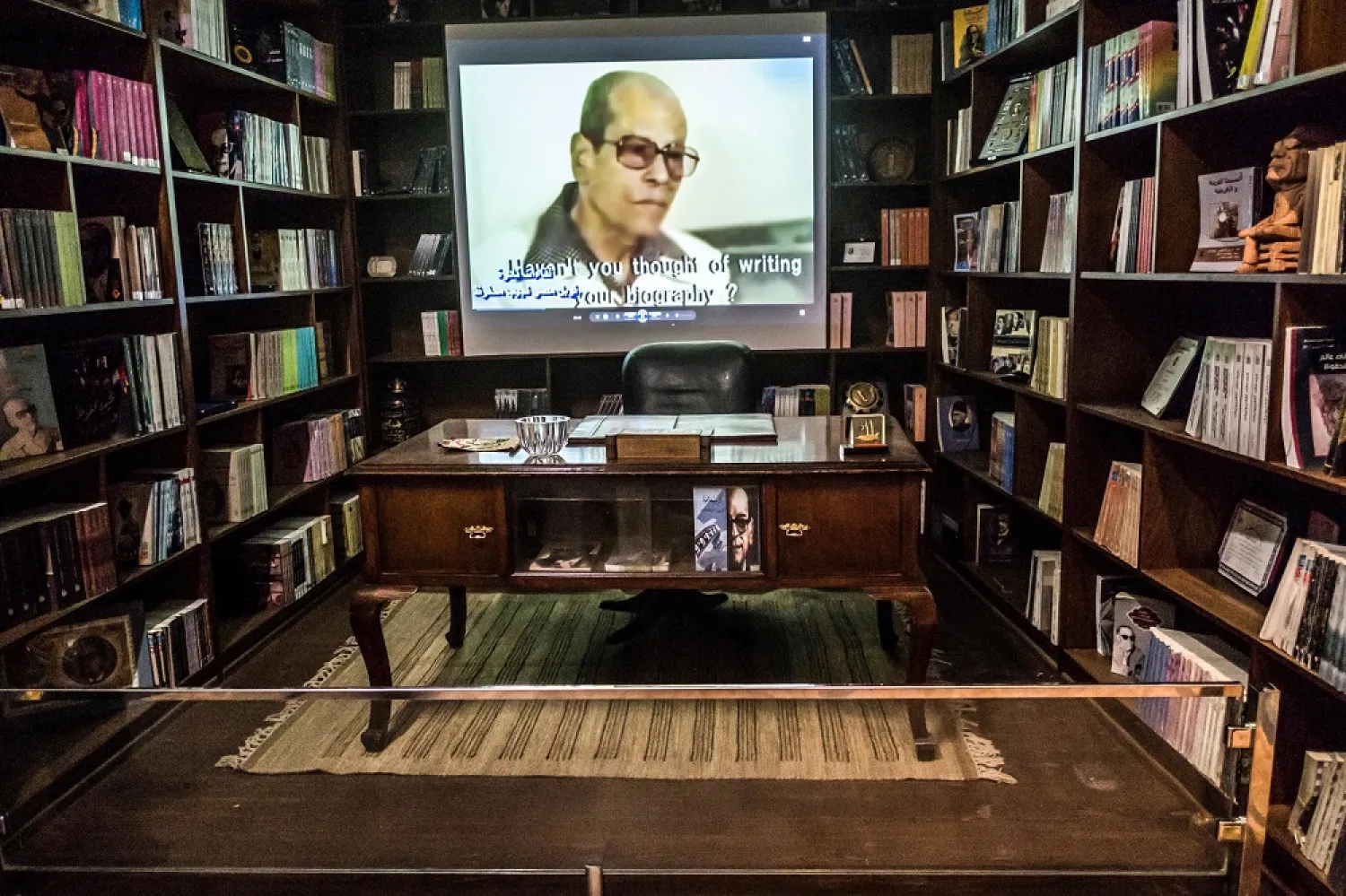
Naguib Mahfouz's desk is just one of the items on display at his museum in the Al-Azhar district of Egypt's capital Cairo. (AFP)
TT

Nobel Winner Mahfouz Lives on in Cairo's Alleyways

Naguib Mahfouz's desk is just one of the items on display at his museum in the Al-Azhar district of Egypt's capital Cairo. (AFP)

The legacy of Islamic Cairo's most famous son Naguib Mahfouz lives on in its winding lanes more than three decades after he became the only Arab to win the Nobel Prize for Literature.

A mosaic of the bespectacled author overlooks a market teeming with children on bikes, waiters balancing trays of hot drinks and shoppers haggling with hawkers over the price of meat.

It could be a scene straight out of a typical Mahfouz novel focusing on the minutiae of life in the Egyptian capital, with its satirically political overtones and timeless characters.

After years in the making, a museum in the writer's honor opened in July this year, reported AFP.

A new translation of previously unpublished Mahfouz work is also in print, underscoring 13 years after his death the mark he made both on world literature and on Egyptians themselves.

In November, young writer Ahmed Mourad sparked controversy in Egypt when he suggested that the quality of Mahfouz's work needed to be adapted to make it more contemporary.

The backlash at this tarnishing of the great man's reputation forced Mourad to go on the popular television talk show circuit to clarify his comments.

Mahfouz is considered to be the father of the modern Arabic novel: he broadened its literary range by pushing through sacred red lines including religious taboos.

And he was nearly killed for doing so. In 1994, a knifeman stabbed him in the neck in an assassination attempt.

The attacker had been acting on a fatwa or religious edict issued by radical Egyptian-American imam Omar Abdel-Rahman, denouncing what he deemed to be the prodigious author's blasphemous prose.

'About Cairo with love'

Mahfouz's daughter Om Kalthoum said he was so deeply enmeshed in the chaotic energy of Cairo that the city itself was a major character in his work.

The writer's routine included walks along the corniche by the Nile to his favorite cafes near Tahrir Square, epicenter of the 2011 revolution, and to cultural salons.

"He wrote about Cairo with true love. He described it in granular detail. Even if he criticized it, it was still full of love," she told AFP.

She and her sister accepted their father's 1988 Nobel Prize on his behalf because of his inability to travel due to his deteriorating eyesight.

Om Kalthoum said: "I remember sometimes we used to go to Al-Hussein (the area around the Al-Hussein mosque in the heart of Islamic Cairo) and we'd sit in the cafe bearing his name," the Naguib Mahfouz Cafe.

"He showed us Midaq Alley -- it was pretty much the size a small room -- and he would tell us great stories about his days as a schoolchild," she recalled.

'Midaq Alley' was one of his most widely read books globally and was adapted into a 1995 film starring Salma Hayek.

The site of the museum dedicated to him is in a beautifully restored Ottoman guesthouse in Islamic Cairo dating to 1774, and was chosen because he spent his early years there.

In the Al-Gamaleya neighborhood the budding writer was surrounded by 10th century walls and a myriad of hiding spots for curious kids.

Om Kalthoum noted that being raised there left an indelible mark on her father's imagination.

Mahfouz's precious belongings including his mahogany desk, honors such as his Nobel certificate and even his last pack of cigarettes are among the items displayed in an exhibition that covers three floors.

A universal writer

Roger Allen, emeritus professor at Penn University in the United States and a prolific translator of Arab writers but especially Mahfouz, told AFP the author was monumental "in the development of Egyptian fiction".

His writings delved into "ancient Egypt, Sufism, politics", Allen said.

"You get glimpses of his many interests. He was working on multiple tracks throughout his career."

Allen translated a collection of his writings into English this year in a work entitled 'The Quarter'.

The collection "reflects what a Cairene quarter looks like" -- much like where the museum dedicated to him is located now.

It is also "a heavily symbolic entity associated with humanity", Allen added.

"His works take on universal themes that show how to organize society and how it can be disrupted by forces," he said.

The new collection is based on a pile of papers that his daughter found years after his death. It was organized and originally published in Arabic by Mohammed Shoair, an editor with the culture journal Akhbar Al-Adab.

He told AFP that "in the years before winning the Nobel, he lost his eyesight so his relationship with reality was almost severed. Writing for him became an obsession."

Shoair has been archiving Mahfouz's papers with Om Kalthoum's help for a multi-volume biography.

He talked about Mahfouz's pioneering role in revolutionizing the Arab novel to the extent that many Arab authors now follow in his footsteps.

Alaa al-Aswany from Egypt, Ahmed Saadawi from Iraq and Algeria's Ahlam Mosteghanemi have all found a global readership with books that have won international awards.

"The main idea behind his work since the 80s was returning to his childhood... his beginnings and the alley," Shoair said of Mahfouz.

"He was talking about his personal life in a way, but through the memories of the past."


Saudi Arabia Participates in Drafting the International AI Safety Report 2026

General view of Riyadh, Saudi Arabia. (SPA)
TT

Saudi Arabia Participates in Drafting the International AI Safety Report 2026

General view of Riyadh, Saudi Arabia. (SPA)

The Kingdom of Saudi Arabia, represented by the Saudi Data and Artificial Intelligence Authority (SDAIA), participated for the second consecutive year in the preparation of the International AI Safety Report 2026, reinforcing its international efforts to advance AI safety and support responsible innovation worldwide, the Saudi Press Agency said on Monday.

The report, emerging from the 2023 AI Safety Summit at Bletchley Park, provides a scientific assessment of advances in advanced AI systems, examines associated risks, and outlines practical approaches to strengthening safety standards and global governance, serving as a key reference for policymakers, regulators, and researchers.

The report is a comprehensive global document assessing AI risks and related challenges and serves as a trusted scientific reference to support regulatory policies and the development of governance frameworks for the safe and responsible use of advanced technologies.

The report was developed by a distinguished group of international scientists and experts in AI safety and technology governance, featuring specialists from prestigious universities and research centers, as well as representatives from over 30 countries and major international organizations, including the United Nations, the Organization for Economic Co-operation and Development, and the European Union.

The report highlights several key messages, notably the importance of keeping pace with the rapidly growing capabilities of AI through advanced regulatory and scientific frameworks, the need to invest in safety and technical compliance research to ensure systems remain under effective human oversight, and the promotion of international coordination to establish common standards supporting the safe and responsible use of advanced technologies.

It also emphasizes the need to consider economic and social dimensions to ensure the fair distribution of AI benefits and reduce inequality gaps.

Saudi Arabia’s participation in this international effort aligns with the objectives of Saudi Vision 2030, which aims to establish the Kingdom as a global hub for technological innovation while upholding the highest standards of responsibility and technical security.

It reflects the Kingdom’s commitment to actively shaping the global future of AI, promoting sustainable development, safeguarding community security, and enhancing international cooperation toward a safer, more stable technological future.


US Astronaut to Take her 3-year-old's Cuddly Rabbit Into Space

FILE PHOTO: An evening launch of a SpaceX Falcon 9 rocket carrying 20 Starlink V2 Mini satellites, from Space Launch Complex at Vandenberg Space Force Base is seen over the Pacific Ocean from Encinitas, California, US, June 23, 2024. REUTERS/Mike Blake/File Photo
TT

US Astronaut to Take her 3-year-old's Cuddly Rabbit Into Space

FILE PHOTO: An evening launch of a SpaceX Falcon 9 rocket carrying 20 Starlink V2 Mini satellites, from Space Launch Complex at Vandenberg Space Force Base is seen over the Pacific Ocean from Encinitas, California, US, June 23, 2024. REUTERS/Mike Blake/File Photo

When the next mission to the International Space Station blasts off from Florida next week, a special keepsake will be hitching a ride: a small stuffed rabbit.

American astronaut and mother, Jessica Meir, one of the four-member crew, revealed Sunday that she'll take with her the cuddly toy that belongs to her three-year-old daughter.

It's customary for astronauts to go to the ISS, which orbits 250 miles (400 kilometers) above Earth, to take small personal items to keep close during their months-long stint in space.

"I do have a small stuffed rabbit that belongs to my three-year-old daughter, and she actually has two of these because one was given as a gift," Meir, 48, told an online news conference.

"So one will stay down here with her, and one will be there with us, having adventures all the time, so that we'll keep sending those photos back and forth to my family," AFP quoted her as saying.

US space agency NASA says SpaceX Crew-12 will lift off on a SpaceX Falcon 9 rocket from Cape Canaveral in Florida to the orbiting scientific laboratory early Wednesday.

The mission will be replacing Crew-11, which returned to Earth in January, a month earlier than planned, during the first medical evacuation in the space station's history.

Meir, a marine biologist and physiologist, served as flight engineer on a 2019-2020 expedition to the space station and participated in the first all-female spacewalks.

Since then, she's given birth to her daughter. She reflected Sunday on the challenges of being a parent and what is due to be an eight-month separation from her child.

"It does make it a lot difficult in preparing to leave and thinking about being away from her for that long, especially when she's so young, it's really a large chunk of her life," Meir said.

"But I hope that one day, she will really realize that this absence was a meaningful one, because it was an adventure that she got to share into and that she'll have memories about, and hopefully it will inspire her and other people around the world," Meir added.

When the astronauts finally get on board the ISS, they will be one of the last crews to live on board the football field-sized space station.

Continuously inhabited for the last quarter century, the aging ISS is scheduled to be pushed into Earth's orbit before crashing into an isolated spot in the Pacific Ocean in 2030.

The other Crew-12 astronauts are Jack Hathaway of NASA, European Space Agency astronaut Sophie Adenot, and Russian cosmonaut Andrey Fedyaev.


iRead Marathon Records over 6.5 Million Pages Read

Participants agreed that the number of pages read was not merely a numerical milestone - SPA
TT

iRead Marathon Records over 6.5 Million Pages Read

Participants agreed that the number of pages read was not merely a numerical milestone - SPA

The fifth edition of the iRead Marathon achieved a remarkable milestone, surpassing 6.5 million pages read over three consecutive days, in a cultural setting that reaffirmed reading as a collective practice with impact beyond the moment.

Hosted at the Library of the King Abdulaziz Center for World Culture (Ithra) and held in parallel with 52 libraries across 13 Arab countries, including digital libraries participating for the first time, the marathon reflected the transformation of libraries into open, inclusive spaces that transcend physical boundaries and accommodate diverse readers and formats.

Participants agreed that the number of pages read was not merely a numerical milestone, but a reflection of growing engagement and a deepening belief in reading as a daily, shared activity accessible to all, free from elitism or narrow specialization.

Pages were read in multiple languages and formats, united by a common conviction that reading remains a powerful way to build genuine connections and foster knowledge-based bonds across geographically distant yet intellectually aligned communities, SPA reported.

The marathon also underscored its humanitarian and environmental dimension, as every 100 pages read is linked to the planting of one tree, translating this edition’s outcome into a pledge of more than 65,000 trees. This simple equation connects knowledge with sustainability, turning reading into a tangible, real-world contribution.

The involvement of digital libraries marked a notable development, expanding access, strengthening engagement, and reinforcing the library’s ability to adapt to technological change without compromising its cultural role. Integrating print and digital reading added a contemporary dimension to the marathon while preserving its core spirit of gathering around the book.

With the conclusion of the iRead Marathon, the experience proved to be more than a temporary event, becoming a cultural moment that raised fundamental questions about reading’s role in shaping awareness and the capacity of cultural initiatives to create lasting impact. Three days confirmed that reading, when practiced collectively, can serve as a meeting point and the start of a longer cultural journey.