


Turtles, Tourists Share Same Beach in Tunisia

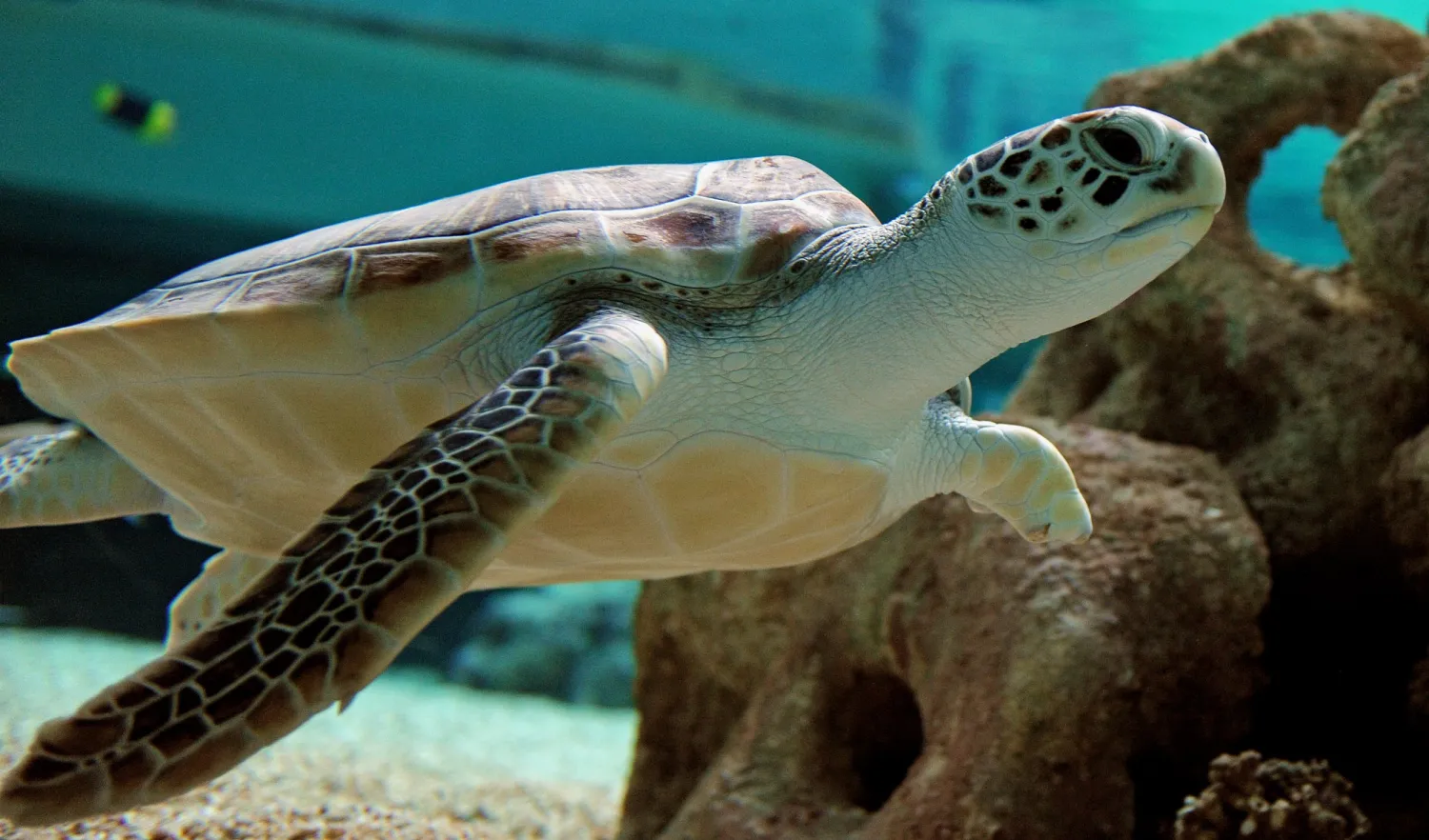
A two-year-old green sea turtle named Sea Biscuit swims at a tropical reef aquarium in Australia. AFP
TT

Turtles, Tourists Share Same Beach in Tunisia

A two-year-old green sea turtle named Sea Biscuit swims at a tropical reef aquarium in Australia. AFP

Between plastic chairs on a crowded Tunisian tourist beach, a sign indicates where another species shares the sand: a nest is buried below.

On this paradisaical island off the coast of Monastir -- a resort town south of the capital Tunis -- tourists co-exist with loggerhead turtles thanks to a novel initiative.

Since 2017, the Tunisian government and a local NGO have jointly run a turtle conservation program under the noses of bathing-suited beach-goers, who are offered an environmental education along with their holiday.

The Kuriat islands are the westernmost permanent loggerhead turtle breeding site on the Mediterranean's south coast, and are in the process of being listed as a protected nature reserve.

But while the islands are an important turtle sanctuary, the white sand beaches and crystal waters of little Kuriat are irresistible to holidaymakers.

During turtle hatching season from July to October, day-trippers arrive daily in their hundreds, transported on pirate-themed boats for barbecues and swimming.

"I thought that this was just an island where I'd go to swim, eat and return," said holidaymaker Souad Khachnaoui.

"I'd never imagined that this site was so important for turtles, birds and other species."

Rather than ban visitors, the authorities work with local volunteers to brief arriving tourists on the local fauna, including the jellyfish-eating turtles, which can live for a century.

"Many people are stunned on arrival, they didn't think that we had these kinds of animals in our country," said Manel Ben Ismail, co-founder of the environmental NGO Notre Grand Bleu, which means "Our great blue (ocean)".

And if they are lucky, tourists can watch as volunteers help defenseless hatchling turtles -- measuring just five centimeters across -- on their journey from the nest to the sea.

Loggerheads are classified as vulnerable by the International Union for the Conservation of Nature. They do not become fertile until about 20 years old and breed only every two to three years. 

Female loggerheads return to the same beach where they were born to lay their clutch of about 100 eggs. But it is a perilous life cycle and only one in a thousand juveniles lives to reproductive age.

The Kuriat islands -- the largest of which is a military zone and the smaller is not permanently settled -- offer young turtles slightly better survival odds.

Both are far from the light pollution of the mainland, which can disorientate hatchlings. 

This year 42 nests were recorded on the islands. Layings have increased since monitoring started in 1997.

If managed correctly, tourism can be a boon for the islands as visitors learn about conservation, the government believes.

"We try to strike a balance between ecological activities and the economic activities of people on this site," said Ahmed Ben Hamida, head of the Kuriat Marine Protected Area for the government agency for coastal protection.



iRead Marathon Records over 6.5 Million Pages Read

Participants agreed that the number of pages read was not merely a numerical milestone - SPA
TT

iRead Marathon Records over 6.5 Million Pages Read

Participants agreed that the number of pages read was not merely a numerical milestone - SPA

The fifth edition of the iRead Marathon achieved a remarkable milestone, surpassing 6.5 million pages read over three consecutive days, in a cultural setting that reaffirmed reading as a collective practice with impact beyond the moment.

Hosted at the Library of the King Abdulaziz Center for World Culture (Ithra) and held in parallel with 52 libraries across 13 Arab countries, including digital libraries participating for the first time, the marathon reflected the transformation of libraries into open, inclusive spaces that transcend physical boundaries and accommodate diverse readers and formats.

Participants agreed that the number of pages read was not merely a numerical milestone, but a reflection of growing engagement and a deepening belief in reading as a daily, shared activity accessible to all, free from elitism or narrow specialization.

Pages were read in multiple languages and formats, united by a common conviction that reading remains a powerful way to build genuine connections and foster knowledge-based bonds across geographically distant yet intellectually aligned communities, SPA reported.

The marathon also underscored its humanitarian and environmental dimension, as every 100 pages read is linked to the planting of one tree, translating this edition’s outcome into a pledge of more than 65,000 trees. This simple equation connects knowledge with sustainability, turning reading into a tangible, real-world contribution.

The involvement of digital libraries marked a notable development, expanding access, strengthening engagement, and reinforcing the library’s ability to adapt to technological change without compromising its cultural role. Integrating print and digital reading added a contemporary dimension to the marathon while preserving its core spirit of gathering around the book.

With the conclusion of the iRead Marathon, the experience proved to be more than a temporary event, becoming a cultural moment that raised fundamental questions about reading’s role in shaping awareness and the capacity of cultural initiatives to create lasting impact. Three days confirmed that reading, when practiced collectively, can serve as a meeting point and the start of a longer cultural journey.


Imam Turki bin Abdullah Royal Reserve Launches Fifth Beekeeping Season

Jazan’s Annual Honey Festival - File Photo/SPA
TT

Imam Turki bin Abdullah Royal Reserve Launches Fifth Beekeeping Season

Jazan’s Annual Honey Festival - File Photo/SPA

The Imam Turki bin Abdullah Royal Nature Reserve Development Authority launched the fifth annual beekeeping season for 2026 as part of its programs to empower the local community and regulate beekeeping activities within the reserve.

The launch aligns with the authority's objectives of biodiversity conservation, the promotion of sustainable environmental practices, and the generation of economic returns for beekeepers, SPA reported.

The authority explained that this year’s beekeeping season comprises three main periods associated with spring flowers, acacia, and Sidr, with the start date of each period serving as the official deadline for submitting participation applications.

The authority encouraged all interested beekeepers to review the season details and attend the scheduled virtual meetings to ensure organized participation in accordance with the approved regulations and the specified dates for each season.


Hail Municipality Named Arab Green City For 2024-2025

The achievement establishes Hail as a leading Arab model for sustainable urban development - SPA
TT

Hail Municipality Named Arab Green City For 2024-2025

The achievement establishes Hail as a leading Arab model for sustainable urban development - SPA

The Hail Region Municipality has secured first place in the Arab Green City award for 2024-2025 at the 15th session of the Arab Towns Organization.

This recognition honors the municipality’s commitment to environmental sustainability, the expansion of green spaces, and the implementation of urban practices that elevate the quality of life, SPA reported.

The award follows a series of strategic environmental initiatives, including large-scale afforestation, the modernization of public parks, and the adoption of eco-friendly solutions to enhance the urban landscape and resource efficiency.

By aligning its projects with the sustainability goals of Saudi Vision 2030, the municipality continues to foster a healthy and safe environment for residents and visitors.

This achievement establishes Hail as a leading Arab model for sustainable urban development.