
Psychologists From 40 Countries Pledge to Address Climate Change

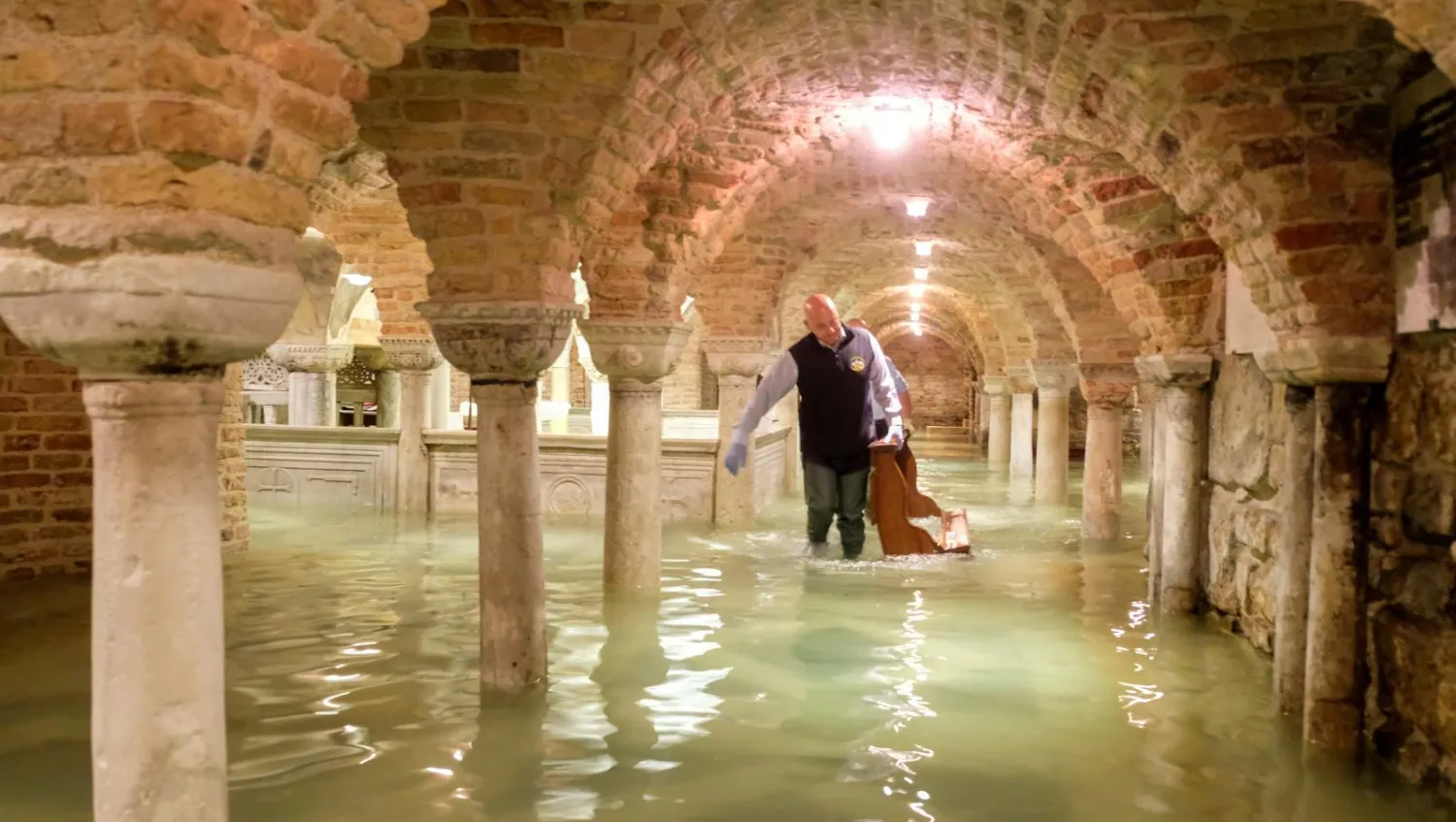
A man wades in the flooded crypt of St Mark’s Basilica during a period of exceptionally high water levels in Venice, Italy November 13, 2019. | REUTERS
TT

Psychologists From 40 Countries Pledge to Address Climate Change

A man wades in the flooded crypt of St Mark’s Basilica during a period of exceptionally high water levels in Venice, Italy November 13, 2019. | REUTERS

The leaders of psychological associations from more than 40 countries signed a proclamation this week at a conference on psychology and global health in Lisbon, pledging to use their expertise as psychologists to “take urgent action to combat climate change and its impacts.”

Already, psychologists have recognized that climate change is a threat to psychological health. But with this move, psychological associations from around the world are signaling a desire to actually address the problem.

The proclamation, as well as a draft resolution set to be finalized this week, expresses a commitment to “inform our respective members and the public about climate crisis,” to advocate for programs to minimize the psychological harm of climate change, advocate for “those most susceptible” to “mental health impacts of climate crisis,” and encourage policymakers to “use more psychological science” in addressing climate change.

The American Psychological Association, one of the groups whose leaders signed the document, made history in 2017 by throwing its weight behind a body of research that pointed to “eco anxiety” as a legitimate affliction. That year, the APA published a 69-page report that urged broad recognition of the connection between mental health and climate change: The changing environment is a legitimate source of distress already affecting many people, the report emphasized, and it has the potential to be psychologically destabilizing.

“To compound the issue, the psychological responses to climate change, such as conflict avoidance, fatalism, fear, helplessness, and resignation are growing,” the APA wrote at the time. “These responses are keeping us, and our nation, from properly addressing the core causes of and solutions for our changing climate, and from building and supporting psychological resiliency.”

Now, psychologists need strategies to deal with the ways climate change may be harming the mental health of their patients. Arthur Evans, the APA’s CEO, spoke to Quartz from the gathering of psychological associations in Lisbon, and said the urgency around the topic at the conference is palpable. “We have people here from the Bahamas and New Zealand and they’re talking about the disasters in their countries and the psychological impact of those.”

“And then there’s the impending impact,” Evans says. People living on islands or in low-lying areas are bracing themselves for a future where their home environments may be destroyed. “We know that that is creating anxieties in populations.”

But, Evans says, treating individuals is hardly the only way psychologists should interact with the crisis of climate change. Psychology is a broad discipline, and includes cognitive psychologists, who work to understand how people think, and behavioral psychologists, who study how to create behavioral change. Psychologists could play a role in crafting public awareness campaigns that truly speak to people and are less likely to be ignored, for example.

“Climate change has occurred because of human behavior. Psychologists are experts in human behavior. One of the things we’re assuming is that psychology needs to be part of those strategies if you’re going to be successful,” Evans says. If recent history is any guide, merely relaying the scientific facts of climate change “will not be adequate” to prompt people to change their behaviors.

“I think psychologists somewhat compartmentalize this issue. Most psychologists understand the importance of climate change, but see it more from a political standpoint,” Evans says. But that is changing. “I think increasingly psychologists are connecting [climate change] to the work that they do and the expertise they have, and how that could be helpful.”

The document is the result of several years of relationship-building with international psychology groups, Evans says. “We started to talk about how we could raise the role psychologists could play on major issues, and climate change rose to the top. We couldn’t think of a more important issue,” Evans says. The declaration itself is short and unspecific, but the signatories are expected to finalize the language of a longer resolution at the Lisbon conference tomorrow, November 16. You can read the draft resolution below:

“WHEREAS there is overwhelming agreement among climate scientists that climate crisis poses a serious global threat, is occurring faster than previously anticipated, and is caused in part by human behavior;

WHEREAS the resistance of some individuals worldwide to accept evidence of climate crisis reflects a variety of psychological, social, economic, and political factors, including misunderstanding the relevant science; psychological threats of departing from the consensus view of one’s peer-group; deliberate exposure to misinformation; and concerns about financial losses stemming from addressing climate crisis;

WHEREAS current research and public communication on the impact of climate crisis have often emphasized the major physical damage caused by extreme weather, such as floods, droughts, hurricanes, and wildfires, and insufficiently addressed the increased displacement, migration, and conflict affecting those populations involved;

WHEREAS climate crisis has a disproportionate impact on already vulnerable groups with fewer resources, including low-income individuals or those who live in rural areas, people of color, women, children, older adults, and individuals with disabilities;

WHEREAS research shows that climate change-related events can result in major acute and chronic adverse mental health outcomes, including stress, trauma, and shock; post-traumatic stress disorder and other forms of anxiety; depression; and substance use disorder, which have been a secondary consideration in climate change communication and action;

THEREFORE, BE IT RESOLVED that our psychology organizations will advocate for and support international and cross-disciplinary collaboration to mitigate and facilitate adaptation to climate crisis.

We will inform our respective members and the public about climate crisis, emphasizing scientific research and consensus on its causes and short- and long-term harms, and the need for immediate personal and societal action;

We will encourage our members and other mental health leaders to be vocal advocates concerning the necessary preparatory and responsive adaptations to climate crisis and to invest more in research and practice is this area;

We will advocate for Universities and other entities could include [in]formation [sic] on societal challenges and, particularly, climate crisis for psychologists and other mental health professionals;

We will increase the availability of services and supportive interventions to help minimize harm to mental health and well-being, especially among vulnerable populations, and increase community resilience;

We will advocate for the rights of those most susceptible to the negative health, and mainly, mental health impacts of climate crisis, for example, by encouraging policymakers to fully fund programs to aid those who suffer harm from severe climate crisis-related events;

We will support the development of a public awareness campaign to encourage individuals and communities to adopt behaviors to help prepare for and recover from gradual climate change and acute climate crisis events;

​We will encourage governmental, educational, health, and corporate leaders to use more psychological science in police [sic] designs as well as to adopt norms, values, and policy to promote sustainable preventive and corrective behaviors in individuals, groups, and communities.”

(Quartz) - Tribune Media Services


British Museum to Keep Pendant Linked to Henry VIII

The Tudor Heart pendant, linked to Britain's King Henry VIII and his first wife Katherine of Aragon, which the British Museum acquired after raising 3.5 million pounds, in this undated handout image. The British Museum/Handout via REUTERS.
TT

British Museum to Keep Pendant Linked to Henry VIII

The Tudor Heart pendant, linked to Britain's King Henry VIII and his first wife Katherine of Aragon, which the British Museum acquired after raising 3.5 million pounds, in this undated handout image. The British Museum/Handout via REUTERS.

The British Museum has successfully raised £3.5 million ($4.8 million) to keep a gold pendant linked to King Henry VIII's marriage to his first wife, Katherine of Aragon, according to BBC.

The central London museum launched a fundraising appeal in October so it could permanently acquire the Tudor Heart, found by a metal detectorist in a Warwickshire field in 2019.

It has now announced that it reached its fundraising goal after receiving £360,000 in public donations and a string of donations from grants, trusts and arts organizations.

Museum director Nicholas Cullinan said: “The success of the campaign shows the power of history to spark the imagination and why objects like the Tudor Heart should be in a museum.”

Research led by the British Museum has revealed that the Tudor Heart pendant may have been made to celebrate the betrothal of their two-year-old daughter Princess Mary to the eight-month-old French heir-apparent in 1518.

The pendant unites the Tudor rose with Katherine's pomegranate symbol and features a banner that reads “tousiors,” the old French for “always.”

After it was found, the pendant was reported under the Treasure Act 1996, which gives museums and galleries in England a chance to acquire historical objects and put them on display.

In order to put the pendant on permanent display, the museum had to pay a reward to the metal detectorist who made the discovery and the owner of the land it was found on.

The museum was keen to keep the Tudor Heart as it believed that few artifacts related to Henry VIII's marriage to Katherine of Aragon have survived.

Since the appeal, it said, more than 45,000 members of the public had contributed to the cause, helping it raise just over 10% of its £3.5 million goal.

It also received £1.75 million from The National Heritage Memorial Fund, which aims to save the UK's most outstanding, at-risk heritage treasures.

Other donors include the charity Art Fund, the Julia Rausing Trust and The American Friends of the British Museum.

Cullinan told BBC Radio 4's Today program: “The fact 45,000 members of the public have got behind this and donated money to keep it on the country on public display shows the enthusiasm for this object - it really is unique.”


New York Seeks Rights for Beloved but Illegal ‘Bodega Cats’

Guest Dan Rimada, founder of Bodega Cats of New York holds a cat named Ashley in a bodega corner store on December 17, 2025 in New York City. (AFP)
TT

New York Seeks Rights for Beloved but Illegal ‘Bodega Cats’

Guest Dan Rimada, founder of Bodega Cats of New York holds a cat named Ashley in a bodega corner store on December 17, 2025 in New York City. (AFP)

Simba, a large cat with thick ginger and white fur, is one of thousands of felines that live in New York's corner shops known as "bodegas" -- even if their presence is illegal.

Praised for warding off pests, so-called bodega cats are also a cultural fixture for New Yorkers, some of whom are now pushing to enshrine legal rights for the little store helpers.

"Simba is very important to us because he keeps the shop clean of the mice," Austin Moreno, a shopkeeper in Manhattan, told AFP from behind his till.

The fluffy inhabitant also helps to entice customers.

"People, very often, they come to visit to ask, what is his name? The other day, some girls saw him for the first time and now they come every day," said Moreno.

Around a third of the city's roughly 10,000 bodegas are thought to have a resident cat despite being liable to fines of $200-$350 for keeping animals in a store selling food, according to Dan Rimada, founder of Bodega Cats of New York.

Rimada photographs the felines for his social media followers and last year launched a petition to legalize bodega cats, which drew nearly 14,000 signatures.

"These cats are woven into the fabric of New York City, and that's an important story to tell," he said.

- Pressure point -

Inspired by Rimada's petition, New York City council member Keith Powers has proposed a measure to shield the owners of bodega cats from penalties.

His legislation would also provide free vaccinations and spay or neuter services to the felines.

But animal shelters and rights groups say this wouldn't go far enough.

While Simba can nap in the corner of his shop with kibble within paw's reach, many of his fellow cats are locked in basements, deprived of food or proper care, and abandoned when they grow old or fall ill.

Becky Wisdom, who rescues cats in New York, warned that lifting the threat of fines could remove "leverage" to encourage bodega owners to better care for the animals.

She also opposes public funds being given to business owners rather than low-income families who want their cats spayed or neutered.

The latter is a big issue in New York, where the stray cat population is estimated at around half a million.

- Radical overhaul -

Regardless of what the city decides, it is the state of New York that has authority over business rules, said Allie Taylor, president of Voters for Animal Rights.

Taylor said she backs another initiative proposed by state assembly member Linda Rosenthal, a prominent animal welfare advocate, who proposes allowing cats in bodegas under certain conditions.

These would include vet visits, mandatory spaying or neutering, and ensuring the cats have sufficient food, water and a safe place to sleep.

Beyond the specific case of bodega cats, Taylor is pushing for a more radical overhaul of animal protection in New York.

"Instead of focusing on one subset of cats, we need the city to make serious investments, meaning tens of millions of dollars per year into free or low cost spay, neuter and veterinary care," she said.


Warming Climate Threatens Greenland’s Ancestral Way of Life

Musher Nukaaraq Lennert Olsen offers some dry food to his dogs after a ride near the "dog town" ofSisimiut, Greenland on January 31, 2026. (AFP)
TT

Warming Climate Threatens Greenland’s Ancestral Way of Life

Musher Nukaaraq Lennert Olsen offers some dry food to his dogs after a ride near the "dog town" ofSisimiut, Greenland on January 31, 2026. (AFP)

Standing in his boat with binoculars in hand, hunter Malik Kleist scans the horizon for seals. But this February, the sea ice in southwestern Greenland has yet to freeze, threatening traditional livelihoods like his.

"Normally the seals are on the ice or in the more calm waters. But today we had to sail all the way into the fjords to find them," the 37-year-old tells AFP.

The Arctic region is on the frontline of global warming, heating up four times faster than the rest of the planet since 1979, according to a 2022 study in scientific journal Nature, causing the sea ice to retreat.

Seals rely on pack ice to give birth, to rest and for protection.

Hunters increasingly have to sail farther along the jagged coast of Sisimiut, navigating into the fjords for several hours to find them.

Traditionally, hunters' boats would head straight out to sea, slowly pushing through the ice and creating holes that attract seals coming up for air.

But without any ice, "it's too windy and the waves are too big," Kleist says.

Last year was exceptionally warm in the vast autonomous territory, with several temperature records beaten, according to the Danish Meteorological Institute (DMI).

In December, the Summit Station, located at the height of Greenland's ice sheet, recorded an average temperature of -30.9 degrees C (-23.6 Fahrenheit), 8.1C higher than the December average during the period 1991-2020.

"It affects everything we do. Because normally around November, December the ice comes. And this year there's no ice, so it affects our living a lot," Kleist says.

- Financial woes -

For the same reason, the government has also had to postpone the annual winter musk ox hunt that was due to start on January 31.

There wasn't enough snow and ice to transport the massive animals that roam the Arctic tundra back from Kangerlussuaq where they are predominantly found, around 165 kilometers (103 miles) away. Greenland has no roads connecting its towns.

That has left some Sisimiut hunters with less income than usual.

"This time of year there is not much to hunt. So we rely on musk ox meat and skin," Kleist says.

"Many of my fellow hunters are struggling with money right now."

Every part of the animal, from the fur to the meat, is either used or sold.

The summer hunting season has therefore gained importance, enabling Greenlanders to fill their freezers to get them through the winter months, he tells AFP over a steaming bowl of fish stew.

The shorter winter season has also impacted another key activity in Greenland, one that has become increasingly important to the tourism sector: dogsled tours.

In the Sisimiut neighborhood where the dogs are kept, their thunderous barking mounts as Nukaaraq Olsen, a 21-year-old musher, attaches them to the sled.

Raring to get going, his 18 dogs are hard to hold back. Twenty minutes later, the group bounds off.

But the road is bumpy, and several times Olsen has to get up to manually push the sled, stuck on the tundra's rocks in patches where there is no ice.

"This year we had a lot of hot, warm days, even though it's December or January," he says.

Other parts of the route are no longer safe to use, due to repeated melting and freezing of snowfall which causes uneven layers, he explains.

- Dehydrated dogs -

The dogs' health is also affected by the changing climate.

They are used to quenching their thirst with snow, but with little or no snowfall, they can easily get dehydrated. Mushers have to take that into account when caring for their animals.

Many have even had to get rid of their dogs, the business of maintaining them no longer profitable with the dogsled season shrinking to just two months, says Emilie Andersen-Ranberg, a researcher at the University of Copenhagen who runs a dog clinic in Sisimiut.
Others, such as 72-year-old Johanne Bech, are finding novel ways to adapt.

She plans to put wheels on her sled to continue running dogsled tours during the summer period.

That solution is growing in popularity, as "the window with snow is getting more and more narrow," the veterinarian says.

Over the past 20 years, the number of sleddogs has been halved from 25,000 to 13,000, according to a 2024 article from the University of Greenland in 2024.

Yet Johanne Bech remains optimistic about the future.

"I hope this is just for a short time, so we can go back to a little more stable snow or more ice in the future."