


Iran Videos Hit Internet Revealing Scope of Crackdown

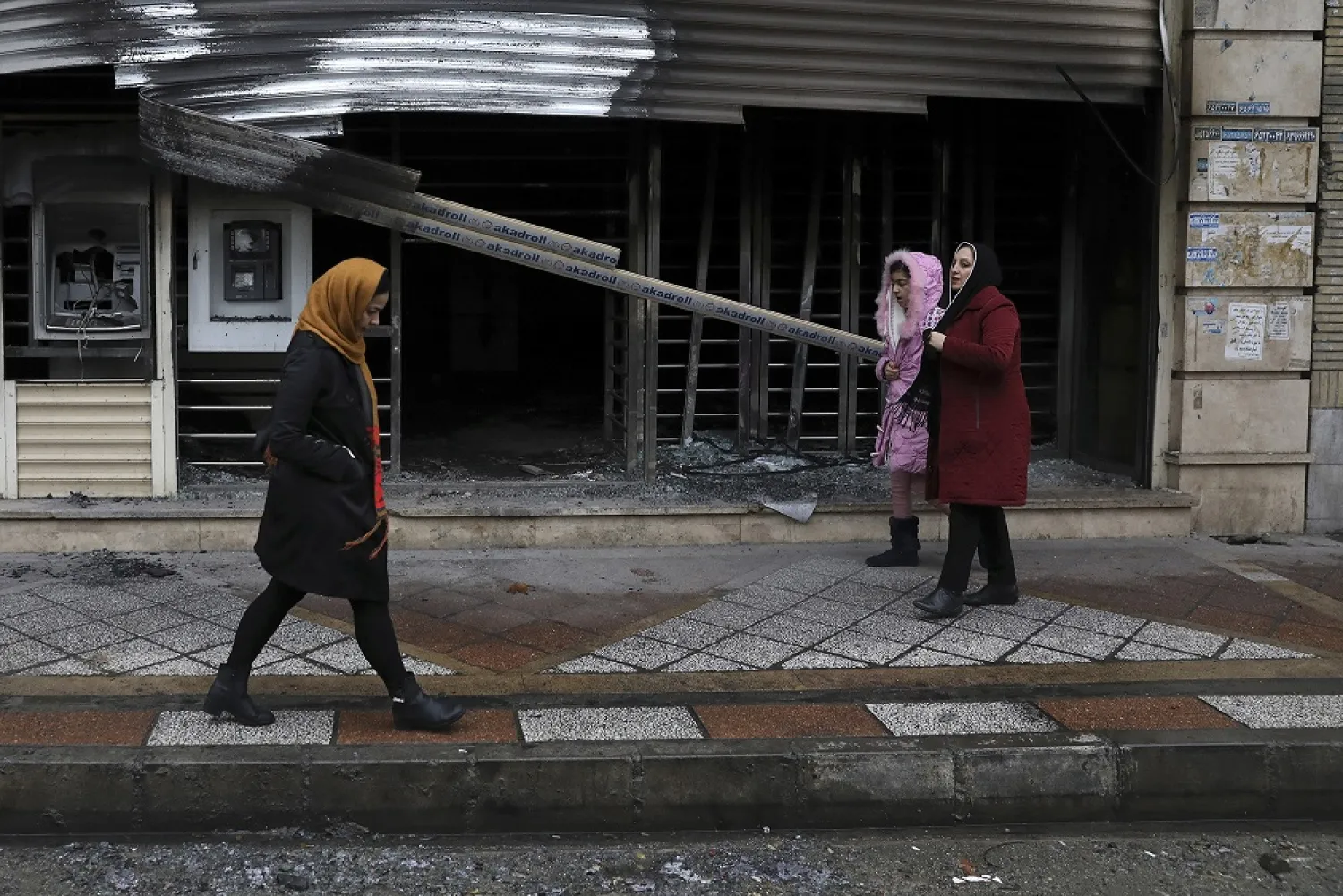
People walk past a bank that was burned in recent protests in Shahriar, Iran. (AP)
TT

Iran Videos Hit Internet Revealing Scope of Crackdown

People walk past a bank that was burned in recent protests in Shahriar, Iran. (AP)

Videos showing harrowing scenes of bleeding protesters, burning roadblocks and snipers on rooftops have emerged after Iran lifted a near-total internet blackout, opening a window onto what analysts say was one of Tehran's bloodiest crackdowns.

This repression "was harsher" than during previous protests in Iran, Kamran Matin, senior lecturer in International Relations at Sussex University in Britain, told AFP in Nicosia.

"All the videos I have seen from before the internet was shut down show that from the moment of the gathering of people to 'shoot to kill' was very short."

The protests that broke out across the country from November 15 were ignited by a price hike on fuel -- a heavily subsidized commodity in one of OPEC's largest producers -- as part of an effort to ease pressure on the sanctions-hit economy.

But global insight into the protests and most Iranians' access to those outside the country was quickly cut off when authorities clamped down on internet access, according to NetBlocks, which monitors internet disruptions.

Shaky footage

As the internet was gradually restored a week later -- with supreme leader Ali Khamenei saying a "very dangerous" plot had been foiled -- a picture of events began to emerge piecemeal.

Many videos from some of the estimated 100 areas where demonstrations erupted appear to show security forces firing at close range at unarmed demonstrators or beating them with batons.

Shaky footage shows bloodied people prone on the street, shouts and panicked screaming as others rush to their aid.

Crowds can be heard chanting slogans against the security apparatus and the ruling elite, venting frustrations over high inflation and unemployment.

Iran "has never felt so hopeless and sad", said one Iranian living abroad who was in the country during the unrest, asking not to be named.

Shops, banks, petrol stations and police cars were torched, while major traffic arteries were blocked with tipped dumpsters and burning tires.

In one video from an eastern Tehran neighborhood verified by London-based rights group Amnesty International, a cluster of security forces rush out from behind a building, firing at demonstrators in the street.

Another shows several gunmen in dark uniforms repeatedly firing at people from the roof of a government building in Javanrud, west of Tehran in Kermanshah Province.

Ethnically Kurdish western areas and majority ethnically Arab Khuzestan province were initial sites of unrest, Matin said.

'So many what-ifs'

Amnesty researcher Raha Bahreini said in a New York Times Op-Ed on Monday that authorities have used excessive force in the past against peaceful protesters. "What we've seen this time though is an unprecedented use of lethal force against unarmed protesters".

Amnesty says 208 people are now believed to have died, with the actual figure expected to be much higher.

Iran's judiciary on Tuesday rejected as "utter lies" unofficial casualty figures, saying they were being spread by "hostile groups".

Authorities have said five people were killed and have announced more than 500 arrests, including some 180 "ringleaders", blaming the unrest on "thugs" backed by outside enemies, including archfoes the United States and Israel.

But even with careful verification, building a full picture of what happened remains challenging.

Nick Waters of investigative group Bellingcat told AFP it was possible old images from previous protests were being recirculated.

"Right now, there's a load of content coming out at the same time, which makes it more difficult to verify because you don't have as good a view of the contextual information," he said.

"You're not seeing the whole picture," said Nazila Fathi, author of "The Lonely War: One Woman's Account of the Struggle for Modern Iran".

"You're just seeing what's in front of the camera, so it's really hard to put it in numbers. How many people are there, how they were instigated... what if they are older videos. There are so many what-ifs."

'Can you hear us?'

According to Amnesty, "families of victims have been threatened and warned not to speak to the media".

Some are still doing so, such as the family of Pooya Bakhtiari, one of those confirmed dead by the rights organization.

Videos sent to US-based activist Masih Alinejad by the family start with a warning. In a morgue, someone unzips the body-bag to expose Bakhtiari's corpse, showing where he was apparently shot in the head.

But for many others, the fear of reprisals is an effective deterrent.

Journalist Mohammad Mosaed was reportedly arrested after he circumvented the blackout to tweet: "Hello Free World! I used 42 different proxies to write this! Millions of Iranians don't have internet. Can you hear us?"

Kaveh Azarhoosh, senior researcher at Small Media, which monitors access to information and digital rights in Iran, said many Iranians were likely fearful of directly posting videos, often opting to send them to journalists and activists abroad.

"The policy-making establishment has realized that you cannot control online behavior by just controlling online connectivity, there has to be an element of offline fear as well," he said.



Top Trump Iran Negotiator Says Visits US Aircraft Carrier in Middle East

US Special Envoy Steve Witkoff delivers a press conference upon the signing of the declaration on deploying post-ceasefire force in Ukraine, during the so-called "Coalition of the Willing" summit, at the Elysee Palace in Paris, France, January 6, 2026. (Reuters)
TT

Top Trump Iran Negotiator Says Visits US Aircraft Carrier in Middle East

US Special Envoy Steve Witkoff delivers a press conference upon the signing of the declaration on deploying post-ceasefire force in Ukraine, during the so-called "Coalition of the Willing" summit, at the Elysee Palace in Paris, France, January 6, 2026. (Reuters)

US President Donald Trump's lead Iran negotiator Steve Witkoff on Saturday said he visited the USS Abraham Lincoln aircraft carrier currently in the Arabian Sea, with Washington and Tehran due to hold further talks soon.

"Today, Adm. Brad Cooper, Commander of US Naval Forces Central Command, Jared Kushner, and I met with the brave sailors and Marines aboard the USS Abraham Lincoln, her strike group, and Carrier Air Wing 9 who are keeping us safe and upholding President Trump's message of peace through strength," said Witkoff in a social media post.

Iranian Foreign Minister Abbas Araghchi said on Saturday he hoped talks with the United States would resume soon, while reiterating Tehran's red lines and warning against any American attack.


Israel’s Netanyahu Expected to Meet Trump in US on Wednesday and Discuss Iran

Israeli Prime Minister Benjamin Netanyahu delivers a speech during a special session to mark the 77th anniversary of the Knesset's establishment and the 60th anniversary of the dedication of the current building at the Knesset, the Israeli parliament, in Jerusalem, 02 February 2026. (EPA)
TT

Israel’s Netanyahu Expected to Meet Trump in US on Wednesday and Discuss Iran

Israeli Prime Minister Benjamin Netanyahu delivers a speech during a special session to mark the 77th anniversary of the Knesset's establishment and the 60th anniversary of the dedication of the current building at the Knesset, the Israeli parliament, in Jerusalem, 02 February 2026. (EPA)

Israeli Prime Minister Benjamin Netanyahu is expected to meet US President Donald Trump on Wednesday in Washington, where they will discuss negotiations with Iran, Netanyahu's office said on Saturday.

Iranian and US officials held indirect nuclear ‌talks in the ‌Omani capital ‌Muscat ⁠on Friday. ‌Both sides said more talks were expected to be held again soon.

A regional diplomat briefed by Tehran on the talks told Reuters Iran insisted ⁠on its "right to enrich uranium" ‌during the negotiations with ‍the US, ‍and that Tehran's missile capabilities ‍were not raised in the discussions.

Iranian officials have ruled out putting Iran's missiles - one of the largest such arsenals in the region - up ⁠for discussion, and have said Tehran wants recognition of its right to enrich uranium.

"The Prime Minister believes that any negotiations must include limiting ballistic missiles and halting support for the Iranian axis," Netanyahu's office said in a ‌statement.


Italy FM Rules Out Joining Trump’s ‘Board of Peace’

Italy's Minister for Foreign Affairs Antonio Tajani speaks to the press during the EPP Leaders’ meeting, in Zagreb, Croatia, 30 January 2026. (EPA)
TT

Italy FM Rules Out Joining Trump’s ‘Board of Peace’

Italy's Minister for Foreign Affairs Antonio Tajani speaks to the press during the EPP Leaders’ meeting, in Zagreb, Croatia, 30 January 2026. (EPA)

Italy will not take part in US President Donald Trump's "Board of Peace", Italian Foreign Minister Antonio Tajani said Saturday, citing "insurmountable" constitutional issues.

Trump launched his "Board of Peace" at the World Economic Forum in Davos in January and some 19 countries have signed its founding charter.

But Italy's constitution bars the country from joining an organization led by a single foreign leader.

Prime Minister Giorgia Meloni, a Trump ally, last month noted "constitutional problems" with joining, but suggested Trump could perhaps reopen the framework "to meet the needs not only of Italy, but also of other European countries".

Tajani appeared Saturday to rule that out.

"We cannot participate in the Board of Peace because there is a constitutional limit," he told the ANSA news agency.

"This is insurmountable from a legal standpoint," he said, the day after meeting US Secretary of State Marco Rubio and US Vice President JD Vance at the Olympics in Milan.

Although originally meant to oversee Gaza's rebuilding, the board's charter does not limit its role to the Palestinian territory and appears to want to rival the United Nations.