


Fallen Rights Icon at UN Court for Rohingya Genocide Case

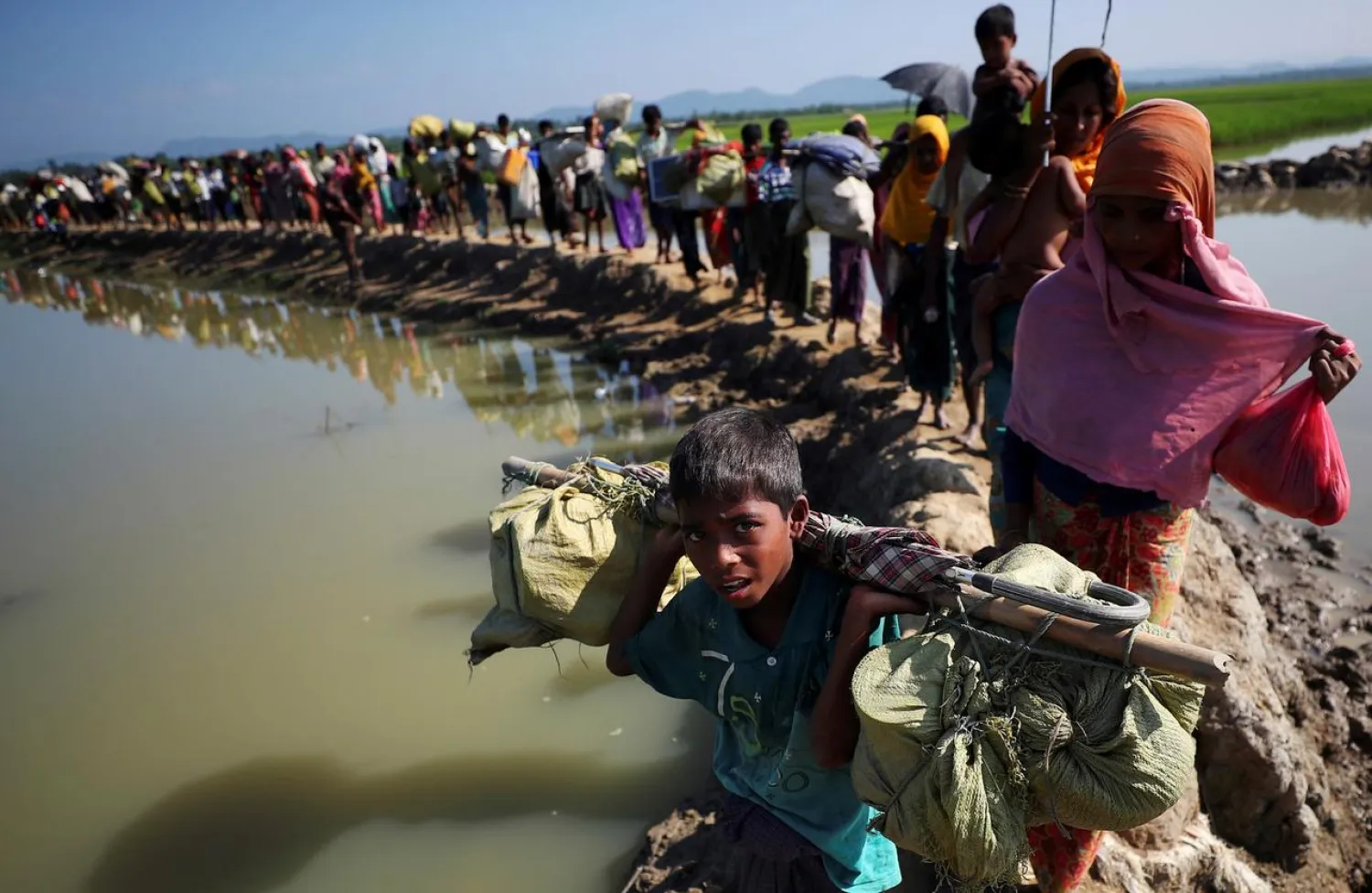
Rohingya refugees make their way to a refugee camp after crossing the Bangladesh-Myanmar border in Palong Khali, near Cox's Bazar, Bangladesh, November 3, 2017. (Reuters)
TT

Fallen Rights Icon at UN Court for Rohingya Genocide Case

Rohingya refugees make their way to a refugee camp after crossing the Bangladesh-Myanmar border in Palong Khali, near Cox's Bazar, Bangladesh, November 3, 2017. (Reuters)

Twenty-eight years to the day after Aung San Suu Kyi’s husband and sons accepted her Nobel Peace Prize while she remained under house arrest in Myanmar, the former pro-democracy icon appeared in a United Nations court ready to defend her country's army from allegations of committing genocide against the Rohingya minority.

Suu Kyi looked on attentively from the front bench at the International Court of Justice in The Hague Tuesday as a legal team for Gambia detailed accounts of killings - including of women and children - sexual violence and the destruction of tens of thousands of Muslim minority homes in northern Rakhine state.

Acting on behalf of the 57-country Organization of Islamic Cooperation, Gambia is asking the world court to take “all measures within its power to prevent all acts that amount to or contribute to the crime of genocide.”

Opening Gambia’s case, Justice Minister Aboubacarr Tambadou urged the court to “tell Myanmar to stop these senseless killings, to stop these acts of barbarity that continue to shock our collective conscience, to stop this genocide of its own people.”

“It is indeed sad for our generation that 75 years after human kind committed itself to the words ‘never again’, another genocide is unfolding right before our eyes,” Tambadou said. “Yet we do nothing to stop it.”

“This is a stain on our collective conscience,” he said.

Myanmar’s army began a crackdown on the Rohingya in August 2017 in response to an insurgent attack. More than 700,000 Rohingya fled to neighboring Bangladesh to escape what has been called an ethnic cleansing campaign involving mass rapes, killings and the torching of homes.

The head of a UN fact-finding mission on Myanmar warned in October that “there is a serious risk of genocide recurring.” The mission also found that Myanmar should be held responsible in international legal forums for alleged genocide against the Rohingya.

Myanmar has strongly denied the charges but says it stands ready to take action against wrongdoers if there is sufficient evidence.

A statement on the website of the Ministry of the Interior said recently that the renewed international pressure on the country was due to a lack of understanding of “the complexities of the issue and the narratives of the people of Myanmar.”

Beyond detailing graphic accounts of rape, mutilation and the killing of children by soldiers in a three-hour presentation, Gambia’s representatives underscored what they said was Myanmar’s “ongoing genocidal intent” and the government’s continued incitement of racial hatred.

They said there is “overwhelming” evidence of genocide and they want steps taken to prevent “extrajudicial killings or physical abuse; rape or other forms of sexual violence; burning of homes or villages; destruction of lands and livestock, deprivation of food” and other acts “calculated to bring about the physical destruction of the Rohingya group in whole or in part.”

Scores of Rohingya supporters gathered outside the court behind a banner marked “Stop Genocide.” Some carried photos of Suu Kyi with “Shame” and “agent of the military" written under them.

An extraordinary scene is set for Wednesday, when Suu Kyi - once a shining light for democracy and a global beacon of hope for human rights - is expected to defend the actions of the armed forces despite having spent 15 years under military-ordered house arrest.

Suu Kyi, who was awarded the 1991 Nobel Peace Prize for championing democracy and rights under Myanmar’s then-ruling junta, is leading the Myanmar delegation in her capacity as foreign minister.

A group of seven Nobel peace prize winners has called on her “to publicly acknowledge the crimes, including genocide, committed against the Rohingya. We are deeply concerned that instead of condemning these crimes, Aung San Suu Kyi is actively denying that these atrocities even occurred. “

They wrote in a signed statement ahead of the hearing, which runs until Thursday, that “Aung San Suu Kyi must be held criminally accountable, along with her army commanders, for crimes committed.”

In Myanmar, hundreds of people have rallied to show support for her in recent days.

At one rally, around 700 people, including many members of Suu Kyi's National League of Democracy party, gathered outside the colonial-era City Hall in Yangon, Myanmar’s largest city.

As the crowd waved national flags and listened to music and poetry, a popular local singer told them “Mother Suu is the bravest human being in the world — her weapon is love.”



Iran's Supreme Leader Urges Iranians to Show 'Resolve' against Foreign Pressure

Iran's supreme leader Ali Khamenei on (File Photo/Supreme Leader's website).
TT

Iran's Supreme Leader Urges Iranians to Show 'Resolve' against Foreign Pressure

Iran's supreme leader Ali Khamenei on (File Photo/Supreme Leader's website).

Iran's supreme leader Ali Khamenei on Monday called on his compatriots to show "resolve" ahead of the anniversary of the 1979 Islamic revolution this week.

Since the revolution, "foreign powers have always sought to restore the previous situation", Ali Khamenei said, referring to the period when Iran was under the rule of shah Reza Pahlavi and dependent on the United States, AFP reported.

"National power is less about missiles and aircraft and more about the will and steadfastness of the people," the leader said, adding: "Show it again and frustrate the enemy."


UK PM's Communications Director Quits

British Prime Minister Keir Starmer delivers a speech at Horntye Park Sports Complex in St Leonards, Britain, February 05, 2026. Peter Nicholls/Pool via REUTERS
TT

UK PM's Communications Director Quits

British Prime Minister Keir Starmer delivers a speech at Horntye Park Sports Complex in St Leonards, Britain, February 05, 2026. Peter Nicholls/Pool via REUTERS

British Prime Minister Keir Starmer's director of communications Tim Allan resigned on Monday, a day after Starmer's top aide Morgan McSweeney quit over his role in backing Peter Mandelson over his known links to Jeffrey Epstein.

The loss of two senior aides ⁠in quick succession comes as Starmer tries to draw a line under the crisis in his government resulting from his appointment of Mandelson as ambassador to the ⁠US.

"I have decided to stand down to allow a new No10 team to be built. I wish the PM and his team every success," Allan said in a statement on Monday.

Allan served as an adviser to Tony Blair from ⁠1992 to 1998 and went on to found and lead one of the country’s foremost public affairs consultancies in 2001. In September 2025, he was appointed executive director of communications at Downing Street.


Road Accident in Nigeria Kills at Least 30 People

FILE PHOTO: A police vehicle of Operation Fushin Kada (Anger of Crocodile) is parked on Yakowa Road, as schools across northern Nigeria reopen nearly two months after closing due to security concerns, following the mass abductions of school children, in Kaduna, Nigeria, January 12, 2026. REUTERS/Nuhu Gwamna/File Photo
TT

Road Accident in Nigeria Kills at Least 30 People

FILE PHOTO: A police vehicle of Operation Fushin Kada (Anger of Crocodile) is parked on Yakowa Road, as schools across northern Nigeria reopen nearly two months after closing due to security concerns, following the mass abductions of school children, in Kaduna, Nigeria, January 12, 2026. REUTERS/Nuhu Gwamna/File Photo

At least 30 people have been killed and an unspecified number of people injured in a road accident in northwest Nigeria, authorities said.

The accident occurred Sunday in Kwanar Barde in the Gezawa area of Kano state and was caused by “reckless driving” by the driver of a truck-trailer, Gov. Abba Yusuf said in a statement. He did not specify what other vehicles were involved.

Yusuf described the accident as “heartbreaking and a great loss” to the affected families and the state. He did not provide more details of the accident, said The Associated Press.

Africa’s most populous country recorded 5,421 deaths in 9,570 road accidents in 2024, according to data by the country’s Federal Road Safety Corps.

Experts say a combination of factors including a network of bad roads, lax enforcement of traffic laws and indiscipline by some drivers produce the grim statistics.

In December, boxing heavyweight champion Anthony Joshua was in a deadly car crash that injured him and killed Sina Ghami and Latif “Latz” Ayodele, two of his friends, in southwest Nigeria.

Adeniyi Mobolaji Kayode, Joshua’s driver, was charged with dangerous and reckless driving and his trial is scheduled to begin later this month.

Africa has the highest road fatality rate in the world despite having only about 3% of the world’s vehicles, mainly due to weak enforcement of road laws, poor infrastructure and widespread use of unsafe transport.