


Saudi Arabia's Tourism Strategy Is Paying Off

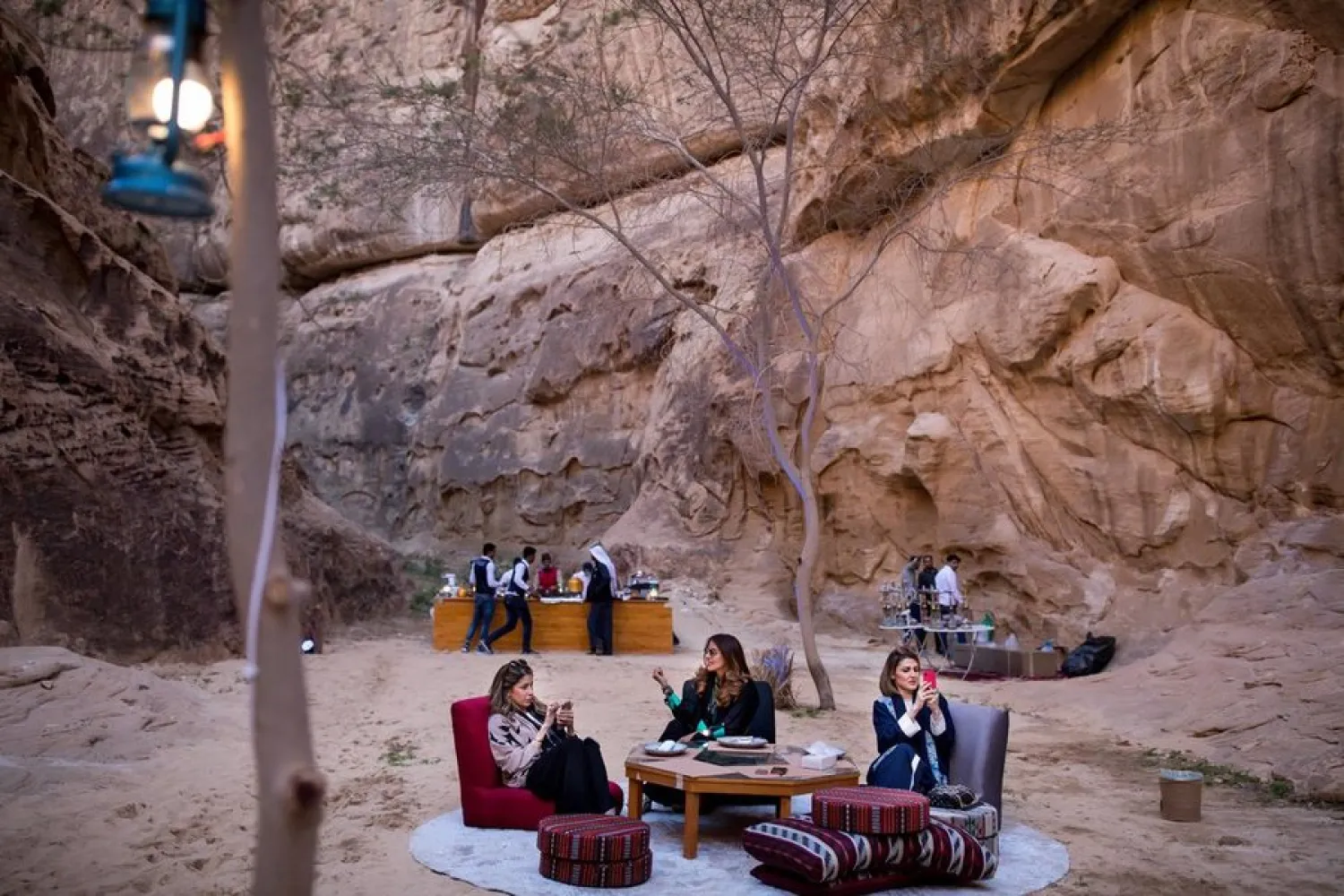
Tourists in Al-Ula, which includes ruins of an ancient city of carved rock tombs.Credit...Tasneem Alsultan for The New York Times
TT

Saudi Arabia's Tourism Strategy Is Paying Off

Tourists in Al-Ula, which includes ruins of an ancient city of carved rock tombs.Credit...Tasneem Alsultan for The New York Times

In a makeshift camp under a starry sky, Ghazi Al-Anazi talked about his experience in the fledgling Saudi tourist business. A decade ago, barely in his 20s, he started taking British business associates of his brother to see the wind-carved hills of the Saudi desert.

Now 31, he has a small fleet of S.U.V.s, nearly a dozen employees and a self-taught ability to cater to the whims of visitors from many nations.

“I know what they want to do, and what I need to do about it,” he said, ladling out a dinner of barbecued chicken and Middle Eastern salads to a couple of dozen tourists from France, Ukraine, Malaysia, and the United States.

Mr. Al-Anazi and his business, Ghazi Tours, take up to 900 visitors a month on treks like this one to a dry riverbed dotted with venerable acacia trees north of Riyadh, the Saudi capital.
ImageTourists, led by Ghazi Al-Anazi, climbing a rock formation in the desert near Riyadh.

But he’s confident those numbers are about to multiply, as Saudi Arabia begins to open itself up as a major tourist destination. The government recently began issuing tourist visas for the first time, a remarkable shift for a traditionally shuttered society.

And it goes far beyond that: Billions of dollars are being poured into vast tourism projects throughout the kingdom, from flashy resorts to new airports, in a bid to shift the economy away from its dependence on the petroleum industry and the government jobs it finances.

Visiting Saudi Arabia has long been a difficult proposition for everyone except Muslim pilgrims going on the hajj and business travelers. For decades, historic sites have been largely ignored, and hotels and travel services were scarce outside major cities.

Unemployment among Saudi nationals is stubbornly high, about 12 percent. But the government figures that the travel industry, which employs about 600,000 people, can be expanded to create up to a million more jobs, as the need for everything from drivers, chefs and guides to hotel managers and archaeologists expands.

The move toward tourism was devised by Crown Prince Mohammed bin Salman, the kingdom’s 34-year-old chief policymaker, whose Vision 2030 program seeks to diversify the economy, draw in more outside investment and expand the private sector.

The Saudis are hiring international real estate executives and introducing elaborate advertising campaigns to try to put themselves on the map. Already, there are signs the push is paying off: Saudi hotel room sales in the first nine months of 2019 increased 11.8 percent from the same period last year.

Saudi Arabia is promoting ultramodern resorts, ruins from ancient civilizations and romantic desert landscapes once crossed by Lawrence of Arabia. And tour guides won’t object if you want to take a selfie with a camel.

Referring the vast golden vistas, “I call it the new yellow oil,” said Amr Al Madani, the chief executive of the Royal Commission for Al-Ula, a region in the northwest part of the kingdom that is roughly the size of New Jersey.

Al-Ula includes the evocative ruins of an ancient city of carved rock tombs, called Mada’in Saleh. Like Petra, a popular tourist draw in southern Jordan, the city was built by the Nabataeans about 2,000 years ago.

The vast region has only 45,000 residents. There are some existing resorts, and France’s Accor chain recently agreed to manage one. Mr. Madani is planning an investment of up to $20 billion, from a mix of public and private sources, to finance airport expansion, hotels and other facilities to accommodate up to two million visitors drawn to archaeological sites as well as food and cultural attractions.

An even more ambitious scheme is under construction on Saudi Arabia’s western coast. The Red Sea project covers a remote area with 120 miles of coastline, more than 90 islands and extensive coral reefs that could one day be a diving and snorkeling paradise.

The Saudis want to put four dozen luxury hotels there, including 14 in a first phase, forecasting that these facilities will eventually contribute around $6 billion a year to the economy. Accor has agreed to participate, and the developers say they are in talks with other international hotel groups.

The Public Investment Fund, Prince Mohammed’s $320 billion vehicle for economic makeover, owns the Red Sea scheme and is providing some of the initial capital. Proceeds from the recent sale of a stake in the national oil company, Saudi Aramco, are likely to flow into the investment fund, and could finance other tourist projects.

Prince Mohammed chairs the Red Sea Development Company as well as the Al-Ula commission. John Pagano, Red Sea’s chief executive, said the prince knew the area “intimately” from excursions on his yacht.

On one occasion, the prince told the developers to think again about putting a resort on a certain island because the water surrounding it is not turquoise enough.

“We never made that mistake again, “ said Mr. Pagano, a former senior executive at London’s Canary Wharf development.

These projects are the size of small countries, and the prince is taking advantage of their scale and sparse populations to plan distinctive communities. The Red Sea development, for instance, will not be connected to the national electric grid and will rely completely on renewable energy like wind and solar, according to Mr. Pagano, who is a Canadian citizen.

Both the Red Sea and Al-Ula projects aspire to attract wealthy, ecology-minded tourists willing to pay a premium for a novel and relatively unspoiled destination. Some travel analysts say this approach may pay dividends.

“This planet is running out of places to go,” said Philip Wooller, Middle East director for the travel research firm STR.

Aman Resorts, a Swiss-based hotel group that caters to the wealthy and celebrities, is setting up three establishments in Al-Ula, with a plan to open in 2023. “There is a huge amount of culture to be discovered and explored, and that is exactly what our guests want to do,” said Anna Nash, a spokeswoman for the company.

Still, Mr. Wooller said, the Saudis are starting “at the very very beginning.” Although the kingdom accommodates about 15 million international visitors a year, the bulk of them for Muslim pilgrimages, tourism has largely been limited to side trips after business meetings. A huge training and hotel-building exercise is going to be required to meet the government’s goal of 100 million domestic and international visits by 2030, more than double the 41 million of 2018.

(The New York Times)



Olympic Tourists in Cortina Can Explore the Dolomites with the New ‘Uber Snowmobile’ Service

 The peaks of the Dolomites are seen from the Cortina Sliding Centre during the Milano Cortina 2026 Winter Olympic Games in Cortina d'Ampezzo on February 5, 2026. (AFP)
The peaks of the Dolomites are seen from the Cortina Sliding Centre during the Milano Cortina 2026 Winter Olympic Games in Cortina d'Ampezzo on February 5, 2026. (AFP)
TT

Olympic Tourists in Cortina Can Explore the Dolomites with the New ‘Uber Snowmobile’ Service

 The peaks of the Dolomites are seen from the Cortina Sliding Centre during the Milano Cortina 2026 Winter Olympic Games in Cortina d'Ampezzo on February 5, 2026. (AFP)
The peaks of the Dolomites are seen from the Cortina Sliding Centre during the Milano Cortina 2026 Winter Olympic Games in Cortina d'Ampezzo on February 5, 2026. (AFP)

The peaks of the Dolomites are seen from the Cortina Sliding Centre during the Milano Cortina 2026 Winter Olympic Games in Cortina d'Ampezzo on February 5, 2026. (AFP)

For one month starting on Saturday, Olympic spectators keen for a side trip to a UNESCO World Heritage Site can use Uber to reserve a ride on a snowmobile along the snow-covered road to the base of the Three Peaks of Lavaredo.

The dramatic, jagged limestone pinnacles stand just 23 kilometers (14.3 miles) from the Cortina venues where athletes are competing in the 2026 Winter Olympics and Paralympics.

One of the Olympic torchbearers, Giulia Baffetti, runs snowmobiling tours through Cortina-based winter activities outfit Snowdreamers. The company partnered with Uber, the official ride-hailing sponsor for the Games, to offer free tours on the weekends in February to people in town.

"Uber Snowmobile" tours, which can only be booked through Uber, include a ride in an Uber transfer bus for up to eight people from Cortina to the spot where riders mount their snowmobiles for departure. Tourgoers then follow the instructor, who leads the line of snowmobiles.

The first slots offered went fast, but Uber spokesperson Caspar Nixon said Friday that it planned to add more.

The three peaks are a magical place, Baffetti said, and this is a way for more people to experience it. Hikers and climbers flock there in the warmer months. In the winter, it’s a prime spot for cross-country skiing, snowshoeing and sledding. Snowmobiling is allowed in a limited area in order to protect the environment.

"We want to give an experience to the tourists, so they can feel the mountains in a different way," she said.

The Associated Press took the one-hour tour on Thursday, ahead of the Saturday launch, along with one other person. Helmets are essential, while heated handgrips are a most welcome feature. And that red button? Passengers can push it to stop the snowmobile if it veers off course or they feel unsafe.

The adrenaline-filled ride reaches speeds up to 40 kph (25 mph) when zooming past snow-covered trees, and drivers are instructed to slow when coming upon cross-country skiers and sledders. Deer and wolves are sometimes seen along the 7-kilometer (4.3-mile) route up to the base of the peaks.

Also visible on Thursday was the southernmost of the three Lavaredo peaks, rising sharply out of the fog. While the Dolomites are breathtaking from Cortina — and on Friday, the sun shone and the view was clear from town — they are even more impressive up close.

The route back includes a short loop around Lake Antorno. Before traversing all the ups and downs, the snowmobile instructor leading the tour offers a reminder about that red button.

Saher Deeb, an Israeli tourist, was along for the ride Thursday, one day after his 29th birthday. It was his first time on a snowmobile, and he was all smiles as he climbed off at the end.

"It was perfect," he said.


French Duo Finish Walking from France to Shanghai After 1.5 Years

 Performers throw molten iron to create sparks during a performance on the Bund promenade along the Huangpu river, ahead of the upcoming Lunar New Year of the Horse in Shanghai on February 2, 2026. (AFP)
Performers throw molten iron to create sparks during a performance on the Bund promenade along the Huangpu river, ahead of the upcoming Lunar New Year of the Horse in Shanghai on February 2, 2026. (AFP)
TT

French Duo Finish Walking from France to Shanghai After 1.5 Years

 Performers throw molten iron to create sparks during a performance on the Bund promenade along the Huangpu river, ahead of the upcoming Lunar New Year of the Horse in Shanghai on February 2, 2026. (AFP)
Performers throw molten iron to create sparks during a performance on the Bund promenade along the Huangpu river, ahead of the upcoming Lunar New Year of the Horse in Shanghai on February 2, 2026. (AFP)

Two French adventurers reached the end of an epic walk from France to Shanghai on Saturday, after nearly a year and a half crossing 16 countries almost entirely on foot.

Loic Voisot and Benjamin Humblot embraced as they stood by the river on the Bund promenade, the financial hub's distinctive skyline glittering in the background.

Voisot and Humblot set off from Annecy in September 2024.

"We were thinking about this moment almost every day for more than a year now, so it's a really strong feeling," Humblot said of reaching their destination.

Hanging out after work one day, the two friends realized they both yearned for a "great adventure".

They wanted to visit China -- but without flying, which they believe is too harmful to the environment.

A plan to set out on foot was hatched, and except for a stretch in Russia which was done by bus for safety reasons, 518 days and around 12,850 kilometers (7,980 miles) later they took the last steps to completing it.

Around 50 people gathered at the start point for the last 10km stretch of their odyssey, many local people who have been following them on social media.

Along the way their numbers swelled, as media, French residents of Shanghai and others joined.

"If your dreams are crazy, just take it step by step and sometimes you will not succeed, but sometimes you will," said Voisot.

Asked what he would do first now the walk was over, he joked: "Sleep a lot!"


Annual Orchids Show Brings Vivid Color to Chicago Winter

Orchids adorn a Volkswagen Beetle as finishing touches are placed on the 12th annual Chicago Botanic Garden Orchid Show, Friday, Feb. 6, 2026, in Glencoe, Ill. (AP)
TT

Annual Orchids Show Brings Vivid Color to Chicago Winter

Orchids adorn a Volkswagen Beetle as finishing touches are placed on the 12th annual Chicago Botanic Garden Orchid Show, Friday, Feb. 6, 2026, in Glencoe, Ill. (AP)

A soft layer of white snow blankets the grounds of the Chicago Botanic Garden. The air is chilly, the sky gray.

Inside, however, the air is warm and lights illuminate more than 10,000 vividly colored orchids. Staff members move in and out of greenhouses, preparing to open the garden’s 12th annual Orchid Show on Saturday.

This year’s theme is “Feelin’ Groovy" with several installations calling back to the 1970s, including a yellow Volkswagen Beetle filled with orchids.

“It’s just a really great way to get out of the winter cold and come into our greenhouses,” said Jodi Zombolo, associate vice president of visitor events and programs. “I think people are really looking for something to kind of bring happiness and something that they will enjoy and find whimsy in.”

The orchid family is one of the largest in the plant world and some of the species in the show are rare, exhibits horticulturist Jason Toth said. One example is the Angraecum sesquipedale, also known as Darwin’s orchid, on display in the west gallery.

Toth said the orchid led Darwin to correctly conclude that pollinators have adapted in order to reach down the flower's very long end.

"It has a great story and it’s quite remarkable-looking,” said Toth.

Elsewhere, massive, gnarly roots dangle from purple, pink and yellow Vanda orchids in the south greenhouse. These epiphytic orchids grow on the surface of trees instead of in soil.

“I think everyone’s tired of the winter,” said Toth. “So having some kind of flower show at this point is what we’re all craving. And 'Orchids' fits the bill.”

The show is expected to draw 85,000 visitors this year.
