
A Walk on the Frontier of Art, Where the Sky Is the Limit

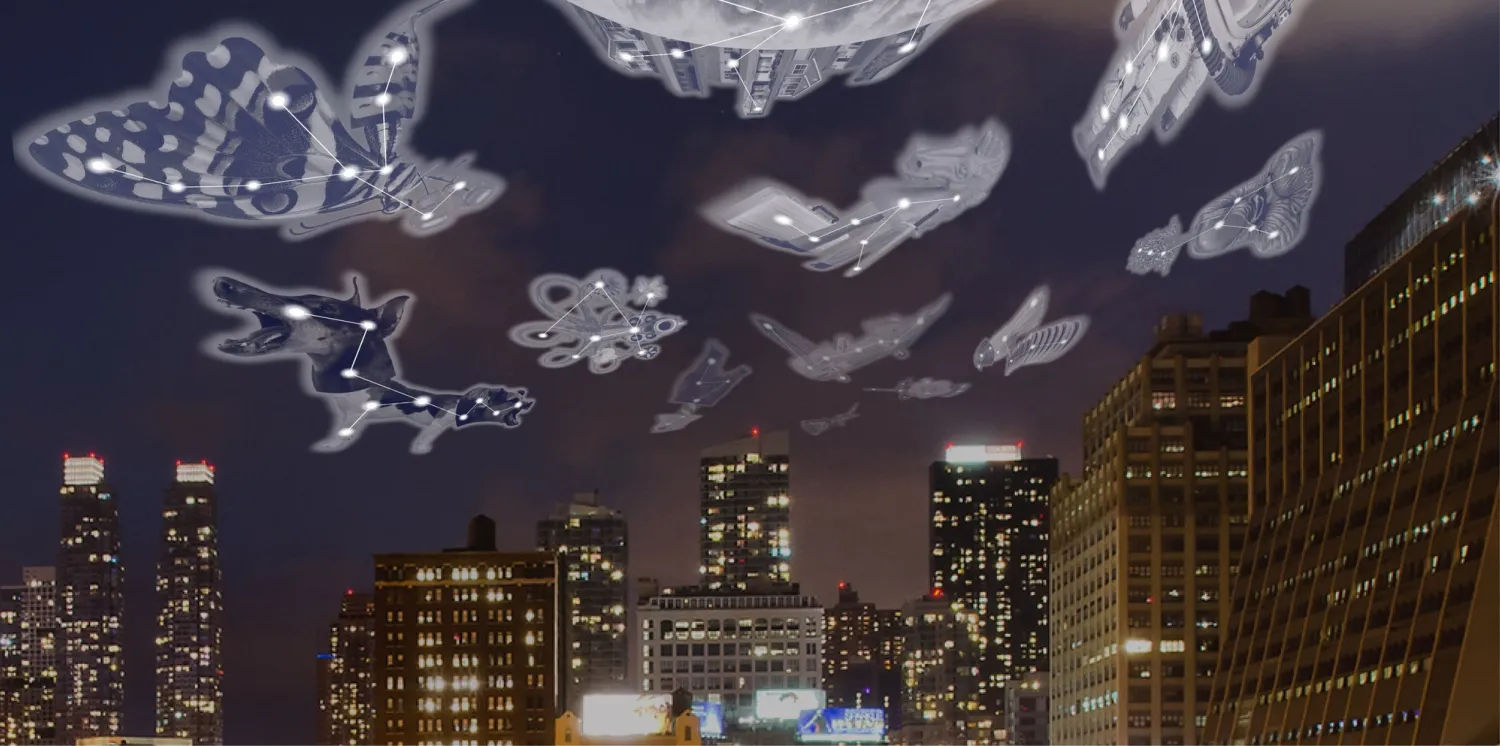
Richard Humann’s “Ascension” consists of 12 imaginary constellations suspended in the sky and is viewed through an iPad using the augmented reality platform Aery.Credit...Richard Humann
TT

A Walk on the Frontier of Art, Where the Sky Is the Limit

Richard Humann’s “Ascension” consists of 12 imaginary constellations suspended in the sky and is viewed through an iPad using the augmented reality platform Aery.Credit...Richard Humann

Augmented reality and virtual reality are opening doors to new experiences for artists and the public.

When walking on the High Line, it’s tough to look more lost than some of the tourists, but I did a pretty good job of it last month when I tripped on a curb while looking at art. (I caught myself before falling, but still.)

I was taking in an exhibition from Aery, a new augmented reality platform tailored to digital art exhibitions. Looking up to the heavens through an iPad, and not at my feet, I was using a loaner tablet to get an artwork by Richard Humann to magically appear.

But it worked: On the iPad, a constellation of a rose appeared, at an angle in the sky and topped by a crown, as Mr. Humann intended. A couple of out-of-towners who were watching me seemed mightily impressed when they looked over my shoulder at the screen.

The technologies known as augmented reality and virtual reality (AR and VR, for short) may seem futuristic, but they are being employed by artists more often.

For me — someone who looks at art for a living, but also avoids downloading new apps — experiencing three exhibitions of augmented reality art over a couple of weeks was a crossing of a threshold, one that more and more people will experience in the years ahead.

“It’s going to have a huge impact on the art world,” said Jay Van Buren, who, as chief executive and co-founder of the tech company Membit, helped create Aery, a joint venture between Membit and the real estate firm Related Companies. “Artists can do anything with it,” Mr. Van Buren said.

Membit’s technology is based on what it calls a Human Positioning System, its version of GPS. Essentially, the user adjusts the placement of the device based on a set of instructions. Aery is currently in beta mode, but is coming to Apple’s App Store soon for iPad and iPhone, and eventually will have an Android version.

As part of Aery’s inaugural exhibition, the artist Shuli Sade created a piece called “Wild, Heterotopias,” based on her photographs of the landscaping along the High Line. I viewed it in the High Line Nine Galleries: What appeared before me on the iPad, in an otherwise empty white gallery, were globes of spinning, floating greenery and flowers.

Ms. Sade, who is based in New York, has worked with augmented reality a few times during the past five years, building on her background in photography.

She likened the technology to a kiln or a paint brush: In the big picture, it is simply another way for an artist to create. “It’s a fabrication tool,” Ms. Sade said. “It’s a medium.”

“Whether it will develop further, I’m not sure,” she said. “But it’s a fun ride.”

In the same way that most sculptors do not cast a piece in bronze themselves — that work is done by experts at a foundry, to the artist’s specifications — Ms. Sade sent her photographs to Mr. Van Buren to be turned into augmented reality.

That is how it worked for [AR]T Walk, a joint venture from Apple and the New Museum in New York City. The experience is free in six cities — San Francisco, New York, London, Paris, Hong Kong and Tokyo — and is slightly customized in each. Seven artists contributed, including the poet-artist John Giorno, who died last month, and the Chicago-based Nick Cave.

Massimiliano Gioni, the New Museum’s artistic director who helped curate the artist contributions, said that when Apple approached the museum about collaborating on the project, the curators saw the same potential the company did.

“The benchmarks were previously more from the world of entertainment and gaming,” Mr. Gioni said of augmented reality and virtual reality. “And they wanted to go well beyond that.” (Mr. Van Buren said that whenever he was called upon to explain augmented reality, he mentioned Pokémon GO, the interactive game craze.)

I did [AR]T Walk on a glorious fall day in Central Park, starting at the Apple store on 59th Street and Fifth Avenue. I used one of its iPhones (you do not use your own) to experience the artworks, and to get each piece to appear, I pointed the phone at an object, usually a sign, part of process that the company calls “anchoring.”

The art is calibrated based on the position of you and the anchor, and when you have lined up the phone and the sign correctly you feel a slight vibration in the phone that the company calls “haptic feedback.”

Mr. Cave’s contribution, “Accumul-Istic Quest,” had his usual ebullience: At the beginning I was asked to pick one of several personality types, and on the screen I was suddenly being shadowed by a very bouncy, multicolored fright wig. He calls the different characters “istics.” (Mr. Cave also created an in-store augmented reality piece called “Amass,” which can be experienced in any Apple outlet around the world on your own iPhone.)

Normally the walk is a group affair of about 10 people, and every participant gets an istic. About five minutes into the walk, a large, friendly monster of sorts appears above the tree line — it has a head like a gramophone horn, a version of Mr. Cave’s “Soundsuits” characters, which he has been working with for years — and consumes everyone’s istics.

Though done with humor, Mr. Cave told me there was a larger theme at work.

“I wanted it to absorb and swallow everybody, becoming multicultural in the process,” he said.

The process of making the work involved many phone calls, with Mr. Cave sketching his ideas and making multiple trips to Apple headquarters in Silicon Valley. “We were practically in a relationship,” Mr. Cave joked.

For now, augmented reality seems to be getting more play among fine artists than virtual reality. As Mr. Van Buren put it, “AR loops you in more firmly to the place where you are, rather than taking you away into another world.”

But that could change. Bjarne Melgaard’s “My Trip” (2019) is a virtual reality work that can be experienced through Dec. 15 in Berlin at the Julia Stoschek Collection. It is a production of Acute Art, a virtual reality studio that collaborates with international artists.

Daniel Birnbaum, Acute Art’s director, said “My Trip” was a “trippy fantasy about darkness” that worked as an autobiography of the Norwegian artist.

To create the characters in the piece, Acute’s team scanned sculptures by Mr. Melgaard, and for some of the environments that people can experience in the piece, the artist provided developers with photographs of paintings.

“AR is easier, but it has limitations,” Mr. Birnbaum said. “You only see things on the phone. It can be a little gimmicky.”

But augmented reality’s ability to show two realities at once can be a powerful storytelling approach, as demonstrated by the New York-based artist Alan Michelson’s show “Wolf Nation,” at the Whitney Museum of American Art through Jan. 12.

Two of the four works in the show are made with augmented reality, and Mr. Michelson — a Mohawk member of Six Nations of the Grand River — collaborated on both with Steven Fragale, a painter who has become an augmented reality specialist, creating his own apps for his work.

One of the pieces, “Town Destroyer,” looks like a two-dimensional wall work depicting George Washington’s home at Mount Vernon. But when activated by the show’s augmented reality app on an iPhone, the bust of Washington in the center goes through a rapid transformation, overlaid with a series of colors, patterns and texts. “Town Destroyer” was the name given to Washington by the people of the Iroquois Confederacy, whose villages were burned and pillaged during the Revolutionary War.

To present an indigenous perspective on a familiar icon, “AR provided a solution — more than a solution, actually, a tool with all sorts of metaphorical aspects,” Mr. Michelson said.

Mr. Michelson said that the idea of multiple people holding up their phones to see his works at the same time also made him think of the technology’s “social possibilities.”

Although augmented reality and virtual reality explicitly take us out of the real world — our noses in another screen or two, and possibly tripping along the way — they also can be an invitation to interact with others about what they are seeing.

Mr. Gioni of the New Museum agreed. “The effects are in some ways just a pretext to come together,” he said. “This gets real only when you share it.”

The New York Times


UK's Prince William and Son George Volunteer at Homelessness Charity

FILE PHOTO: Britain's Prince William, Prince of Wales and Prince George join Second World War veterans at a tea party in Buckingham Palace, central London, following the military procession to mark the 80th anniversary of VE Day, May 5, 2025. Jordan Pettitt/Pool via REUTERS/File Photo
TT

UK's Prince William and Son George Volunteer at Homelessness Charity

FILE PHOTO: Britain's Prince William, Prince of Wales and Prince George join Second World War veterans at a tea party in Buckingham Palace, central London, following the military procession to mark the 80th anniversary of VE Day, May 5, 2025. Jordan Pettitt/Pool via REUTERS/File Photo

Britain's Prince William took his oldest son, Prince George, to a homelessness charity in London where the pair helped make Christmas lunch for people in need, Kensington Palace said on Saturday.

The visit was particularly poignant for William, heir to the throne, because his late mother Princess Diana had taken him to the same charity when he was 11 years old, an experience which inspired him to set up a ⁠program aimed at ending homelessness.

During the trip to the charity's center, named The Passage, George signed the visitor's book on the same page previously signed by Diana, who was killed in a car crash in Paris in 1997 when William ⁠was 15 years old, Reuters reported.

Wearing aprons, George, 12, and his father worked in the kitchen, placing food in baking trays, while they talked and laughed with the center’s catering staff, before heading out to lay long tables with napkins and Christmas crackers.

"It was important to The Prince of Wales to share with Prince George the work of The Passage and to spend ⁠time volunteering alongside the team," a spokesperson for Kensington Palace said.

"They both greatly enjoyed meeting staff, volunteers and service users as well as learning more about the charity’s work."

As well as working to try to stop people becoming homeless, William also champions environmental causes and campaigns for more openness about mental health issues.

William, his wife Kate and their three children are expected to spend Christmas at King Charles' Sandringham estate in eastern England.


Paraplegic Engineer Becomes the First Wheelchair User to Blast Off for Space

This image provided by Blue Origin, Michaela Benthaus poses after the Blue Origin's capsule landed on Saturday, Dec. 20, 2025 in West Texas. (Blue Origin via AP)
TT

Paraplegic Engineer Becomes the First Wheelchair User to Blast Off for Space

This image provided by Blue Origin, Michaela Benthaus poses after the Blue Origin's capsule landed on Saturday, Dec. 20, 2025 in West Texas. (Blue Origin via AP)

A paraplegic engineer from Germany blasted off on a dream-come-true rocket ride with five other passengers Saturday, leaving her wheelchair behind to float in space while beholding Earth from on high.

Severely injured in a mountain bike accident seven years ago, Michaela Benthaus became the first wheelchair user to launch to space, soaring from West Texas with Jeff Bezos’ company Blue Origin. She was accompanied by a retired SpaceX executive also born in Germany, Hans Koenigsmann, who helped organize and, along with Blue Origin, sponsored her trip. Their ticket prices were not divulged, The AP news reported.

The 10-minute space-skimming flight required only minor adjustments to accommodate Benthaus, according to the company. That’s because the autonomous New Shepard capsule was designed with accessibility in mind, “making it more accessible to a wider range of people than traditional spaceflight,” said Blue Origin’s Jake Mills, an engineer who trained the crew and assisted them on launch day.

Among Blue Origin’s previous space tourists: those with limited mobility and impaired sight or hearing, and a pair of 90-year-olds.

For Benthaus, Blue Origin added a patient transfer board so she could scoot between the capsule’s hatch and her seat. The recovery team also had a carpet to lay on the desert floor following touchdown, providing immediate access to her wheelchair, which she left behind at liftoff. She practiced in advance, with Koenigsmann taking part with the design and testing. An elevator was already in place at the launch pad to ascend the seven stories to the capsule perched atop the rocket.

Benthaus, 33, part of the European Space Agency’s graduate trainee program in the Netherlands, experienced snippets of weightlessness during a parabolic airplane flight out of Houston in 2022. Less than two years later, she took part in a two-week simulated space mission in Poland.

“I never really thought that going on a spaceflight would be a real option for me because even as like a super healthy person, it’s like so competitive, right?” she told The AP ahead of the flight.

Her accident dashed whatever hope she had. “There is like no history of people with disabilities flying to space," she said.

When Koenigsmann approached her last year about the possibility of flying on Blue Origin and experiencing more than three minutes of weightlessness on a space hop, Benthaus thought there might be a misunderstanding. But there wasn't, and she immediately signed on.

It’s a private mission for Benthaus with no involvement by ESA, which this year cleared reserve astronaut John McFall, an amputee, for a future flight to the International Space Station. The former British Paralympian lost his right leg in a motorcycle accident when he was a teenager.

An injured spinal cord means Benthaus can’t walk at all, unlike McFall who uses a prosthetic leg and could evacuate a space capsule in an emergency at touchdown by himself. Koenigsmann was designated before flight as her emergency helper; he also was tapped to help her out of the capsule and down the short flight of steps at flight’s end.

Benthaus was adamant about doing as much as she could by herself. Her goal is to make not only space accessible to the disabled, but to improve accessibility on Earth too.

While getting lots of positive feedback within “my space bubble,” she said outsiders aren't always as inclusive.

“I really hope it’s opening up for people like me, like I hope I’m only the start," she said.

Besides Koenigsmann, Benthaus shared the ride with business executives and investors, and a computer scientist. They raised Blue Origin’s list of space travelers to 86.

Bezos, the billionaire founder of Amazon, created Blue Origin in 2000 and launched on its first passenger spaceflight in 2021. The company has since delivered spacecraft to orbit from Cape Canaveral, Florida, using the bigger and more powerful New Glenn rocket, and is working to send landers to the moon.


Everything about Christmas, and How it Has Evolved into a Global Holiday

 People browse products at a Christmas market stall in downtown Madrid, Spain, 18 December 2025 (issued 20 December 2025). People continue to do last-minute shopping ahead of Christmas. EPA/SERGIO PEREZ
People browse products at a Christmas market stall in downtown Madrid, Spain, 18 December 2025 (issued 20 December 2025). People continue to do last-minute shopping ahead of Christmas. EPA/SERGIO PEREZ
TT

Everything about Christmas, and How it Has Evolved into a Global Holiday

 People browse products at a Christmas market stall in downtown Madrid, Spain, 18 December 2025 (issued 20 December 2025). People continue to do last-minute shopping ahead of Christmas. EPA/SERGIO PEREZ
People browse products at a Christmas market stall in downtown Madrid, Spain, 18 December 2025 (issued 20 December 2025). People continue to do last-minute shopping ahead of Christmas. EPA/SERGIO PEREZ

Christmas is a Christian holiday that observes the birth of Jesus. But did you know that the earliest followers of Jesus did not annually commemorate his birth? Or that Santa Claus is inspired by the acts of kindness of a fourth-century Christian saint? And have you heard about the modern-day Japanese tradition of eating Kentucky Fried Chicken on Christmas?

Since the early 20th century, Christmas has evolved from a religious holiday to a hugely popular cultural holiday observed by Christian and secular people across the globe who gather with families, exchange gifts and cards and decorate Christmas trees.

Here’s a look at the history, beliefs and the evolution of Christmas according to the AP news:

Origins and early history of Christmas Early followers of Jesus did not annually commemorate his birth but instead focused on commemorating their belief in his resurrection at Easter.

The story of the birth of Jesus appears only in two of the four Gospels of the New Testament: Matthew and Luke. They provide different details, though both say Jesus was born in Bethlehem.

The exact day, month and even year of Jesus’s birth are unknown, said Christine Shepardson, a professor at the University of Tennessee who studies early Christianity.

The tradition of celebrating Jesus’ birth on Dec. 25, she said, only emerged in the fourth century.

“It’s hard to overemphasize how important the fourth century is for constructing Christianity as we experience it in our world today,” Shepardson said. It was then, under Emperor Constantine, that Christians began the practice of gathering at churches instead of meeting at homes.

Some theories say the date coincides with existing pagan winter solstice festivals, including the Roman celebration of Sol Invictus, or the “Unconquered Sun,” on Dec 25.

While most Christians celebrate Christmas on Dec. 25, some Eastern Orthodox traditions celebrate the holy day on Jan. 7. That’s because they follow the ancient Julian calendar, which runs 13 days behind the Gregorian calendar, used by Catholic and Protestant churches as well as by much of the secular world.
For centuries, especially during the Middle Ages, Christmas was associated with rowdy street celebrations of feasting and drinking, and for many Christians, it “was not in good standing as a holiday,” said Thomas Ruys Smith, a professor of American literature and culture at the University of East Anglia in England.

“Puritans,” he said, “were not fond of Christmas.”

But in the 19th century, he said, Christmas became “respectable” with “the domestic celebration that we understand today — one centered around the home, the family, children, gift-giving.”

The roots of modern-day Christmas can be traced back to Germany. In the late 19th century, there are accounts of Christmas trees and gift-giving that, according to Smith, later spread to Britain and America, helping to revitalize Christmas on both sides of the Atlantic.

Christmas became further popularized with the publication of “A Christmas Carol” by Charles Dickens in 1843, and the writings of Washington Irving, who was a fan of St. Nicholas and helped popularize the celebration of Christmas in America.

The first Rockefeller Center Christmas tree was put up by workers in 1931 to raise spirits during the Great Depression. The tradition stuck as the first tree-lighting ceremony was held in 1933 and remains one of New York City’s most popular holiday attractions.

America’s secular Santa is inspired by a Christian saint St. Nicholas was a fourth-century Christian bishop from the Mediterranean port city of Myra (in modern-day Türkiye). His acts of generosity inspired the secular Santa Claus legend.

The legends surrounding jolly old St. Nicholas — celebrated annually on Dec. 6 — go way beyond delivering candy and toys to children. He is believed to have interceded on behalf of wrongly condemned prisoners and miraculously saved sailors from storms.

Devotion to St. Nicholas spread during the Middle Ages across Europe and he became a favorite subject for medieval artists and liturgical plays. He is the patron saint of sailors and children, as well as of Greece, Russia and New York.

Devotion to St. Nicholas seems to have faded after the 16th century Protestant Reformation, except in the Netherlands, where his legend remained as Sinterklaas. In the 17th century, Dutch Protestants who settled in New York brought the Sinterklaas tradition with them.

Eventually, St. Nicholas morphed into the secular Santa Claus.

It’s not just Santa who delivers the gifts In the UK, it’s Father Christmas; in Greece and Cyprus, St. Basil (who arrives on New Year’s Eve). In some parts of Italy, it’s St. Lucy (earlier in December) and in other Italian regions, Befana, a witch-like figure, who brings presents on the Epiphany on Jan. 6.

Instead of a friendly Santa Claus, children in Iceland enjoy favors from 13 mischievous troll brothers, called the Yule Lads. They come down from their mountain cave 13 days before Christmas, according to folklore.

One of the oldest traditions around Christmas is bringing greenery — holly, ivy or evergreen trees — into homes. But determining whether it’s a Christian tradition is harder. “For many people, the evergreen can symbolize Christ’s promise of eternal life and his return from death,” Smith said. “So, you can interpret that evergreen tradition within the Christian concept.”

The decorating of evergreen trees is a German custom that began in the 16th century, said Maria Kennedy, a professor at Rutgers University—New Brunswick’s  Department of American Studies. It was later popularized in England and America.

“Mistletoe, an evergreen shrub, was used in celebrations dating back to the ancient Druids — Celtic religious leaders — some 2,000 years ago,” Kennedy writes in The Surprising History of Christmas Traditions.

“Mistletoe represented immortality because it continued to grow in the darkest time of the year and bore white berries when everything else had died.”

Other traditions include Christmas services and Nativity scenes at homes and churches. More recently, Nativity scenes — when erected on public property in the US — have triggered legal battles over the question of the separation of church and state.

Christmas caroling, Kennedy writes, can also be traced back to European traditions, where people would go from home to home during the darkest time of the year to renew relationships within their communities and give wishes for good luck, health and wealth for the forthcoming year.

“They would recite poetry, sing and sometimes perform a skit. The idea was that these acts would bring about good fortune to influence a future harvest,” Kennedy writes.

Kentucky Fried Chicken for Christmas in Japan Among the many Christmas traditions that have been adopted and localized globally, there’s one that involves KFC.

In 1974, KFC launched a Christmas campaign where they began to sell fried chicken with a bottle of wine so it could be used for a Christmas party.

KFC says the idea for the campaign came from an employee who overheard a foreign customer at one of its Tokyo restaurants saying that since he couldn’t get turkey in Japan, he’d have to celebrate Christmas with Kentucky Fried Chicken.

“That really stuck,” Smith said. “And still today, you have to order your KFC months in advance to make sure that you’re going to get it at Christmas Day.”