

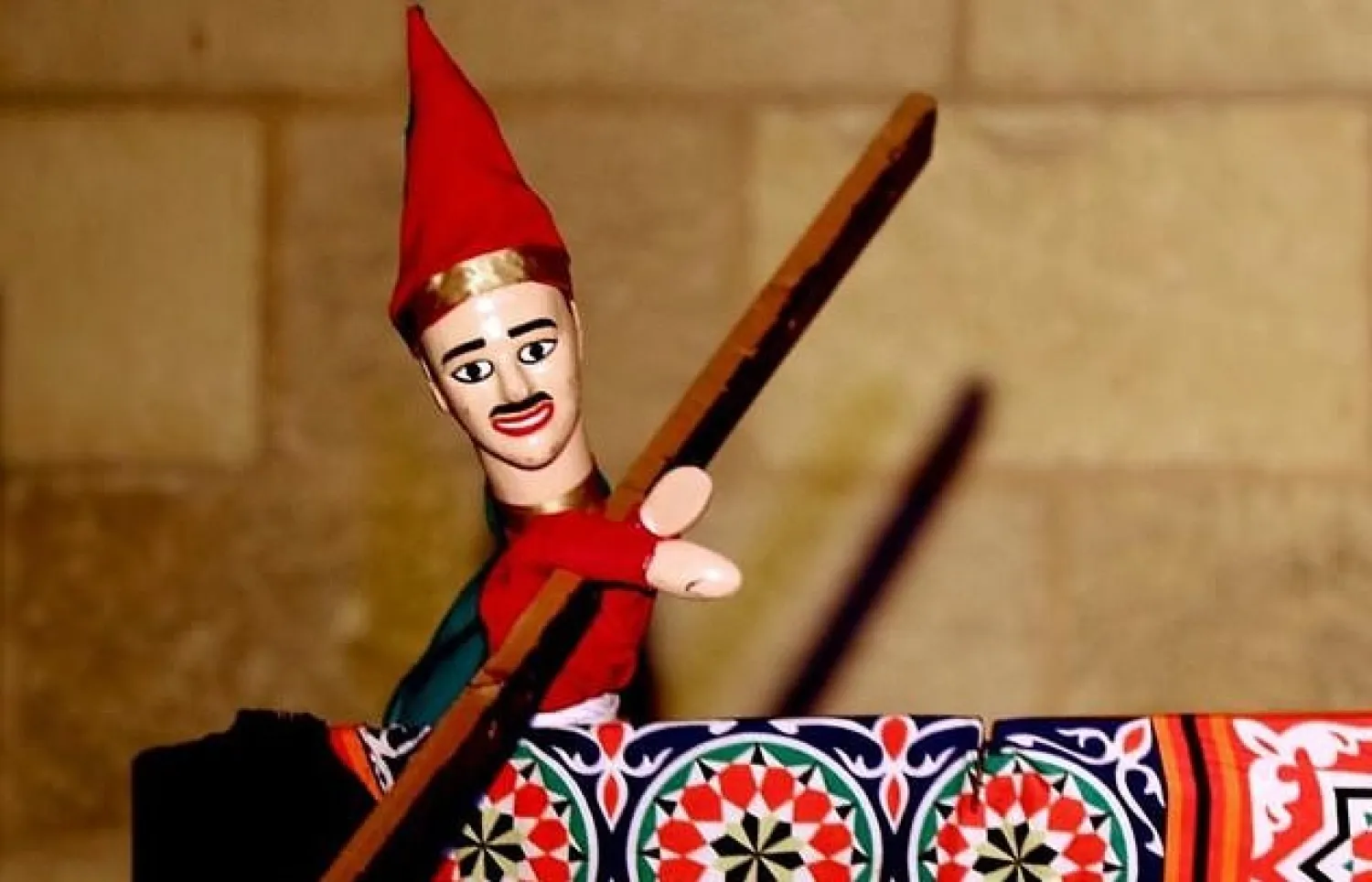

Folk Puppets Keeping Heritage of Egyptian Satire Alive

A glove puppet named Aragoz remains popular in Egypt with comic sketches recounting moral tales, some of which date back centuries
TT

Folk Puppets Keeping Heritage of Egyptian Satire Alive

A glove puppet named Aragoz remains popular in Egypt with comic sketches recounting moral tales, some of which date back centuries

In an era of on-screen entertainment,a simple glove puppet named Aragoz still lures Egyptian audiences with comic sketches showing how wits and skill can defeat the thuggish and corrupt.

Recounting stories with a thought-provoking moral in their tale, puppeteers evoke peels of laughter from spectators, mainly children, as they enact Aragoz's exploits, some of which date back centuries to Ottoman times.

"I fell in love with Aragoz as I grew up. Everyone loves it actually," said Sabry Metawly, one of a diminishing band of veteran puppeteers still putting on performances of Egypt's most adored folk figure, AFP reported.

"It has clicked with the people because it represents them. It succeeds where they cannot by challenging and winning against rivals."

The squeaky-voiced puppet, with a wooden head, red conical hat, thin painted moustache and a bright red cloth cloak, was recognised by UNESCO in 2018 as part of the planet's intangible cultural heritage.

"Aragoz humorously criticises the actions of the powerful and resists the corrupt during the plays," said Nabil Bahgat, founder of the Wamda troupe, of which Metawly is also a member.

"But it does not target specific figures of current politics or leaders."

Outspoken, mocking, stubborn and often vulgar, the Aragoz character has long been viewed as a reflection of popular Egyptian society.

The troupe -- which comprises only six members -- has been drawing weekly audiences for more than a decade at the Ottoman-era Beit al-Sehimi building in Cairo.

- Tales as old as time -

Like his father before him, Metawly performs from behind a portable box-like booth moving two puppets, one on each hand.

He has been working as a puppeteer for more than 50 years, following in his father's footsteps.

He learned the stories -- which are passed down orally -- by watching his father perform in the streets and at rural festivals and Muslim celebrations.

By 2003 when Bahgat formed Wamda he had managed to collect 19 plays orally and commit them to paper.

All the Aragoz sketches, still performed today, are part of the country's cultural heritage, passed down from one generation of performers to the next, without being properly documented, he said.

"All plays are authorless," Bahgat added.

"Practitioners were in the habit of learning them by heart from their predecessors and passing them on to the new generations," he said.

- Verbal sparring -

None of the plays can be traced to a certain time or specific person, said troupe member Mahmoud Sayed.

In them, Aragoz is often pitted against other puppets resembling an Ottoman-era policeman, a sheikh or a bully, and gets into comical verbal sparring matches sprinkled with clever puns.

In one sketch, Aragoz argues with a bully dubbed the fetewa, a term used to describe powerful men who ran local neighbourhoods outside the law.

"What do you want?" Aragoz asks after a long banter, with the bully immediately replying he wants a fight to see who is the most powerful.

"Whoever wins gets the support of this audience," says the fetewa.

Aragoz immediately pounces on the bully dealing him a flurry of blows. He wins the scuffle after three rounds, and kicks his opponent off the box.

"Get out!" shouts Aragoz, to huge cheers and applause.

- Disappearing act -

Metawly always feared the art form would disappear, as veteran puppeteers dwindled in numbers and digital advancement took over entertainment.

Some trace it back to the Fatimid dynasty from the 10th to 12th centuries, and others say it particularly flourished when the Ottomans took over Egypt from the 16th century.

The origins of the name Aragoz is also a subject of debate.

Some argue that it was inspired by the Ottoman-era shadow theatre form known as Karagoz. Others say it dates back to the Pharaohs, said Sayed.

But practitioners have preserved its intrinsic features, including the puppet's unique squeaky high-pitched voice created by a swazzle the puppeteers hold in their mouths.

According to AFP, over the decades, Aragoz has also become a more general insult for a clown.

In October, Egypt's most famous veteran puppeteer Mostafa Othman died at the age of 80.

"We have pushed for a long time to preserve this heritage," said Bahgat.

"We have done our part. It is now time for people to step up and preserve their culture."



Caffeinated Beverages May Help Protect the Brain, Study Says

A cup of coffee and a cappuccino are seen at a Juan Valdez store in Bogota, Colombia June 5, 2019. (Reuters)
TT

Caffeinated Beverages May Help Protect the Brain, Study Says

A cup of coffee and a cappuccino are seen at a Juan Valdez store in Bogota, Colombia June 5, 2019. (Reuters)

Drinking a few cups of caffeinated coffee or tea every day may help in a small way to preserve brain power and prevent dementia, researchers reported on Monday.

People with the highest daily intake of caffeinated coffee had an 18% lower risk of developing dementia compared to those with the lowest such intake, according to a study based on responses to questionnaires by 132,000 U.S. adults spanning four decades.

The study, published in JAMA, also found that the people with the highest intake had a lower rate - by nearly 2 percentage points - of ‌self-perceived memory ‌or thinking problems compared to those with ‌the ⁠lowest intake.

Results were ‌similar with caffeinated tea, but not with decaffeinated beverages, the researchers said.

While the findings are encouraging, the study does not prove caffeine helps protect the brain, they said.

The magnitude of caffeine's effect, if any, was small, and there are other better-documented ways to protect cognitive function as people age, study leader Dr. Daniel Wang ⁠of Harvard Medical School said in a statement.

Lifestyle factors linked with lower risks of ‌dementia include physical exercise, a healthy diet ‍and adequate sleep, according to previous ‍research.

"Our study suggests that caffeinated coffee or tea consumption can ‍be one piece of that puzzle," Wang said.

The findings were most pronounced in participants who consumed two to three cups of caffeinated coffee or one to two cups of caffeinated tea daily, the researchers reported.

Those who drank caffeinated coffee also showed better performance on some objective tests of cognitive function, according to the ⁠study funded by the National Institutes of Health.

Further research is needed to validate the factors and mechanisms responsible for the findings, the researchers said.

They noted that bioactive ingredients in coffee and tea such as caffeine and polyphenols have emerged as possible factors that reduce nerve cell inflammation and damage while protecting against cognitive decline.

"We also compared people with different genetic predispositions to developing dementia and saw the same results - meaning coffee or caffeine is likely equally beneficial for people with high and low genetic risk of developing ‌dementia," study coauthor Dr. Yu Zhang of the Harvard T.H. Chan School of Public Health said in a statement.


AlUla Announces Exceptional Ramadan Experiences

These programs come as part of efforts to enhance AlUla’s tourism experience - SPA
TT

AlUla Announces Exceptional Ramadan Experiences

These programs come as part of efforts to enhance AlUla’s tourism experience - SPA

AlUla Governorate is welcoming the holy month of Ramadan this year with a wide range of diverse tourism experiences that reflect the area’s distinctive character and rich cultural heritage, reinforcing its position as one of the Kingdom’s most prominent destinations to visit during the holy month.

During Ramadan, AlUla offers an integrated experience catering to different visitor preferences, including guided stargazing experiences, cultural events, and night markets, in addition to traditional dining experiences for Iftar and Suhoor, embodying the depth of AlUla’s cultural heritage and local identity.

The Ramadan programs in AlUla include a variety of standout events, such as Ramadan experiences at Maraya Hall, a cultural market, and live performances in the atmosphere of Ashar Valley, alongside heritage tours in AlUla Old Town that narrate stories of AlUla and its Ramadan customs, including the award-winning Incense Road Experience, SPA reported.

The programs also feature seasonal art exhibitions hosted across multiple cultural venues, including Design Space AlUla, the fourth edition of Desert X AlUla, and the Arduna exhibition at AlUla Oasis, in addition to experiences combining art, nature, and stargazing at Daimumah Oasis in collaboration with AlUla Manara.

Visitors are also offered tours to prominent archaeological sites, including Hegra, Dadan, and Jabal Ikmah, to explore ancient sites dating back centuries BCE and view unique rock inscriptions, as well as adventure experiences ranging from dinner and stargazing in Sharaan, hot-air balloon rides, mountain hiking trails, and safari tours.

These programs come as part of efforts to enhance AlUla’s tourism experience during the holy month of Ramadan and provide diverse options that meet visitor expectations, contributing to the growth of tourism activity and showcasing the governorate’s natural and cultural assets.


NCW Releases over 10,000 Animals under Reintroduction Programs

The releases carried out by the center over the past years included more than 80 priority wildlife species - SPA
TT

NCW Releases over 10,000 Animals under Reintroduction Programs

The releases carried out by the center over the past years included more than 80 priority wildlife species - SPA

The National Center for Wildlife (NCW) announced that the total number of wildlife animals released under its breeding and reintroduction programs for locally threatened species has exceeded 10,000 animals, an achievement reflecting the scale of the center’s sustained efforts to develop wildlife, restore ecosystems, and enhance biodiversity across various regions of the Kingdom.

The releases carried out by the center over the past years included more than 80 priority wildlife species, including reem gazelles (sand gazelles), Arabian oryx, Idmi gazelles, mountain ibex, houbara bustards, ostriches, and sandgrouse, as part of efforts aimed at supporting the recovery of natural populations of these species and enhancing their sustainability within their environmental and historical ranges, SPA reported.

CEO of NCW Dr. Mohammad Qurban noted that release operations are among the key tools for restoring ecosystems and reducing ecological imbalance, as the return of wildlife to their natural habitats contributes to protecting biodiversity and improving environmental quality, which in turn supports habitat integrity, the continuity of plant and animal components, and the enhancement of ecosystem functions over the long term.

NCW continues to implement its strategic plans to develop wildlife, protect endangered species, and enhance the efficiency of natural habitat management through expanding breeding programs, enhancing applied scientific research, building national capacities, and applying the best international practices in biodiversity management, in addition to raising environmental awareness, engaging local communities, and supporting eco-tourism, thereby contributing to achieving the objectives of the Saudi Green Initiative and Saudi Vision 2030, and the National Environment Strategy, toward thriving and sustainable wildlife, biodiversity, and ecosystems.
