Iraqis Celebrate after Soleimani Death

AP file photo of Qassem Soleimani
TT

Iraqis Celebrate after Soleimani Death

AP file photo of Qassem Soleimani

Iraqis celebrated on Friday the killing of top Iranian commander Qasem Soleimani in a US airstrike in Baghdad. 
A video showed Iraqis dancing in the street. 

"Iraqis — Iraqis — dancing in the street for freedom; thankful that General Soleimani is no more," Pompeo wrote, alongside footage of scores of people running along a road and waving what appeared to be Iraqi flags and other banners.
 

President Donald Trump ordered the killing of the Iran Revolutionary Guards commander, who died Friday "in a decisive defensive action to protect US personnel abroad," the Pentagon said.


"General Soleimani was actively developing plans to attack American diplomats and service members in Iraq and throughout the region," the Department of Defense said in a statement.


"General Soleimani and his Quds Force were responsible for the deaths of hundreds of American and coalition service members and the wounding of thousands more." 


The strike at Baghdad's international airport also killed the deputy chief of Iraq's Popular Mobilization Forces (PMF).


A pro-Iran mob this week laid siege to the US embassy following deadly American air strikes on Kataib Hezbollah.


The US had called the strikes in response to a rocket attack days earlier that killed an American contractor working in Iraq.  
The Pentagon said Soleimani had orchestrated attacks on coalition bases in Iraq over the past months, including on December 27, the day the contractor was killed.


"General Soleimani also approved the attacks on the US Embassy in Baghdad that took place this week," it said.


Eisenkot Vows to Bring About New Israeli Government Swiftly

Gadi Eisenkot celebrates with his party members after a voting session for the new Knesset speaker at the Knesset, the Israeli parliament, in Jerusalem, Israel, 17 November 2026. (EPA)
TT

Eisenkot Vows to Bring About New Israeli Government Swiftly

Gadi Eisenkot celebrates with his party members after a voting session for the new Knesset speaker at the Knesset, the Israeli parliament, in Jerusalem, Israel, 17 November 2026. (EPA)

Gadi Eisenkot, who has been tasked with forming the next Israeli government, on Friday vowed not to let coalition-building talks drag on as his wide-ranging bloc faces divisions on the way forward.

The former military chief's remarks appear as a warning to his own camp, which is split over whether to forge alliances with the ultra-Orthodox parties, Arab-majority lists, or whether to form a national unity government with caretaker prime minister Benjamin Netanyahu.

"I have no intention of letting this drag on. When the time is right, I will bring a new government before the Knesset for its approval, a good government that I will lead," Eisenkot wrote on X in a message about ongoing negotiations.

Eisenkot has until next month to form a government to replace Netanyahu, after the October election failed to deliver a clear majority for either of them.

While denying any attempt to force through a coalition, Eisenkot stressed the need to act fast.

"We are in very dangerous territory. The outgoing prime minister is acting in ways we have never seen before," he said.

"Military priorities have become entangled with political interests, and the timetable for military operations with the political calendar," he added.

Members of Israel's opposition suspect Netanyahu could launch a new military operation against Iran in order to derail talks and remain in power.

Should efforts to create a broad-based government fail, Eisenkot said he would be prepared to put forward a minority national emergency government for a parliamentary vote.

"Every member of the Knesset will have to follow their conscience and decide whether to allow a new government to take office or whether they are prepared to drag Israel and its citizens into another election with Netanyahu still serving as caretaker prime minister," he said.

These remarks were the clearest sign yet of Eisenkot's growing impatience nearly two weeks after being tasked by President Isaac Herzog with forming a government.

Eisenkot's 48-seat bloc is well short of the 61 needed for a majority in parliament and its members are divided over how to proceed.

Eisenkot appears ready to form a minority government with external backing from the 19 lawmakers in the Arab-majority Raam and Joint List.

But nationalist Avigdor Liberman, who sits in Eisenkot's bloc, has repeatedly refused such an option and instead said he is open to working with the two ultra-Orthodox parties, Shas and United Torah Judaism (UTJ).

Complex negotiations have been underway since.

Netanyahu, meanwhile, is pushing hard for a national unity government, an option that also seems favored by Eisenkot's most important partner, former prime minister Naftali Bennett.


Bessent Says Still Living at US Military Base, Vows to Squeeze Iran

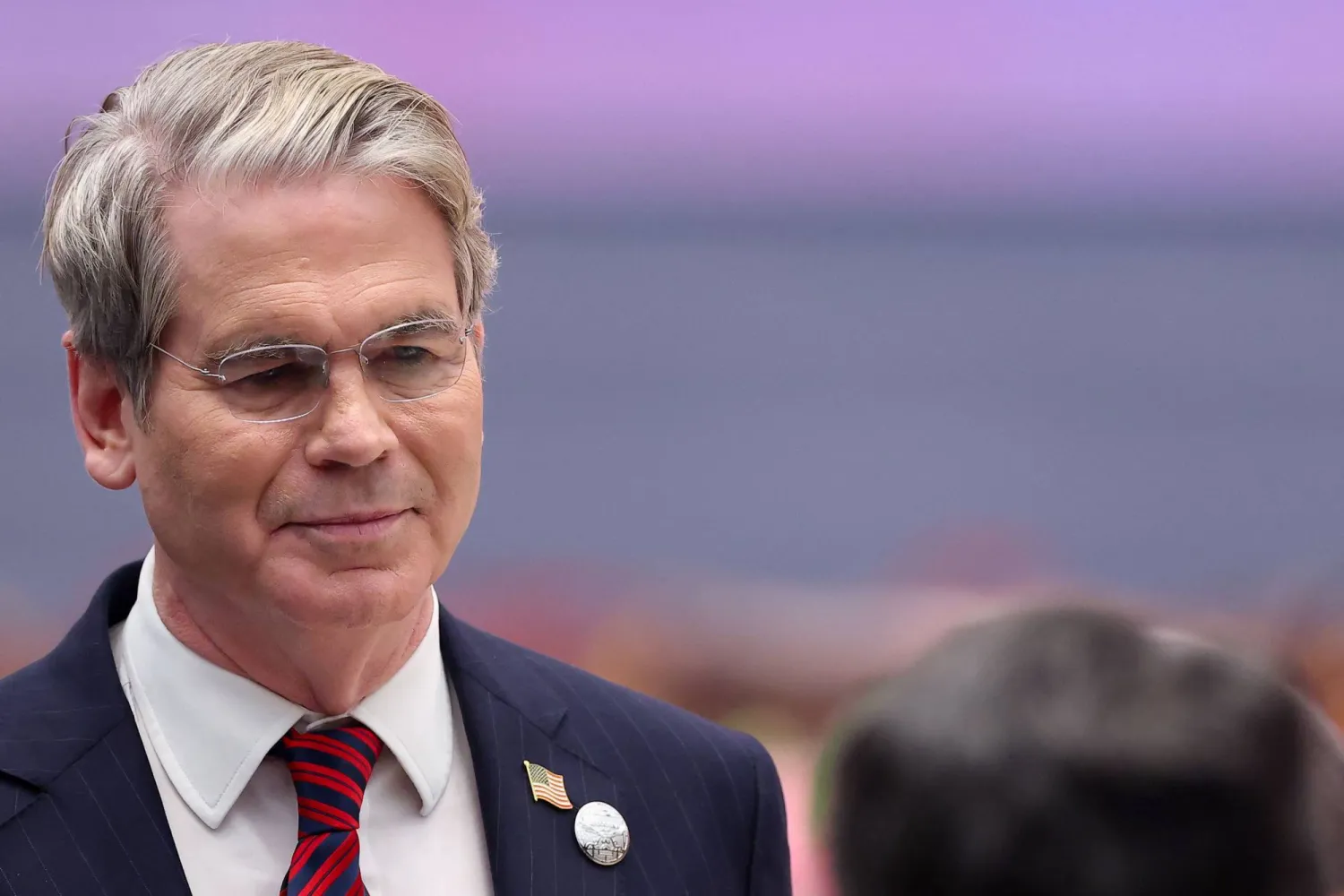
 US Treasury Secretary Scott Bessent attends a welcome banquet for the Asia-Pacific Economic Cooperation (APEC) Economic Leaders' Meeting at the Shenzhen International Communication Center in Shenzhen, Guangdong province on November 18, 2026. (AFP)
US Treasury Secretary Scott Bessent attends a welcome banquet for the Asia-Pacific Economic Cooperation (APEC) Economic Leaders' Meeting at the Shenzhen International Communication Center in Shenzhen, Guangdong province on November 18, 2026. (AFP)
TT

Bessent Says Still Living at US Military Base, Vows to Squeeze Iran

 US Treasury Secretary Scott Bessent attends a welcome banquet for the Asia-Pacific Economic Cooperation (APEC) Economic Leaders' Meeting at the Shenzhen International Communication Center in Shenzhen, Guangdong province on November 18, 2026. (AFP)
US Treasury Secretary Scott Bessent attends a welcome banquet for the Asia-Pacific Economic Cooperation (APEC) Economic Leaders' Meeting at the Shenzhen International Communication Center in Shenzhen, Guangdong province on November 18, 2026. (AFP)

Treasury Secretary Scott Bessent said on Friday he was still living at a US military base after receiving unspecified threats ‌from Iran, ‌but vowed ‌to continue ⁠squeezing the country ⁠economically.

"If the Iranians are after me, it means that they ⁠are being squeezed. We're ‌going ‌to continue squeezing ‌them," Bessent ‌said in an interview with CNBC.

The Treasury has been tightening sanctions ‌on Iran. The US and Israel launched ⁠strikes ⁠against Iran in February and the conflict is simmering in the region despite intermittent talks on a resolution.

SINGAPORE AND MALAYSIA

Separately, US Treasury Department officials met with government authorities in Singapore and Malaysia this week, including regulators and national security bodies, to warn of potential risks they could face if they do not comply with US sanctions on Iran. 

Washington is urging the countries, as well as law firms and banks operating there, to stay alert for Iranian front companies, as it steps up efforts to enforce sanctions in Asia and bring about a speedy end to the conflict in the Middle East. 

The US is urging additional scrutiny on "high-risk" sectors such as maritime transport, aviation services and procurement networks, "to make sure they're not fronting for Iran," said a Treasury Department official. 

"We want it to be understood too, that we're going to target these lifelines, and it's ‌not going to ‌be a negotiation when we find a lifeline that needs to be targeted," ‌the ⁠official said. 

Since the ⁠US and Israel commenced strikes on Iran in February, the US has intensified actions to throttle Tehran's business interests overseas. 

In August, President Donald Trump's administration launched Operation Economic Outcast, resulting in a barrage of sanctions against targets spanning Canadian digital currency platforms to a major Russian banking group. 

OIL ON WATER 

For years, tankers have regularly made stops in the waters around Malaysia, Singapore and Indonesia to make ship-to-ship transfers of Iranian oil that help obscure its origin. 

Last year, Malaysian authorities said they would more tightly enforce rules around these transfers and in February seized two tankers and their cargoes. 

Since ⁠April, the US Navy has imposed a blockade on shipping reaching Iran through ‌the Strait of Hormuz, and this month has cracked down on ‌movement over Iran's land borders and through the Caspian Sea. 

In July, the Treasury Department sanctioned dozens of individuals, vessels and companies ‌based in Singapore, Hong Kong, the UAE, the Marshall Islands and St Kitts and Nevis linked to Iranian ‌oil magnate Mohammad Hossein Shamkhani. 

These efforts were starting to disrupt Iran's source of revenue, the US official said, citing data showing that the country is currently undergoing the worst GDP contraction in four decades and the highest rate of inflation since World War II. 

IRANIAN AIRLINES 

However, the official said there was still work to be done. 

"There's an Iranian airline that flies ‌to Malaysia, or has, recently, so we raised this," the US official said, without naming the carrier. 

Using public flight records, Reuters identified a regularly scheduled flight between ⁠Tehran and Kuala Lumpur ⁠operated by Iran Airtour, which flew as recently as November 14. A scheduled flight on November 17 did not depart, the records also show. 

Iran Airtour did not respond to an emailed request for comment sent outside of business hours on Friday. 

Most Iranian airlines largely stopped flying to Malaysia in 2022 due to US sanctions on refueling Iranian planes. However, Iran Airtour, a privately owned airline, resumed flights to Malaysia in November 2025, according to Iranian media. 

On September 8, the US imposed sanctions on dozens of companies in the UAE, Britain, Malaysia, Türkiye and Kazakhstan it said were supporting Iran's aviation sector to move weapons, personnel and illicit cargo. 

The following day, Iran Air officials met with Malaysia's ambassador to Iran to discuss resuming direct flights between Iran and Kuala Lumpur. 

'DOING OUR PART' 

Both Malaysia and Singapore implement UN Security Council sanctions on Iran. 

Singapore's government said in a statement it "is firmly committed to doing our part" and "preventing bad actors from abusing our corporate vehicles," citing its efforts to strengthen vigilance in the maritime and financial industries this year. 

The Malaysian government did not respond to requests for comment. 


UN Cuts Food Aid Target Despite Looming Hunger Crisis

FILE- Rohingya Muslims, who crossed over from Myanmar into Bangladesh, stretch their arms out to collect food items distributed by aid agencies near Balukhali refugee camp, Bangladesh, Monday, Sept. 18, 2017. (AP Photo/Dar Yasin, File)
TT

UN Cuts Food Aid Target Despite Looming Hunger Crisis

FILE- Rohingya Muslims, who crossed over from Myanmar into Bangladesh, stretch their arms out to collect food items distributed by aid agencies near Balukhali refugee camp, Bangladesh, Monday, Sept. 18, 2017. (AP Photo/Dar Yasin, File)

The United Nations food agency said on Friday it plans to assist fewer people in the coming year due to funding constraints even as it warns of a possible global food crisis on the scale of the one that followed the war in Ukraine.

The World Food Programme - led by America's Luke Lindberg since last month - launched ⁠a 2027 appeal ⁠for $12 billion to help 91 million people around the world, fewer than the 110 million it aimed to help in 2026.

This represents just a third of the 266 million people facing ⁠acute and severe hunger as the Iran conflict drives up food and shipping costs and a powerful El Niño threatens agriculture, creating famine risks in places like war-torn Sudan.

"The shortfalls are forcing some hard choices," WFP director Laura Turner told a Geneva press briefing, adding that its 2026 appeal for $13 billion is ⁠only ⁠half funded. Another WFP official warned that another food crisis was likely in 2027 and that the agency would be constrained to focus on the most vulnerable.

"We could soon be facing a third global food crisis in six years," WFP's Matthew Hollingworth said, referring to price surges during the COVID pandemic and after Russia's invasion of Ukraine in 2022.