

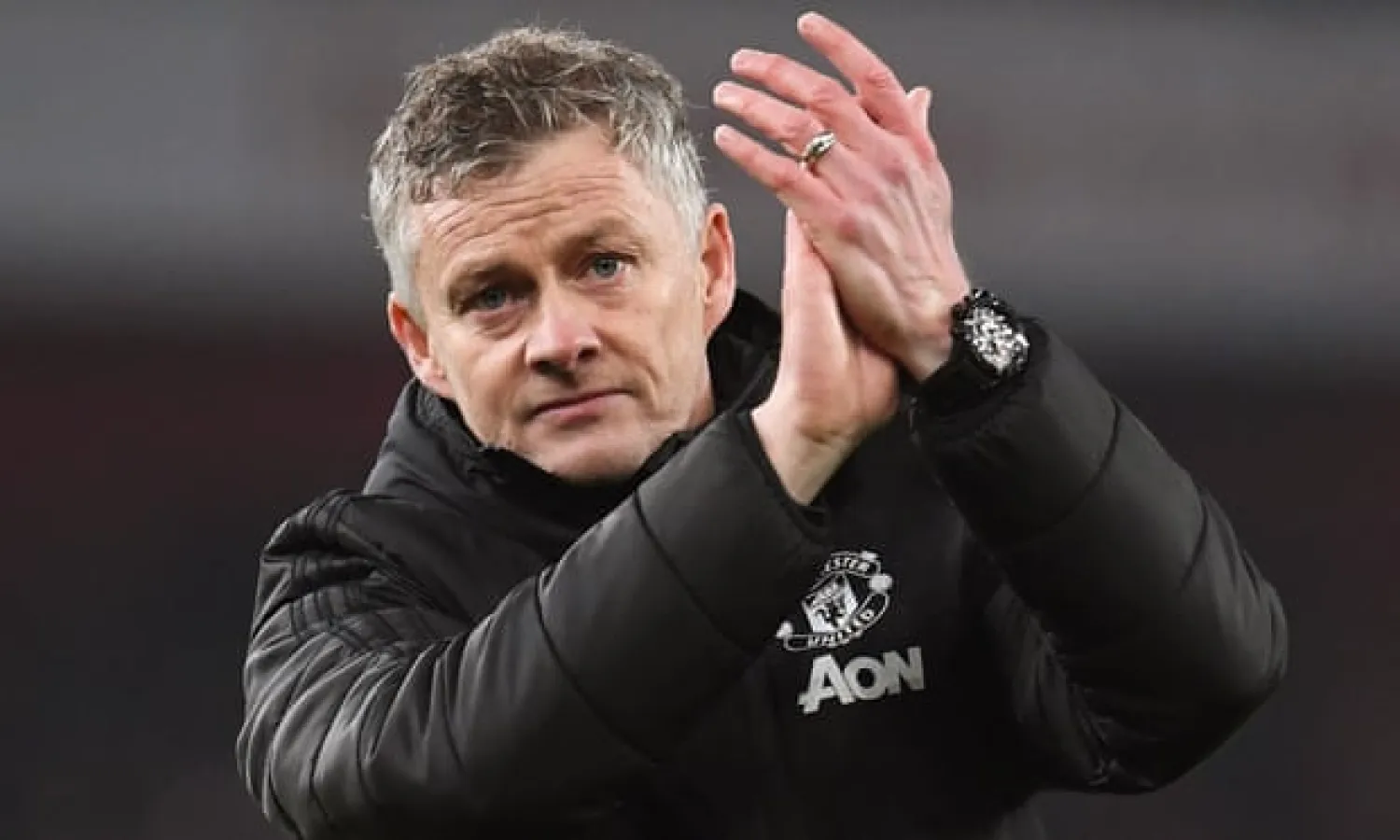

Solskjær’s Game of Patience at Manchester United Is Running Out of Time

 Manchester United have not won three games in a row for 50 weeks, when Ole Gunnar Solskjær had just taken over as manager. Photograph: Andy Rain/EPA
Manchester United have not won three games in a row for 50 weeks, when Ole Gunnar Solskjær had just taken over as manager. Photograph: Andy Rain/EPA
TT

Solskjær’s Game of Patience at Manchester United Is Running Out of Time

 Manchester United have not won three games in a row for 50 weeks, when Ole Gunnar Solskjær had just taken over as manager. Photograph: Andy Rain/EPA
Manchester United have not won three games in a row for 50 weeks, when Ole Gunnar Solskjær had just taken over as manager. Photograph: Andy Rain/EPA

For eight minutes at the Emirates Stadium on Wednesday, everything looked to be going well for Manchester United. And then suddenly it wasn’t. As it was in the game, so it has been for Ole Gunnar Solskjær’s career at Old Trafford. Have patience, the message comes again and again from the United board. Look at the youth in the squad. Wait for it to flower. But for how long, and at what cost?

Watching another insipid United away performance against a side below them in the table, Mauricio Pochettino’s aphorism about the cow came to mind. It can stand in the field every day and watch the train go by but it’s never going to be able to explain the timetable. Just being there, experiencing the same thing over and over doesn’t necessarily bring wisdom, understanding or development and there is little evidence United are developing: they haven’t won three games in a row for 50 weeks, when Solskjær had just taken over and everybody was still euphoric just because he wasn’t José Mourinho.

There is great promise and ability in Marcus Rashford, Mason Greenwood, Daniel James and Aaron Wan-Bissaka. But potential is nothing if it is not guided and supported and, for all the flickers against better sides, it’s becoming increasingly difficult to maintain the faith there is any greater plan.

United have been undermined by the injury to Scott McTominay and whatever is going on with Paul Pogba (perhaps his surgery is just unfortunate circumstance but the terms in which Solskjær discussed it on Wednesday made it seem as though something more complex may be going on that didn’t reflect well on the relationship between club and player), but still United have picked up only 39 points in their last 30 league games. They should be better than this.

In those opening eight minutes, Arsenal looked fragile, vulnerable to the counterattack – as you’d expect for a side who, for the first time, included all four of Pierre-Emerick Aubameyang, Alexandre Lacazette, Nicolas Pépé and Mesut Özil. And then, abruptly, everything became much more difficult.

Pépé scored and the game changed – something Solskjær acknowledged; judge him, he seemed to be saying, on the eight minutes of promise, not the 82 minutes of grim reality that followed. Pépé ripped past Luke Shaw again and again. Sead Kolasinac combined with Aubameyang on the left. Granit Xhaka and Lucas Torreira took control of the centre. The counterattacking opportunities dried up. Rashford and Anthony Martial made run after run, and the ball never arrived, which in part is testimony to the effectiveness of the Arsenal press, even as fatigue again sapped at them in the final stages, but also to a failure of United’s midfield, to the gameplan as a whole. Put under pressure United were unable to adapt and when United aren’t counterattacking they’re not offering a threat.

That’s why United’s record is so much better against teams above them in the table. Against opponents who play against them with caution, or who press effectively, they lack not only basic guile but also attacking cohesion. Much of modern football at the highest level is about the capacity of teams to create space for themselves, to set about through precise inter-movements to pull an opposing defence apart. There is no more evidence United can do that now than there was a year ago when Solskjær took over.

They didn’t do that under Mourinho but that, at least, was understood and accepted. Mourinho is of the opinion that the structured attacking gambits pioneered by Valeriy Lobanovskyi, and practised now by Jürgen Klopp and Pep Guardiola, are of limited value because football is too random for pre‑set moves always to be valuable.

What, he would ask, if the circumstances that allow one of the gambits to be set in motion doesn’t occur? What does a team do then? He pursues instead a process of “guided discovery”, instilling in his players the right mindset so they react to situations with the right decisions.

With Solskjær it’s not clear there is any thinking at all beyond trying to play in the quick lads up front as they run in behind. And if the opposition stops you doing that there’s nothing for it but to look sad and uncomfortable on the bench, a sickly angel in a padded club coat wondering what the Boss would do.

It’s one game and it’s probably unwise to read too much into it but the implication of Wednesday was that Mikel Arteta, stalking the touchline in his roll-neck and trainers, pointing and gesticulating in homage to his mentor, Guardiola, has instilled in Arsenal in three games a more coherent structure than Solskjær has in a year.

It’s all very well to respect the history of the club and seek to maintain its traditions. Planning for the future and investing in potential is broadly laudable but at some point there has to be some evidence of a plan being enacted in the here and now. At United it increasingly feels like jam tomorrow and jam yesterday – but never jam today.

The Guardian Sport


Australia Humiliated by Ecuador in Davis Cup Qualifier

Tennis - Davis Cup - Qualifiers  - Ecuador v Australia - Quito Tenis y Golf Club, Quito, Ecuador - February 8, 2026 Team Ecuador celebrate winning the doubles match between Ecuador's Gonzalo Escobar and Diego Hidalgo, and  Australia's Rinky Hijikata and Jordan Thompson REUTERS/Cristina Vega
Tennis - Davis Cup - Qualifiers - Ecuador v Australia - Quito Tenis y Golf Club, Quito, Ecuador - February 8, 2026 Team Ecuador celebrate winning the doubles match between Ecuador's Gonzalo Escobar and Diego Hidalgo, and Australia's Rinky Hijikata and Jordan Thompson REUTERS/Cristina Vega
TT

Australia Humiliated by Ecuador in Davis Cup Qualifier

Tennis - Davis Cup - Qualifiers  - Ecuador v Australia - Quito Tenis y Golf Club, Quito, Ecuador - February 8, 2026 Team Ecuador celebrate winning the doubles match between Ecuador's Gonzalo Escobar and Diego Hidalgo, and  Australia's Rinky Hijikata and Jordan Thompson REUTERS/Cristina Vega
Tennis - Davis Cup - Qualifiers - Ecuador v Australia - Quito Tenis y Golf Club, Quito, Ecuador - February 8, 2026 Team Ecuador celebrate winning the doubles match between Ecuador's Gonzalo Escobar and Diego Hidalgo, and Australia's Rinky Hijikata and Jordan Thompson REUTERS/Cristina Vega

Australia slumped to their worst Davis Cup result under long-serving captain Lleyton Hewitt, suffering a 3-1 humiliation away to lowly Ecuador in the first round of qualifiers on Sunday.

With Australia's number one Alex De Minaur opting out of the tie in Quito, the 28-times champions crashed out when Rinky Hijikata and Jordan Thompson were beaten 7-6(5) 6-4 by Gonzalo Escobar and Diego Hidalgo in the decisive doubles rubber.

Lacking a player in the top 200, Ecuador set up their unlikely triumph on home clay by claiming ⁠both the opening singles rubbers on Saturday.

Alvaro Guillen Meza downed Hijikata in three sets before 257th-ranked Andres Andrade shocked world number 86 James Duckworth, also in three, Reuters reported.

Ecuador next face Britain in the second round of qualifiers in September.

With De Minaur leading the charge, Australia reached back-to-back finals in 2022-23 and ⁠the semi-finals in 2024.

However, the Ecuador shock continues the team's decline following their failure to reach the eight-nation Finals in 2025, Hewitt's 10th year in charge.

India's Dhakshineswar Suresh won both his singles matches and partnered Yuki Bhambri to victory in the doubles as India beat Netherlands 3-2 in Bengaluru.

The 25-year-old held his nerve under immense pressure in the final rubber against Guy de Ouden to win 6-4 7-6 (4) and guide India to the second round of qualifiers ⁠for the first time since the new Davis Cup format began in 2019.

“It’s just a different feeling when you’re playing for your country,” Suresh, who has a world ranking of 470, told the Davis Cup website after the win. “You are not playing for yourself, you’re playing for the whole nation."

India meet South Korea in the next round in September after the Koreans defeated Argentina 3-2. The United States beat Hungary 4-0 while Britain also secured a 4-0 win over Norway and Canada beat Brazil 3-2.


Saudi Arabia: RCU Partners with ASICS to Support Sports Development

The MoU was signed at the Cultural Oasis in AlUla. SPA
TT

Saudi Arabia: RCU Partners with ASICS to Support Sports Development

The MoU was signed at the Cultural Oasis in AlUla. SPA

Saudi Arabia’s Royal Commission for AlUla (RCU) has signed a Memorandum of Understanding (MoU) with ASICS, aimed at strengthening strategic cooperation to support the development of AlUla’s sports ecosystem and enhance talent pathways, in line with RCU’s long-term vision and future ambitions.

The MoU, signed at the Cultural Oasis in AlUla, establishes a framework for future collaboration through which RCU will explore opportunities to leverage ASICS’ technical, operational, and specialized advisory expertise across sports development and performance services, including assessment and analysis, to enhance the quality of sporting experiences in AlUla.

The cooperation includes joint efforts to support a more integrated sports ecosystem through initiatives that strengthen training environments, enhance athletic performance, and advance athlete development pathways and talent programs. RCU and ASICS will also explore opportunities to develop distinctive events and initiatives and attract regional and international competitions that contribute to AlUla’s growing profile on global sporting calendars.

The MoU further supports collaboration on community engagement through grassroots programs and social impact initiatives that encourage participation and wellbeing. It also enables exploration of digital enhancements that improve event delivery and participant engagement, including smarter registration, data management, and participant tracking for the AlUla Trail Race and other events across AlUla’s calendar.

This step is part of RCU’s ongoing efforts to develop the sports ecosystem in AlUla and increase community participation in sporting activities, in line with the objectives of Saudi Vision 2030 to advance the sports sector and enhance the quality of life.


Hospital: Vonn Had Surgery on Broken Leg from Olympics Crash

This handout video grab from IOC/OBS shows US Lindsey Vonn crashing during the women's downhill event at the Milano Cortina 2026 Winter Olympic Games on February 8, 2026. (Photo by Handout / various sources / AFP)
TT

Hospital: Vonn Had Surgery on Broken Leg from Olympics Crash

This handout video grab from IOC/OBS shows US Lindsey Vonn crashing during the women's downhill event at the Milano Cortina 2026 Winter Olympic Games on February 8, 2026. (Photo by Handout / various sources / AFP)

Lindsey Vonn had surgery on a fracture of her left leg following the American's heavy fall in the Winter Olympics downhill, the hospital said in a statement given to Italian media on Sunday.

"In the afternoon, (Vonn) underwent orthopedic surgery to stabilize a fracture of the left leg," the Ca' Foncello hospital in Treviso said.

Vonn, 41, was flown to Treviso after she was strapped into a medical stretcher and winched off the sunlit Olimpia delle Tofane piste in Cortina d'Ampezzo.

Vonn, whose battle to reach the start line despite the serious injury to her left knee dominated the opening days of the Milano Cortina Olympics, saw her unlikely quest halted in screaming agony on the snow.

Wearing bib number 13 and with a brace on the left knee she ⁠injured in a crash at Crans Montana on January 30, Vonn looked pumped up at the start gate.

She tapped her ski poles before setting off in typically aggressive fashion down one of her favorite pistes on a mountain that has rewarded her in the past.

The 2010 gold medalist, the second most successful female World Cup skier of all time with 84 wins, appeared to clip the fourth gate with her shoulder, losing control and being launched into the air.

She then barreled off the course at high speed before coming to rest in a crumpled heap.

Vonn could be heard screaming on television coverage as fans and teammates gasped in horror before a shocked hush fell on the packed finish area.

She was quickly surrounded by several medics and officials before a yellow Falco 2 ⁠Alpine rescue helicopter arrived and winched her away on an orange stretcher.
