


Egypt Increases Suez Canal Toll 5%

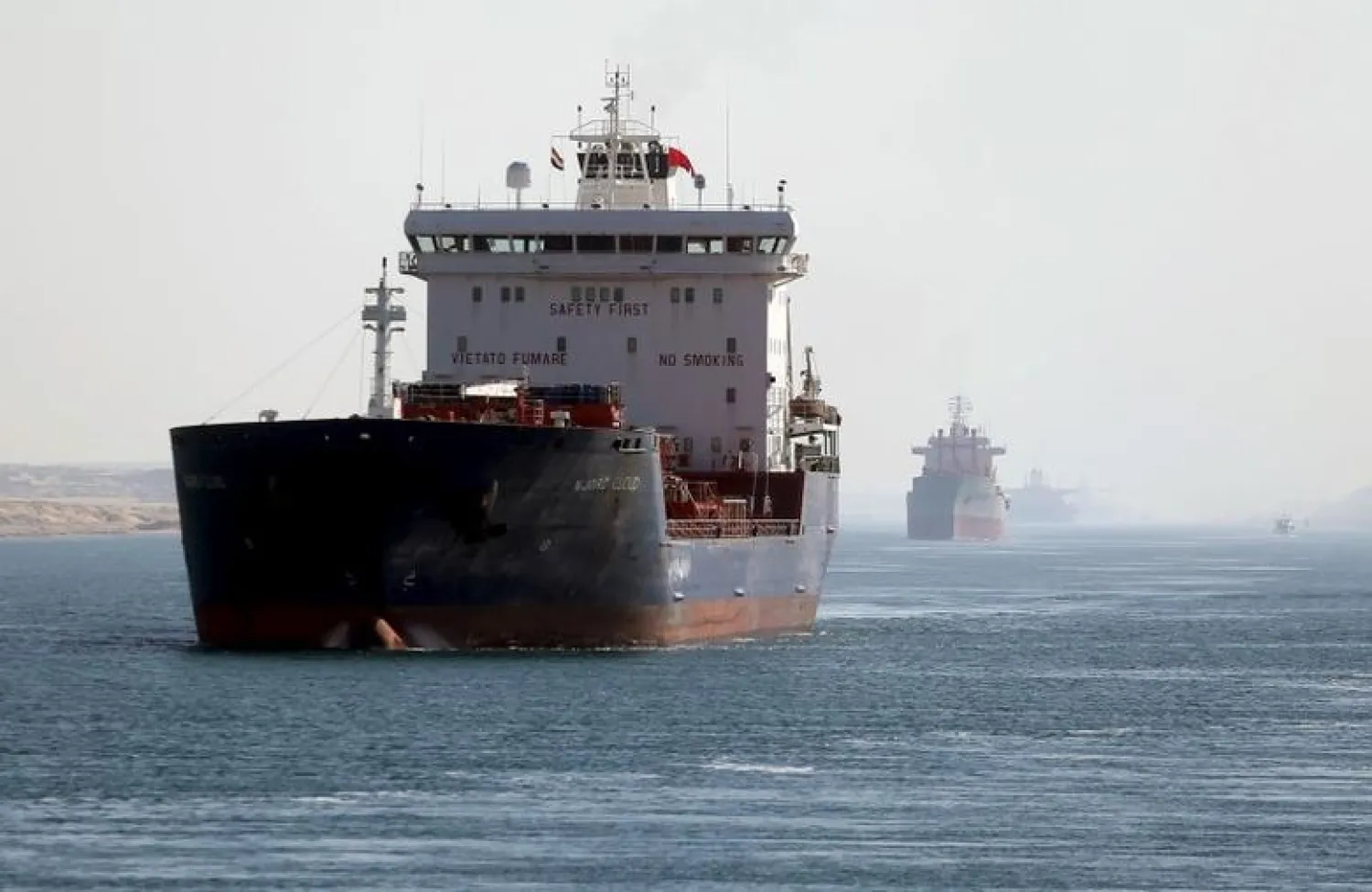
A cargo ship passes through the New Suez Canal in Ismailia, Egypt, (File photo: Reuters)
TT

Egypt Increases Suez Canal Toll 5%

A cargo ship passes through the New Suez Canal in Ismailia, Egypt, (File photo: Reuters)

Egypt announced a five percent increase on Suez Canal transit tolls for dry bulk vessels and LPG carriers, compared to rates applied during 2019, taking effect by April 2020.

The Egyptian state tv announced that the Suez Canal Authority (SCA) issued new resolutions on the ships' tolls during this year. It quoted SCA Chairman and Managing Director Osama Rabie as saying that the Suez Canal transit tolls will remain unchanged for all other types of vessels.

The decision to keep the Suez Canal transit tolls unchanged will benefit container vessels, tankers carrying oil and its products, LNG carriers, car carriers, general cargo vessels, Ro-Ro vessels, cruise vessels, and other types, Rabie said.

He explained that the transit tolls were decided after careful analyses of developments in competitor routes, as well as studies on developments in the maritime transport market, global economy, and the global trade movement.

The Chairman explained that the Suez Canal is a major lifeline for the global seaborne trade, through which 8.3 percent of the total global trade traffic passes besides approximately 25 percent of the total traffic of containerized cargoes globally, and 100 percent of the seaborne container trade between Asia and Europe.

The Suez Canal can accommodate 100 percent of the global fleet of container ships, 92.8 percent of the dry bulk vessels fleet, 61.9 percent of oil tankers fleet, 100 percent of all other fleet types with a full load, and 100 percent of the global ship fleet empty or partially loaded, noted Rabie.

Last November, Chairman Rabie, asked the Canal’s employees to exert all efforts to ensure Suez remains the main gateway to the global trade movement.

Rabie pledged, during the 150th anniversary of the Canal organized by SCA, that it will remain the top navigational destination for the transit of new generations of giant container ships with large submersibles.

He also announced the canal's readiness to receive one -hundred percent of the fleet of container ships in the world thanks to the new canal project, which succeeded in raising the Canal’s classification and maintaining its leading position in the navigation community.



Google to Pay Musk $920 Million a Month for AI Computing Capacity

The headquarters of Space Exploration Technologies Corp. (SpaceX) in California. (AFP)
TT

Google to Pay Musk $920 Million a Month for AI Computing Capacity

The headquarters of Space Exploration Technologies Corp. (SpaceX) in California. (AFP)

SpaceX on Friday signed a blockbuster cloud computing agreement under which Google will pay the Elon Musk-founded rocket company $920 million per month for access to a massive cluster of AI chips, according to a disclosure in its initial public offering filing.

The deal, which will bolster SpaceX's finances ahead of its IPO on June 12, covers a computing infrastructure of approximately 110,000 Nvidia GPUs -- the crucial hardware needed to power Google's Gemini AI models.

The filing says Google will begin paying the full monthly rate in October 2026, with a reduced fee applying during a ramp-up period until then, AFP reported.

The agreement runs through June 2029, implying total payments of roughly $30 billion over the life of the contract.

The deal resembles one struck with AI giant Anthropic, in which SpaceX leased compute capacity at its Colossus data centers in Memphis, Tennessee for $1.25 billion a month.

The facilities were originally built to power Musk's rival AI venture, xAI.

SpaceX's IPO filing revealed that xAI last year posted an operating loss of $6.4 billion on total revenue of $3.2 billion.

"This is a short-term, timely agreement to ensure we have bridge capacity to meet surging customer demand for our agent platform, Gemini Enterprise, which has been even higher than we expected," a Google Cloud spokesperson said in an email to AFP.

The filing adds that after December 31, "the agreement may be terminated by either party upon 90 days' notice."

The deals with Google and Anthropic come just days ahead of SpaceX's IPO, which will be the biggest in history, valuing the company at $1.8 trillion.

That valuation is largely based on faith that Musk can deliver on his ambitions to vastly expand his Starlink satellite business, put data centers into space using SpaceX rockets, as well as begin colonizing Mars.


Rosneft: US Companies Benefit from Strait of Hormuz Closure

Igor Sechin, Chief Executive Officer of Rosneft, during the St. Petersburg International Economic Forum, June 5, 2026 (Reuters).
TT

Rosneft: US Companies Benefit from Strait of Hormuz Closure

Igor Sechin, Chief Executive Officer of Rosneft, during the St. Petersburg International Economic Forum, June 5, 2026 (Reuters).

Rosneft Chief Executive Igor Sechin said on Saturday that US energy companies were the main beneficiaries of the closure of the Strait of Hormuz but warned that continued tensions in the artery for one fifth of the world's crude would undermine long-term demand for oil.

Iran blockaded the Strait, the main route for about a fifth of world oil supplies and other vital goods including fertilisers, after the United States and Israel attacked Iran and killed Supreme Leader Ali Khamenei in February. The US has blockaded Iranian ports.

Sechin, a close ally of President Vladimir Putin and one of the most influential men in Russia's energy sector, cast the US actions as an attempt to change the fundamental contours of the global energy markets to suit US interests, but added that the strategic risks had not been fully assessed.

"The closure of the Strait of Hormuz is an attempt to reshape global energy market regulations to benefit the United States. The measures taken to block the strait were aimed at Iran, but backfired on the entire world. The strategic risks were underestimated," Sechin said at the St. Petersburg International Economic Forum.

"The main beneficiaries, of course, were American companies, which gained non-competitive advantages and the ability to secure high-cost supplies," he said.

"Continued tension in the Strait of Hormuz for a long time undermines the long-term demand for oil. It may also trigger another surge of interest in alternative energy."

If the Strait opens in the near future, then the oil price will be at $95 to $96 per barrel by the end of the year, and in a year it will drop to $80 to $85, and by the second half of 2027 there will be a return to market fundamentals, he said.


First Two of Riyadh Air’s Custom-Built 787-9 Dreamliners Arrive in Saudi Arabia

The arrival of Riyadh Air's two aircraft marks a historic milestone in the company's journey towards launching its flights (SPA)
TT

First Two of Riyadh Air’s Custom-Built 787-9 Dreamliners Arrive in Saudi Arabia

The arrival of Riyadh Air's two aircraft marks a historic milestone in the company's journey towards launching its flights (SPA)

Riyadh Air, Saudi Arabia’s new national carrier and a company wholly owned by the Public Investment Fund (PIF), has announced the arrival of its first two custom-built Boeing 787-9 Dreamliners at King Khalid International Airport in Riyadh.

The aircraft arrived in tandem on Friday at approximately 10 a.m. local time, receiving a water cannon salute upon touchdown.

The aircraft – using the call signs Riyadh 1 and Riyadh 2 and registered as HZ-RXAA and HZ-RXAB – are the first of Riyadh Air’s 72 state-of-the-art Dreamliners.

Their arrival marks the commencement of the carrier's broader strategy to expand its fleet to more than 180 narrow-body and wide-body aircraft.

Leveraging Saudi Arabia’s strategic location at the crossroads of Asia, Africa, and Europe, Riyadh Air aims to connect the capital to over 100 global destinations by 2030, with plans to fly to nearly 20 destinations by the end of this year.

Commenting on the arrival, Riyadh Air CEO Tony Douglas said: “To see our very first custom-built Dreamliners touch down in Riyadh is a truly historic moment for us, and a momentous day for Saudi aviation as part of Vision 2030. I could not be more excited or more confident about the future and the legacy we are creating.”

“Not only are we building an airline, we are opening a new gateway to the world from the heart of the Kingdom. We are absolutely ready and excited to welcome the world to Riyadh,” he added.