Libyan Oil Fields Shut, Cutting Country's Output by More than Halfhttps://english.aawsat.com/home/article/2088516/libyan-oil-fields-shut-cutting-countrys-output-more-half
Libyan Oil Fields Shut, Cutting Country's Output by More than Half
A general view of the Zueitina oil terminal is seen in Zueitina, west of Benghazi April 7, 2014. (Reuters)
Eastern Libya ports controlled by Libyan National Army (LNA), commanded by Khalifa Haftar, shut down oil exports, slashing national crude output by more than half and ramping up tensions ahead of a summit in Germany to discuss the country’s conflict.
The dramatic move came as Germany and the United Nations try to persuade Haftar at the Berlin summit on Sunday to halt his nine-month campaign to take Tripoli, seat of the Government of National Accord (GNA), headed by Fayez al-Sarraj.
Tribesmen in areas controlled by the LNA on Friday stormed the eastern Zueitina oil export port and announced the closure of all terminals under LNA control, reported Reuters.
LNA spokesman Ahmed al-Mismari later told reporters that the “Libyan people had closed the oil ports.”
Analysts said the closure of oil ports would not have been possible without the blessing of the LNA leadership. A source in the National Oil Company (NOC) said the LNA and an eastern oil protection force had ordered the closure of the ports. The oil protection force confirmed exports had been stopped.
Libya’s oil production was an estimated 1.3 million barrels a day before the closures.
The tribesmen allied with Haftar earlier accused the Tripoli government of using oil revenues to pay foreign fighters - a reference to Turkey’s decision to send soldiers and fighters from Syria’s war to western Libya to help the GNA fend off the LNA campaign.
The head of the eastern Zouaya tribe told AFP that blocking exports would "dry up the sources of funding for terrorism via oil revenues".
The tribes also called for the "immediate" closure of the Mellitah, Brega and Misrata pipelines.
NOC chairman Moustafa Sanalla said the oil and gas sector is "vital" for the Libyan economy, as it is the "single source of income for the Libyan people".
"The oil and the oil facilities belong to the Libyan people. They are not cards to be played to solve political matters," he added.
Libya’s oil sector, which brings in almost all of the state's revenues, has frequently been the target of attacks.
Sanalla said the consequences of exports and production being shut down for an extended period could be devastating.
"We face collapse of the exchange rate, a huge and unsustainable increase in the national deficit, the departure of foreign contractors, and the loss of future production, which may take years to restore," he said.
The ports closure mark a setback for the Berlin conference on Sunday where Haftar and Sarraj are expected. The one-day summit is the latest in a series of failed conferences and negotiations to stabilize Libya.
Three Israeli Vetoes Complicate Progress in Southern Lebanonhttps://english.aawsat.com/arab-world/5312193-three-israeli-vetoes-complicate-progress-southern-lebanon
Three Israeli Vetoes Complicate Progress in Southern Lebanon
Members of the United Nations Interim Force in Lebanon (UNIFIL) in southern Lebanon (Reuters)
Israel has raised three objections that are blocking progress toward a political or military resolution in southern Lebanon: it has rejected a proposed Italian force to carry out verification in a pilot zone, opposed expanding the model zones and obstructed plans for the post-UNIFIL phase.
Those plans include proposals for a European force to replace the UN mission when its mandate expires at the end of this year.
Arrangements for the next phase in southern Lebanon are becoming increasingly tangled.
Disputes persist over the security mechanism that would accompany any Israeli withdrawal, who would verify compliance and how far that party’s authority would extend, as Israeli operations in the south continue.
Against that backdrop, President Joseph Aoun met Lebanese Army Commander General Rodolphe Haykal to review security conditions across the country, particularly in the south, amid continued Israeli attacks on southern villages and towns.
Haykal briefed Aoun on his visit to Italy and talks with Italian officials.
The presidential statement gave no details of those discussions or whether they directly addressed proposals for future security arrangements.
Israel accused of obstruction
Nearly two months after the Framework Agreement was signed, there has been no move to establish additional pilot zones.
Israeli media have meanwhile reported objections to a proposal for an Italian force to help monitor areas from which Israeli troops are expected to withdraw and where the Lebanese army would assume responsibility.
Lebanese ministerial sources told Asharq Al-Awsat that Israel’s shifting positions and objections were among the main reasons no decision had been reached on who would take part in the next phase of security arrangements in southern Lebanon, what duties and powers that party would have, or the rules governing its work.
“The Israelis previously had no objection to Italian participation, but they are now objecting to an Italian force, after objections to the French had also emerged,” the sources said.
“So far, there is no final decision on who will participate, what tasks will be assigned to them, the limits of those tasks, or how they will be carried out.”
Israeli positions keep changing, the sources said.
“Sometimes they object to the French and sometimes to the Italians. At every stage, new conditions or positions emerge. That is why the final arrangements have yet to take shape.”
Contacts are continuing as Lebanon explores possible alternatives, but no final formula has been agreed upon, the sources said.
“Otherwise, the outlines of the next phase would already be clearer.”
The terms of the arrangements themselves are a major source of the deadlock, the sources added.
“Israel is making demands about the force’s powers and operating mechanisms, including issues involving searches of homes and the nature of its participation in field operations. These matters raise several concerns and are obstructing an agreement.”
The sources said those demands were accompanied by Israeli claims that the Lebanese army was not fulfilling the role expected of it.
“Taken together, these signs point to an Israeli tendency to obstruct.”
Washington is at the center of talks
Asked what options Lebanon had in the face of the deadlock, the sources said Beirut was consulting Washington because the United States also bore responsibility for the process.
“When the negotiating framework was established, the American role was central to it. The process is therefore not limited to Lebanon and Israel.”
The sources said there was practically no alternative to engaging with Washington.
“The Americans are the party capable of communicating with the Israeli side and influencing the process. Contacts with them are therefore continuing.”
Israel’s account of the pilot zones
Israeli leaks suggest the dispute goes beyond the identity of any international party involved in future arrangements. It also covers the scope of that party’s powers and duties, its relationship with the Lebanese army and the mechanisms for verifying implementation.
Israeli news website Walla reported that Israel had told the United States it was dissatisfied with the results of the pilot zones project and had criticized the Lebanese army’s performance in those areas.
An Israeli security official said the Lebanese army was not carrying out the required measures from Israel’s perspective, according to the website. The official linked that assessment to Tel Aviv’s current refusal to move to additional zones.
Those statements remain part of Israel’s account of how the understandings are being implemented. Lebanese sources, for their part, say contacts are continuing, with neither the arrangements nor a final formula settled.
Israeli veto of Italian force
A separate dispute centers on who could help monitor the implementation of the arrangements.
Israel’s Yedioth Ahronoth newspaper reported that Israel opposed deploying an Italian military force in southern Lebanon to monitor the pilot zones.
It cited Israeli officials as saying they feared any new international presence could restrict the Israeli military’s ability to operate in Lebanon.
The newspaper also quoted Israeli Defense Minister Israel Katz as rejecting the proposal and voicing concern that it could replicate the UNIFIL model.
Can Mazloum Abdi’s Appointment as President's Adviser Bolster Security in Northern Syria?https://english.aawsat.com/arab-world/5312175-can-mazloum-abdi%E2%80%99s-appointment-presidents-adviser-bolster-security-northern
Syrian President Ahmed al-Sharaa, right, meets with the commander of the Kurdish-led Syrian Democratic Forces, Mazloum Abdi, center left, at the presidential palace in Damascus, Syria, Tuesday, Aug. 25, 2026. (AP)
Can Mazloum Abdi’s Appointment as President's Adviser Bolster Security in Northern Syria?
Syrian President Ahmed al-Sharaa, right, meets with the commander of the Kurdish-led Syrian Democratic Forces, Mazloum Abdi, center left, at the presidential palace in Damascus, Syria, Tuesday, Aug. 25, 2026. (AP)
Syrian Kurdish political figures and a senior Arab official in Syria’s Hasakeh region welcomed the appointment of Syrian Democratic Forces (SDF) commander Mazloum Abdi as an adviser to the Syrian president, saying the move could speed up the integration process of Kurdish forces and help stabilize northern and eastern Syria.
A Kurdish politician who served in the former Autonomous Administration said the appointment could help “consolidate stability and security in northern and eastern Syria and across the country.”
An independent Kurdish politician also backed the decision, but said its impact on stability would depend on Abdi’s ability to influence armed groups formerly under his command.
A senior Arab dignitary in Hasakeh hoped that “the integration process will proceed quickly to strengthen security, safety and stability in the region, because that will have a positive impact on Syria as a whole.”
Syrian President Ahmed al-Sharaa issued a decree on Thursday appointing Abdi as a presidential adviser. The move came three days after Abdi announced the SDF's dissolution following the “completion of its mission.”
The decision closes a significant chapter in the history of the Kurds, who fought ISIS with US support during Syria’s civil war.
“We view this appointment positively and consider it an important step that could open the way to a new phase of dialogue and understanding,” said Abdul Karim Omar, a Syrian Kurdish politician who served as the Autonomous Administration’s representative in Damascus.
Omar told Asharq Al-Awsat that “placing a figure such as Abdi, who has a presence and a role in northern and eastern Syria, in an advisory position at the presidency could help bring views closer together, build trust and open broader channels of communication on national issues.”
He added that “genuine understandings between the two sides could lay the groundwork for gradual, mutually agreed institutional integration that preserves the particular character of the Kurdish regions and the rights of all their communities, while strengthening Syria’s unity and sovereignty.”
If backed by political will and serious dialogue, such steps could “help consolidate stability and security in northern and eastern Syria and across the country, and open a new chapter based on national partnership,” he stressed.
Abdi’s appointment and the dissolution of the SDF came as implementation of the January 29 agreement signed by al-Sharaa and Abdi.
The agreement provides for the integration of the military, security, and civilian institutions of the Kurdish Autonomous Administration, which the Kurds established during the conflict, into Syrian state structures. It also calls for handing over border crossings and oil and gas fields and for foreign fighters to leave the region.
Abdelaziz Tammo, President of the Independent Syrian Kurds Association, said the appointment “was expected” and sent a message that “the SDF and the other Kurdish military groups affiliated with the Kurdistan Workers’ Party (PKK) have come to an end and become part of the Syrian state, since their commander is now an adviser to the presidency.”
Tammo told Asharq Al-Awsat that the Syrian government “succeeded in resolving the issue of the SDF and the remaining PKK militias without bloodshed and gave them everything they requested.”
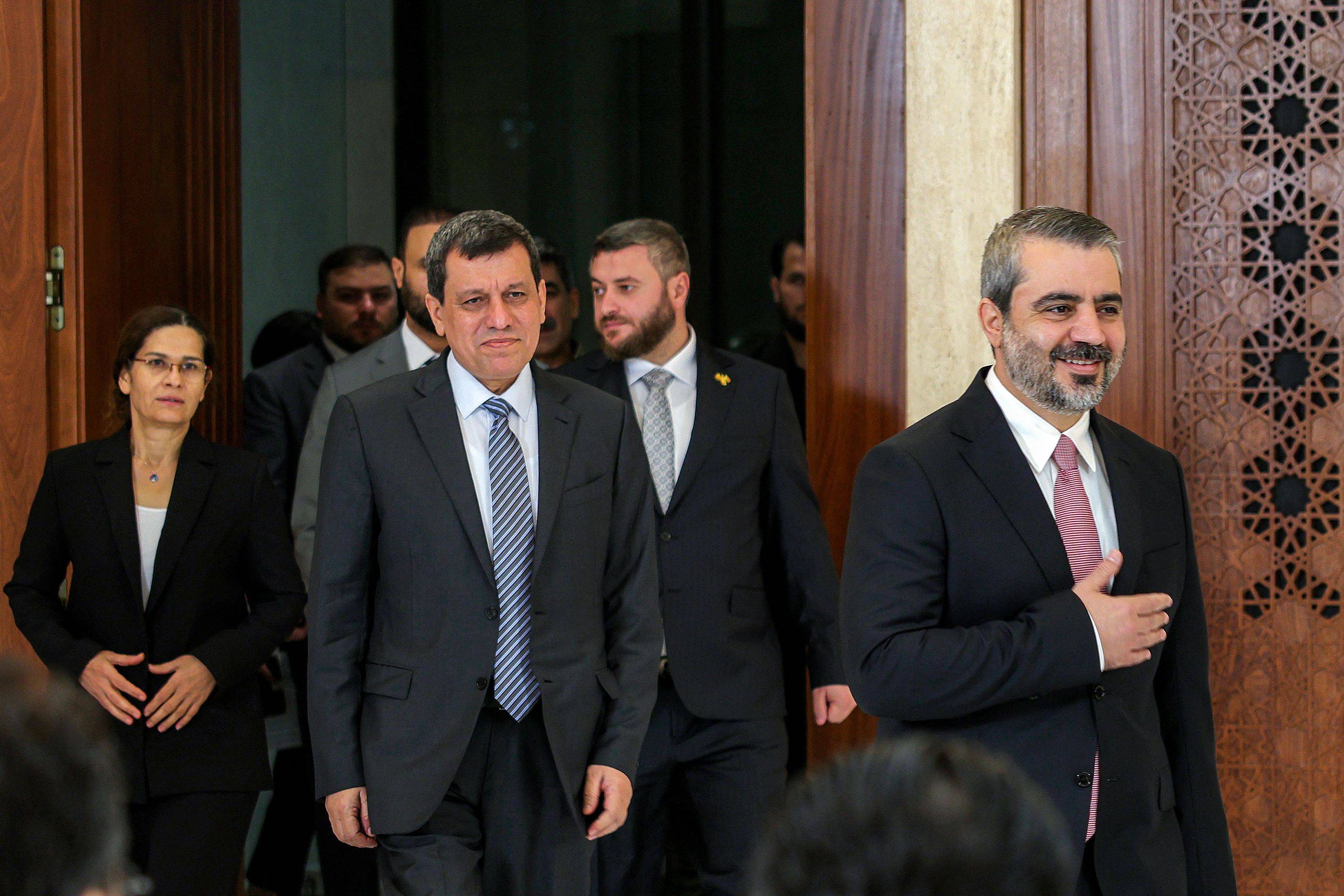
Mazloum Abdi (C), leader of the Kurdish-led Syrian Democratic Forces (SDF), arrives with Syria's interim Foreign Minister Asaad al-Shaibani (R) before a televised speech at the People's Palace in Damascus on August 25, 2026. (AFP)
Through the January agreement, the Syrian government sought to reunify the country, strengthen security and stability in northern and eastern Syria, restore full state sovereignty and authority over its territory, unify the military and security sectors, integrate institutions, enforce the rule of law, and recover economic resources.
Tammo said security and stability in northern and eastern Syria would depend on Abdi’s influence over armed groups affiliated with the PKK that operated under the SDF umbrella, such as the People’s Protection Units (YPG) and Women’s Protection Units.
Following the dissolution of the SDF and Abdi’s appointment, Tammo said: “Anyone who does not comply with the decision is now outside the law, and the state can enforce the law against them.”
“There is no longer any reason for those militias to exist, particularly since PKK leader Abdullah Ocalan announced the dissolution of the party and all its affiliated formations,” he said.
“Since the parent party dissolved itself, the other formations linked to it should naturally dissolve themselves,” Tammo added.
Tammo said integrating the SDF into state institutions would not, by itself, have a major impact on the region because it also required social integration and a return to coexistence.
“The PKK and the SDF committed many violations against Kurds, Arabs and other citizens,” he noted. “To end this crisis, we need to activate the role of social capital, represented by community leaders and independent political figures, to heal wounds and address the consequences of those violations.”
He described the dissolution of the SDF as “a step in the right direction”, hoping it would be implemented on the ground.
In July, residents of Hasakeh mobilized for several days to demand that the state extend its control and authority across the province, allow displaced people to return to their cities and villages, and end the SDF’s dominance over the region and its abuses against residents.
Sheikh Mudar Hammad al-Asaad, director of the Association of Syria Refugees, said Abdi’s appointment “will open the way to accelerating the integration of the SDF and the Autonomous Administration into the Syrian state.”
Al-Asaad told Asharq Al-Awsat that he hoped integration would be implemented on the ground through the release of hundreds of detainees from SDF prisons, disclosure of the fate of missing people and the submission of lists identifying foreign fighters who fought alongside the SDF as a step toward removing them from Syria.
He also called for all government offices to be handed over to the state and for an end to military gatherings organized by some groups in the SDF’s name. Those groups continued to make arrests and operate checkpoints, provoking residents and stoking tensions.
“We hope the integration process will proceed quickly to strengthen security, safety and stability in Hasakeh, because that will have a positive impact on Syria as a whole,” al-Asaad said.
He stressed that Hasakeh “is the country’s breadbasket” and that restoring security and stability would allow the province’s infrastructure to be rehabilitated, agricultural and industrial projects to be established, and oil and gas projects to resume, benefiting all Syrians.
Restoring security and stability would also allow refugees and displaced people to return and halt the current wave of displacement, he said.
Harris Ends Baghdad Posting, Iran Expert Eyed as Successorhttps://english.aawsat.com/arab-world/5312165-harris-ends-baghdad-posting-iran-expert-eyed-successor
Harris Ends Baghdad Posting, Iran Expert Eyed as Successor
Iraqi Prime Minister Ali al-Zaidi meets US Chargé d’Affaires Joshua Harris. (Iraqi Government media)
US Chargé d’Affaires Joshua Harris wrapped up his mission in Iraq with a final meeting with Prime Minister Ali al-Zaidi, as Baghdad-Washington ties enter a new phase marked by reduced US diplomatic representation.
Harris took over after former US Ambassador Alina Romanowski, ushering in a diplomatic downgrade in a country that hosts one of Washington’s largest embassies, sprawling for nearly two kilometers along the Tigris River in Baghdad.
A statement from the prime minister’s media office described Iraq and the US as “two friendly countries.”
Harris, whom associates describe as good-humored despite his imposing physique, met most of Iraq’s leaders as his mission drew to a close. They included Supreme Judicial Council President Faiq Zidan, Hikma Movement leader Ammar al-Hakim and former Prime Minister Nouri al-Maliki.
Harris praised ties between Washington and Baghdad after al-Zaidi thanked him for his service during a transition in the two countries’ relationship, shaped by the US-Iranian conflict and the role of armed factions.
Iraqi Foreign Minister Fuad Hussein also thanked Harris for helping strengthen relations between Iraq and the US, the Foreign Ministry said in a statement.
Factions' weapons
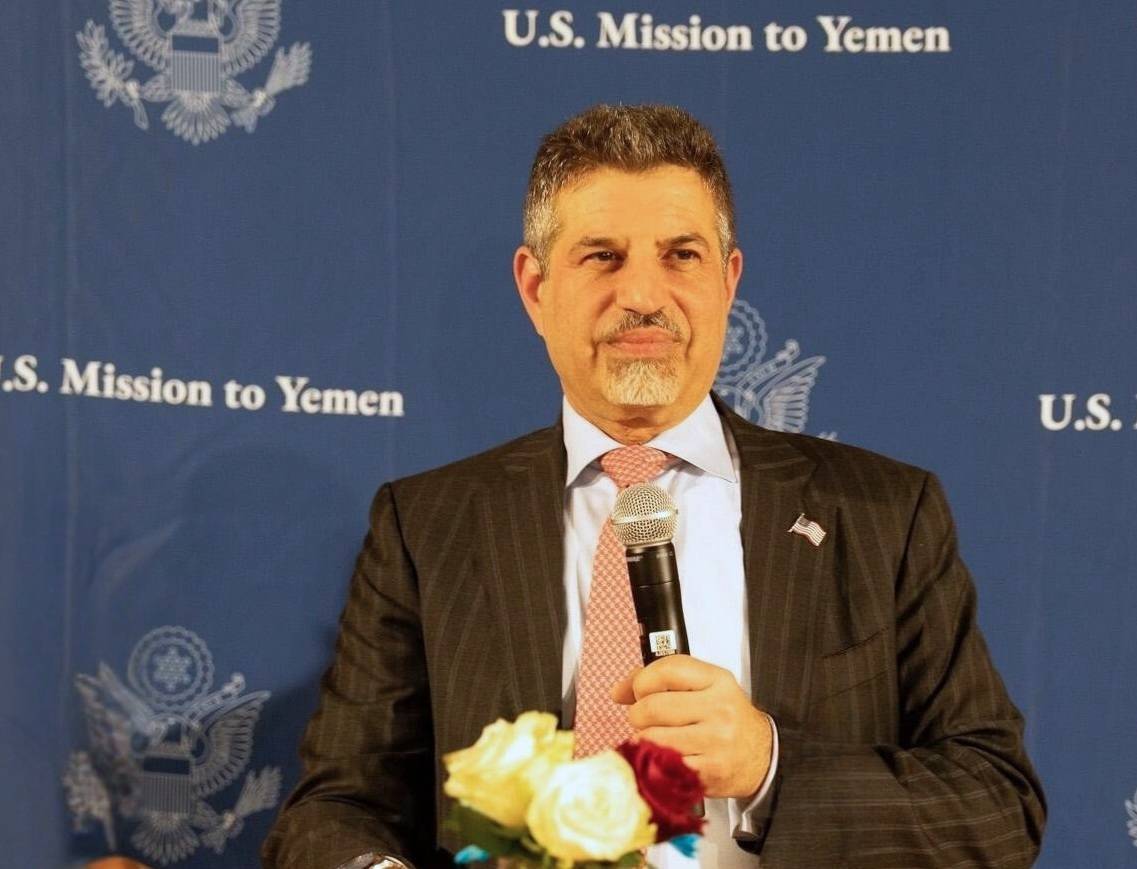
Political circles expect former US Ambassador to Yemen Steven Fagin to become Washington’s new chargé d’affaires in Baghdad. Many describe him as an expert on Iraq and the wider region, particularly Iran.
Iraqi officials and experts told Asharq Al-Awsat that Baghdad-Washington ties could take a different course in the next phase, particularly as they become linked to US-Iranian relations.
“Diplomatic representation remains at a low level, indicating that the US is monitoring progress on the factions’ handover of weapons,” former Iraqi lawmaker Sajjad Salim told Asharq Al-Awsat.
“Washington has no desire to offer further support to the Baghdad government after the prime minister was received at the White House,” he said.
“Despite optimism about the new prime minister and the clear support for him, Washington has concluded that the factions are not serious about handing over their weapons and are merely playing for time.”
Salim said that appointing an expert on Iranian affairs raised two issues.
“First, Iraq is one part of a more complex issue — Iran,” he said. “Second, amid this long-term war with the Iranian regime, aimed at undermining or overthrowing it, Iraq must either remain neutral or become a logistical hub supporting the war effort against Iran.”
Former US Ambassador to Yemen Steven Fagin. (US Mission to Yemen on X)
Uncertain outlook
Kifah Mahmoud Karim, media adviser to Kurdistan Democratic Party leader Masoud Barzani, said US institutions did not act on personal whims.
“Any US official working abroad, regardless of rank or role, operates under a predetermined plan,” he told Asharq Al-Awsat.
Citing people close to Harris, Mahmoud said the outgoing chargé d’affaires had been “more energetic and dynamic in implementing the established policy.”
Asked about the Kurdistan Region’s dealings with US ambassadors to Iraq and Washington’s engagement with the region through them, Mahmoud said the region built its relations through the federal Foreign Ministry.
He said Baghdad-Washington ties remained fraught with uncertainty, “not so much because of changes in US policy as because of shifts in Iraqi policy toward various regional issues, particularly the conflict between the US and Iran.”
“It is not Iraq’s duty to act as Iran’s lawyer or to involve itself in a war in which it has no interest,” Mahmoud said.
“Nor is it in Iraq’s interest to have armed factions carrying out acts that the US considers aggressive and terrorist.”
Abbas Abboud Salem, a researcher and professor of political science, said the Trump administration differed from previous US administrations by nominating ambassadors from outside the State Department.
Such nominees require Senate approval, he said, and because securing that approval can be difficult, a chargé d’affaires becomes the alternative.
“But the chargé d’affaires is ultimately a professional diplomat who understands the role well,” Salem told Asharq Al-Awsat.
“The appointment of a US chargé d’affaires at this stage is extremely important because this is a different phase,” he said.
“It coincides with the withdrawal of US troops and the end of the US-led coalition’s mission. New areas of engagement are therefore expected, including the economy, energy and investment.”
On the political side of Baghdad-Washington ties, Salem said the relationship was often entrusted to US envoy to Iraq Tom Barrack “because he is directly connected to the White House and the president.”
لم تشترك بعد
انشئ حساباً خاصاً بك لتحصل على أخبار مخصصة لك ولتتمتع بخاصية حفظ المقالات وتتلقى نشراتنا البريدية المتنوعة