


World Court Orders Myanmar to Protect Rohingya from Genocide

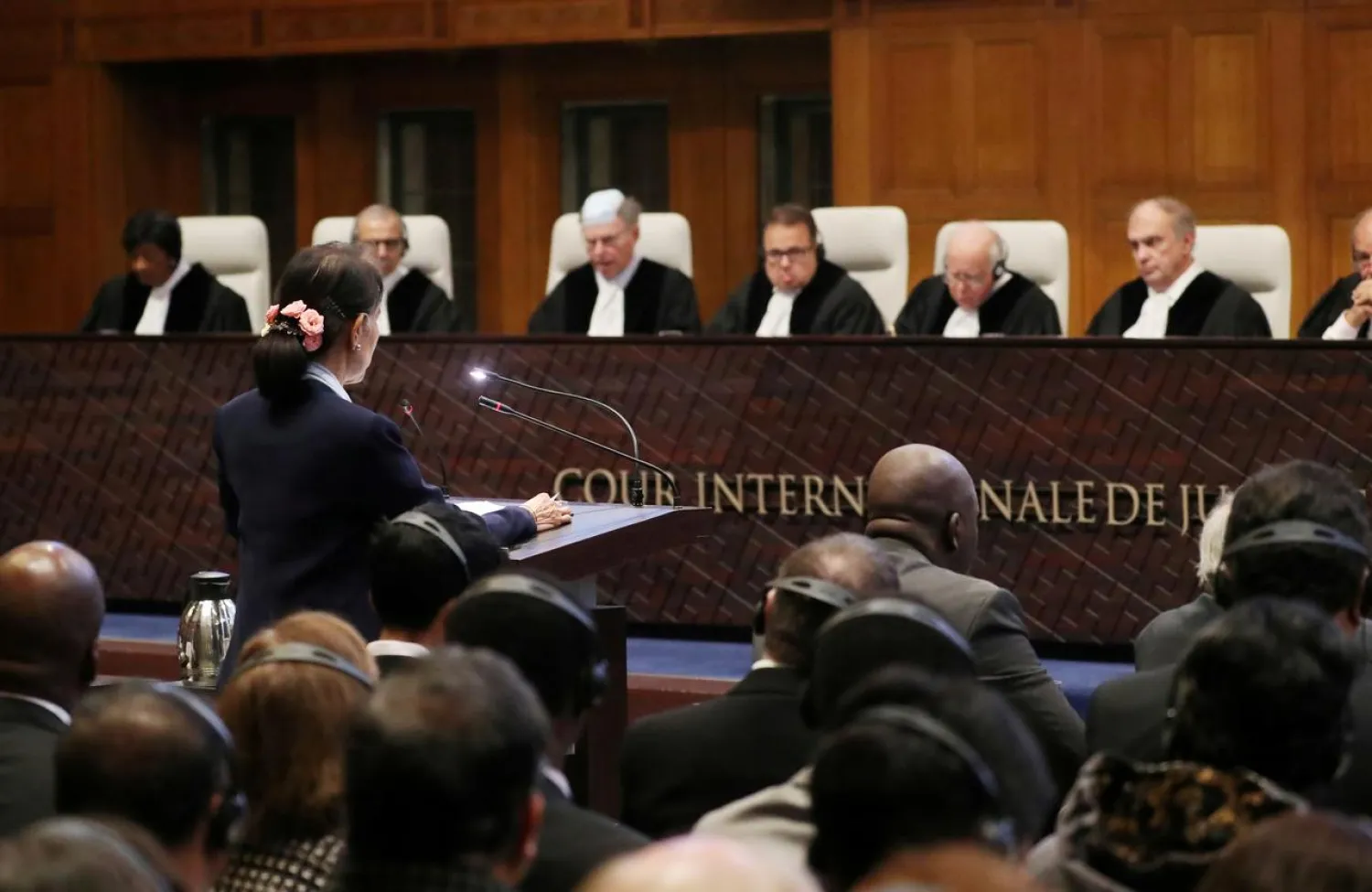
Aung San Suu Kyi appears in court in case filed by Gambia against Myanmar alleging genocide against the Rohingya population, at the ICJ in The Hague, Netherlands December 11, 2019. (Reuters)
TT

World Court Orders Myanmar to Protect Rohingya from Genocide

Aung San Suu Kyi appears in court in case filed by Gambia against Myanmar alleging genocide against the Rohingya population, at the ICJ in The Hague, Netherlands December 11, 2019. (Reuters)

The International Court of Justice on Thursday ordered Myanmar to take urgent measures to protect its Rohingya population from genocide, a ruling cheered by refugees as their first major legal victory since being forced from their homes.

A lawsuit launched by Gambia in November at the United Nations' highest body for disputes between states accuses Myanmar of genocide against Rohingya in violation of a 1948 convention.

The court's final decision could take years, and Thursday's ruling dealt only with Gambia's request for preliminary measures. But in a unanimous ruling by the 17-judge panel, the court said the Rohingya face an ongoing threat and Myanmar must act to protect them.

Myanmar must "take all measures within its power to prevent all acts" prohibited under the 1948 Genocide Convention, and report back within four months, presiding Judge Abdulqawi Yusuf said, reading out a summary of the judgment.

Myanmar must use its influence over its military and other armed groups to prevent violence against the Rohingya "intended to bring about its physical destruction in whole or in part".

Rohingya activists, who had come from all over the world to the Hague, reacted with joy to the unanimous ruling which also explicitly recognized their ethnic minority as a protected group under the Genocide Convention.

"That is something we have been fighting for a long time: to be recognized as humans the same as everyone else," Yasmin Ullah, a Canada-based Rohingya activist said, according to Reuters.

Majority Buddhist Myanmar generally refuses to describe the Muslim Rohingya as an ethnic group and refers to them as Bangladeshi migrants.

Myanmar's ministry of foreign affairs said in a statement late on Thursday it "takes note" of the decision.

"The unsubstantiated condemnation of Myanmar by some human rights actors has presented a distorted picture of the situation in Rakhine and affected Myanmar’s bilateral relations with several countries", it added.

More than 730,000 Rohingya fled Myanmar after a military-led crackdown in 2017, and were forced into squalid camps across the border in Bangladesh. UN investigators concluded that the military campaign had been executed with "genocidal intent".

In camps in Bangladesh where they have fled, Rohingya refugees hovered over mobile phones to watch the judgment.

"For the first time, we have got some justice," said Mohammed Nur, 34. "This is a big achievement for the entire Rohingya community."

Rohingya still living inside Myanmar contacted by phone said they hoped the ruling would force the country to improve their situation.

"We need protection," said Tin Aung, a Rohingya leader living in Myebon township in central Rakhine state, where Muslims have been confined to camps since violence in 2012.

A Myanmar government spokesman and two military spokesmen did not answer calls from Reuters seeking comment.

UN Secretary-General Antonio Guterres welcomed the court order and "recalls that, pursuant to the Charter and to the Statute of the Court, decisions of the Court are binding and trusts that Myanmar will duly comply," U.N. spokesman Stephane Dujarric said in a statement.

‘Triumph’

Gambia's justice minister, Abubacarr Tambadou, hailed the ruling as "a triumph for international justice".

Mainly Muslim Gambia brought the case despite being located halfway around the world, on the argument that all nations have a universal legal duty to prevent genocide. Tambadou, a former prosecutor at a UN tribunal over the Rwanda genocide, took up the issue on behalf of the 57-member OIC group of Muslim states.

The case was argued last month by some of the world's top human rights lawyers, with Myanmar's civilian leader Aung San Suu Kyi personally attending hearings at The Hague to ask judges to dismiss it.

Moments before the court began reading its ruling, the Financial Times published an article by Suu Kyi, in which she said war crimes may have been committed against Rohingya Muslims but refugees had exaggerated abuses.

Although ICJ rulings are final and binding, countries have occasionally flouted them, and the court has no formal mechanism to enforce them.

"The ICJ order to Myanmar to take concrete steps to prevent the genocide of the Rohingya is a landmark step to stop further atrocities against one of the world’s most persecuted people,” said Param-Preet Singh, associate international justice director at Human Rights Watch. "Concerned governments and UN bodies should now weigh in to ensure that the order is enforced. …"

Yusuf, the presiding judge, said the court was not satisfied with Myanmar's own efforts "to facilitate the return of Rohingya refugees present in Bangladesh, to promote ethnic reconciliation, peace and stability in Rakhine State, and to make its military accountable for violations of international humanitarian and human rights law".

Myanmar will now have to regularly report on its efforts to protect the Rohingya from acts of genocide every six months until a final ruling in the case.



Top Trump Iran Negotiator Says Visits US Aircraft Carrier in Middle East

US Special Envoy Steve Witkoff delivers a press conference upon the signing of the declaration on deploying post-ceasefire force in Ukraine, during the so-called "Coalition of the Willing" summit, at the Elysee Palace in Paris, France, January 6, 2026. (Reuters)
TT

Top Trump Iran Negotiator Says Visits US Aircraft Carrier in Middle East

US Special Envoy Steve Witkoff delivers a press conference upon the signing of the declaration on deploying post-ceasefire force in Ukraine, during the so-called "Coalition of the Willing" summit, at the Elysee Palace in Paris, France, January 6, 2026. (Reuters)

US President Donald Trump's lead Iran negotiator Steve Witkoff on Saturday said he visited the USS Abraham Lincoln aircraft carrier currently in the Arabian Sea, with Washington and Tehran due to hold further talks soon.

"Today, Adm. Brad Cooper, Commander of US Naval Forces Central Command, Jared Kushner, and I met with the brave sailors and Marines aboard the USS Abraham Lincoln, her strike group, and Carrier Air Wing 9 who are keeping us safe and upholding President Trump's message of peace through strength," said Witkoff in a social media post.

Iranian Foreign Minister Abbas Araghchi said on Saturday he hoped talks with the United States would resume soon, while reiterating Tehran's red lines and warning against any American attack.


Israel’s Netanyahu Expected to Meet Trump in US on Wednesday and Discuss Iran

Israeli Prime Minister Benjamin Netanyahu delivers a speech during a special session to mark the 77th anniversary of the Knesset's establishment and the 60th anniversary of the dedication of the current building at the Knesset, the Israeli parliament, in Jerusalem, 02 February 2026. (EPA)
TT

Israel’s Netanyahu Expected to Meet Trump in US on Wednesday and Discuss Iran

Israeli Prime Minister Benjamin Netanyahu delivers a speech during a special session to mark the 77th anniversary of the Knesset's establishment and the 60th anniversary of the dedication of the current building at the Knesset, the Israeli parliament, in Jerusalem, 02 February 2026. (EPA)

Israeli Prime Minister Benjamin Netanyahu is expected to meet US President Donald Trump on Wednesday in Washington, where they will discuss negotiations with Iran, Netanyahu's office said on Saturday.

Iranian and US officials held indirect nuclear ‌talks in the ‌Omani capital ‌Muscat ⁠on Friday. ‌Both sides said more talks were expected to be held again soon.

A regional diplomat briefed by Tehran on the talks told Reuters Iran insisted ⁠on its "right to enrich uranium" ‌during the negotiations with ‍the US, ‍and that Tehran's missile capabilities ‍were not raised in the discussions.

Iranian officials have ruled out putting Iran's missiles - one of the largest such arsenals in the region - up ⁠for discussion, and have said Tehran wants recognition of its right to enrich uranium.

"The Prime Minister believes that any negotiations must include limiting ballistic missiles and halting support for the Iranian axis," Netanyahu's office said in a ‌statement.


Italy FM Rules Out Joining Trump’s ‘Board of Peace’

Italy's Minister for Foreign Affairs Antonio Tajani speaks to the press during the EPP Leaders’ meeting, in Zagreb, Croatia, 30 January 2026. (EPA)
TT

Italy FM Rules Out Joining Trump’s ‘Board of Peace’

Italy's Minister for Foreign Affairs Antonio Tajani speaks to the press during the EPP Leaders’ meeting, in Zagreb, Croatia, 30 January 2026. (EPA)

Italy will not take part in US President Donald Trump's "Board of Peace", Italian Foreign Minister Antonio Tajani said Saturday, citing "insurmountable" constitutional issues.

Trump launched his "Board of Peace" at the World Economic Forum in Davos in January and some 19 countries have signed its founding charter.

But Italy's constitution bars the country from joining an organization led by a single foreign leader.

Prime Minister Giorgia Meloni, a Trump ally, last month noted "constitutional problems" with joining, but suggested Trump could perhaps reopen the framework "to meet the needs not only of Italy, but also of other European countries".

Tajani appeared Saturday to rule that out.

"We cannot participate in the Board of Peace because there is a constitutional limit," he told the ANSA news agency.

"This is insurmountable from a legal standpoint," he said, the day after meeting US Secretary of State Marco Rubio and US Vice President JD Vance at the Olympics in Milan.

Although originally meant to oversee Gaza's rebuilding, the board's charter does not limit its role to the Palestinian territory and appears to want to rival the United Nations.