A Winter Break Is More Valuable Than Cup Traditions

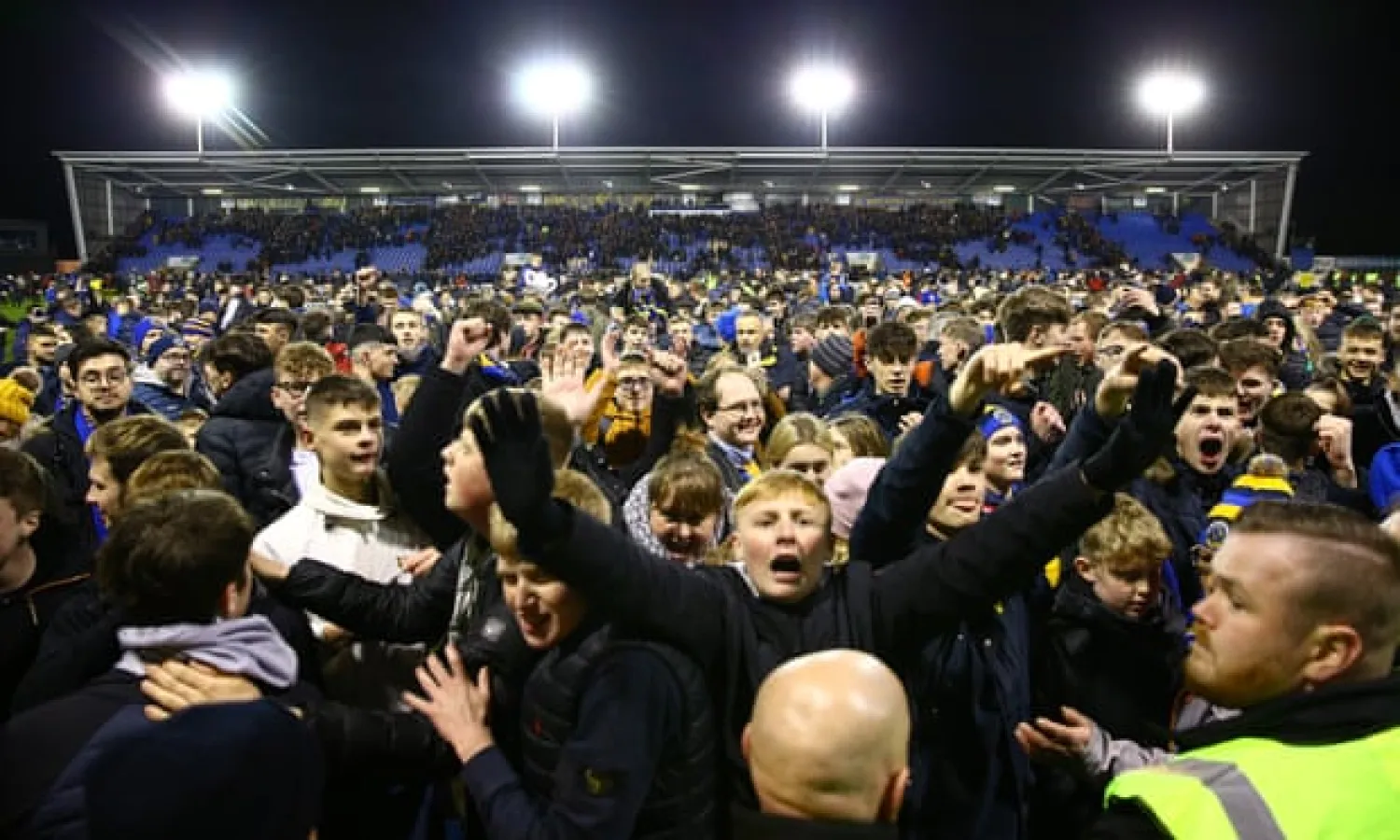
 Shrewbury fans invaded the pitch after securing a replay against Liverpool and their manager Sam Ricketts said the money could ‘change the club’s future’. Photograph: Kieran McManus/BPI/Shutterstock
Shrewbury fans invaded the pitch after securing a replay against Liverpool and their manager Sam Ricketts said the money could ‘change the club’s future’. Photograph: Kieran McManus/BPI/Shutterstock
TT

A Winter Break Is More Valuable Than Cup Traditions

 Shrewbury fans invaded the pitch after securing a replay against Liverpool and their manager Sam Ricketts said the money could ‘change the club’s future’. Photograph: Kieran McManus/BPI/Shutterstock
Shrewbury fans invaded the pitch after securing a replay against Liverpool and their manager Sam Ricketts said the money could ‘change the club’s future’. Photograph: Kieran McManus/BPI/Shutterstock

The Premier League’s winter break is coming, and it’s a bit of a mess. I’m a firm believer that a break is necessary: footballers aren’t superheroes, they are humans competing in a sport more physically demanding now than it has ever been. The pace of English football is the reason Sky, BT and broadcasters around the world are paying billions to show it, but that is only possible thanks to the supreme fitness of those competing in it. If there is no consideration for their bodies and minds, sooner or later it will have an impact on the product – and the profit.

I know the difference even a short break can make. I remember when I stopped playing for England, during the first seven days of an international break training would be minimal because so few players were around, and they became recovery times for me. You get a bit of extra one-to-one coaching, a bit of technical training, and it helped me to feel really fresh for the games after international breaks. Most of the other players had to leave their club, travel, play potentially two games, return to their club and three days later they’re playing again, and all that time I had the opportunity to spend time recovering and preparing, looking after myself. They say dropping international football can add two or three years to your career, because you gain those recovery weeks. That’s one reason why Jamie Vardy and James Milner have excelled well into their 30s, and the argument for guaranteeing every player in the division one of those recovery weeks in a long season seems overwhelming.

The counter-argument is always that there used to be more league games and more cup replays, and they would be played on terrible, muddy pitches – and if you’re playing on a heavy pitch, you’re going to feel it in your legs, for sure. But the pace of the game now, the amount of work and running that is expected, is at another level. I don’t understand how when you’ve got all these billions in the game you’re still expecting the top team in the country to destroy their mid-season break so they can squeeze in an FA Cup replay against Shrewsbury Town.

Liverpool are one of several top-flight clubs who have replays during what was supposed to be their break – Newcastle, Tottenham and Southampton are also affected – though the league leaders have decided to prioritise the break over the Cup and play an under‑23 team, while Jürgen Klopp will not even turn up. Klopp is clearly making the point that for him the break is uncompromisable, but it all seems ridiculous – and completely avoidable.

The competition has a special place in English football, but we can talk all we like about the magic of the FA Cup, the fact is that players need a rest to be fresh enough to play at their best level on a weekly basis. The Christmas period is taxing in terms of games, and the players who come through would benefit from a period of recovery. The evidence is there: it’s no coincidence that Harry Kane ruptured a tendon on New Year’s Day, or that Marcus Rashford suffered a double stress fracture midway through this month. Players are expected to train hard and play hard, week after week, and sooner or later that’s going to result in more muscle injuries and stress fractures. These athletes need time to just do nothing, to be off their feet, recharge, and come back and restart the engine again. But the one short period of rest in a long season is being jeopardised by cup replays.

Perhaps the main reason why replays are so important to smaller clubs is not sporting at all, it’s financial. In their most recent accounts Shrewsbury made a profit of £340,878 on a turnover of about £6.5m, so it’s obvious how much difference two games against Liverpool, including TV broadcast fees and a share of gate receipts from a full house at home and a trip to Anfield, can make. Their manager, Sam Ricketts, has said the replay could allow them to improve the drainage at their training ground, buy video analysis equipment and even “change the club’s future”. It seems wrong to deny them the chance to earn that kind of payday.

But if FA Cup prize money were redistributed a bit more sensibly all lower-league clubs would get rewarded for success in the early rounds, and perhaps they would find the idea of dropping replays a bit more acceptable.

At the moment whoever wins the Cup gets £6.8m across the competition in prize money. Other than Portsmouth in 2008 and Wigan in 2013, in the past 20 years only Arsenal, Chelsea, the two Manchester clubs and Liverpool have won it. It is almost always won by a club big enough and rich enough to be much more interested in the competition for its prestige than its money. That amount of prize money is not game-changing for the top Premier League clubs – it would probably just about cover the wages and bonuses of two players in the Liverpool squad.

Meanwhile lower-league clubs that start in round one and lose in round three will have got £90,000 from the prize pot, and those that make it to round four £225,000. I don’t feel that the distribution of money is fair or sensible – the one team that win the Cup get almost exactly the same in prize money as the 108 teams eliminated in rounds one, two, three and four put together, and even then it doesn’t make much difference to them.

My proposal would be for the lower-ranked team to play at home in FA Cup matches, to scrap replays from round three onwards and for the prize money to be distributed in a totally different way to make success on the field more important than playing for draws and the chance of attracting TV cameras. Reducing the winners’ reward to, say, £3m and redistributing the difference would allow all lower-league teams to earn more, even without replays – games that one or both teams will anyway often see as an inconvenience – while the whole David and Goliath mantra, giving the underdog a chance, would be boosted by giving the smaller side home advantage. It may seem like a big step from what the Cup used to be, but there is no tradition more important than looking after the players

The Guardian Sport


Alcaraz Says Experience Helped Him Crack Indoor Code after Back-to-back Title Wins

Tennis - ATP Finals - Palasport Olimpico, Turin, Italy - November 16, 2026  Spain's Carlos Alcaraz in action during his group stage match against Francis Tiafoe of the US. REUTERS/Guglielmo Mangiapane
Tennis - ATP Finals - Palasport Olimpico, Turin, Italy - November 16, 2026 Spain's Carlos Alcaraz in action during his group stage match against Francis Tiafoe of the US. REUTERS/Guglielmo Mangiapane
TT

Alcaraz Says Experience Helped Him Crack Indoor Code after Back-to-back Title Wins

Tennis - ATP Finals - Palasport Olimpico, Turin, Italy - November 16, 2026  Spain's Carlos Alcaraz in action during his group stage match against Francis Tiafoe of the US. REUTERS/Guglielmo Mangiapane
Tennis - ATP Finals - Palasport Olimpico, Turin, Italy - November 16, 2026 Spain's Carlos Alcaraz in action during his group stage match against Francis Tiafoe of the US. REUTERS/Guglielmo Mangiapane

Carlos Alcaraz said experience has finally taught him how to get the best out of his game on indoor courts, with the world number three carrying his title-winning form from Vienna and Paris into this week's ATP Finals in Turin.

Only three of his 29 career titles have come on indoor hard courts, with his first coming in Rotterdam last year.

The 23-year-old has enjoyed a strong run of form since ⁠returning to the ⁠tour in August after nearly five months out with a right wrist injury.

His 6-2 6-2 win over Frances Tiafoe in his opening match at the ATP Finals on Monday showed he could be a real force at ⁠the season finale.

"I've always said that I'm not bad on indoor courts," the seven-times Grand Slam champion told reporters. "I just feel like others are a little bit better than me.

"It was about time, it was about getting more experience and it was about understanding how I should play on indoor courts,” Reuters quoted him as saying.

The faster conditions can mean Alcaraz has less time to ⁠impose ⁠his game, but he said he was confident of going toe-to-toe with the big servers and flatter hitters.

Tiafoe was in no doubt about Alcaraz's current level.

"He has moments where he's definitely Superman and he's playing pretty insane," Tiafoe said.

"But again, it's one of those things, you've got to appreciate greatness."

Alcaraz continues his campaign for a first ATP Finals crown when he takes on former champion Daniil Medvedev on Wednesday.


Goalkeeper Martinez Set for Argentina Return After Jaw Injury

Football - International Friendly - Argentina v Uruguay - Estadio La Bombonera, Buenos Aires, Argentina - November 13, 2026 Argentina's Emiliano Martinez during the warm up before the match. (Reuters)
TT

Goalkeeper Martinez Set for Argentina Return After Jaw Injury

Football - International Friendly - Argentina v Uruguay - Estadio La Bombonera, Buenos Aires, Argentina - November 13, 2026 Argentina's Emiliano Martinez during the warm up before the match. (Reuters)

Argentina ‌coach Lionel Scaloni said goalkeeper Emiliano Martinez will feature in Tuesday's friendly against Costa Rica after he recovered from a jaw fracture.

Martinez underwent surgery after colliding with Everton defender Jarrad Branthwaite in ‌Chelsea's 2-0 ‌victory last month.

He returned ⁠to Chelsea training ⁠earlier this month and was called up by Scaloni despite not having played for the Premier League club since ⁠the Everton game.

Martinez, ‌34, ‌did not feature in Argentina's 2-1 ‌loss to Uruguay on ‌Friday.

"Emiliano is going to play in goal, he'll be there," Scaloni told reporters on ‌Monday, ahead of the friendly match in Cordoba.

"Maybe ⁠he ⁠was fit for the previous match, but it was a risk, and since we trust Gero (Geronimo Rulli), Juan (Musso) and Santi (Santiago Beltran), we chose to look after him. An extra three days was a prudent choice."


‘Not Competitive’ Brazil Can Improve, Insists Ancelotti

Brazil's head coach Carlo Ancelotti looks on before the Mizuho Blue Challenge – The Kallang Football Series international friendly match between Japan and Brazil at the National Stadium in Singapore, 14 November 2026. (EPA)
TT

‘Not Competitive’ Brazil Can Improve, Insists Ancelotti

Brazil's head coach Carlo Ancelotti looks on before the Mizuho Blue Challenge – The Kallang Football Series international friendly match between Japan and Brazil at the National Stadium in Singapore, 14 November 2026. (EPA)

Brazil coach Carlo Ancelotti on Monday promised an improved performance in the year-ending clash against Singapore, admitting that his squad was "currently not competitive."

The Selecao lost 3-2 against Japan in a friendly in Singapore on Saturday, where Ancelotti and skipper Raphinha were red-carded after Japan scored the dramatic clincher in stoppage time.

"Given that the team is currently not competitive, I want to do more," Ancelotti told reporters in Singapore, where Brazil play on Tuesday.

The Italian, Brazil's first-ever permanent foreign coach, said: "I want to do more because I enjoy being here, so that the team can become more competitive on the global stage.

"The priority is to play well first (tomorrow) and to do well."

Ancelotti, 67, is coming under increasing pressure, following a string of underwhelming performances including two defeats, two wins and a draw in Brazil's last five international outings.

Japan avenged a 2-1 defeat by Brazil in their previous meeting at this year's World Cup, when the South Americans beat them in a round-of-32 clash.

After Saturday's loss, Ancelotti faced a barrage of criticism, including from former Brazilian national team star Romario.

Ancelotti brushed off Romario's remarks, saying "like anyone he has the right to express an opinion."

But the former Real Madrid coach, who reacted with fury after Brazil appealed for a foul in the build-up to Japan's winning goal on Saturday -- which was upheld by VAR -- said that his team "didn't deserve to lose" against Japan.

Japan face Paraguay on Tuesday in the second match of the double-header at Singapore's National Stadium.