

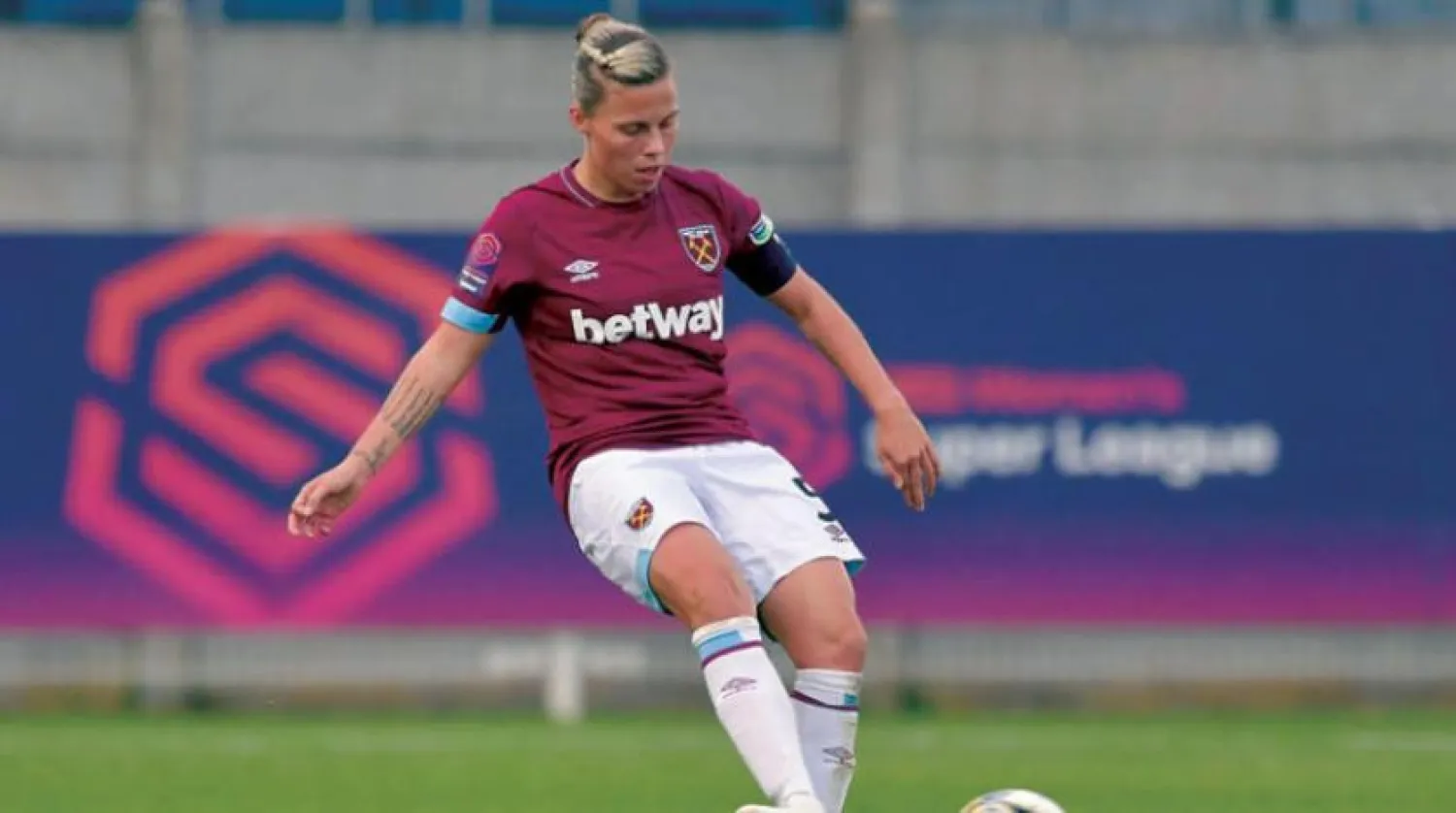

West Ham’s Gilly Flaherty: ‘People Will Be Shocked Because I’m Always Happy’

Club captain speaks publicly for the first time about the attempt to take her own life aged 17 and why it’s important to talk

Gilly Flaherty
Gilly Flaherty
TT

West Ham’s Gilly Flaherty: ‘People Will Be Shocked Because I’m Always Happy’

Gilly Flaherty
Gilly Flaherty

“It was the unknown,” says West Ham’s Gilly Flaherty. “I didn’t know what was going to happen when I went to hospital. If it would change my life.”

It has been more than a decade since the tough-tackling centre-back tried to take her own life and was found by a housemate. Flaherty has not spoken about it publicly since. She has not even talked about it privately with that housemate, nor until recently with her family, who if they referred to the incident at all would mention “that thing you did once”. Yet here she is, at West Ham’s Rush Green training ground, feeling as if she is “sitting in the Big Brother diary room”. Flaherty grins but, much like her hard persona masks a soft centre, the smile hides trepidation about an interview – released on Thursday on Time to Talk day and before the Football Association’s Heads Up weekend – that almost didn’t happen.

“Last week I wasn’t going to do this,” she says. “When I’d made the decision not to do it I went on Twitter and someone had taken their life. The day before they had sent out a tweet saying: ‘These letters are the hardest letters to write.’ Then they passed away. And I thought: ‘I have to do this.’”

Flaherty’s career is packed with trophies. Seven FA Cups, eight top‑division titles, a Champions League win as a part of Arsenal’s quadruple winners; few have had such success. “I think I could have gone through my whole career not having mentioned what I’ve been through,” the 28-year-old captain reflects. “I’m a different person now to the person I was back then – I’m stronger now. But what’s the point in going through stuff if I don’t think I can benefit someone from it?

“People will probably be shocked. They won’t be expecting it from me because I’m such a bubbly person and I’m always happy. And I am now, but back then I wasn’t and there’s a reason why I wasn’t.”

It was moving away from home, from Millwall’s youth teams, and going to Arsenal’s academy, that started the spiral. Flaherty is fiercely sensitive and close to her family. She struggled to cope with being separated from them, and with the death of her grandmother and great aunt. At the same time she was struggling with her sexuality.

“I say to my mum now that I wish I’d never gone. That’s nothing against Arsenal but I just wish now that I would have stayed at home, gone to college and learned a trade and come out with something.

“I was in the academy Monday to Friday. Now my mum will have a go at me when I don’t pick up the phone and ring her. Families have WhatsApp groups but when I was younger, I’d go Monday through Friday and I wouldn’t talk to them all week. I wasn’t doing well in college, I wasn’t interested. I was going through things … I knew I was gay. I had known I was gay for a long time but as you get older you start to think about relationships, you’re talking about taking things a bit further than just liking someone or thinking someone’s nice looking.

“And it’s all of the unknown. OK, I’m gay but what do I do? Do I go to gay bars? There’s no education about it when you’re younger. How do I find gay girls? Where do I find a partner? I did think when I was growing up that I would be this silly old woman with 100 dogs. And you worry about how your parents will react. You don’t want to disappoint them.”

Then there was the football. “I was with Arsenal’s first team but I wasn’t playing. I was on the bench. With the team they had it was no surprise but I don’t think I handled that well and I don’t really think I had the right guidance as a younger player.”

She was cripplingly lonely. That was the context, the cocktail of emotions, that fuelled the attempt to take her own life aged 17. “I just wish I’d been educated about it. Read something. Or had someone grab hold of me. It’s hard because some people have no one.”

There was a heavy helping of luck involved in her survival. It was lucky the lock on her door was broken, enabling her housemate to find her and get her to hospital, where she was put on a drip. “Jayne Ludlow and Ciara Grant, Arsenal players at the time, worked in the academy and were sort of the on-call leaders. They came to the hospital and I remember saying to Jayne: ‘Please don’t call my mum or dad, I don’t want them to know.’ And she was like: ‘Gilly, how can I not call your mum and dad? We have to tell them.’

“I just didn’t want to be told off for doing it. I don’t want people to judge me now on that because I’m a completely different person to the person I was then. My mum said to me the other night: ‘I really worry when you go quiet. Whether it be on social media or the WhatsApp group. Because then I wonder.’ And I said that I would never ever do it again; it would never even come into my mind to do it.

“Back then I didn’t talk to anyone but I also didn’t think about anyone else. I didn’t think about my mum and dad, I didn’t think about my family. Whereas now there’s no way I would even consider leaving those people behind.”

Providing help and support is key. “You’ve got people out there you can talk to but something is stopping people from actually doing it. That’s what is hard. With suicide there’s no second chances. If it’s debt problems, gambling, addiction, struggling with your sexuality, is it bad enough that you want to end your life or is there an alternative? We need to make sure we have as many outlets and alternatives as possible for people.”

Coming out to her parents months helped to lift a weight. “My mum and dad knew that I was gay, even if I hadn’t told them.”

Though she never hid her relationship with her partner, Lily, coming out publicly with the Rainbow Laces campaign in 2018 further lifted the weight. Now, talking about the attempt to take her own life is a part of her owning something she thinks about daily. “It will never leave me,” she says.

It is an experience, though, that has made her better able to deal with struggles and manage her feelings. “I now know to talk. When I was younger, during that time, I was never allowed to show emotion. Crying on the pitch was a no go. Because if you cry on the pitch people will think you can’t handle it. Whereas now I cry watching everything on the telly. I’m not going to hide it. I’ll cry over everything.

“I’m an emotional person and I’m a loving person. I’ve gone through so much worse than that now. But I just think: ‘No, I’m not going to bow down. I’m not going to let anything defeat me.’”

(The Guardian)


Hospital: Vonn Had Surgery on Broken Leg from Olympics Crash

This handout video grab from IOC/OBS shows US Lindsey Vonn crashing during the women's downhill event at the Milano Cortina 2026 Winter Olympic Games on February 8, 2026. (Photo by Handout / various sources / AFP)
TT

Hospital: Vonn Had Surgery on Broken Leg from Olympics Crash

This handout video grab from IOC/OBS shows US Lindsey Vonn crashing during the women's downhill event at the Milano Cortina 2026 Winter Olympic Games on February 8, 2026. (Photo by Handout / various sources / AFP)

Lindsey Vonn had surgery on a fracture of her left leg following the American's heavy fall in the Winter Olympics downhill, the hospital said in a statement given to Italian media on Sunday.

"In the afternoon, (Vonn) underwent orthopedic surgery to stabilize a fracture of the left leg," the Ca' Foncello hospital in Treviso said.

Vonn, 41, was flown to Treviso after she was strapped into a medical stretcher and winched off the sunlit Olimpia delle Tofane piste in Cortina d'Ampezzo.

Vonn, whose battle to reach the start line despite the serious injury to her left knee dominated the opening days of the Milano Cortina Olympics, saw her unlikely quest halted in screaming agony on the snow.

Wearing bib number 13 and with a brace on the left knee she ⁠injured in a crash at Crans Montana on January 30, Vonn looked pumped up at the start gate.

She tapped her ski poles before setting off in typically aggressive fashion down one of her favorite pistes on a mountain that has rewarded her in the past.

The 2010 gold medalist, the second most successful female World Cup skier of all time with 84 wins, appeared to clip the fourth gate with her shoulder, losing control and being launched into the air.

She then barreled off the course at high speed before coming to rest in a crumpled heap.

Vonn could be heard screaming on television coverage as fans and teammates gasped in horror before a shocked hush fell on the packed finish area.

She was quickly surrounded by several medics and officials before a yellow Falco 2 ⁠Alpine rescue helicopter arrived and winched her away on an orange stretcher.


Meloni Condemns 'Enemies of Italy' after Clashes in Olympics Host City Milan

Demonstrators hold smoke flares during a protest against the environmental, economic and social impact of the Milano-Cortina 2026 Winter Olympics in Milan, Italy, February 7, 2026. REUTERS/Kevin Coombs
TT

Meloni Condemns 'Enemies of Italy' after Clashes in Olympics Host City Milan

Demonstrators hold smoke flares during a protest against the environmental, economic and social impact of the Milano-Cortina 2026 Winter Olympics in Milan, Italy, February 7, 2026. REUTERS/Kevin Coombs

Italian Prime Minister Giorgia Meloni has condemned anti-Olympics protesters as "enemies of Italy" after violence on the fringes of a demonstration in Milan on Saturday night and sabotage attacks on the national rail network.

The incidents happened on the first full day of competition in the Winter Games that Milan, Italy's financial capital, is hosting with the Alpine town of Cortina d'Ampezzo.

Meloni praised the thousands of Italians who she said were working to make the Games run smoothly and present a positive face of Italy.

"Then ⁠there are those who are enemies of Italy and Italians, demonstrating 'against the Olympics' and ensuring that these images are broadcast on television screens around the world. After others cut the railway cables to prevent trains from departing," she wrote on Instagram on Sunday.

A group of around 100 protesters ⁠threw firecrackers, smoke bombs and bottles at police after breaking away from the main body of a demonstration in Milan.

An estimated 10,000 people had taken to the city's streets in a protest over housing costs and environmental concerns linked to the Games.

Police used water cannon to restore order and detained six people.

Also on Saturday, authorities said saboteurs had damaged rail infrastructure near the northern Italian city of Bologna, disrupting train journeys.

Police reported three separate ⁠incidents at different locations, which caused delays of up to 2-1/2 hours for high-speed, Intercity and regional services.

No one has claimed responsibility for the damage.

"Once again, solidarity with the police, the city of Milan, and all those who will see their work undermined by these gangs of criminals," added Meloni, who heads a right-wing coalition.

The Italian police have been given new arrest powers after violence last weekend at a protest by the hard-left in the city of Turin, in which more than 100 police officers were injured.


Liverpool New Signing Jacquet Suffers 'Serious' Injury

Soccer Football - Ligue 1 - RC Lens v Stade Rennes - Stade Bollaert-Delelis, Lens, France - February 7, 2026  Stade Rennes' Jeremy Jacquet in action REUTERS/Benoit Tessier
Soccer Football - Ligue 1 - RC Lens v Stade Rennes - Stade Bollaert-Delelis, Lens, France - February 7, 2026 Stade Rennes' Jeremy Jacquet in action REUTERS/Benoit Tessier
TT

Liverpool New Signing Jacquet Suffers 'Serious' Injury

Soccer Football - Ligue 1 - RC Lens v Stade Rennes - Stade Bollaert-Delelis, Lens, France - February 7, 2026  Stade Rennes' Jeremy Jacquet in action REUTERS/Benoit Tessier
Soccer Football - Ligue 1 - RC Lens v Stade Rennes - Stade Bollaert-Delelis, Lens, France - February 7, 2026 Stade Rennes' Jeremy Jacquet in action REUTERS/Benoit Tessier

Liverpool's new signing Jeremy Jacquet suffered a "serious" shoulder injury while playing for Rennes in their 3-1 Ligue 1 defeat at RC Lens on Saturday, casting doubt over the defender’s availability ahead of his summer move to Anfield.

Jacquet fell awkwardly in the second half of the ⁠French league match and appeared in agony as he left the pitch.

"For Jeremy, it's his shoulder, and for Abdelhamid (Ait Boudlal, another Rennes player injured in the ⁠same match) it's muscular," Rennes head coach Habib Beye told reporters after the match.

"We'll have time to see, but it's definitely quite serious for both of them."
Liverpool agreed a 60-million-pound ($80-million) deal for Jacquet on Monday, but the 20-year-old defender will stay with ⁠the French club until the end of the season.

Liverpool, provisionally sixth in the Premier League table, will face Manchester City on Sunday with four defenders - Giovanni Leoni, Joe Gomez, Jeremie Frimpong and Conor Bradley - sidelined due to injuries.
