

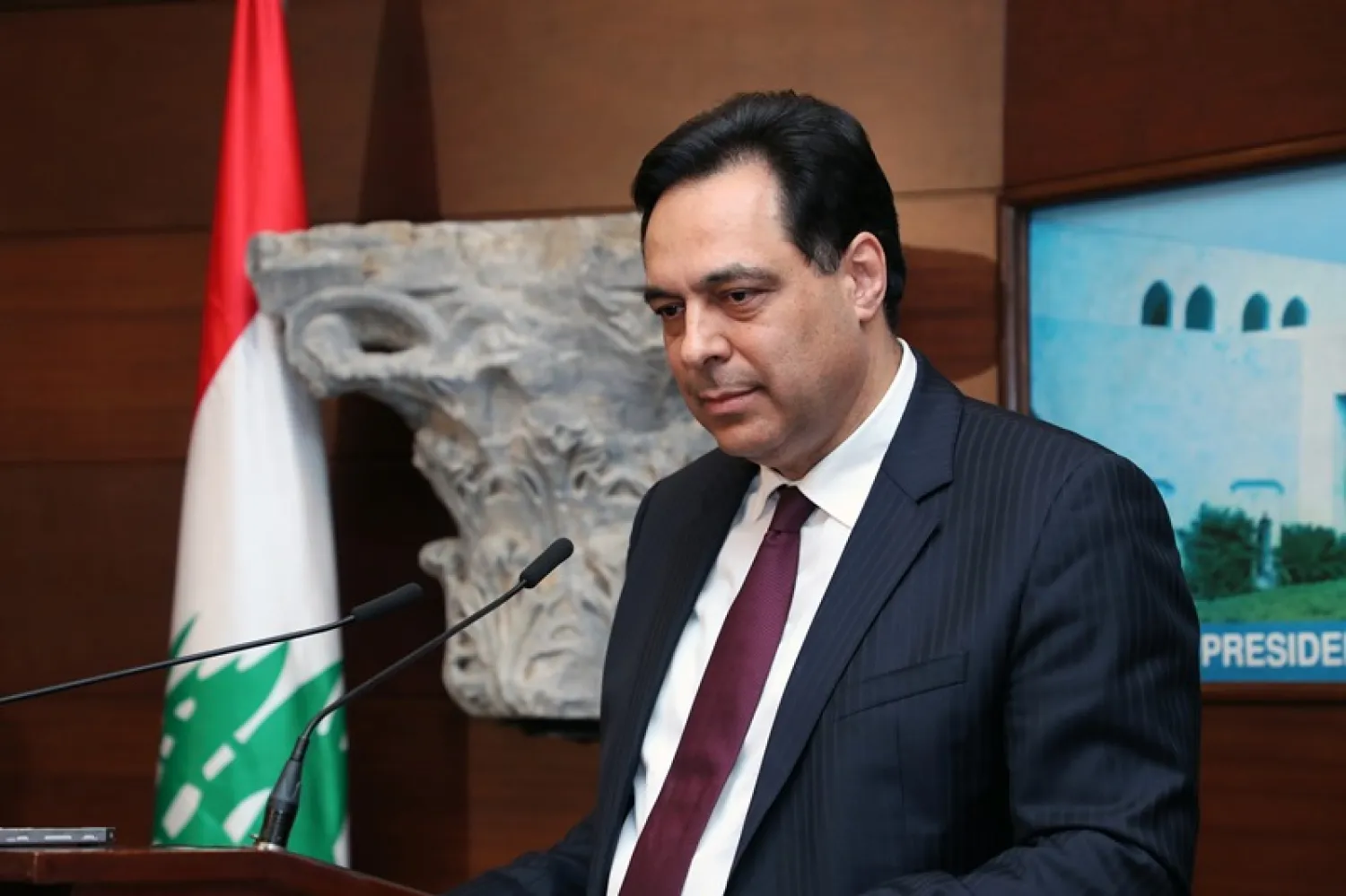

French Envoy in Beirut over CEDRE Decisions

PM Hassan Diab is expected to travel to Paris to meet with Macron (NNA)
TT

French Envoy in Beirut over CEDRE Decisions

PM Hassan Diab is expected to travel to Paris to meet with Macron (NNA)

A French envoy is expected in Beirut early next week to be briefed on the plans of the new government, which is badly in need of international aid pledged at the CEDRE donors conference held in Paris in 2018.

“Christophe Farno, director of the Middle East and North Africa Department at the French Foreign Ministry, is expected to arrive in Beirut soon,” a Lebanese diplomatic source in Paris told Asharq Al-Awsat Thursday.

Farno visited Beirut last November.

At the CEDRE conference held in Paris in April 2018, international donors pledged to provide Lebanon with $11 billion in loans and grants on condition that the country conducts serious reforms.

The CEDRE decisions list 72 reform projects.

A Lebanese government official told Asharq Al-Awsat on Thursday that Lebanon could soon receive a French green light on the implementation of some projects, which Beirut had proposed to the conference’s Paris-based secretariat. They include solutions to Lebanon’s electricity sector and a project on a highway linking Jiyyeh and Choueifat.

“France is expected to release funds (to implement) these projects following a visit by Prime Minister Hassan Diab to Paris, where he is expected to meet with President Emmanuel Macron and announce the implementation of some of the projects announced at the CEDRE conference,” the source said.

Last month, Lebanon formed Diab's new cabinet with pledges to work on necessary reforms to save the country from an economic and financial collapse.

On Wednesday, the French Foreign Ministry said the government must act quickly to respond to the economic, social and political expectations that the Lebanese people have been expressing for several months.

The Lebanese official source said that the French Ministry did not welcome the formation of the new cabinet. However, he stated that the international community awaits the reforms that the government is expected to introduce, mainly on economic transparency, fighting corruption and its ability to withstand economic and financial shocks.



Syrian Military, SDF Announce New Truce After Guards Leave Camp Housing ISIS Families

Members of the Syrian army ride a vehicle en route to al-Hassakeh, following the withdrawal of the Syrian Democratic Forces, Syria, January 20, 2026. (Reuters)
TT

Syrian Military, SDF Announce New Truce After Guards Leave Camp Housing ISIS Families

Members of the Syrian army ride a vehicle en route to al-Hassakeh, following the withdrawal of the Syrian Democratic Forces, Syria, January 20, 2026. (Reuters)

Guards from the Kurdish-led Syrian Democratic Forces (SDF) abandoned a camp Tuesday in northeast Syria housing thousands of people linked to the ISIS group, and the Syrian military said that allowed detainees to escape.

Hours later, the Syrian government and the SDF announced a new four-day truce after a previous ceasefire broke down. The two sides have been clashing for two weeks, amid a breakdown in negotiations over a deal to merge their forces together.

The al-Hol camp houses mainly women and children who are relatives of ISIS members. Thousands of accused ISIS militants are separately housed in prisons in northeast Syria.

Syria's interior ministry accused the SDF of allowing the release of “a number of detainees from the ISIS militant (group) along with their families.” The AP could not independently confirm if detainees had escaped from the camps or how many.

The SDF subsequently confirmed that its guards had withdrawn from the camp, but did not say whether any detainees escaped. The group blamed “international indifference toward the issue of the (ISIS) terrorist organization and the failure of the international community to assume its responsibilities in addressing this serious matter."

It said its forces had redeployed in other areas "that are facing increasing risks and threats” from government forces.

An official with the US military’s Central Command who spoke on condition of anonymity because they were not authorized to speak publicly said, “We are aware of the reports and are closely monitoring the situation.”

The SDF and the government also traded blame over the escape Monday of ISIS members from a prison in the northeastern town of Shaddadi.

The Syrian defense ministry in a statement said it is prepared to take over al-Hol camp and the prisons and accused the SDF of using them as “bargaining chips.”

At its peak in 2019, some 73,000 people were living at al-Hol camp. Since then the number has declined with some countries repatriating their citizens.

Sheikhmous Ahmad, a Kurdish official overseeing camps for displaced in northeastern Syria, told The Associated Press that the al-Hol's current population is about 24,000, about 14,500 of whom are Syrians and nearly 3,000 Iraqis.

He added that about 6,500 from other nationalities are held in a highly secured section of the camp, many of whom are die-hard ISIS supporters who came from around the world to join the extremist group.

Government and SDF trade blame over prison break

Earlier Tuesday, Syria's interior ministry said that 120 ISIS members had escaped Monday from the prison in Shaddadi, amid clashes between government forces and the SDF. Security forces recaptured 81 of them, the statement said.

Also Tuesday, the SDF accused “Damascus-affiliated factions” of cutting off water supplies to the al-Aqtan prison near the city of Raqqa, which it called a “blatant violation of humanitarian standards.”

The SDF, the main US-backed force that fought ISIS in Syria, controls more than a dozen prisons in the northeast where some 9,000 ISIS members have been held for years without trial.

ISIS was defeated in Iraq in 2017 and in Syria two years later, but the group’s sleeper cells still carry out deadly attacks in both countries.

Under a deal announced Sunday, government forces were to take over control of the prisons from the SDF, but the transfer did not go smoothly.

New ceasefire deal announced

The Syrian military announced Tuesday evening a new four-day ceasefire. The SDF confirmed the deal and said “it will not initiate any military action unless our forces are subjected to attacks.”

Elham Ahmad, a senior official with the Kurdish-led local administration in northeast Syria, told journalists Tuesday that an earlier ceasefire had fallen apart after SDF leader Mazloum Abdi requested a five-day grace period to implement the conditions and Syrian Interim President Ahmed al-Sharaa refused.

She blamed the government for violating the agreement but called for a return to dialogue.

In response to a journalist's question regarding whether the SDF had requested help from Israel - which previously intervened in clashes between government forces and groups from the Druze religious minority last year - Ahmad said “certain figures” from Israel had communicated with the SDF. She added that the SDF is ready to accept support from any source available.

A statement from al-Sharaa’s office said government forces will not enter Kurdish-majority areas until plans are agreed upon for their “peaceful integration” and that Kurdish villages will be patrolled by “local security forces drawn from the residents of the area.”

It said Abdi will put forward nominees from the SDF for the posts of deputy defense minister, governor of al-Hassakeh province, representatives in the parliament, and for other positions in Syrian state institutions.

SDF disappointment

SDF officials have expressed disappointment that the US did not intervene on their behalf. The group was long the main US partner in Syria in the fight against ISIS, but that has changed as the Trump administration has developed closer ties with al-Sharaa's government.

US envoy to Syria Tom Barrack in a statement Tuesday urged the SDF to move forward with integration into the new Syrian government and army and appeared to warn the Kurdish-led force that no help would be coming from Washington if it continued fighting.

He said SDF's role as the primary anti-ISIS force "has largely expired, as Damascus is now both willing and positioned to take over security responsibilities” and that “recent developments show the US actively facilitating this transition, rather than prolonging a separate SDF role."

Since toppling Bashar al-Assad in December 2024, Syria’s new leaders have struggled to assert full authority over the war-torn country. An agreement was reached in March that would merge the SDF with Damascus, but it didn’t gain traction.

Earlier this month, clashes broke out in the city of Aleppo, followed by the government offensive that seized control of Deir Ezzor and Raqqa provinces, critical areas under the SDF that include oil and gas fields, river dams along the Euphrates and border crossings.

Al-Sharaa postponed a planned trip to Germany Tuesday amid the ongoing tensions.


Gaza Committee Faces Israeli Hurdles as it Seeks Pressure from Mediators

Destroyed buildings in Gaza, as seen from Israel, January 20, 2026. (Reuters)
TT

Gaza Committee Faces Israeli Hurdles as it Seeks Pressure from Mediators

Destroyed buildings in Gaza, as seen from Israel, January 20, 2026. (Reuters)

The committee tasked with administering the Gaza Strip has begun work in Cairo, but its planned entry into the enclave has been blocked by Israel, a move mediators are seeking to head off as part of the second phase of the Gaza ceasefire agreement that began in mid-January and has drawn objections from Prime Minister Benjamin Netanyahu.

The ban followed Israel's objection to the White House announcement of leaders who will play a role in overseeing the next steps in Gaza.

Experts speaking to Asharq Al-Awsat said these objections represent major obstacles that complicate the second phase, which includes an Israeli withdrawal from Gaza, the launch of reconstruction, the deployment of stabilization forces, and the disarmament of Hamas.

They warned the obstacles could delay or derail implementation, stressing that pressure from the international community and mediators could push Washington to neutralize any Israeli hurdles.

Israel’s Haaretz newspaper quoted sources on Tuesday as saying Netanyahu’s government is refusing to allow members of the Palestinian “technocrats committee” to enter Gaza.

It said the committee members had been scheduled to enter the enclave this week via the Rafah crossing to assume civil administration duties by the end of the week.

The report said the committee’s members continue to hold meetings in Cairo, while mediators, particularly Egypt, are working with the United States to secure approval for the committee’s entry into Gaza by the end of the month.

Qatar’s Foreign Ministry spokesman Majed al-Ansari said at a press conference in Doha on Tuesday that the international community must pressure Israel to allow the technocrats committee to enter Gaza.

Hamas said in a statement on Tuesday that government bodies in Gaza have begun taking steps to facilitate the work of the national committee and hand over authority.

It stressed it has placed no preconditions on forming the committee or starting its work, but expects “independent professional and technical performance.”

Ahmed Fouad Anwar, a member of the Egyptian Council for Foreign Affairs and an academic specializing in Israeli affairs, said the Israeli ban is part of a pattern of obstacles Israel has attempted to impose at every stage of the Gaza agreement, as it did during the first phase.

He said he expects US pressure to prevent the continued ban on committee members.

Palestinian political analyst Nizar Nazzal said Israel wants an administrative committee stripped of authority and willpower, adding that the ban is calculated and deliberate.

He nevertheless expects the committee to eventually enter Gaza to begin work, saying Israeli leaks appear to be a media bubble aimed mainly at domestic audiences.

Reuters reported that Israeli Finance Minister Bezalel Smotrich urged Netanyahu on Monday to shut down the US-led multinational coordination center supporting President Donald Trump’s plan to end the war in Gaza, calling for Hamas to be given a final ultimatum to disarm or face the destruction of the enclave.

The White House announced on Friday the formation of an 11-member Gaza Executive Board, including Egyptian intelligence chief Hassan Rashad, Turkish Foreign Minister Hakan Fidan, UN Special Coordinator for the Middle East Peace Process Sigrid Kaag, UAE Minister of State for International Cooperation Reem Al-Hashimy, and Israeli-Cypriot billionaire Yakir Gabay.

A day after Trump announced the executive bodies, Netanyahu’s office said the move was made without coordination with Israel and runs counter to its policy, adding that Foreign Minister Gideon Saar would raise the issue with his US counterpart Marco Rubio.

Anwar said Israeli objections began even before the second phase of the Gaza plan, with Netanyahu’s government demanding the return of the last remains of Israeli hostages and the disarmament of Hamas.

He said the phase began nonetheless without Washington responding to those demands, predicting that Israel would try to obstruct the second phase, while the US continues to ignore them.


Türkiye’s Erdogan Says Discusses Syria, Gaza with Trump in 'Very Good' Call

US President Donald Trump, left, greets Turkish President Recep Tayyip Erdogan during a summit on Gaza in Sharm el-Sheikh on October 13, 2025. (AFP)
TT

Türkiye’s Erdogan Says Discusses Syria, Gaza with Trump in 'Very Good' Call

US President Donald Trump, left, greets Turkish President Recep Tayyip Erdogan during a summit on Gaza in Sharm el-Sheikh on October 13, 2025. (AFP)

Turkish President Recep Tayyip Erdogan discussed developments in Syria and Gaza in a call with US President Donald Trump, his office said on Wednesday, as Syria's ​Türkiye-backed government announced a ceasefire with US-allied Kurdish forces after days of clashes.

Syria's government this week seized swathes of territory in the northeast and gave the Kurdish-led Syrian Democratic Forces four days to agree on integrating into the central state.

The SDF's main ally, the United States, said in a statement that the partnership with the group had changed nature after Syria's ‌new government ‌emerged and urged the group to ‌accept.

"During ⁠the ​call, President ‌Erdogan stated that Türkiye was closely following developments in Syria, that Syria's unity, harmony and territorial integrity were important for Türkiye," the Turkish presidency said in a statement.

It added that Erdogan and Trump also discussed the battle with ISIS and "the situation of the ISIS prisoners in the Syrian prisons".

Türkiye deems the SDF a ⁠terrorist organization linked with the outlawed Kurdistan Workers Party (PKK), which has carried out a ‌four-decade insurgency against the Turkish state.

Ankara ‍has been engaged in a ‍peace process with the PKK, under which it says the ‍militant group - and its extensions - must disband and disarm.

Ankara, the main foreign backer of Syria's new government, has praised Damascus' advances against the SDF and repeatedly demanded that the group disband, disarm, and integrate into ​the Syrian state apparatus.

"Our President said that a Syria that is developing with all of its elements, is ⁠rid of terror and in peace will contribute to the region's stability," Erdogan's office said.

The two presidents also discussed developments in Gaza, it said, adding Erdogan told Trump that Türkiye would continue to work in coordination with its NATO ally the United States to achieve peace there.

Erdogan thanked Trump for inviting him to join the Board of Peace, it added.

Trump said earlier on Tuesday that he had a "very good call" with Erdogan, without elaborating, after having told reporters during a briefing prior to the meeting that the ‌discussions were going to be "very important".