


Running Reaches Crossroads as Nike-Led Footwear Arms Race Infects Mainstream

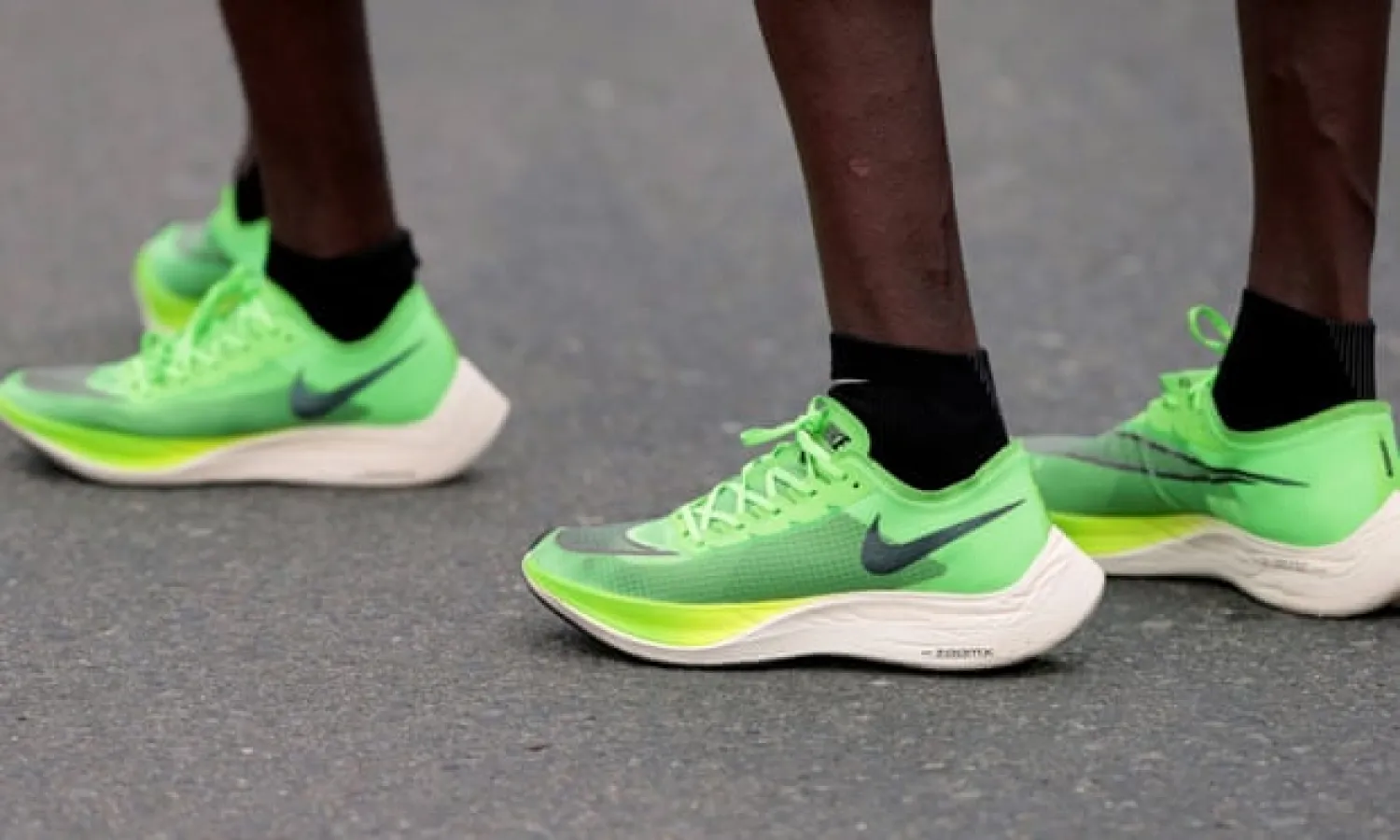
 Nike’s Vaporfly have been been dominant as eight of the top 12 men’s or women’s marathon times have been set in the last 18 months. Photograph: Christopher Pike/Reuters
Nike’s Vaporfly have been been dominant as eight of the top 12 men’s or women’s marathon times have been set in the last 18 months. Photograph: Christopher Pike/Reuters
TT

Running Reaches Crossroads as Nike-Led Footwear Arms Race Infects Mainstream

 Nike’s Vaporfly have been been dominant as eight of the top 12 men’s or women’s marathon times have been set in the last 18 months. Photograph: Christopher Pike/Reuters
Nike’s Vaporfly have been been dominant as eight of the top 12 men’s or women’s marathon times have been set in the last 18 months. Photograph: Christopher Pike/Reuters

There was a guy at parkrun the weekend before last wearing a pair of lime-green Vaporflys on the start line. At least he looked suitably sheepish about it – pointedly ignoring the sharp whispers, the discreet pointing, the gentle ribbing from his running club mates. With its clownish platform heels and lurid alien colour scheme, the Vaporfly is not a shoe for blending into the crowd. Even in a field of 600 anonymous runners the eye is always going to be drawn to the one wearing what looks like a mutant tropical fish on each foot. The race began and off he streaked: a blur of lime-green disappearing into the distance, leaving the rest of us, with our boring reasonably-priced shoes and sniggering moral judgments, in his dust.

Of course, it’s easy to scoff when the stakes are minuscule. Turning up for your local Saturday morning fun run in £250 space-age trainers: objectively very funny, and largely analogous to the guy who wears his Lionel Messi astro boots to Wednesday five-a-side (and leaves with several painful stud-shaped indentations in his ankle). What happens, though, when the stakes are far higher? When the prize is an Olympic gold medal, when the audience is global, when the margins are life-changing? Should it matter what shoes the competitors are wearing? And if not, why not?

These are some of the questions with which athletics has been grappling in recent months. In a way they go well beyond the optimum thickness of a nitrogen-infused midsole or whether two carbon plates should be allowed to overlap. No question of sporting ethics can be resolved purely through science and, by the same token, the terms of our emotional engagement are far too important to be dictated by administrators bearing formulae. The question of the Nike Vaporflys – and its successor models – is thus one that cuts to the very core of what sport is about, or should be.

By now readers will be aware of how Vaporfly-shod athletes have been laying waste to the record books, quietly and quickly changing the face of the sport. Eight of the 12 fastest men’s or women’s marathons in history have been run in the last 18 months. In October, in Vienna, Eliud Kipchoge became the first man to run the marathon distance in under two hours. The prototype Alphafly shoes he wore for that effort are banned but last month World Athletics retroactively declared the Vaporflys legal as well as the records set in them.

The first point to make here – although in the scale of things, not a terrifically helpful one – is that Nike have done nothing illegal or even that novel. Carbon plates date back to the early 2000s, with Paul Tergat breaking the marathon world record in a pair of Filas in 2003. Nor is there much new in the deployment of energy-efficient foam, which Adidas first pioneered almost a decade ago. Nike’s stroke of insight has been to synthesise largely existent technologies into a single devastating package, one that with the backing of World Athletics has in effect rewritten the terms of distance running. Either you join the arms race (if, that is, you can negotiate Nike’s imperial battalion of patent lawyers). Or you lose.

You don’t have to be a luddite or a nostalgic to wonder about where this vision of athletics might ultimately lead. For those at the vanguard of the revolution these are genuinely transformative times – a chance to rebrand athletics as a high-powered, jaw-dropping spectator entertainment. When Kipchoge states, with all the evangelical zeal of a tech bro in a headset giving a Ted talk, that “we must go with technology” and compares Nike’s trainer innovation with the role of tyre manufacturers in Formula One, he is articulating an entirely different sort of sport from the one we grew up with: one in which the turning wheel of technological progress is not merely an auxiliary sideshow but part of the spectacle itself.

The main gripe here is not driven by ideology or anti-progress. We are not talking about returning to cinder tracks and putting everyone in Dunlop Green Flash. Nor is it the increasingly corrosive influence of Nike on athletics, an entire sport now in effect in thrall to a single company; nor the inevitable human wastage of athletes physiologically unsuited to the new technology or sponsored by companies unable to replicate it or simply unable to afford it; nor even the colossal environmental dereliction of a shoe that has to be thrown away after 200 miles of use.

No, the real point is this: in the same way that nobody reads novels to marvel at the typeface, nobody watches athletics – in many ways the oldest and purest sport of all – to gawp at the trainers. Do you know how many butt-numbingly boring articles about shoe technology I had to read before I could start writing this column? Even its very existence feels like the triumph of the inane over the essential, a lame surrender to the Nike marketing octopus. (Woman in Nike’s PR department, reading Vaporfly’s press coverage: “Oh, no. Another article criticising our shoes for being too fast. How utterly terrible.”)

But then, if you’re a sport in 2020 and not somehow facilitating disposable parasite-consumerism, then do you even really exist? Perhaps once, long ago, before we were terminally jaded by doping scandals, we could still cling to the idea that athletics somehow represented the very best of us as a species; that its feats might inspire us, rather than simply inspire us to buy trainers; that this was genuinely a sport operating by the laws of the body, not the laws of the market. Or perhaps this too was always delusion: a lime-green speck on the horizon, gently receding ever further into the distance.

The Guardian Sport


Hospital: Vonn Had Surgery on Broken Leg from Olympics Crash

This handout video grab from IOC/OBS shows US Lindsey Vonn crashing during the women's downhill event at the Milano Cortina 2026 Winter Olympic Games on February 8, 2026. (Photo by Handout / various sources / AFP)
TT

Hospital: Vonn Had Surgery on Broken Leg from Olympics Crash

This handout video grab from IOC/OBS shows US Lindsey Vonn crashing during the women's downhill event at the Milano Cortina 2026 Winter Olympic Games on February 8, 2026. (Photo by Handout / various sources / AFP)

Lindsey Vonn had surgery on a fracture of her left leg following the American's heavy fall in the Winter Olympics downhill, the hospital said in a statement given to Italian media on Sunday.

"In the afternoon, (Vonn) underwent orthopedic surgery to stabilize a fracture of the left leg," the Ca' Foncello hospital in Treviso said.

Vonn, 41, was flown to Treviso after she was strapped into a medical stretcher and winched off the sunlit Olimpia delle Tofane piste in Cortina d'Ampezzo.

Vonn, whose battle to reach the start line despite the serious injury to her left knee dominated the opening days of the Milano Cortina Olympics, saw her unlikely quest halted in screaming agony on the snow.

Wearing bib number 13 and with a brace on the left knee she ⁠injured in a crash at Crans Montana on January 30, Vonn looked pumped up at the start gate.

She tapped her ski poles before setting off in typically aggressive fashion down one of her favorite pistes on a mountain that has rewarded her in the past.

The 2010 gold medalist, the second most successful female World Cup skier of all time with 84 wins, appeared to clip the fourth gate with her shoulder, losing control and being launched into the air.

She then barreled off the course at high speed before coming to rest in a crumpled heap.

Vonn could be heard screaming on television coverage as fans and teammates gasped in horror before a shocked hush fell on the packed finish area.

She was quickly surrounded by several medics and officials before a yellow Falco 2 ⁠Alpine rescue helicopter arrived and winched her away on an orange stretcher.


Meloni Condemns 'Enemies of Italy' after Clashes in Olympics Host City Milan

Demonstrators hold smoke flares during a protest against the environmental, economic and social impact of the Milano-Cortina 2026 Winter Olympics in Milan, Italy, February 7, 2026. REUTERS/Kevin Coombs
TT

Meloni Condemns 'Enemies of Italy' after Clashes in Olympics Host City Milan

Demonstrators hold smoke flares during a protest against the environmental, economic and social impact of the Milano-Cortina 2026 Winter Olympics in Milan, Italy, February 7, 2026. REUTERS/Kevin Coombs

Italian Prime Minister Giorgia Meloni has condemned anti-Olympics protesters as "enemies of Italy" after violence on the fringes of a demonstration in Milan on Saturday night and sabotage attacks on the national rail network.

The incidents happened on the first full day of competition in the Winter Games that Milan, Italy's financial capital, is hosting with the Alpine town of Cortina d'Ampezzo.

Meloni praised the thousands of Italians who she said were working to make the Games run smoothly and present a positive face of Italy.

"Then ⁠there are those who are enemies of Italy and Italians, demonstrating 'against the Olympics' and ensuring that these images are broadcast on television screens around the world. After others cut the railway cables to prevent trains from departing," she wrote on Instagram on Sunday.

A group of around 100 protesters ⁠threw firecrackers, smoke bombs and bottles at police after breaking away from the main body of a demonstration in Milan.

An estimated 10,000 people had taken to the city's streets in a protest over housing costs and environmental concerns linked to the Games.

Police used water cannon to restore order and detained six people.

Also on Saturday, authorities said saboteurs had damaged rail infrastructure near the northern Italian city of Bologna, disrupting train journeys.

Police reported three separate ⁠incidents at different locations, which caused delays of up to 2-1/2 hours for high-speed, Intercity and regional services.

No one has claimed responsibility for the damage.

"Once again, solidarity with the police, the city of Milan, and all those who will see their work undermined by these gangs of criminals," added Meloni, who heads a right-wing coalition.

The Italian police have been given new arrest powers after violence last weekend at a protest by the hard-left in the city of Turin, in which more than 100 police officers were injured.


Liverpool New Signing Jacquet Suffers 'Serious' Injury

Soccer Football - Ligue 1 - RC Lens v Stade Rennes - Stade Bollaert-Delelis, Lens, France - February 7, 2026  Stade Rennes' Jeremy Jacquet in action REUTERS/Benoit Tessier
Soccer Football - Ligue 1 - RC Lens v Stade Rennes - Stade Bollaert-Delelis, Lens, France - February 7, 2026 Stade Rennes' Jeremy Jacquet in action REUTERS/Benoit Tessier
TT

Liverpool New Signing Jacquet Suffers 'Serious' Injury

Soccer Football - Ligue 1 - RC Lens v Stade Rennes - Stade Bollaert-Delelis, Lens, France - February 7, 2026  Stade Rennes' Jeremy Jacquet in action REUTERS/Benoit Tessier
Soccer Football - Ligue 1 - RC Lens v Stade Rennes - Stade Bollaert-Delelis, Lens, France - February 7, 2026 Stade Rennes' Jeremy Jacquet in action REUTERS/Benoit Tessier

Liverpool's new signing Jeremy Jacquet suffered a "serious" shoulder injury while playing for Rennes in their 3-1 Ligue 1 defeat at RC Lens on Saturday, casting doubt over the defender’s availability ahead of his summer move to Anfield.

Jacquet fell awkwardly in the second half of the ⁠French league match and appeared in agony as he left the pitch.

"For Jeremy, it's his shoulder, and for Abdelhamid (Ait Boudlal, another Rennes player injured in the ⁠same match) it's muscular," Rennes head coach Habib Beye told reporters after the match.

"We'll have time to see, but it's definitely quite serious for both of them."
Liverpool agreed a 60-million-pound ($80-million) deal for Jacquet on Monday, but the 20-year-old defender will stay with ⁠the French club until the end of the season.

Liverpool, provisionally sixth in the Premier League table, will face Manchester City on Sunday with four defenders - Giovanni Leoni, Joe Gomez, Jeremie Frimpong and Conor Bradley - sidelined due to injuries.
