
Syria War Enters 10th Year With No Hope in Sight

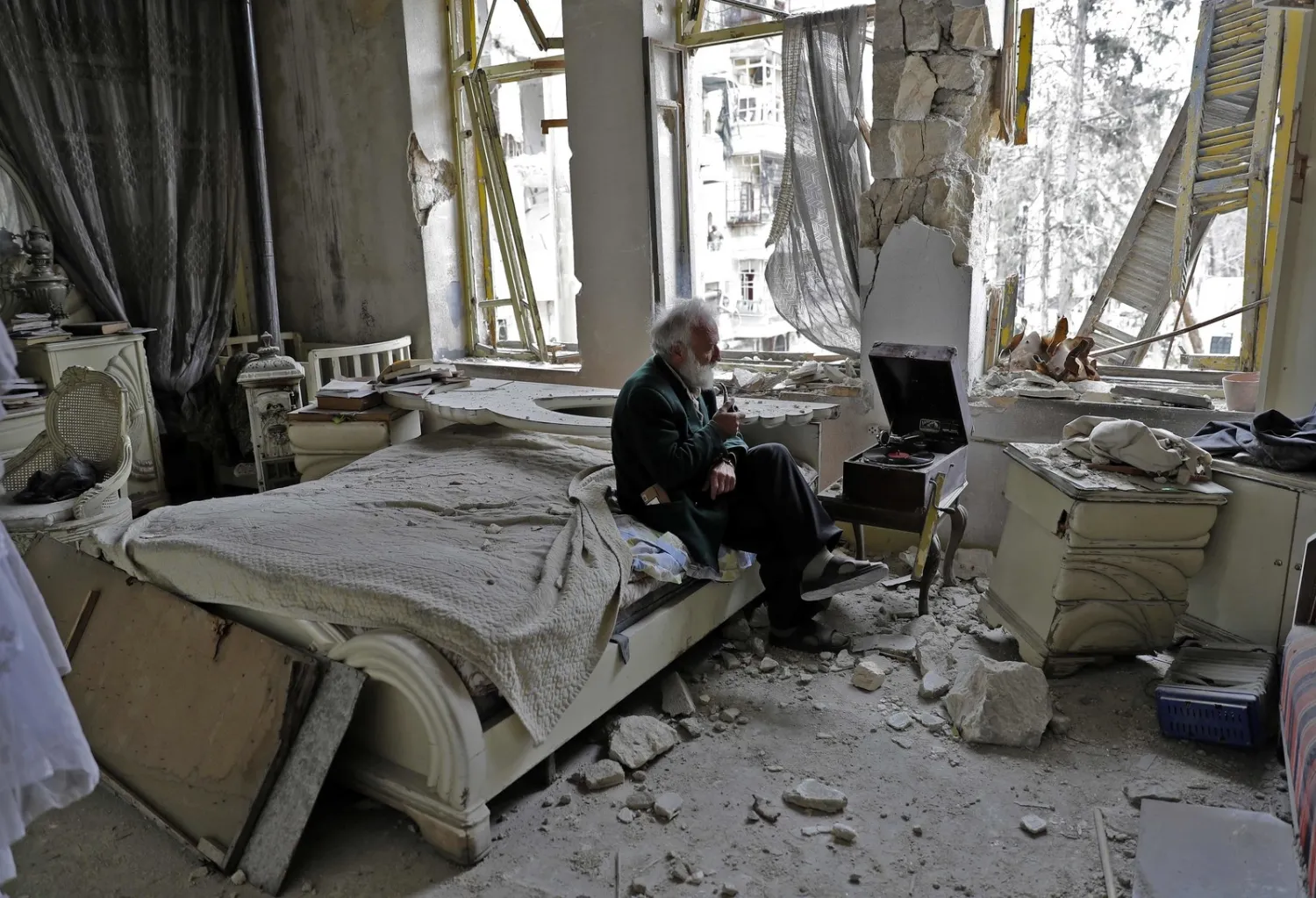
A Syrian man smokes his pipe in his destroyed bedroom in Aleppo's formerly rebel-held Shaar neighborhood on March 9, 2017 | AFP
TT

Syria War Enters 10th Year With No Hope in Sight

A Syrian man smokes his pipe in his destroyed bedroom in Aleppo's formerly rebel-held Shaar neighborhood on March 9, 2017 | AFP

As it enters its tenth year, the war in Syria is anything but abating, as foreign powers scrap over a ravaged country where human suffering keeps reaching new levels.

When protesters in March 2011 demanded their rights and regime change, they likely never imagined it would trigger a reaction that has led to the 21st century's biggest war.

Nine years on, President Bashar al-Assad is still in power and there to stay, more than 380,000 people have died, dozens of towns and cities razed to the ground and half of the country's entire population displaced.

Nearly a year after the Islamic State group's "caliphate" was dismantled, the West's attention towards Syria was only pricked again last month when Turkey threatened to open the floodgates for migrants seeking to flee to Europe.

While the number of fronts has been reduced by Damascus' reconquest in recent years, the nature of the war is changing and violence is still raging in the northwest.

Some other regions have long been pacified, but people there have yet to feel the dividends of peace as Syria plays host to a complex international showdown involving Russia, the United States, Turkey, Israel and Iran.

"It's certainly not a simple international conflict," said Syria researcher Fabrice Balanche.

Nine years ago, teenagers inspired by Arab Spring uprisings they saw on television, spray-painted a message on the walls of a school in the southern city of Daraa.\

"Down with the regime. Your turn, Doctor," they scrawled, referring to Assad, a trained ophthalmologist.

Within days security forces detained them, sparking angry protests many say triggered Syria's uprising.

But a violent crackdown soon saw revolutionaries take up arms with backing from Gulf nations, and wrest key areas from government control.

Militant groups also emerged, most notably ISIS, which swept across large parts of the country and neighboring Iraq in 2014.

As the situation unraveled, foreign armies soon entered the arena, eventually leading Damascus, with the support of Russia and Iran, to regain the upper hand. It now controls 70 percent of the country.

- Five foreign powers -

Alarmed by ISIS, Washington intervened in 2014 with airstrikes on Syrian soil as the head of a global coalition against the militants.

A year later Moscow waded in on Assad's side in a move that would turn the tide of Syria's war.

Iran, with its elite Revolutionary Guards and allied Iraqi and Lebanese fighters, also took an active role in backing the regime, in what analysts say was a move to secure access to the Mediterranean.

Turkey, meanwhile, launched the first of several incursions across its southern border in 2016 and last year seized a 120-kilometer (70-mile) long strip of land from Kurdish fighters it views as "terrorists".

Israel has carried out hundreds of strikes in Syria, which it says mostly target Iranian and Lebanese fighters.

Omar Abu Leyla, an activist now living abroad, accuses Western powers who initially took a stand against Assad of shifting all their focus to fighting jihadists after 2014 -- to the detriment of the revolution.

"Syria became increasingly destroyed and splintered after 2011, and the international community is responsible," he said.

- 'Russian-Iranian protectorate' -

Syria's war has displaced more than 11 million people at home and abroad, with Turkey absorbing more Syrian refugees than any other country in the world.

In the latest fighting, a Russia-backed offensive since December on the last major rebel bastion of Idlib has forced almost a million people to flee towards the closed Turkish border within months.

The ongoing humanitarian emergency in northwestern Syria has been described by the aid community as the worst since the start of the war.

A Russian-Turkish ceasefire holds for now in Idlib, though it is not clear for how long it will stem resisting jihadists and Turkey-backed rebels.

The deal was met with skepticism by residents who have seen countless other initiatives flounder in recent years, but Balanche said he expected the fighting to die down in the coming years.

After the northeast returns to the government, "the country will be a Russian-Iranian protectorate while Turks occupy the north", Balanche said.

Idlib would likely become a Syrian version of the Gaza Strip, he said, with millions crammed into a narrow sliver of land on the border.

"Assad will stay in power and be re-elected in 2021," he said.

In regime-held areas, the government has been accused of widespread detentions and forced army conscriptions.

Omar al-Hariri, another exiled activist, said it was hard to believe so many of his fellow Syrians were now dead.

"If we asked people today if they'd rather revert to the way things were before 2011, they might say yes," he said.

"But what's done is done. There's no going back."


Rescue Teams Search for Survivors in Building Collapse that Killed at Least 2 in Northern Lebanon

A Lebanese flag is pictured, in the aftermath of a massive explosion, in Beirut's damaged port area, Lebanon August 17, 2020. REUTERS/Hannah McKay
TT

Rescue Teams Search for Survivors in Building Collapse that Killed at Least 2 in Northern Lebanon

A Lebanese flag is pictured, in the aftermath of a massive explosion, in Beirut's damaged port area, Lebanon August 17, 2020. REUTERS/Hannah McKay

At least two people were killed and four rescued from the rubble of a multistory apartment building that collapsed Sunday in the city of Tripoli in northern Lebanon, state media reported.

Rescue teams were continuing to dig through the rubble. It was not immediately clear how many people were in the building when it fell.

The bodies pulled out were of a child and a woman, the state-run National News Agency reported.

Dozens of people crowded around the site of the crater left by the collapsed building, with some shooting in the air.

The building was in the neighborhood of Bab Tabbaneh, one of the poorest areas in Lebanon’s second largest city, where residents have long complained of government neglect and shoddy infrastructure. Building collapses are not uncommon in Tripoli due to poor building standards, according to The AP news.

Lebanon’s Health Ministry announced that those injured in the collapse would receive treatment at the state’s expense.

The national syndicate for property owners in a statement called the collapse the result of “blatant negligence and shortcomings of the Lebanese state toward the safety of citizens and their housing security,” and said it is “not an isolated incident.”

The syndicate called for the government to launch a comprehensive national survey of buildings at risk of collapse.


Israel to Take More West Bank Powers and Relax Settler Land Buys

A view of Israeli settlement of Maale Adumim, in the West Bank, Sunday, June 18, 2023. (AP)
TT

Israel to Take More West Bank Powers and Relax Settler Land Buys

A view of Israeli settlement of Maale Adumim, in the West Bank, Sunday, June 18, 2023. (AP)

Israel's security cabinet approved a series of steps on Sunday that would make it easier for settlers in the occupied West Bank to buy land while granting Israeli authorities more enforcement powers over Palestinians, Israeli media reported.

The West Bank is among the territories that the Palestinians seek for a future independent state. Much of it is under Israeli military control, with limited Palestinian self-rule in some areas run by the Western-backed Palestinian Authority (PA).

Citing statements by Finance Minister Bezalel Smotrich and Defense Minister Israel Katz, Israeli news sites Ynet and Haaretz said the measures included scrapping decades-old regulations that prevent Jewish private citizens buying land in the West Bank, The AP news reported.

They were also reported to include allowing Israeli authorities to administer some religious sites, and expand supervision and enforcement in areas under PA administration in matters of environmental hazards, water offences and damage to archaeological sites.

Palestinian President Mahmoud Abbas said the new measures were dangerous, illegal and tantamount to de-facto annexation.

The Israeli ministers did not immediately respond to requests for comment.

The new measures come three days before Prime Minister Benjamin Netanyahu is scheduled to meet in Washington with US President Donald Trump.

Trump has ruled out Israeli annexation of the West Bank but his administration has not sought to curb Israel's accelerated settlement building, which the Palestinians say denies them a potential state by eating away at its territory.

Netanyahu, who is facing an election later this year, deems the establishment of any Palestinian state a security threat.

His ruling coalition includes many pro-settler members who want Israel to annex the West Bank, land captured in the 1967 Middle East war to which Israel cites biblical and historical ties.

The United Nations' highest court said in a non-binding advisory opinion in 2024 that Israel's occupation of Palestinian territories and settlements there is illegal and should be ended as soon as possible. Israel disputes this view.


Arab League Condemns Attack on Aid Convoys in Sudan

A general view shows the opening session of the meeting of Arab foreign ministers at the Arab League Headquarters (Reuters)
TT

Arab League Condemns Attack on Aid Convoys in Sudan

A general view shows the opening session of the meeting of Arab foreign ministers at the Arab League Headquarters (Reuters)

Arab League Secretary-General Ahmed Aboul Gheit strongly condemned the attack by the Rapid Support Forces on humanitarian aid convoys and relief workers in North Kordofan State, Sudan.

In a statement reported by SPA, secretary-general's spokesperson Jamal Rushdi quoted Aboul Gheit as saying the attack constitutes a war crime under international humanitarian law, which prohibits the deliberate targeting of civilians and depriving them of their means of survival.

Aboul Gheit stressed the need to hold those responsible accountable, end impunity, and ensure the full protection of civilians, humanitarian workers, and relief facilities in Sudan.