


'No Games, Nothing to Do': Coronavirus Wreaks Havoc With Asian Football

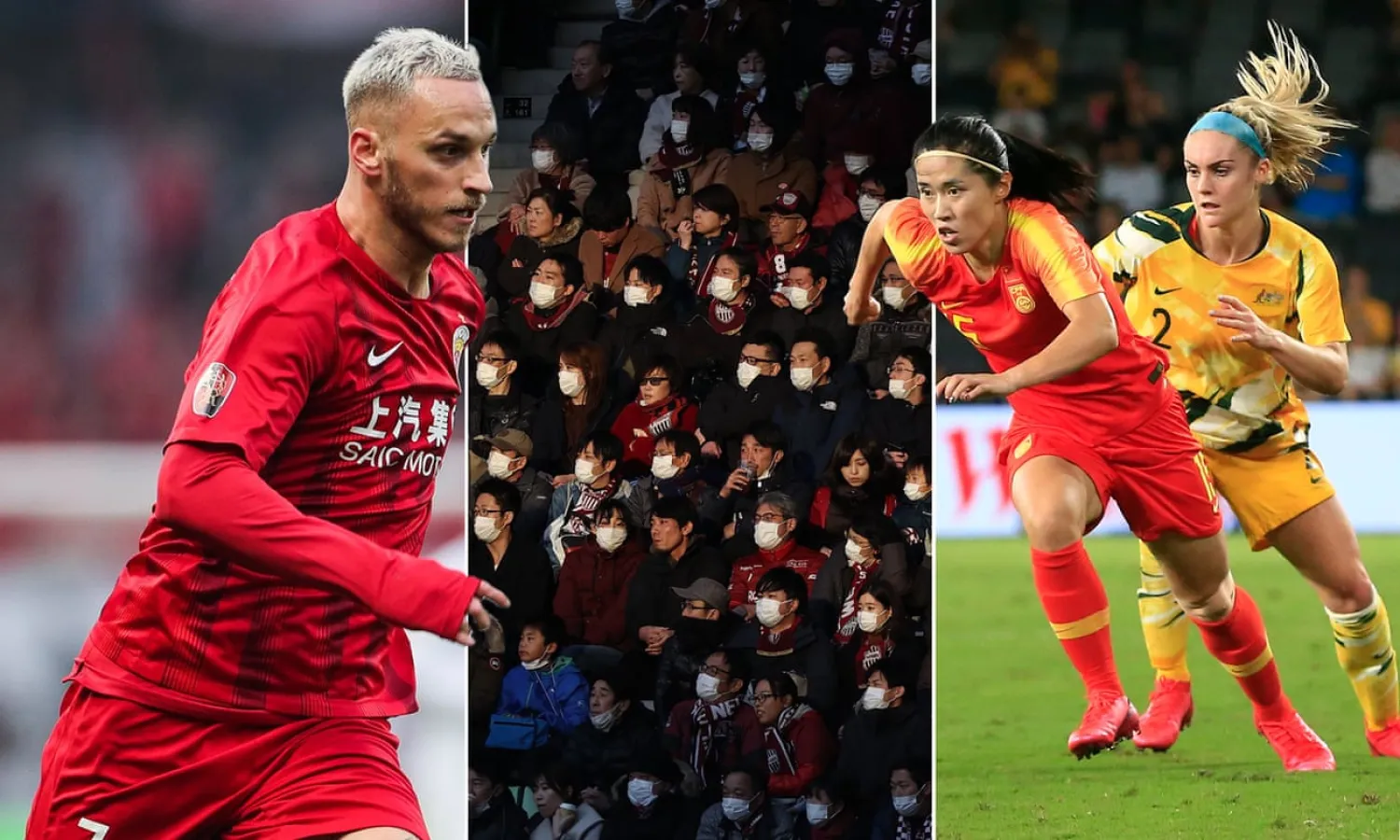
 From left to right: Marko Arnautovic of Shanghai, Vissel Kobe fans wearing face masks, Song Duan of China competes for the ball with Ellie Carpenter of the Matildas. Photograph: Getty, Shutterstock
From left to right: Marko Arnautovic of Shanghai, Vissel Kobe fans wearing face masks, Song Duan of China competes for the ball with Ellie Carpenter of the Matildas. Photograph: Getty, Shutterstock
TT

'No Games, Nothing to Do': Coronavirus Wreaks Havoc With Asian Football

 From left to right: Marko Arnautovic of Shanghai, Vissel Kobe fans wearing face masks, Song Duan of China competes for the ball with Ellie Carpenter of the Matildas. Photograph: Getty, Shutterstock
From left to right: Marko Arnautovic of Shanghai, Vissel Kobe fans wearing face masks, Song Duan of China competes for the ball with Ellie Carpenter of the Matildas. Photograph: Getty, Shutterstock

Much of football was unhappy when the 2022 World Cup was moved to winter but those extra five months may yet be appreciated. This is especially true in Asia where qualification for Qatar has been delayed as football in the giant continent grinds to a halt in what is usually one of the busiest months of the year. One person at the Korean Football Association said: “I go to the office but don’t do anything. There are no games, no tournaments and not many meetings. We can only wait.”

The coronavirus started to impact Asian football in January. Thailand’s Buriram United were uncomfortable about the prospect of facing Hulk, Oscar and Marko Arnautovic in Shanghai but not, this time, because the Asian Champions League qualifying play-off was a one legged game away from home. What really concerned them was this new virus that was spreading around China. Buriram wondered whether the game should be postponed but were told that it would be played behind closed doors, and Asian football has been playing catch up ever since.

On 22 January, the Asian Football Confederation (AFC) moved Group B of women’s qualifiers for the Olympics from Wuhan, where the virus emerged, to the eastern city of Nanjing. It seems so innocent now. It was soon shifted to Australia but the visiting Chinese team had to stay quarantined in a Brisbane hotel and exercise in corridors. Despite the limitations, the team performed well, earning an elimination play-off against South Korea. That game was postponed to April but the Chinese didn’t want to go to Korea and the the host city of Yongin wanted nothing to do with it. Now it will be, hopefully, June.

Every new measure taken has been followed by a stricter one. In terms of international competitions, pretty much everything that can be postponed has been. The same is true of a growing number of domestic leagues. Unlike Europe, many seasons are just starting so there is some leeway but, assuming the situation calms down at some point in the next month or two, there are going to be some serious fixture logjams to clear. This is the best-case scenario.

The Chinese Super League was the first to delay the big kick off, scheduled for 22 February. At that time, many teams were not even in the country. Shijiazhuang Everbright, for example, had left the Middle Kingdom for an Abu Dhabi training camp in January. It was supposed to last for two weeks but those two weeks have become seven as returning home early could see the players and staff confined to their clubhouse.

Trying to keep players motivated and focused is a challenge for the coach, Afshin Ghotbi. What made it worse was after six weeks, the UAE Tour came to the same hotel and brought with it suspected cases. Fortunately, Shijiazhuang had to stay inside for just two days before switching hotels. “It was a difficult situation as we could not leave the hotel,” Ghotbi told the Guardian. “There was a gym of course but there were also 300 cyclists with the same idea. We had lots of discussions and told authorities that our players were being well-looked after and were being closely monitored by our own staff. I am proud how the players handled it. Now we are waiting to hear when the season will start.” It is unlikely to do so before May.

Trying to keep players – many concerned about family back home – motivated and focused is a challenge for coach Afshin Ghotbi. What made it worse was after six weeks in the city, cyclists in the UAE Tour that were staying in the same hotel tested positive for the virus. Fortunately, Shijiazhuang had to stay inside for just two days before switching hotels. May is the earliest when football in China will restart.

South Korea had told fans attending early Champions League games (the continental competition started but has been pushed back on numerous occasions) to wear masks, have temperatures taken and submit a medical questionnaire before entering stadiums, but suddenly there was a sudden surge in cases and the K-League was postponed.

The J League did play a first round of games, with Vissel Kobe telling fans not to sing, chant or move too much – though clapping was OK – before taking a three-week break. The planned mid-March restart is not going to happen. The 2020 Olympics, set to start in Tokyo in late July, are weighing heavily on minds and not only in the Japanese capital. For South Korea’s men the prospect of not being able to compete when a medal means exemption from military service is starting to become a genuine possibility.

The Asian World Cup qualifiers due to take place in March and June have been postponed and moved to, probably, September and October, although this does come with a silver lining, at least in China. The national team has been struggling in the second stage of qualification. Only top spot gives an automatic place in the next round but four of the eight best runners-up also go through. That now is China’s target.

Later in the year, Brazilian playmaker Ricardo Goulart, one of the best imports in recent years, will be eligible to turn out for Team Dragon. After one point from two games against the Philippines and Syria ended with the resignation of Marcello Lippi in November, the delay also means there is more time for new boss Li Tie, formerly of Everton and Sheffield United, and a bright coaching prospect, to spend with his players.

At the moment, however, there is nothing to do but wait.

The Guardian Sport


International Olympic Committee Lifts Restrictions on Belarusian Athletes

The International Olympic Committee on Thursday lifted restrictions imposed on Belarusian athletes (Reuters)
TT

International Olympic Committee Lifts Restrictions on Belarusian Athletes

The International Olympic Committee on Thursday lifted restrictions imposed on Belarusian athletes (Reuters)

The International Olympic Committee on Thursday lifted all restrictions on Belarusian athletes, clearing the way for their return to international competitions, including at qualifiers for the Los Angeles 2028 Olympics, it said in a statement.

The IOC had recommended that Russian and Belarusian athletes and officials be banned from events since 2022 following Russia's invasion of Ukraine.

Belarus was used as a staging ground for ⁠the Russian invasion.

"The ⁠IOC Executive Board no longer recommends any restrictions on the participation of Belarusian athletes, including teams, in competitions governed by International Federations and international sports event organizers," Reuters quoted the Olympic body as saying.

Athletes from Belarus can now freely compete under their own flag and anthem, including in team ⁠sports. They can also take part in all qualifying events starting later this year for the 2028 Los Angeles Olympics.

At both the 2024 Paris Olympics and the 2026 Milano Cortina Winter Olympics, only a handful of Russian and Belarusian athletes were allowed to compete, in individual events only and as neutral athletes without their flag.

The IOC said the lifting of restrictions would not apply to Russian athletes.

There has been increased speculation a similar decision ⁠could be ⁠made for Russia in the coming months.

"The situation relating to the Russian Olympic Committee (ROC) is different from that relating to the National Olympic Committee (NOC) of Belarus. The NOC of Belarus is in good standing and complies with the Olympic Charter," the IOC said.

Russia's Olympic committee was suspended in October 2023 for recognizing regional Olympic councils for Russian-occupied regions of Ukraine - Luhansk, Donetsk, Kherson and Zaporizhzhia - following Russia's invasion.

The IOC said at the time this had violated the Olympic Charter and the territorial integrity of Ukraine’s Olympic Committee.


Italy's Tennis Chief Wants to Break Grand Slam 'Monopoly' with New Major

(FILES) Italy's Jasmine Paolini (L) and Angelo Binaghi, President of the Italian Tennis Federation, celebrate after victory in her women's singles final match against US's Coco Gauff during the WTA Rome Open tennis tournament at Foro Italico in Rome on May 17, 2025. (Photo by Tiziana FABI / AFP)
TT

Italy's Tennis Chief Wants to Break Grand Slam 'Monopoly' with New Major

(FILES) Italy's Jasmine Paolini (L) and Angelo Binaghi, President of the Italian Tennis Federation, celebrate after victory in her women's singles final match against US's Coco Gauff during the WTA Rome Open tennis tournament at Foro Italico in Rome on May 17, 2025. (Photo by Tiziana FABI / AFP)

Angelo Binaghi has dragged Italian tennis from the doldrums to a golden age since taking charge of the country's federation (FITP) a quarter of a century ago, with Jannik Sinner just the very best of some of the world's top players.

But the organizer of the Italian Open, which runs in Rome until May 17, has an even bigger goal -- breaking what he calls the Grand Slam monopoly and hosting a fifth major tournament in his home nation.

"The monopoly is scandalous and is a big handicap for tennis," Binaghi said in an interview with AFP and the Associated Press.

"It's a scandal that there is no meritocratic system, instead the system protects those who don't do as much as they could for tennis.

"There are four countries in the world that have a mountain of money to invest in tennis that other nations don't have. I'm trying to break that monopoly."

Binaghi insists that Italy is the place to host a fifth Slam given the explosion in popularity of the sport in recent years, pushed by the likes of Sinner and Jasmine Paolini, reigning women's champion here in Rome.

The 65-year-old said he was willing to organize the eventual tournament "anywhere in Italy and on any surface", but he was vague on the practicalities of creating a new Slam.

"Tennis is experiencing the sort of boom that will be difficult to replicate in the future, right at the time when our national football team is going through a disastrous period," he said.

"That makes our successes all the more important for our country."

- Fifth Slam? -

Binaghi suggested that his proposed tournament wouldn't be held at the Foro Italico where the Italian Open has blossomed into one of the tennis calendar's most prestigious events.

The center court in the Italian capital is set to have a retractable roof and an increased capacity of 12,500 by 2028.

But Binaghi said that the area around the grounds, which also houses the Stadio Olimpico where football clubs Roma and Lazio play their home matches, presents challenges for a Grand Slam.

"The existing site poses a number of problems: there is no metro stop, barely any buses, and it's difficult to find taxis," said Binaghi

"It's the most beautiful place to play tennis in the world, but it generates a mountain of extra costs. Every single structure apart from the center court, has to be put up and then dismantled, and that weighs on the budget.

"When I took over the FITP, the Italian Open was dead (...) tennis was the tenth or twelfth sport in Italy, we had no money, we had no players, we had nothing.

"It has been a hundred times more difficult to make the Italian Open what it is today than it would be to complete the final step needed to get a Grand Slam. As long as I am in charge, I will try to achieve it... And if we don't succeed, tennis will miss a unique opportunity that no-one else will have for the next 100 years."


IOC: No Summer Sports at the 2030 Winter Olympics

International Olympic Committee (IOC) President Kirsty Coventry speaks during the opening of the executive board meeting of the International Olympic Committee (IOC), at the Olympic House, in Lausanne, Switzerland, 06 May 2026. EPA/ANDREAS BECKER
TT

IOC: No Summer Sports at the 2030 Winter Olympics

International Olympic Committee (IOC) President Kirsty Coventry speaks during the opening of the executive board meeting of the International Olympic Committee (IOC), at the Olympic House, in Lausanne, Switzerland, 06 May 2026. EPA/ANDREAS BECKER

There will be no summer sports at the 2030 Winter Olympics in the French Alps, the International Olympic Committee (IOC) said on Thursday, with any potential crossover to come after that date.

The IOC has been reviewing all aspects of the Games in the past year, including potentially introducing traditional summer sports in the winter edition, to ⁠boost popularity and ⁠participation in the Winter Olympics.

It would also increase medal chances for countries that may not have strong winter sports traditions. Among potential additions mentioned were cycling and running ⁠with cross-country or snow events.

"For 2030 we have taken the decision, no crossover sports, no summer sports," IOC President Kirsty Coventry told a press conference.

She said any change would affect the Games from 2034 onwards. Salt Lake City will host the 2034 Winter Games.

"The Olympic program commission... will look at ⁠all ⁠avenues, and that would potentially lend itself to 2034," Reuters quoted her as saying.

Winter sports federations have opposed such plans, saying bringing in summer sports would dilute the brand of the Winter Olympics.

Introducing popular sports such as athletics or cycling in the Winter Olympics would also mean existing winter sports federations would have to share revenues with them.
