


Football in Brazil Continues Despite Coronavirus

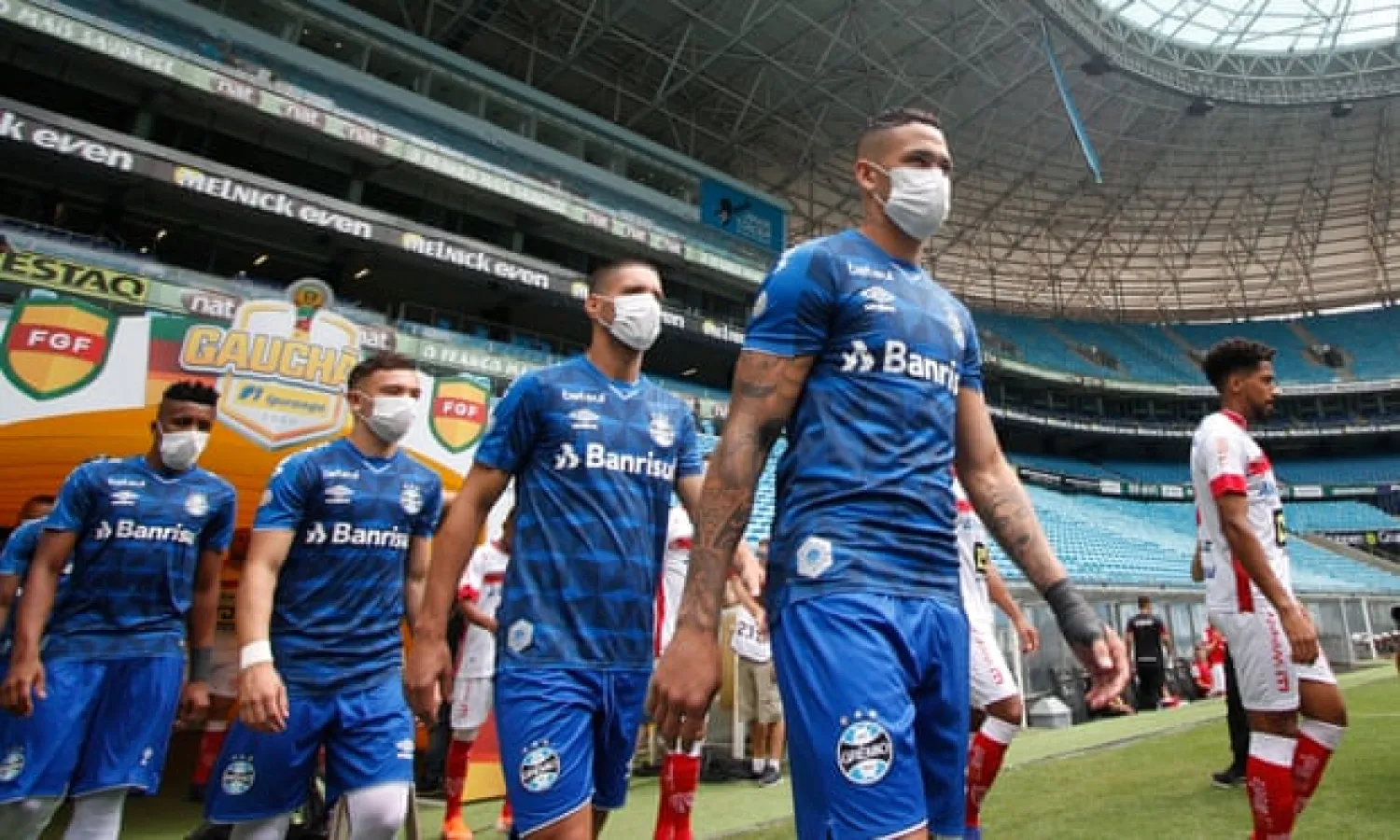
 Grêmio players wear protective masks as a protest. Photograph: Richard Ducker/AFP via Getty Images
Grêmio players wear protective masks as a protest. Photograph: Richard Ducker/AFP via Getty Images
TT

Football in Brazil Continues Despite Coronavirus

 Grêmio players wear protective masks as a protest. Photograph: Richard Ducker/AFP via Getty Images
Grêmio players wear protective masks as a protest. Photograph: Richard Ducker/AFP via Getty Images

On Sunday morning in the southern Brazilian state of Rio Grande do Sul, Grêmio players and coaching staff emerged from the tunnel at their empty stadium wearing surgical masks in protest at having to fulfil their Campeonato Gaúcho fixture against São Luiz despite the coronavirus pandemic. While many countries have brought a halt to all sporting activities, Brazilian football has been slow and inconsistent in its reaction to the pandemic.

Later on Sunday, the national football confederation, the CBF, released a statement announcing that all national competitions would be suspended indefinitely and with immediate effect. Ongoing tournaments under their jurisdiction include the first and second divisions of women’s Brazilian championship, as well as the men’s U17 national championship and men’s U20 Brazilian Cup. Yet the men’s senior game in Brazil is in the midst of the state championship season and the power to suspend those competitions rests with local federations rather than the CBF.

After meetings on Sunday and Monday, some state federations have now taken decisive action. On Sunday night, the Minas Gerais federation put games on hold indefinitely from Tuesday. On Monday, the federations in São Paulo, Paraná, Santa Catarina and Maranhão followed suit. The Alagoas, Pará, Rio Grande do Sul and Rio de Janeiro federations, meanwhile, have suspended activities for 15 days. But without consensus across the country on how to proceed, football is yet to stop in all regions.

For players, club employees and many commentators, the authorities have already taken, and in some cases continue to take, unnecessary risks. “The countries that are containing the situation are those that adopt strong measures”, said Grêmio vice-president Paulo Luz. “We must prioritise life.” Similar scenes to those at the Arena do Grêmio played out in Rio de Janeiro later on Sunday, as Vasco da Gama and Botafogo players lined up before their respective games with protective masks on their faces. Botafogo players carried a banner that pointedly read, “Coronavirus: protect yourself! This fight belongs to all of us.”

In both Rio de Janeiro and Rio Grande do Sul, matches were already being played behind closed doors as a precaution over the weekend. On Friday, Rio de Janeiro state governor Wilson Witzel said: “With closed gates, there is no agglomeration of people. On the contact between players… that’s their risk.” Vasco defender Leandro Castán responded sarcastically to Witzel, tweeting, “The risk is ours, great response, great governor, thanks for your respect with the players!!!”

Stadiums were also closed in the city of São Paulo, the centre of infections in the country. The derby between São Paulo and Santos took place in a deserted Morumbi stadium and Corinthians played Ituano at home with recordings of singing fans being played over the speaker system at high volume.

Yet, elsewhere in São Paulo state and in numerous states from Santa Catarina in the south to Mato Grosso do Sul in the west, Pará in the north and Pernambuco in the north east, games went ahead as usual, with tickets sold and fans occupying, if not entirely filling, the terraces. Authorities in many of Brazil’s 26 states are still reluctant to suspend games. In Amapá, Mato Grosso do Sul, Pernambuco and Ceará the federations have announced that the local championships will continue without the presence of fans. Others prevaricate over the situation.

André Pitta, president of the state football federation of Goiás, said on Sunday: “Our position is to maintain the championship behind closed doors. We will have a meeting with the clubs before the end of the week, without rushing, with tranquility, to evaluate the situation. The CBF’s decision is different from that with regards to the state championship.”

Brazil president Jair Bolsonaro supported Pitta’s stance and criticised the CBF’s approach in an interview with CNN on Sunday evening. “When you prohibit football matches, you are approaching hysteria,” he declared. “I don’t want that.” He said the CBF could instead “sell a percentage of the tickets, taking into account the quantity of people in the stands, and not immediately prohibit this or that, because cancelling [football] will not contain the spread. The economy cannot stop. It will generate unemployment.”

O Globo columnist Martín Fernández disagrees. “Stop everything as soon as possible,” he suggests. “That is what specialists who study the subject recommend. Playing games without fans does not make sense – the meeting up of people in the stadium or around the television is the reason the game exists. Playing without fans is encouraging people to move around and meet up. And that is an error.”

Yet the power in Brazilian football, and the jurisdiction in this matter, remains in the hands of the state federations. If they do not all, individually, see fit to suspend games, then football will continue.

While things remain up in the air, players, coaches and club directors are understandably concerned. Grêmio manager Renato Portaluppi used a post-match interview on Sunday to question those in power, saying: “Is it not the case that Brazilian football must stop? The whole world has stopped. Will we have to go on strike?” Meanwhile, the Internacional midfielder Damián Musto displayed his dismay by tweeting: “What are they waiting for? Stop everything, hijos de puta! They play with lives as if it were a video game. Stop before it is too late!”

In Ceará, the federation’s decision to maintain the football calendar was supported by the presidents of the two big local clubs, Ceará and Fortaleza. But the president of the professional footballers’ union said his members were unhappy. “Despite players being young and healthy, they are not immune from the virus,” he said. “A football match, even without a crowd, moves at least 200 people, many of an advanced age, who according to official data are the worst affected by the virus.”

Juca Kfouri, the doyen of Brazilian football writing, expressed his view in the daily paper Folha: “There is nothing that justifies playing games without fans, and even less submitting the players to the risk of coronavirus. Wash your hands, do not touch people near you, keep your distance and … gooool!!!” Brazil’s football-watching public waits to see how much longer it will take before players are no longer forced to play and commentators are no longer screaming that last word over the airwaves.

The Guardian Sport


Hospital: Vonn Had Surgery on Broken Leg from Olympics Crash

This handout video grab from IOC/OBS shows US Lindsey Vonn crashing during the women's downhill event at the Milano Cortina 2026 Winter Olympic Games on February 8, 2026. (Photo by Handout / various sources / AFP)
TT

Hospital: Vonn Had Surgery on Broken Leg from Olympics Crash

This handout video grab from IOC/OBS shows US Lindsey Vonn crashing during the women's downhill event at the Milano Cortina 2026 Winter Olympic Games on February 8, 2026. (Photo by Handout / various sources / AFP)

Lindsey Vonn had surgery on a fracture of her left leg following the American's heavy fall in the Winter Olympics downhill, the hospital said in a statement given to Italian media on Sunday.

"In the afternoon, (Vonn) underwent orthopedic surgery to stabilize a fracture of the left leg," the Ca' Foncello hospital in Treviso said.

Vonn, 41, was flown to Treviso after she was strapped into a medical stretcher and winched off the sunlit Olimpia delle Tofane piste in Cortina d'Ampezzo.

Vonn, whose battle to reach the start line despite the serious injury to her left knee dominated the opening days of the Milano Cortina Olympics, saw her unlikely quest halted in screaming agony on the snow.

Wearing bib number 13 and with a brace on the left knee she ⁠injured in a crash at Crans Montana on January 30, Vonn looked pumped up at the start gate.

She tapped her ski poles before setting off in typically aggressive fashion down one of her favorite pistes on a mountain that has rewarded her in the past.

The 2010 gold medalist, the second most successful female World Cup skier of all time with 84 wins, appeared to clip the fourth gate with her shoulder, losing control and being launched into the air.

She then barreled off the course at high speed before coming to rest in a crumpled heap.

Vonn could be heard screaming on television coverage as fans and teammates gasped in horror before a shocked hush fell on the packed finish area.

She was quickly surrounded by several medics and officials before a yellow Falco 2 ⁠Alpine rescue helicopter arrived and winched her away on an orange stretcher.


Meloni Condemns 'Enemies of Italy' after Clashes in Olympics Host City Milan

Demonstrators hold smoke flares during a protest against the environmental, economic and social impact of the Milano-Cortina 2026 Winter Olympics in Milan, Italy, February 7, 2026. REUTERS/Kevin Coombs
TT

Meloni Condemns 'Enemies of Italy' after Clashes in Olympics Host City Milan

Demonstrators hold smoke flares during a protest against the environmental, economic and social impact of the Milano-Cortina 2026 Winter Olympics in Milan, Italy, February 7, 2026. REUTERS/Kevin Coombs

Italian Prime Minister Giorgia Meloni has condemned anti-Olympics protesters as "enemies of Italy" after violence on the fringes of a demonstration in Milan on Saturday night and sabotage attacks on the national rail network.

The incidents happened on the first full day of competition in the Winter Games that Milan, Italy's financial capital, is hosting with the Alpine town of Cortina d'Ampezzo.

Meloni praised the thousands of Italians who she said were working to make the Games run smoothly and present a positive face of Italy.

"Then ⁠there are those who are enemies of Italy and Italians, demonstrating 'against the Olympics' and ensuring that these images are broadcast on television screens around the world. After others cut the railway cables to prevent trains from departing," she wrote on Instagram on Sunday.

A group of around 100 protesters ⁠threw firecrackers, smoke bombs and bottles at police after breaking away from the main body of a demonstration in Milan.

An estimated 10,000 people had taken to the city's streets in a protest over housing costs and environmental concerns linked to the Games.

Police used water cannon to restore order and detained six people.

Also on Saturday, authorities said saboteurs had damaged rail infrastructure near the northern Italian city of Bologna, disrupting train journeys.

Police reported three separate ⁠incidents at different locations, which caused delays of up to 2-1/2 hours for high-speed, Intercity and regional services.

No one has claimed responsibility for the damage.

"Once again, solidarity with the police, the city of Milan, and all those who will see their work undermined by these gangs of criminals," added Meloni, who heads a right-wing coalition.

The Italian police have been given new arrest powers after violence last weekend at a protest by the hard-left in the city of Turin, in which more than 100 police officers were injured.


Liverpool New Signing Jacquet Suffers 'Serious' Injury

Soccer Football - Ligue 1 - RC Lens v Stade Rennes - Stade Bollaert-Delelis, Lens, France - February 7, 2026  Stade Rennes' Jeremy Jacquet in action REUTERS/Benoit Tessier
Soccer Football - Ligue 1 - RC Lens v Stade Rennes - Stade Bollaert-Delelis, Lens, France - February 7, 2026 Stade Rennes' Jeremy Jacquet in action REUTERS/Benoit Tessier
TT

Liverpool New Signing Jacquet Suffers 'Serious' Injury

Soccer Football - Ligue 1 - RC Lens v Stade Rennes - Stade Bollaert-Delelis, Lens, France - February 7, 2026  Stade Rennes' Jeremy Jacquet in action REUTERS/Benoit Tessier
Soccer Football - Ligue 1 - RC Lens v Stade Rennes - Stade Bollaert-Delelis, Lens, France - February 7, 2026 Stade Rennes' Jeremy Jacquet in action REUTERS/Benoit Tessier

Liverpool's new signing Jeremy Jacquet suffered a "serious" shoulder injury while playing for Rennes in their 3-1 Ligue 1 defeat at RC Lens on Saturday, casting doubt over the defender’s availability ahead of his summer move to Anfield.

Jacquet fell awkwardly in the second half of the ⁠French league match and appeared in agony as he left the pitch.

"For Jeremy, it's his shoulder, and for Abdelhamid (Ait Boudlal, another Rennes player injured in the ⁠same match) it's muscular," Rennes head coach Habib Beye told reporters after the match.

"We'll have time to see, but it's definitely quite serious for both of them."
Liverpool agreed a 60-million-pound ($80-million) deal for Jacquet on Monday, but the 20-year-old defender will stay with ⁠the French club until the end of the season.

Liverpool, provisionally sixth in the Premier League table, will face Manchester City on Sunday with four defenders - Giovanni Leoni, Joe Gomez, Jeremie Frimpong and Conor Bradley - sidelined due to injuries.
