


Football Behind Closed Doors May Tell US Much About How Home Advantage Works

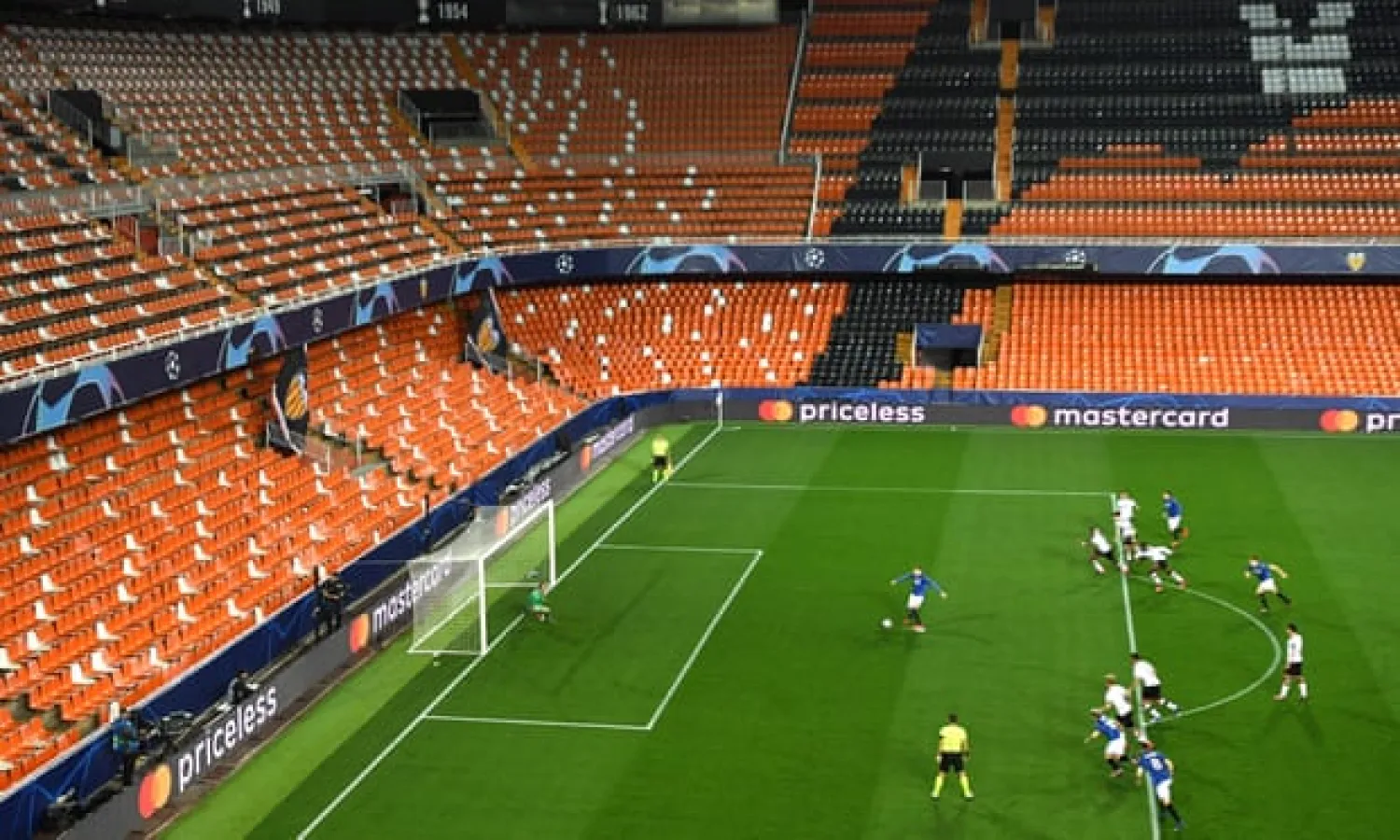
 Atalanta’s Josip Ilicic scores an early penalty in his side’s 4-3 away win against Valencia at an empty Mestalla. Photograph: UEFA/EPA
Atalanta’s Josip Ilicic scores an early penalty in his side’s 4-3 away win against Valencia at an empty Mestalla. Photograph: UEFA/EPA
TT

Football Behind Closed Doors May Tell US Much About How Home Advantage Works

 Atalanta’s Josip Ilicic scores an early penalty in his side’s 4-3 away win against Valencia at an empty Mestalla. Photograph: UEFA/EPA
Atalanta’s Josip Ilicic scores an early penalty in his side’s 4-3 away win against Valencia at an empty Mestalla. Photograph: UEFA/EPA

The Mestalla in Valencia has to be one of the most intimidating stadiums in the world for visiting football teams. Its stands, which have the pitch of a ski jump, allow home fans to create a claustrophobic wall of noise. The rabid screams of 55,000 Valencians, bouncing off the concrete foundations, have made it something of a fortress for the local team and a popular venue for Spain’s home fixtures. A while back, I watched Valencia play Barcelona at the Mestalla, and there was a febrile menace in the air that night unlike any other I have experienced in a football ground.

The vibe at the Mestalla was rather different last week, when Valencia hosted Atalanta in the second leg of the sides’ Champions League last-16 tie. If ever a team needed a boost from their 12th man, their fans, it was now: Valencia had to make up a 4-1 deficit from the first leg. But, because of the coronavirus outbreak, the fixture was played behind closed doors. Watching the match on TV was eerie: you could hear the players shouting for the ball or celebrating or appealing for a foul. At times you had to remind yourself that it wasn’t a training exercise.

The match became even more listless after just 90 seconds, when Atalanta were awarded a penalty. The Slovenian striker Josip Ilicic buried it and added three more in a 4-3 victory. “Fabulous game missed by fans at Mestalla,” Gary Lineker tweeted. “Imagine scoring all 4 goals like Ilicic has done with barely a soul in the stadium.”

On Friday, it was announced that all elite football in England and Scotland will be postponed until at least April. The Champions League and Europa League have also been suspended. What happens next is decidedly murky. There may be play‑offs to decide titles and relegation. Euro 2020 could be delayed. And there might well be more surreal spectacles like the one that played out between Valencia and Atalanta.

If more matches do have to be played in empty stadiums without fans, can we expect it to affect the results? Will Liverpool suddenly be less formidable without the Kop behind them? Home advantage is one of the immutable facts of sport, especially football – what happens when you remove the crowd from the equation?

Playing sport behind closed doors has traditionally been used as a punishment for the home team. In football, it dates back to the early 1980s, when English clubs were feared across Europe for their tenacity on the field and their brutality off it. West Ham were the first team on the receiving end. In September 1980, the Hammers played Castilla, essentially Real Madrid’s feeder team, at the Bernabéu in the European Cup Winners Cup. When they lost 3-1 in the first leg – perhaps because they were humiliated by losing to a second‑string outfit, or maybe because they just fancied a punch-up – the West Ham supporters went on the rampage. Dozens were ejected from the stadium; outside, one was run over by a bus and died.

Uefa determined that the second leg should be played in an empty Upton Park. In fact, the official attendance was 262, when you took players, staff, ball kids and media into account. But the atmosphere was unquestionably odd: the West Ham goalkeeper Phil Parkes recalled afterwards that he had to tune out commentary on the game from a radio behind the goal. It became known as “the ghost match”.

In one sense, West Ham were punished for the riot in Madrid: the club would have expected a full house of 36,000 for the second leg, so it made a hefty dent in their income. But what about on the pitch? Did West Ham suffer from not having the Upton Park faithful roaring them on?

Not especially. Back in London, West Ham tied the match 3-1 in 90 minutes; in extra time they scored two more. It was a similar story in September 1982, when Aston Villa were made to start their European campaign on a Wednesday afternoon at 2.30pm in front of 187 spectators, as a censure for rioting by their supporters the previous season in Belgium. Again, it wasn’t much of a punishment: Villa beat Besiktas 3-1. Internazionale had to play three Champions League home games behind closed doors in 2005, and they won all three.

So we’re clear: it’s not that home clubs usually perform better when forced to play behind closed doors. That’s probably not the case, and there’s not enough statistical evidence to confirm or deny it. But these matches played without supporters do make you wonder how influential fans in the stadium are to the performance of their beloved team.

Research shows home advantage is clearly and definitely a major factor in football. Taken aAcross all teams and all leagues in England, the home team invariably wins around 45% of matches, and draws 25%. Fans might believe this is down to their support but actually the size of the crowd and the intensity of their screaming does not appear to have a significant impact on the result.

Where the home crowd can sometimes have a game-changing influence, however, is on the decisions of the referee. A couple of studies have indicated that football officials – unwittingly, of course – were wary of making controversial calls against the home team because they suspected, perhaps subliminally, that the crowd would turn on them. In practice, this means fewer yellow cards, more penalties given – and the louder and more partisan the crowd, the greater the unconscious bias.

If some of the key fixtures this season do end up being decided behind closed doors, they will be intriguing to watch (obviously on a screen, not in the stands). Will referees make better decisions? Will the intensity of home players dip without the crowd to gee them up?

Or, counter-intuitively, will these players suddenly display a new sense of freedom? Joey Barton once complained that abusive Newcastle fans at St James’ Park had destroyed the confidence of the players. Likewise, there must have been times when Gary Neville was manager at Valencia in 2016 when he wished the Mestalla was empty. As thrilling as it must be when 55,000 fans are chanting your name, imagine how soul-destroying it is when they are screaming as one: “Gary, vete ya!” or “Gary, go now!”

The Guardian Sport


Nigeria Let 3 Goal Lead Slip before Edging Past Tunisia

Nigeria's Victor Osimhen, top, wins a header against Tunisia's Ferjani Sassi during the Africa Cup of Nations group C soccer match between Nigeria and Tunisia in Fez, Morocco, Saturday, Dec. 27, 2025. (AP Photo/Mosa'ab Elshamy)
TT

Nigeria Let 3 Goal Lead Slip before Edging Past Tunisia

Nigeria's Victor Osimhen, top, wins a header against Tunisia's Ferjani Sassi during the Africa Cup of Nations group C soccer match between Nigeria and Tunisia in Fez, Morocco, Saturday, Dec. 27, 2025. (AP Photo/Mosa'ab Elshamy)

Nigeria put on an impressive display of attacking prowess but had to hang on in the end for a narrow 3-2 win over Tunisia at the Africa Cup of Nations on Saturday, becoming the second team to make sure of a place in the last 16.

Victor Osimhen opened the scoring a minute before halftime and captain Wilfred Ndidi and Ademola Lookman added two more after the break.

But Tunisia staged a late comeback with goals from defenders Montassar Talbi and Ali Abdi that set up a frenetic finish, Reuters reported.

It was Nigeria's second win in ⁠Group C and ensures they will top the standings, even with one first-round fixture still to play.

Their six-point haul is three more than second-placed Tunisia with Tanzania and Uganda, who drew 1-1 in Rabat earlier, on one point each.

Osimhen had a series of narrow misses from as early as the eighth minute as Nigeria came out of the starting blocks swarming all over Tunisia.

But it took until ⁠the 44th minute for the striker, wearing his customary mask to protect his cheekbone, to score as he rose at the back post to head home Lookman’s cross.

Nigeria were 2-0 up five minutes into the second half when Ndidi soared high above the Tunisian defence to head home from a corner.

Osimhen turned provider for Nigeria's third in the 67th minute, dragging the ball into the path of Lookman, who looked initially to have spurned a good opportunity but after hesitating was still able to get a shot away and it went in off the post.

Tunisia pulled the first goal back in the 74th ⁠minute as Hannibal Mejri's free kick was met by Talbi and the error-prone Nigeria goalkeeper Stanley Nwabali slipped in his efforts to stop it.

Tunisia won a fortunate penalty with five minutes left as the ball hit Bright Osayi-Samuel's hand as he was trying to head clear. The spot kick was thrashed home by Abdi, setting up a late surge from Tunisia with Ferjani Sassi's header deep in stoppage time inches away from a dramatic equaliser.

Egypt on Friday became the first team into the last 16 when they beat South Africa 1-0 to make sure of top place in Group B.

Nigeria stay in Fes for the last group game on Tuesday against Uganda while Tanzania and Tunisia clash at the same time in Rabat.


Ronaldo Double Drives Al Nassr to Record 10th Straight Win

Football - Saudi Pro League - Al Nassr v Al Okhdood - Al Awwal Park, Riyadh, Saudi Arabia - December 27, 2025 Al Nassr's Cristiano Ronaldo with teammates celebrate after the match. (Reuters)
TT

Ronaldo Double Drives Al Nassr to Record 10th Straight Win

Football - Saudi Pro League - Al Nassr v Al Okhdood - Al Awwal Park, Riyadh, Saudi Arabia - December 27, 2025 Al Nassr's Cristiano Ronaldo with teammates celebrate after the match. (Reuters)

Cristiano Ronaldo scored twice as Al Nassr beat struggling Al Okhdood 3-0 on Saturday to become the first team in Saudi Pro League history to win their opening 10 matches, setting a new record and extending their perfect start to the season.

Ronaldo opened the scoring in the 31st ‌minute with a ‌close-range finish after ‌a ⁠corner and ‌added a spectacular backheel in first-half stoppage time to take his tally to 12 goals this season.

The Portuguese forward now sits joint-top of the scoring chart alongside teammate João Félix, who ⁠sealed the victory with a late strike in ‌second-half stoppage time.

The win ‍keeps Al Nassr ‍top of the table with 30 ‍points from 10 matches, four clear of nearest rivals Al Hilal.

By achieving 10 consecutive wins, Al Nassr surpassed the previous best start in the league’s history — nine straight victories by Al ⁠Hilal in the 2018-2019 season under Portuguese coach Jorge Jesus, who now leads Al Nassr.

Ronaldo, who also had a third goal ruled out for offside in the 65th minute, continues to dominate in a campaign with Al Nassr.

The match came after the resumption of the league following the Arab ‌Cup in Qatar earlier this month, won by Morocco.


Mane Rescues AFCON Draw for Senegal Against DR Congo

 Senegal's Sadio Mane reacts after scoring a goal during the Africa Cup of Nations group D soccer match between Senegal and DR Congo in Tangier, Morocco, Saturday, Dec. 27, 2025. (AP)
Senegal's Sadio Mane reacts after scoring a goal during the Africa Cup of Nations group D soccer match between Senegal and DR Congo in Tangier, Morocco, Saturday, Dec. 27, 2025. (AP)
TT

Mane Rescues AFCON Draw for Senegal Against DR Congo

 Senegal's Sadio Mane reacts after scoring a goal during the Africa Cup of Nations group D soccer match between Senegal and DR Congo in Tangier, Morocco, Saturday, Dec. 27, 2025. (AP)
Senegal's Sadio Mane reacts after scoring a goal during the Africa Cup of Nations group D soccer match between Senegal and DR Congo in Tangier, Morocco, Saturday, Dec. 27, 2025. (AP)

Sadio Mane's equalizer earned 2022 champions Senegal a 1-1 draw with the Democratic Republic of Congo in their heavyweight Africa Cup of Nations clash on Saturday.

Cedric Bakambu had given the Leopards the lead just after the hour mark in Tangiers but Al Nassr forward Mane replied soon after and the result ensures Senegal stay on top of Group D with one round of matches still to play.

Both teams have four points but Senegal have a superior goal difference before their final group match against Benin on Tuesday.

Benin have three points after a 1-0 victory earlier Saturday in Rabat against Botswana, who are bottom without a point or a goal scored.

Sebastien Desabre's Congolese side were seeking revenge after a dramatic defeat in the last meeting of the nations, in World Cup qualifying in September.

Senegal came from 2-0 down to win that encounter 3-2 in Kinshasa, a result which allowed them to go on and top their group to secure a place at next year's finals in North America.

DR Congo were therefore forced to settle for second place but can still make the World Cup if they win a one-off play-off against either New Caledonia or Jamaica in Mexico in March.

Senegal, fresh from beating Botswana 3-0 and seen as perhaps the biggest threat to Morocco's chances of winning the title on home soil, had more of the possession and more chances on the day.

However, the Leopards took the lead in the 61st minute when Theo Bongonda -- scorer of the only goal in their opening win against Benin -- had a shot at the end of a fine move parried by goalkeeper Edouard Mendy and Real Betis striker Bakambu pounced to convert the loose ball.

But Senegal were only behind for eight minutes, their equalizer coming after a superb run by teenage substitute Ibrahim Mbaye.

The 17-year-old Paris Saint-Germain winger Mbaye, who was born in France and represented them up to Under-20 level, recently committed his international future to Senegal, for whom he qualifies through one of his parents.

He replaced Ismaila Sarr just after Bakambu's opener, and made the leveler from a penetrating run down the right.

Mbaye burst away from Arthur Masuaku, who appeared to injure himself going to tackle, and then saw his shot blocked by Lionel Mpasi, but Mane was on hand to score.

It was a 10th AFCON goal for former Liverpool superstar Mane, who is appearing at his sixth tournament.
