


Suspension of Lazio's Scudetto Charge Reveals Scars of Century-Old Dispute

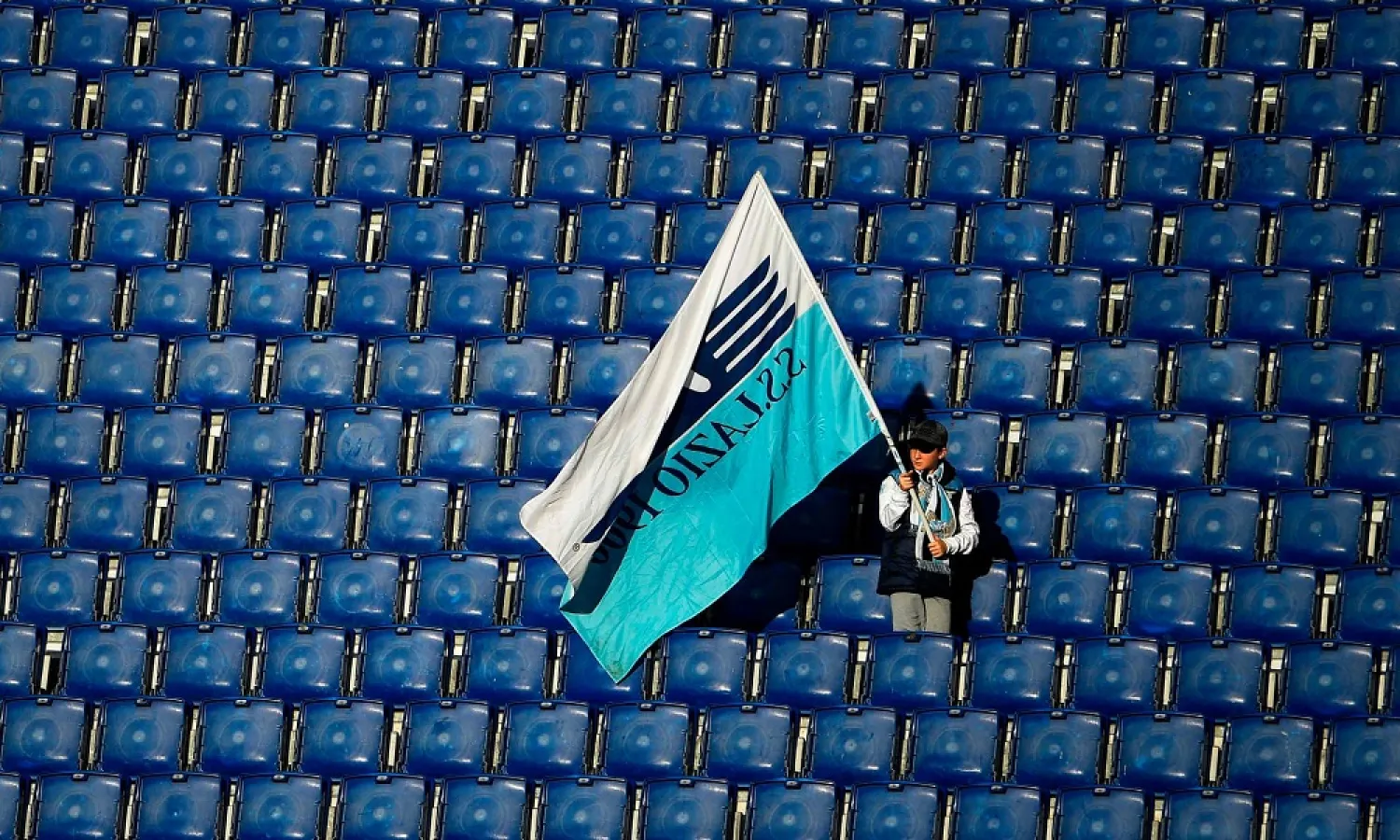
A young Lazio supporter amid empty seats at their 2-0 home win over Bologna – the last match they played before the Serie A shutdown. (Getty Images)
TT

Suspension of Lazio's Scudetto Charge Reveals Scars of Century-Old Dispute

A young Lazio supporter amid empty seats at their 2-0 home win over Bologna – the last match they played before the Serie A shutdown. (Getty Images)

It is the fate of Lazio supporters, according to the Italian voice actor Pino Insegno, to “suffer even in those moments when we were not supposed to”. The Biancocelesti were enjoying one of their finest seasons prior to the coronavirus outbreak, sitting one point off the top of Serie A at the moment when games were suspended. They are undefeated in the league since September, and beat the leaders, Juventus, twice in December.

Football, as Insegno was quick to remind listeners to the Roman station Radiosei last week, is of secondary importance at a time when Italy is on lockdown. “We need to stay home, and that’s it,” he continued. “We have not lived through a moment like this since the war.” Still, it is a curious quirk of fate that Lazio – champions of Italy just twice in their history – were denied a shot at a title on the only previous occasion when football was suspended mid-season on the peninsula.

It was war that thwarted them in 1915. No single top division existed back then, but rather a series of regional tournaments. The season was supposed to culminate in a grand final between the champions of the north and the best of the rest. Those plans were shelved after Italy entered the first world war in May, prompting the national football federation (FIGC) to suspend play.

Lazio had already progressed through a regional sub-section and then won a mini-league between the top four teams from central Italy. All that separated them from the grand final was a knock-out tie against the champions of the south. But that match never took place.

Instead, the Scudetto lay vacant for four years before, according to Gazzetta dello Sport, the FIGC issued a resolution awarding it to Genoa in 1919. The Rossoblu had been top of the northern section at the time when the leagues were suspended, with one game still to play.

A nation in post-war recovery barely noticed. Another two years would pass before Gazzetta – acting as an official mouthpiece for the federation – arranged a small dinner ceremony to present Genoa with their title. Almost a century later, that act is still under dispute.

This February, a lawyer named Gian Luca Mignogna presented fresh documents to the FIGC, asserting that their own regulations from the era should have prohibited the title from being awarded in such a manner. He has argued for it to be shared between Genoa and Lazio instead. A petition supporting him on change.org has drawn more than 35,000 signatures.

In truth, Lazio were not the only ones with a right to feel aggrieved. Genoa’s remaining game in the northern section would have been against Torino, who lay within overtaking distance and had beaten them 6-1 in their previous head-to-head. Inter, in third, were not mathematically out of the running either.

The picture was less clear in the southern section, with a deciding game between Naples and Internazionale Napoli reportedly annulled due to an irregularity with player registrations. In theory, Lazio still needed to overcome the winner of that tie to qualify for the grand finale.

Northern teams were manifestly dominant in this period. Lazio had reached the previous two finals only to get thumped on both occasions: losing 6-0 to Pro Vercelli at a neutral venue in 1913, then 9-1 to Casale over two legs a year later. After the war, teams representing the north went on to win every Scudetto until the formation of a single national top division in 1926.

Such outcomes were no accident. In an era before professionalism, teams from wealthier cities were often able to recruit more effectively with the help of friendly local businesses that lured players with the promise of comfortable employment. Some had more direct means. Two Genoa players were banned for life in 1913 after being caught trying to pay in substantial cheques signed by their club’s president, though those suspensions were eventually overturned.

Much has changed over the course of a century, yet the fact that the FIGC are still dealing with the fallout from 1915 might be a salutary lesson for football’s governing bodies as they consider how to proceed today. The federation’s president, Gabriele Gravina, last week outlined four options for Serie A to proceed once quarantine restrictions are lifted.

The first, preferred solution, would see all the games being completed on a delayed schedule (perhaps even, as he suggested on Monday, by splitting the games across two seasons). If that is not possible, then the league will either need to declare this season vacant, set the current standings as final or hold some form of play-off for the top positions and relegation.

None of those options would be universally popular, and tensions between clubs with competing interests are rising. Lazio’s president, Claudio Lotito, is reported to have argued with his Juventus counterpart, Andrea Agnelli, during a conference call on Friday over the prospect of players returning to training before the country’s lockdown is lifted.

In the midst of a pandemic with a rising death toll, the hope must be that all parties can find a common ground that places public health as the greatest priority. But it is clear that for some people, at least, the scars of 1915 are yet to heal.

“The fear is that the current season will come to the same end as the one interrupted by the Great War, and, just like back then, the interruption will become an occasion to deny Lazio the recognition of a Scudetto won on the pitch,” wrote Lazio’s head of communications, Arturo Diaconale, in a long Facebook post on March 9, shortly before Serie A was suspended.

“This syndrome of the denied title from 1915 is spreading almost as much as the epidemic from China. Because it releases that old fear that, in a situation of maximum uncertainty provoked by a health emergency paralyzing our country, the interests of the big clubs can be turned to the damage of the Biancocelesti.”

His crass (and, bluntly, incorrect) framing drew condemnation even from many of his own followers. Diaconale followed up with a clarification two days later that his social media posts represented only his own views rather than those of the club or Lotito.

There are plenty of Lazio supporters, though, who share at least some part of his sentiment. Their team has played brilliantly this season, mounting its most compelling title challenge since 2001. No conspiracy theories are required to understand why a fanbase might feel frustration at the prospect of seeing a great season end without resolution for the second time in their history, due to events beyond anyone’s control.

The Guardian Sport


‘Don’t Jump in Them’: Olympic Athletes’ Medals Break During Celebrations

Gold medalists team USA celebrate during the medal ceremony after the Team Event Free Skating of the Figure Skating competitions at the Milano Cortina 2026 Winter Olympic Games, in Milan, Italy, 08 February 2026. (EPA)
TT

‘Don’t Jump in Them’: Olympic Athletes’ Medals Break During Celebrations

Gold medalists team USA celebrate during the medal ceremony after the Team Event Free Skating of the Figure Skating competitions at the Milano Cortina 2026 Winter Olympic Games, in Milan, Italy, 08 February 2026. (EPA)

Handle with care. That's the message from gold medalist Breezy Johnson at the Milan Cortina Winter Olympics after she and other athletes found their medals broke within hours.

Olympic organizers are investigating with "maximum attention" after a spate of medals have fallen off their ribbons during celebrations on the opening weekend of the Games.

"Don’t jump in them. I was jumping in excitement, and it broke," women's downhill ski gold medalist Johnson said after her win Sunday. "I’m sure somebody will fix it. It’s not crazy broken, but a little broken."

TV footage broadcast in Germany captured the moment biathlete Justus Strelow realized the mixed relay bronze he'd won Sunday had fallen off the ribbon around his neck and clattered to the floor as he danced along to a song with teammates.

His German teammates cheered as Strelow tried without success to reattach the medal before realizing a smaller piece, seemingly the clasp, had broken off and was still on the floor.

US figure skater Alysa Liu posted a clip on social media of her team event gold medal, detached from its official ribbon.

"My medal don’t need the ribbon," Liu wrote early Monday.

Andrea Francisi, the chief games operations officer for the Milan Cortina organizing committee, said it was working on a solution.

"We are aware of the situation, we have seen the images. Obviously we are trying to understand in detail if there is a problem," Francisi said Monday.

"But obviously we are paying maximum attention to this matter, as the medal is the dream of the athletes, so we want that obviously in the moment they are given it that everything is absolutely perfect, because we really consider it to be the most important moment. So we are working on it."

It isn't the first time the quality of Olympic medals has come under scrutiny.

Following the 2024 Summer Olympics in Paris, some medals had to be replaced after athletes complained they were starting to tarnish or corrode, giving them a mottled look likened to crocodile skin.


African Players in Europe: Ouattara Fires Another Winner for Bees

Football - Premier League - Newcastle United v Brentford - St James' Park, Newcastle, Britain - February 7, 2026 Brentford's Dango Ouattara celebrates scoring their third goal with Brentford's Rico Henry. (Reuters)
TT

African Players in Europe: Ouattara Fires Another Winner for Bees

Football - Premier League - Newcastle United v Brentford - St James' Park, Newcastle, Britain - February 7, 2026 Brentford's Dango Ouattara celebrates scoring their third goal with Brentford's Rico Henry. (Reuters)

Burkina Faso striker Dango Ouattara was the Brentford match-winner for the second straight weekend when they triumphed 3-2 at Newcastle United.

The 23-year-old struck in the 85th minute of a seesaw Premier League struggle in northeast England. The Bees trailed and led before securing three points to go seventh in the table.

Last weekend, Ouattara dented the title hopes of third-placed Aston Villa by scoring the only goal at Villa Park.

AFP Sport highlights African headline-makers in the major European leagues:

ENGLAND

DANGO OUATTARA (Brentford)

With the match at Newcastle locked at 2-2, the Burkinabe sealed victory for the visitors at St James' Park by driving a left-footed shot past Magpies goalkeeper Nick Pope to give the Bees a first win on Tyneside since 1934. Ouattara also provided the cross that led to Vitaly Janelt's headed equalizer after Brentford had fallen 1-0 behind.

BRYAN MBEUMO (Manchester Utd)

The Cameroon forward helped the Red Devils extend their perfect record under caretaker manager Michael Carrick to four games by scoring the opening goal in a 2-0 win over Tottenham after Spurs had been reduced to 10 men by captain Cristian Romero's red card.

ISMAILA SARR (Crystal Palace)

The Eagles ended their 12-match winless run with a 1-0 victory at bitter rivals Brighton thanks to Senegal international Sarr's 61st-minute goal when played in by substitute Evann Guessand, the Ivory Coast forward making an immediate impact on his Palace debut after joining on loan from Aston Villa during the January transfer window.

ITALY

LAMECK BANDA (Lecce)

Banda scored direct from a 90th-minute free-kick outside the area to give lowly Leece a precious 2-1 Serie A victory at home against mid-table Udinese. It was the third league goal this season for the 25-year-old Zambia winger. Leece lie 17th, one place and three points above the relegation zone.

GERMANY

SERHOU GUIRASSY (Borussia Dortmund)

Guirassy produced a moment of quality just when Dortmund needed it against Wolfsburg. Felix Nmecha's silky exchange with Fabio Silva allowed the Guinean to sweep in an 87th-minute winner for his ninth Bundesliga goal of the season. The 29-year-old has scored or assisted in four of his last five games.

RANSFORD KOENIGSDOERFFER (Hamburg)

A first-half thunderbolt from Ghana striker Koenigsdoerffer put Hamburg on track for a 2-0 victory at Heidenheim. It was their first away win of the season. Nigerian winger Philip Otele, making his Hamburg debut, split the defense with a clever pass to Koenigsdoerffer, who hit a shot low and hard to open the scoring in first-half stoppage time.

FRANCE

ISSA SOUMARE (Le Havre)

An opportunist goal by Soumare on 54 minutes gave Le Havre a 2-1 home win over Strasbourg in Ligue 1. The Senegalese received the ball just inside the area and stroked it into the far corner of the net as he fell.


Olympic Town Warms up as Climate Change Puts Winter Games on Thin Ice

 Milano Cortina 2026 Olympics - Alpine Skiing - Men's Team Combined Downhill - Stelvio Ski Centre, Bormio, Italy - February 09, 2026. Alexis Monney of Switzerland in action during the Men's Team Combined Downhill. (Reuters)
Milano Cortina 2026 Olympics - Alpine Skiing - Men's Team Combined Downhill - Stelvio Ski Centre, Bormio, Italy - February 09, 2026. Alexis Monney of Switzerland in action during the Men's Team Combined Downhill. (Reuters)
TT

Olympic Town Warms up as Climate Change Puts Winter Games on Thin Ice

 Milano Cortina 2026 Olympics - Alpine Skiing - Men's Team Combined Downhill - Stelvio Ski Centre, Bormio, Italy - February 09, 2026. Alexis Monney of Switzerland in action during the Men's Team Combined Downhill. (Reuters)
Milano Cortina 2026 Olympics - Alpine Skiing - Men's Team Combined Downhill - Stelvio Ski Centre, Bormio, Italy - February 09, 2026. Alexis Monney of Switzerland in action during the Men's Team Combined Downhill. (Reuters)

Olympic fans came to Cortina with heavy winter coats and gloves. Those coats were unzipped Sunday and gloves pocketed as snow melted from rooftops — signs of a warming world.

“I definitely thought we’d be wearing all the layers,” said Jay Tucker, who came from Virginia to cheer on Team USA and bought hand warmers and heated socks in preparation. “I don’t even have gloves on.”

The timing of winter, the amount of snowfall and temperatures are all less reliable and less predictable because Earth is warming at a record rate, said Shel Winkley, a Climate Central meteorologist. This poses a growing and significant challenge for organizers of winter sports; The International Olympic Committee said last week it could move up the start date for future Winter Games to January from February because of rising temperatures.

While the beginning of the 2026 Olympic Winter Games in Cortina truly had a wintry feel, as the town was blanketed in heavy snow, the temperature reached about 40 degrees Fahrenheit (4.5 degrees Celsius) Sunday afternoon. It felt hotter in the sun.

This type of February “warmth” for Cortina is made at least three times more likely due to climate change, Winkley said. In the 70 years since Cortina first held the Winter Games, February temperatures there have climbed 6.4 degrees Fahrenheit (3.6 degrees Celsius), he added.

For the Milan Cortina Games, there's an added layer of complexity. It’s the most spread-out Winter Games in history, so Olympic venues are in localities with very different weather conditions. Bormio and Livigno, for example, are less than an hour apart by car, but they are separated by a high mountain pass that can divide the two places climatically.

The organizing committee is working closely with four regional and provincial public weather agencies. It has positioned weather sensors at strategic points for the competitions, including close to the ski jumping ramps, along the Alpine skiing tracks and at the biathlon shooting range.

Where automatic stations cannot collect everything of interest, the committee has observers — “scientists of the snow”— from the agencies ready to collect data, according to Matteo Pasotti, a weather specialist for the organizing committee.

The hope? Clear skies, light winds and low temperatures on race days to ensure good visibility and preserve the snow layer.

The reality: “It’s actually pretty warm out. We expected it to be a lot colder,” said Karli Poliziani, an American who lives in Milan. Poliziani was in Cortina with her father, who considered going out Sunday in just a sweatshirt.

And forecasts indicate that more days with above-average temperatures lie ahead for the Olympic competitions, Pasotti said.

Weather plays a critical role in the smooth running and safety of winter sports competitions, according to Filippo Bazzanella, head of sport services and planning for the organizing committee. High temperatures can impact the snow layer on Alpine skiing courses and visibility is essential. Humidity and high temperatures can affect the quality of the ice at indoor arenas and sliding centers, too.

Visibility and wind are the two factors most likely to cause changes to the competition schedule, Bazzanella added. Wind can be a safety issue or a fairness one, such as in the biathlon where slight variations can disrupt the athletes' precise shooting.

American alpine skier Jackie Wiles said many races this year have been challenging because of the weather.

“I feel like we’re pretty good about keeping our heads in the game because a lot of people are going to get taken out by that immediately,” she said at a team press conference last week. “Having that mindset of: it’s going to be what it’s going to be, and we still have to go out there and fight like hell regardless.”
