

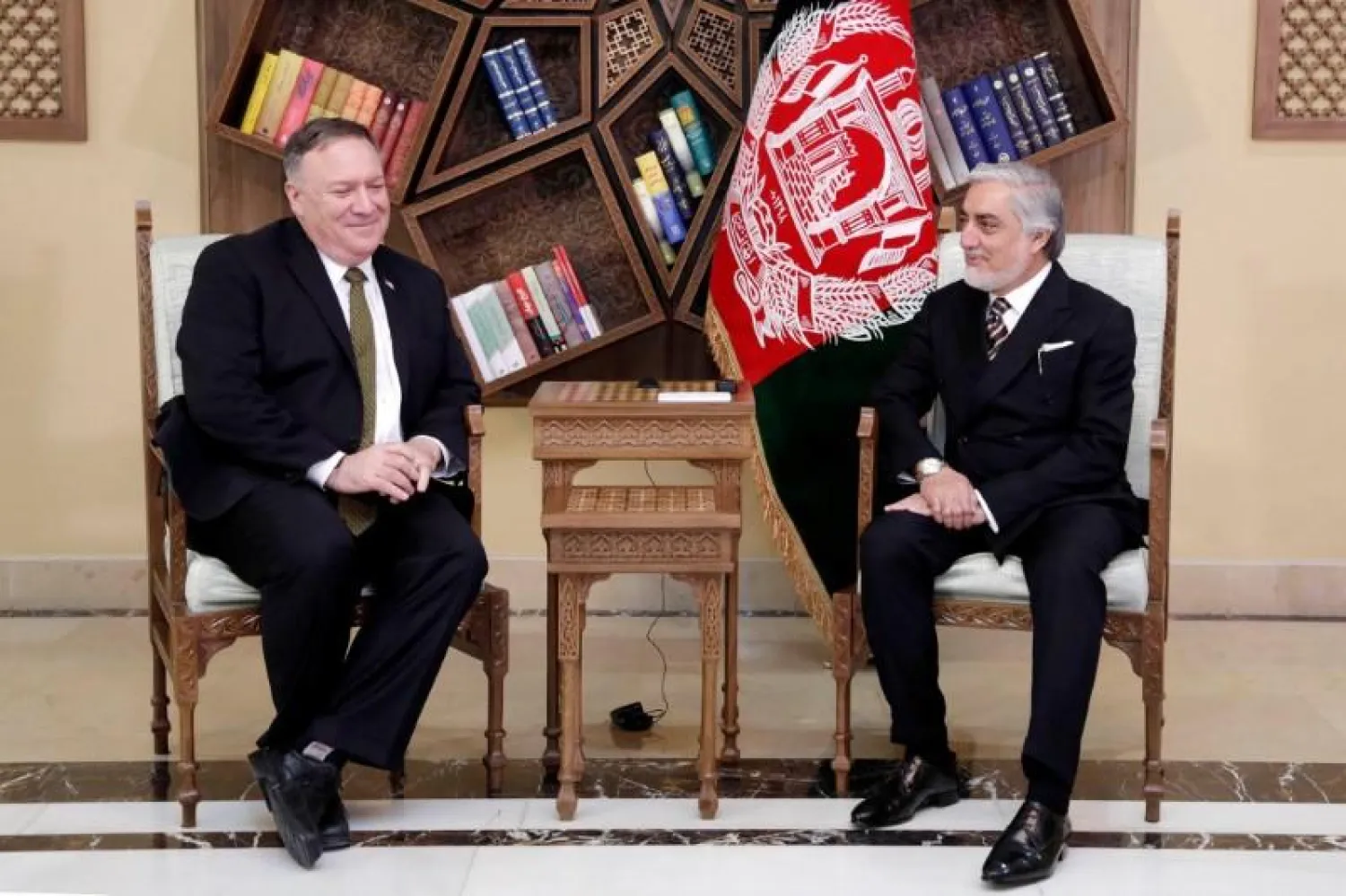

US Secretary of State Pompeo Meets Taliban Official in Qatar

Afghanistan's Abdullah Abdullah, President Ashraf Ghani's political rival, meets with US Secretary of State Mike Pompeo in Kabul, Afghanistan March 23, 2020. Afghanistan's Chief Executive Office/Handout via REUTERS
TT

US Secretary of State Pompeo Meets Taliban Official in Qatar

Afghanistan's Abdullah Abdullah, President Ashraf Ghani's political rival, meets with US Secretary of State Mike Pompeo in Kabul, Afghanistan March 23, 2020. Afghanistan's Chief Executive Office/Handout via REUTERS

US Secretary of State Mike Pompeo has flown to Doha to meet with Taliban officials on Monday on his way back from a one-day trip to Afghanistan as part of efforts to salvage a historic deal signed with the insurgent group in February.

“Secretary Pompeo is going to meet with Taliban officials in Doha including Mullah Baradar, Taliban’s chief negotiator, to press the Taliban to continue to comply with the agreement signed last month,” said State Department spokeswoman Morgan Ortagus.

Pompeo on Monday announced a $1 billion cut in US aid to Afghanistan after he had spent eight hours in Kabul meetings that failed to bridge a political divide that has led to the creation of parallel Afghan presidencies.

“The United States is disappointed in them and what their conduct means for Afghanistan and our shared interests,” Pompeo said as he flew back to Washington. “Their failure has harmed US-Afghan relations and, sadly, dishonors those Afghan, Americans and coalition partners who have sacrificed their lives and treasure in the struggle to build a new future for this country.”

The United States also is prepared to cut 2021 assistance by the same amount and is conducting “a review of all of our programs and projects to identify additional reductions, and reconsider our pledges to future donor conferences for Afghanistan,” Pompeo said in a statement.

Afghan President Ashraf Ghani was sworn in earlier this month for a second five-year term. But his election challenger, former ally Abdullah Abdullah, refused to accept the results amid allegations of fraud. Instead, Abdullah, the country’s former chief executive officer, has declared himself president and sought to create a parallel government in Kabul.

Pompeo got both men to agree to meet with him on Monday at Ghani’s presidential palace. Ghani rejected demands by Abdullah that he be named executive prime minister and have equal power, according to Afghan government officials.

“The mediation by Secretary Pompeo had no result, and he left Kabul,” a senior Afghan government official said.

Pompeo had planned to meet again with both men after they held private talks. He left Kabul without seeing the Afghan leaders again.

On his way back to Washington, Pompeo landed at a military base in Qatar for a 75-minute meeting with Taliban officials, including their top negotiator, Mullah Baradar Akhund.

Speaking to reporters after departing Qatar, Pompeo declined to detail how the $1 billion in aid cuts would be apportioned or whether he set a deadline for Ghani and Abdullah to settle their dispute.

But he indicated that the aid cut could be canceled if they came to an agreement.

“We are hopeful, frankly, that they will get their act together and we won’t have to do it. But we’re prepared to do that,” he said.

Instead, he announced plans to immediately cut $1 billion of an estimated $4.5 billion in annual military and political aid. And he threatened to cut another $1 billion next year.

The Trump administration agreed last month to pull all its forces out of Afghanistan by July 2021—if the Taliban does what it can to make sure the country isn’t used as a haven for terrorists planning attacks on the U.S.

After the deal was signed, President Trump spoke by phone with Mullah Baradar and expressed optimism that the Taliban leader would honor the pact.

U.S. officials have warned the Taliban that they are squandering an opportunity for peace by carrying out a series of deadly attacks across Afghanistan since they signed the deal in Doha.

After failing to broker a deal in Kabul, Mr. Pompeo flew to a joint U.S.-Qatar military base in Doha where he met with Mullah Baradar, the Taliban’s chief negotiator, in a bid to persuade the group to accept a compromise prison swap plan that is supposed to happen before the next phase of peace talks begins.

The Taliban are refusing to meet with the Afghan government for substantive talks until Kabul frees 5,000 of its prisoners—a deal the U.S. agreed to help broker when it signed the deal with the militant group.

The Taliban were supposed to sit down with Afghan leaders two weeks ago to launch direct talks. But they have to resolve the prisoner swap first.

On Sunday, the U.S. and Qatar helped broker an unusual Skype meeting between Taliban leaders and Afghan government officials to discuss the impasse. Mr. Pompeo sought Monday to advance a compromise that would allow peace talks to proceed.

The U.S.-Taliban deal raised hopes for a significant reduction in violence in Afghanistan. That hasn’t happened. The Taliban vowed to avoid attacks on U.S. troops in Afghanistan, but said they would keep fighting Afghan security forces.

At least 100 security forces and civilians have been killed since the deal was signed about three weeks ago. The deadliest attack took place last week in southern province of Zabul, where at least 25 security forces were killed in an attack on their checkpoints, local officials said.

Mr. Pompeo praised the Taliban for curbing attacks.

“The reduction in violence is real,” he said. “It’s not perfect but it’s in a place that’s pretty good.”

—Jessica Donati in Washington contributed to this article.


Factory Explosion Kills 8 in Northern China

Employees work on an electric vehicle (EV) production line at the Volkswagen Anhui factory in Hefei, Anhui province, China, February 4, 2026. REUTERS/Florence Lo
TT

Factory Explosion Kills 8 in Northern China

Employees work on an electric vehicle (EV) production line at the Volkswagen Anhui factory in Hefei, Anhui province, China, February 4, 2026. REUTERS/Florence Lo

An explosion at a biotech factory in northern China has killed eight people, Chinese state media reported Sunday, increasing the total number of fatalities by one.

State news agency Xinhua had previously reported that seven people died and one person was missing after the Saturday morning explosion at the Jiapeng biotech company in Shanxi province, citing local authorities.

Later, Xinhua said eight were dead, adding that the firm's legal representative had been taken into custody.

The company is located in Shanyin County, about 400 kilometers west of Beijing, AFP reported.

Xinhua said clean-up operations were ongoing, noting that reporters observed dark yellow smoke emanating from the site of the explosion.

Authorities have established a team to investigate the cause of the blast, the report added.

Industrial accidents are common in China due to lax safety standards.
In late January, an explosion at a steel factory in the neighboring province of Inner Mongolia left at least nine people dead.


Iran Warns Will Not Give Up Enrichment Despite US War Threat

Traffic moves through a street in Tehran on February 7, 2026. (Photo by ATTA KENARE / AFP)
TT

Iran Warns Will Not Give Up Enrichment Despite US War Threat

Traffic moves through a street in Tehran on February 7, 2026. (Photo by ATTA KENARE / AFP)

Iran will never surrender the right to enrich uranium, even if war "is imposed on us,” its foreign minister said Sunday, defying pressure from Washington.

"Iran has paid a very heavy price for its peaceful nuclear program and for uranium enrichment," Abbas Araghchi told a forum in Tehran.

"Why do we insist so much on enrichment and refuse to give it up even if a war is imposed on us? Because no one has the right to dictate our behavior," he said, two days after he met US envoy Steve Witkoff in Oman.

The foreign minister also declared that his country was not intimidated by the US naval deployment in the Gulf.

"Their military deployment in the region does not scare us," Araghchi said.


Washington Post Publisher Will Lewis Stepping Down Days after Big Layoffs

A person walks outside The Washington Post headquarters in Washington, DC, USA, 04 February 2026. EPA/JIM LO SCALZO
TT

Washington Post Publisher Will Lewis Stepping Down Days after Big Layoffs

A person walks outside The Washington Post headquarters in Washington, DC, USA, 04 February 2026. EPA/JIM LO SCALZO

Washington Post publisher Will Lewis said Saturday that he’s stepping down, ending a troubled tenure three days after the newspaper said that it was laying off one-third of its staff.

Lewis announced his departure in a two-paragraph email to the newspaper's staff, saying that after two years of transformation, “now is the right time for me to step aside.” The Post's chief financial officer, Jeff D'Onofrio, was appointed temporary publisher, The Associated Press reported.

Neither Lewis nor the newspaper's billionaire owner Jeff Bezos participated in the meeting with staff members announcing the layoffs on Wednesday. While anticipated, the cutbacks were deeper than expected, resulting in the shutdown of the Post's renowned sports section, the elimination of its photography staff and sharp reductions in personnel responsible for coverage of metropolitan Washington and overseas.

They came on top of widespread talent defections in recent years at the newspaper, which lost tens of thousands of subscribers following Bezos' order late in the 2024 presidential campaign pulling back from a planned endorsement of Kamala Harris, and a subsequent reorienting of its opinion section in a more conservative direction.

Martin Baron, the Post’s first editor under Bezos, condemned his former boss this week for attempting to curry favor with President Donald Trump and called what has happened at the newspaper “a case study in near-instant, self-inflicted brand destruction.”

The British-born Lewis was a former top executive at The Wall Street Journal before taking over at The Post in January 2024. His tenure has been rocky from the start, marked by layoffs and a failed reorganization plan that led to the departure of former top editor Sally Buzbee.

His initial choice to take over for Buzbee, Robert Winnett, withdrew from the job after ethical questions were raised about both he and Lewis' actions while working in England. They include paying for information that produced major stories, actions that would be considered unethical in American journalism. The current executive editor, Matt Murray, took over shortly thereafter.

Lewis didn't endear himself to Washington Post journalists with blunt talk about their work, at one point saying in a staff meeting that they needed to make changes because not enough people were reading their work.

This week's layoffs have led to some calls for Bezos to either increase his investment in The Post or sell it to someone who will take a more active role. Lewis, in his note, praised Bezos: “The institution could not have had a better owner,” he said.

“During my tenure, difficult decisions have been taken in order to ensure the sustainable future of The Post so it can for many years ahead publish high-quality nonpartisan news to millions of customers each day,” Lewis said.

The Washington Post Guild, the union representing staff members, called Lewis' exit long overdue.

“His legacy will be the attempted destruction of a great American journalism institution,” the Guild said in a statement. “But it’s not too late to save The Post. Jeff Bezos must immediately rescind these layoffs or sell the paper to someone willing to invest in its future.”

Bezos did not mention Lewis in a statement saying D'Onofrio and his team are positioned to lead The Post into “an exciting and thriving next chapter.”

“The Post has an essential journalistic mission and an extraordinary opportunity,” Bezos said. “Each and every day our readers give us a roadmap to success. The data tells us what is valuable and where to focus.”

D'Onofrio, who joined the paper last June after jobs at the digital ad management company Raptive, Google, Zagat and Major League Baseball, said in a note to staff that "we are ending a hard week of change with more change.

“This is a challenging time across all media organizations, and The Post is unfortunately no exception,” he wrote. “I've had the privilege of helping chart the course of disrupters and cultural stalwarts alike. All faced economic headwinds in changing industry landscapes, and we rose to meet those moments. I have no doubt we will do just that, together.”
