


Mideast Traditions Come to Abrupt Halt as Virus Spreads

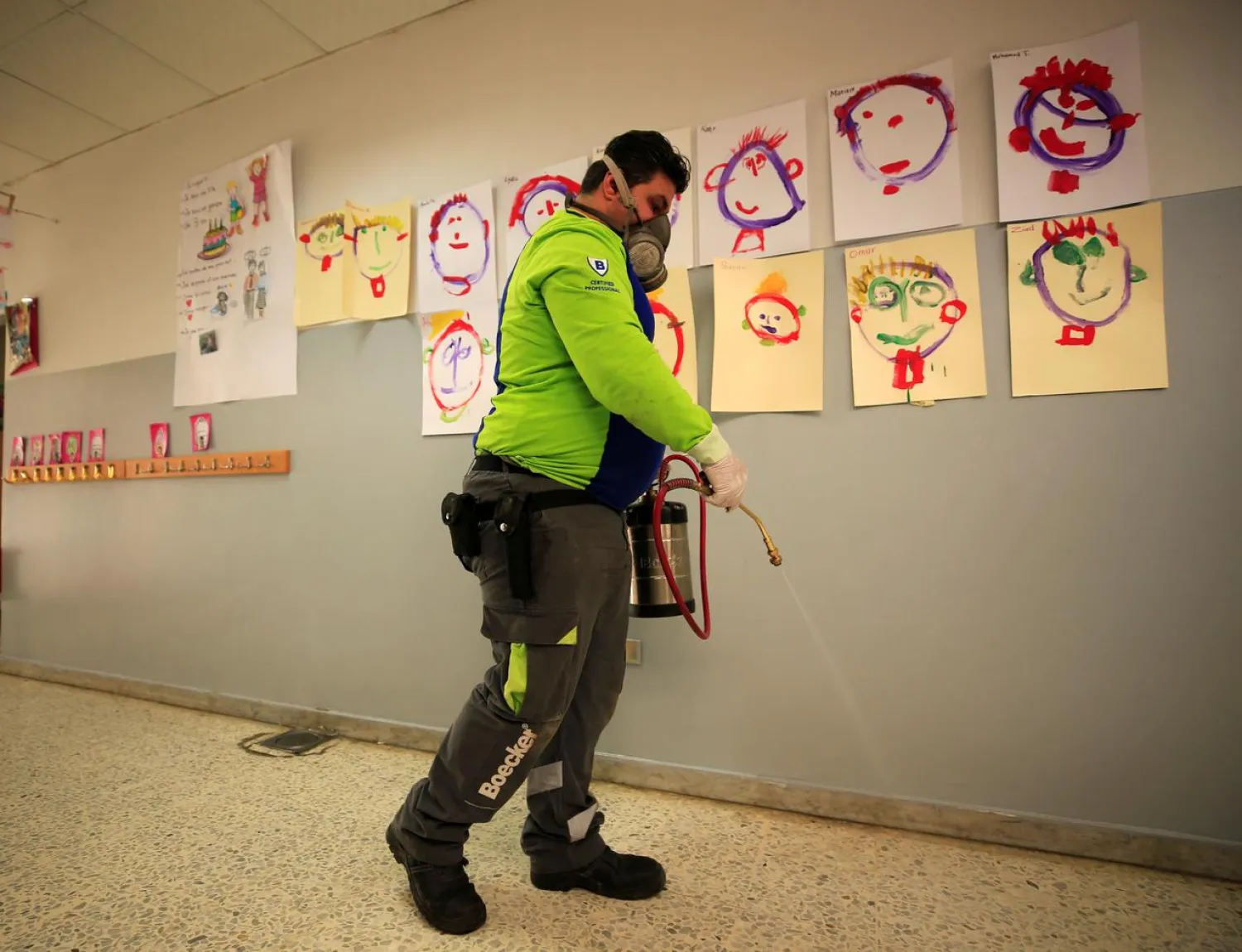
An employee from a disinfection company sanitizes a closed school, as a precaution against the spread of the coronavirus, in Sidon, Lebanon February 29, 2020. REUTERS/Ali Hashisho
TT

Mideast Traditions Come to Abrupt Halt as Virus Spreads

An employee from a disinfection company sanitizes a closed school, as a precaution against the spread of the coronavirus, in Sidon, Lebanon February 29, 2020. REUTERS/Ali Hashisho

Under the sign “Take out only” and a tall bottle of antiseptic by his side, Mazin Hashim, 54, rearranged the coals heating a water pipe outside his famed cafe in Baghdad.

He put up the placard to satisfy recent government restrictions on movement and gatherings that are aimed at slowing the outbreak of the new coronavirus. Once inside, however, thick white plumes of fragrant smoke choked the air as over a dozen young men whiled away the hours in defiance of the directives, The Associated Press reported.

As the pandemic continues to spread, governments across the Middle East have put a stop to the practice of cherished traditions: No more massive weddings and celebrations. No more evenings spent mostly by men in traditional coffee shops across the region. And most importantly, no more smoking of the beloved shisha, or water pipe, in public places.

In a region where life is often organized around large families, communal meals and tribal rules, social distancing can be difficult.

In Iraq, clarion calls sound twice a day to remind people to adhere to the ban on public gatherings. But that has little impact at Hashim's shisha parlor, second home to 29-year-old Mustafa Ahmed who comes every day to meet friends and seek solace from the monotony of domestic life.

Not even at the height of Iraq's sectarian wars was he made to spend seven straight days at home. He and his friends smoked shisha at Hashim's instead.

"It's normal for us to come here during times of crisis," said Ahmed. “The only difference this time is we are hiding from the police.”

Down the street from Hashim, Tony Paulis, 60, said he tried to promote social distancing with a poster outside his barbershop door. It has an “X” over an image of two men leaning in for a greeting, and a warning message: “Please limit yourselves to handshakes.”

The Lebanese port city of Sidon, south of the capital Beirut, is mostly deserted. It once bustled with people flocking to its traditional coffee shops where elderly men gathered to smoke cigarettes and play cards and backgammon. Those closed after the Lebanese government ordered a lockdown last week.

Qassem Bdeir, a fisherman, sat with a group of friends near a hidden segment of the port, discussing the situation, each seated a meter away from the other.

“We used to meet at the coffee shop after a day's work to talk and play cards. Now there's no work, and we steal these few moments to talk and commiserate sitting away from each other before we go home to lock ourselves up," he said.

The virus has also upended plans for weddings — often extravagant affairs in the region, with hundreds of invitees.

In Beirut, Bassam Makki, the 42-year-old owner of a jewelry shop had been in the final stages of planning his wedding when the pandemic started. He and his fiance took out a loan and planned a celebration for 130 people at a four-star hotel in Beirut. The party, which had been scheduled for April 10, has been canceled.

“I guess it wasn't meant to be," he said, trying to offer a smile.

Others pressed ahead with weddings.

Rawan Mohammed found an open tract of agricultural land outside the northern Iraqi city of Dohuk for his wedding after the Kurdistan Regional Government closed wedding halls as part of preventive measures.

“We told everyone at the beginning, they can come by to tell us congratulations and take pictures, but without handshaking or hugging," he said.



Rare Diamond Changes Lives of Two Indian Friends

Satish Khatik and Sajid Mohammed found a 15.34-carat gem-quality diamond in Panna (Amit Rathaur)
TT

Rare Diamond Changes Lives of Two Indian Friends

Satish Khatik and Sajid Mohammed found a 15.34-carat gem-quality diamond in Panna (Amit Rathaur)

On a recent winter morning in Panna, a diamond mining region in central India, two childhood friends made a discovery that they think could change their lives forever.

Satish Khatik and Sajid Mohammed stumbled upon a large, glistening rock on a plot of land they had leased just weeks earlier, according to BBC India.

When they took the stone to the city's official diamond evaluator, they learnt they had found a 15.34-carat gem-quality diamond - one of the finest varieties of natural diamonds that exist.

“The estimated market price of the stone is around five to six million rupees [$55,000 - $66,000] and it will be auctioned soon,” Anupam Singh, the diamond evaluator, told BBC Hindi.

The government holds quarterly auctions, drawing buyers from across India and abroad to bid for the diamonds.

“Estimated prices depend on the dollar rate and benchmarks set by the Rapaport report,” Singh said. Rapaport is widely regarded as a leading authority on independent diamond and jewelry market analysis.

Khatik and Mohammed say they are over the moon. “We can now get our sisters married,” they said.

Khatik, 24, who runs a meat shop and Mohammed, 23 who sells fruits, come from poor backgrounds and are the youngest sons in their families.

For generations, their families have been trying their luck at finding diamonds, which is a common quest among the district's residents.

Panna, which is in Madhya Pradesh state, is among India's least developed districts - its residents face poverty, water scarcity and unemployment.

While most mines are run by the federal government, state authorities lease small plots to locals each year at nominal rates. With few job opportunities in the city, residents hope for a prized find to improve their fortunes - but most come up empty-handed.

Mohammed said his father and grandfather had dug through these plots for decades but discovered nothing more that “dust and slivers of quartz.”

His father Nafees said that the “gods have finally rewarded their hard work and patience.”

They leased a plot in search of diamonds partly out of desperation, as their meagre incomes could not keep pace with rising household costs - let alone pay for a wedding, Mohammed told the BBC.


SpaceX Loses Contact with Starlink Satellite after Mishap

FILE PHOTO: SpaceX logo and Elon Musk silhouette are seen in this illustration taken, December 19, 2022. REUTERS/Dado Ruvic/Illustration/File Photo
TT

SpaceX Loses Contact with Starlink Satellite after Mishap

FILE PHOTO: SpaceX logo and Elon Musk silhouette are seen in this illustration taken, December 19, 2022. REUTERS/Dado Ruvic/Illustration/File Photo

SpaceX's Starlink said one of its satellites experienced an anomaly in space on Wednesday that created a "small number" of debris and cut off communications with the spacecraft at 418 km (259.73 miles) in altitude, a rare kinetic accident in orbit for the satellite internet giant.

"The satellite is largely intact, tumbling, and will reenter the Earth's atmosphere and fully demise within weeks," Starlink said in a post on X.

The company said it was working with the US Space Force and NASA to monitor the debris pieces, the number of which SpaceX did not say.

Space Force's space-tracking unit did not immediately return a Reuters request for comment on the number of trackable debris, which could pose risks for other active satellites in orbit.

With the Starlink satellite still somewhat intact, the event seemed smaller in scale than other orbital mishaps such as the breakup of an Intelsat satellite that created more than 700 pieces, or the breakup of a Chinese rocket body last year.


Lion, Bear Kept as Pets in Albania Find New Homes in German Wildlife Sanctuaries

In this photo, released on Tuesday, Dec. 16, 2025 by Four Paws, veterinarians prepare Erion, a three-year-old lion for its transportation from Tirana to Germany after its illegal keeping in Albania. (Four Paws via AP)
TT

Lion, Bear Kept as Pets in Albania Find New Homes in German Wildlife Sanctuaries

In this photo, released on Tuesday, Dec. 16, 2025 by Four Paws, veterinarians prepare Erion, a three-year-old lion for its transportation from Tirana to Germany after its illegal keeping in Albania. (Four Paws via AP)

A lion and bear rescued from captivity in northern Albania arrived in animal sanctuaries in Germany in early December after authorities in Tirana discovered they were being illegally kept as pets on a private estate.

Erion, a 3-year-old lion, and Flora, a 2-year-old bear, are now both starting a new life.

“We are very happy that the authorities confiscated the animals and that we now have the chance to bring them to Germany, where they can start over and live in species-appropriate conditions,” said Magdalena Scherk-Trettin, a senior project manager responsible for rescues at the international animal welfare organization FOUR PAWS.

A team from FOUR PAWS carried out the rescue after Albania’s National Forestry Agency located the lion based on videos posted on TikTok by its owner.

Neither authorities nor the organization have named the person who was keeping them as pets.

Veterinarians administered anesthesia before the animals were loaded into crates for their long trip to new homes. On Dec. 13, they ended a 70-hour journey through several European countries, with Erion now housed in a wild animal sanctuary in southeast Germany and Flora in a bear sanctuary in the north of the country, FOUR PAWS said.

The organization said both animals had been in poor condition.

“An initial visual check determined that Flora is malnourished and has dental issues, so her recovery plan is already underway,” the organization said.

And when Erion was rescued, his mane had fallen out, for reasons that the veterinarians have not yet been able to determine, it said.

Despite the challenging journey, the rescue was worth it, said Scherk-Trettin. “We are delighted to see these animals begin their new lives.”

Illegal wildlife trade remains a systemic problem in Albania and across the region, where bears in particular, as well as exotic animals, are kept in cages at restaurants or on private properties with little or no expert care.

Erion's and Flora's origins remain unclear. FOUR PAWS said it believes the lion is a victim of illegal wildlife trafficking, while the bear was likely poached from the wild.

“The rescue highlights Albania’s urgent need to tackle illegal wildlife trade and private keeping,” The Associated Press quoted the organization as saying in a statement.

Weak legislation, legal loopholes and poor enforcement have contributed to the widespread private captivity and trade of wild animals in Albania, according to FOUR PAWS, which estimates that more than 60 big cats are still being kept in poor conditions in Albania.

Albanian law allows for individuals or organizations to keep specimens of wild animals if they were born in captivity – for example in a zoo or a specialized facility. Non-native species born outside of Albania can also be kept if documents can be provided proving they were acquired from specialized breeding and trade centers.

Sajmir Shehu, a project manager at Four Paws, said the law lacks a stringent framework based on which organizations like his could prevent wild animals being kept in captivity.

The law also allows for animals to be confiscated if welfare or veterinary standards are not met, but imposes no sanctions on the owners of exotic pets.