

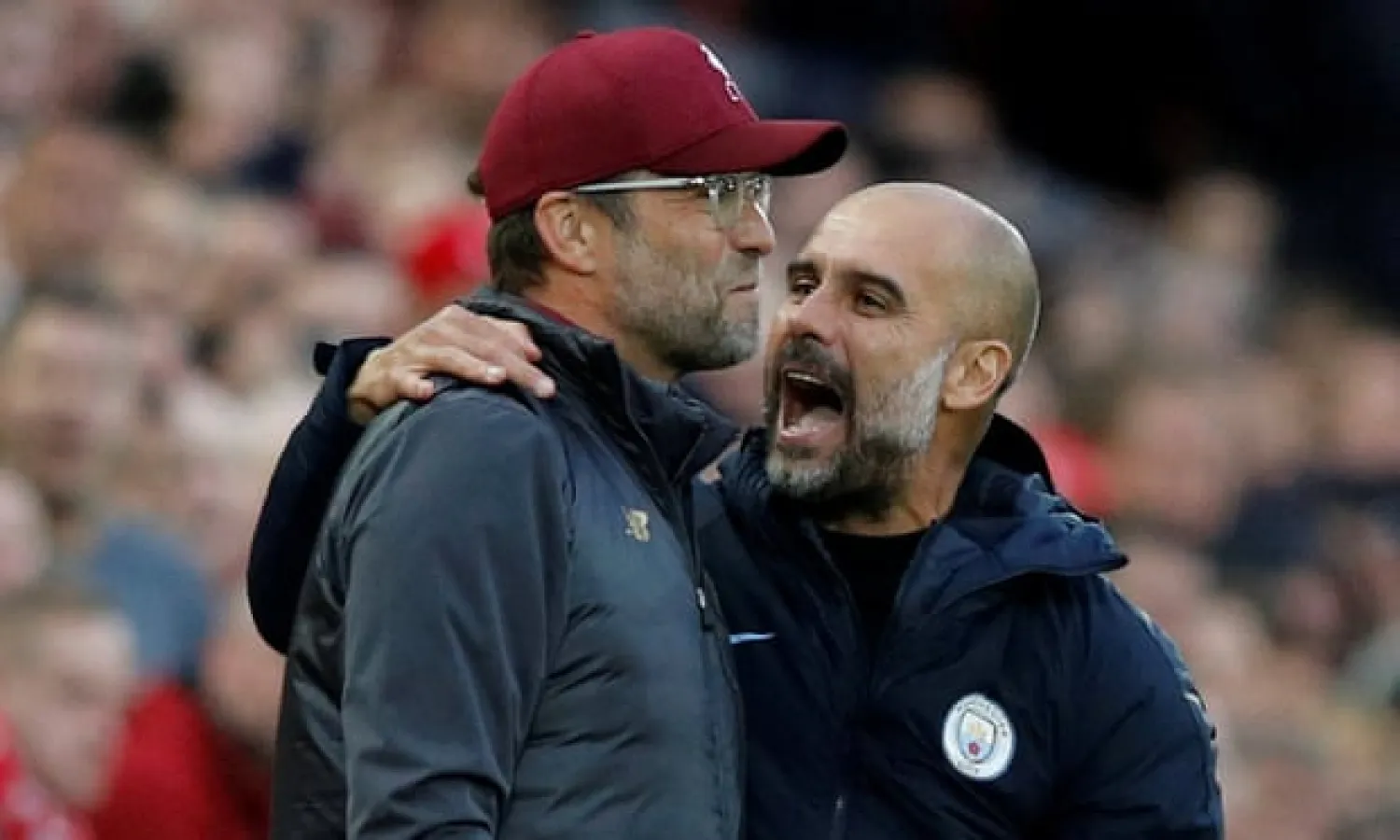

Football's Rare Pause for Thought Gives Coaches Time for Inspiration

 Jürgen Klopp and Pep Guardiola, coaches with contrasting styles tweaked to combat the other’s. What will they come up with next? Photograph: Phil Noble/Reuters
Jürgen Klopp and Pep Guardiola, coaches with contrasting styles tweaked to combat the other’s. What will they come up with next? Photograph: Phil Noble/Reuters
TT

Football's Rare Pause for Thought Gives Coaches Time for Inspiration

 Jürgen Klopp and Pep Guardiola, coaches with contrasting styles tweaked to combat the other’s. What will they come up with next? Photograph: Phil Noble/Reuters
Jürgen Klopp and Pep Guardiola, coaches with contrasting styles tweaked to combat the other’s. What will they come up with next? Photograph: Phil Noble/Reuters

Marton Bukovi showed his courage in wartime Zagreb but the Hungarian also rethought football tactics. Today’s coaches should use their layoff constructively

“What did you do in the war, Mr Bukovi?” “I invented the false 9. What did you do?”

That wasn’t all Marton Bukovi did during the second world war. The Hungarian coach – quite possibly the greatest tactical mind football has known – found himself in Zagreb, coaching Gradjanski, when the conflict began. When the Ustashe seized power and began enacting antisemitic legislation, his position became insecure, given he was the son of a Jewish father and a Catholic mother. He, in as much as religion bothered him at all, seems to have identified as Christian, and there is a cross on his gravestone in the Rakoskeresztur cemetery in Budapest, but his wife, Aranka Klein, was Jewish and at least one of his sisters was a practising Jew.

Bukovi not only kept working but also helped protect the club’s groundsman, a Jewish refugee called Max Reisfeld who had fled Nazi Vienna, taking food and provisions to him and his family as they hid under a stand at the stadium where, for four years, they remained undetected and survived.

Bukovi was courageous and a man of firm principle but he was also notoriously difficult. He had his habits and was rarely minded to change them. He loved the cinema and would go every day after training, but he hated being distracted so would turn up at the box office, ask if his wife were there and, if she were, he would go on to a different cinema.

“He was a hard man,” said Marika Lantos, whose husband, Mihaly, later worked as Bukovi’s assistant at Olympiakos. “Precise, strict and consistent. He demanded order and discipline. It didn’t matter who a player was; he would always tell him what he thought of him. That might be why many didn’t love him. He could be reserved and grumpy but he had a heart of gold. He was like a bad mother-in-law: he commented on everything and always found fault. He meant well, but he couldn’t understand that he needed to make distinctions between people. He just said what he wanted to say.”

But then he was a genius, and geniuses perhaps are allowed some leeway with the social graces. When the war in Yugoslavia was over and the Communists were in control, the clubs who had played in the fascist league were disbanded and, in many cases, had their archives destroyed. Gradjanski, eventually, were reborn as Dinamo and Bukovi was persuaded to become manager.

The interim had given him time to think. He had already overseen Gradjanski’s transition from a 2-3-5 to the W-M formation but what, he wondered, if you went further? What if you withdrew the centre-forward so deep he was almost a midfielder, gave your inside-forwards licence and pulled one of the wing-halves so deep he was in effect a second central defender, turning the 3-2-2-3 of W-M into something very close to 4-2-4?

And so, in 1946, in the game against Lokomotiva that would decide the Zagreb championship, Bukovi put his theory into practice.

Gradjanski won and Bukovi was vindicated – not that he was entirely happy. “Dragutin Hripko played the role,” he said. “He played it closer to well than to poorly, but far from ideally. As a footballer he never achieved great quality, but I always spoke about him when asked about a withdrawn striker. He was my lab rat … I can clearly remember how the Lokomotiva players didn’t know how to handle him.”

Bukovi took the system with him when he returned to Budapest and by 1952 Hungary were using it to win Olympic gold, part of a four-year unbeaten run – in which they twice hammered a befuddled England – that ended with defeat by West Germany in the 1954 World Cup final.

Managers rarely get time to think. The churn of games, the routine of training, of the day-to-day dealing with players is too much. But now, during a shutdown that will last at least a couple of months, managers do have time. Football is a mature game now: huge developmental steps such as Bukovi’s are unlikely. Everything happens by increments. But what is possible? What might an enlightened manager do having been given this long period without the immediate pressure of games?

Elite-level football tends to move forward by solutions. A team is successful playing in a particular way and so a means must be found to interrupt that. The possession-heavy game of Pep Guardiola and his imitators was eventually overcome by the high-energy, highly focused press and transition game of Jürgen Klopp – to the extent that Guardiola has begun to change.

That makes sense: the way to defeat possession football is to work out a way of disrupting those patterns of passing and regaining the ball better.

So what comes next? How do you disrupt a pressing game? One way is simply to pass the ball better, in less predictable patterns. Perhaps if Guardiola’s Barcelona of 2008-11 were still around, still at their peak and still with the dribbling potency of Lionel Messi, that would be possible (it may be that what passed was less their stylistic hegemony than simply the peak of that side). But given it is not, and given the seeming impossibility of that aim, how else could hard-pressing football be circumvented?

An obvious way, which Guardiola briefly took against Klopp’s Borussia Dortmund in a German cup game, is to go over the press. Guardiola used Javi Martínez as his target man, but perhaps target men in general are due a comeback. What better way to thwart a well-deployed pressing line than by whacking it long and early at a Niall Quinn or a Joe Jordan or a Nat Lofthouse, particularly if they could be supported by a rapid poacher? How better to unsettle two central defenders picked less for their marking and battling qualities than their positioning and passing than by making them defend against a pair?

Or perhaps not. But in this time of enforced inaction, it’s perhaps worth managers asking, what would Marton Bukovi do?

The Guardian Sport


Hospital: Vonn Had Surgery on Broken Leg from Olympics Crash

This handout video grab from IOC/OBS shows US Lindsey Vonn crashing during the women's downhill event at the Milano Cortina 2026 Winter Olympic Games on February 8, 2026. (Photo by Handout / various sources / AFP)
TT

Hospital: Vonn Had Surgery on Broken Leg from Olympics Crash

This handout video grab from IOC/OBS shows US Lindsey Vonn crashing during the women's downhill event at the Milano Cortina 2026 Winter Olympic Games on February 8, 2026. (Photo by Handout / various sources / AFP)

Lindsey Vonn had surgery on a fracture of her left leg following the American's heavy fall in the Winter Olympics downhill, the hospital said in a statement given to Italian media on Sunday.

"In the afternoon, (Vonn) underwent orthopedic surgery to stabilize a fracture of the left leg," the Ca' Foncello hospital in Treviso said.

Vonn, 41, was flown to Treviso after she was strapped into a medical stretcher and winched off the sunlit Olimpia delle Tofane piste in Cortina d'Ampezzo.

Vonn, whose battle to reach the start line despite the serious injury to her left knee dominated the opening days of the Milano Cortina Olympics, saw her unlikely quest halted in screaming agony on the snow.

Wearing bib number 13 and with a brace on the left knee she ⁠injured in a crash at Crans Montana on January 30, Vonn looked pumped up at the start gate.

She tapped her ski poles before setting off in typically aggressive fashion down one of her favorite pistes on a mountain that has rewarded her in the past.

The 2010 gold medalist, the second most successful female World Cup skier of all time with 84 wins, appeared to clip the fourth gate with her shoulder, losing control and being launched into the air.

She then barreled off the course at high speed before coming to rest in a crumpled heap.

Vonn could be heard screaming on television coverage as fans and teammates gasped in horror before a shocked hush fell on the packed finish area.

She was quickly surrounded by several medics and officials before a yellow Falco 2 ⁠Alpine rescue helicopter arrived and winched her away on an orange stretcher.


Meloni Condemns 'Enemies of Italy' after Clashes in Olympics Host City Milan

Demonstrators hold smoke flares during a protest against the environmental, economic and social impact of the Milano-Cortina 2026 Winter Olympics in Milan, Italy, February 7, 2026. REUTERS/Kevin Coombs
TT

Meloni Condemns 'Enemies of Italy' after Clashes in Olympics Host City Milan

Demonstrators hold smoke flares during a protest against the environmental, economic and social impact of the Milano-Cortina 2026 Winter Olympics in Milan, Italy, February 7, 2026. REUTERS/Kevin Coombs

Italian Prime Minister Giorgia Meloni has condemned anti-Olympics protesters as "enemies of Italy" after violence on the fringes of a demonstration in Milan on Saturday night and sabotage attacks on the national rail network.

The incidents happened on the first full day of competition in the Winter Games that Milan, Italy's financial capital, is hosting with the Alpine town of Cortina d'Ampezzo.

Meloni praised the thousands of Italians who she said were working to make the Games run smoothly and present a positive face of Italy.

"Then ⁠there are those who are enemies of Italy and Italians, demonstrating 'against the Olympics' and ensuring that these images are broadcast on television screens around the world. After others cut the railway cables to prevent trains from departing," she wrote on Instagram on Sunday.

A group of around 100 protesters ⁠threw firecrackers, smoke bombs and bottles at police after breaking away from the main body of a demonstration in Milan.

An estimated 10,000 people had taken to the city's streets in a protest over housing costs and environmental concerns linked to the Games.

Police used water cannon to restore order and detained six people.

Also on Saturday, authorities said saboteurs had damaged rail infrastructure near the northern Italian city of Bologna, disrupting train journeys.

Police reported three separate ⁠incidents at different locations, which caused delays of up to 2-1/2 hours for high-speed, Intercity and regional services.

No one has claimed responsibility for the damage.

"Once again, solidarity with the police, the city of Milan, and all those who will see their work undermined by these gangs of criminals," added Meloni, who heads a right-wing coalition.

The Italian police have been given new arrest powers after violence last weekend at a protest by the hard-left in the city of Turin, in which more than 100 police officers were injured.


Liverpool New Signing Jacquet Suffers 'Serious' Injury

Soccer Football - Ligue 1 - RC Lens v Stade Rennes - Stade Bollaert-Delelis, Lens, France - February 7, 2026  Stade Rennes' Jeremy Jacquet in action REUTERS/Benoit Tessier
Soccer Football - Ligue 1 - RC Lens v Stade Rennes - Stade Bollaert-Delelis, Lens, France - February 7, 2026 Stade Rennes' Jeremy Jacquet in action REUTERS/Benoit Tessier
TT

Liverpool New Signing Jacquet Suffers 'Serious' Injury

Soccer Football - Ligue 1 - RC Lens v Stade Rennes - Stade Bollaert-Delelis, Lens, France - February 7, 2026  Stade Rennes' Jeremy Jacquet in action REUTERS/Benoit Tessier
Soccer Football - Ligue 1 - RC Lens v Stade Rennes - Stade Bollaert-Delelis, Lens, France - February 7, 2026 Stade Rennes' Jeremy Jacquet in action REUTERS/Benoit Tessier

Liverpool's new signing Jeremy Jacquet suffered a "serious" shoulder injury while playing for Rennes in their 3-1 Ligue 1 defeat at RC Lens on Saturday, casting doubt over the defender’s availability ahead of his summer move to Anfield.

Jacquet fell awkwardly in the second half of the ⁠French league match and appeared in agony as he left the pitch.

"For Jeremy, it's his shoulder, and for Abdelhamid (Ait Boudlal, another Rennes player injured in the ⁠same match) it's muscular," Rennes head coach Habib Beye told reporters after the match.

"We'll have time to see, but it's definitely quite serious for both of them."
Liverpool agreed a 60-million-pound ($80-million) deal for Jacquet on Monday, but the 20-year-old defender will stay with ⁠the French club until the end of the season.

Liverpool, provisionally sixth in the Premier League table, will face Manchester City on Sunday with four defenders - Giovanni Leoni, Joe Gomez, Jeremie Frimpong and Conor Bradley - sidelined due to injuries.
