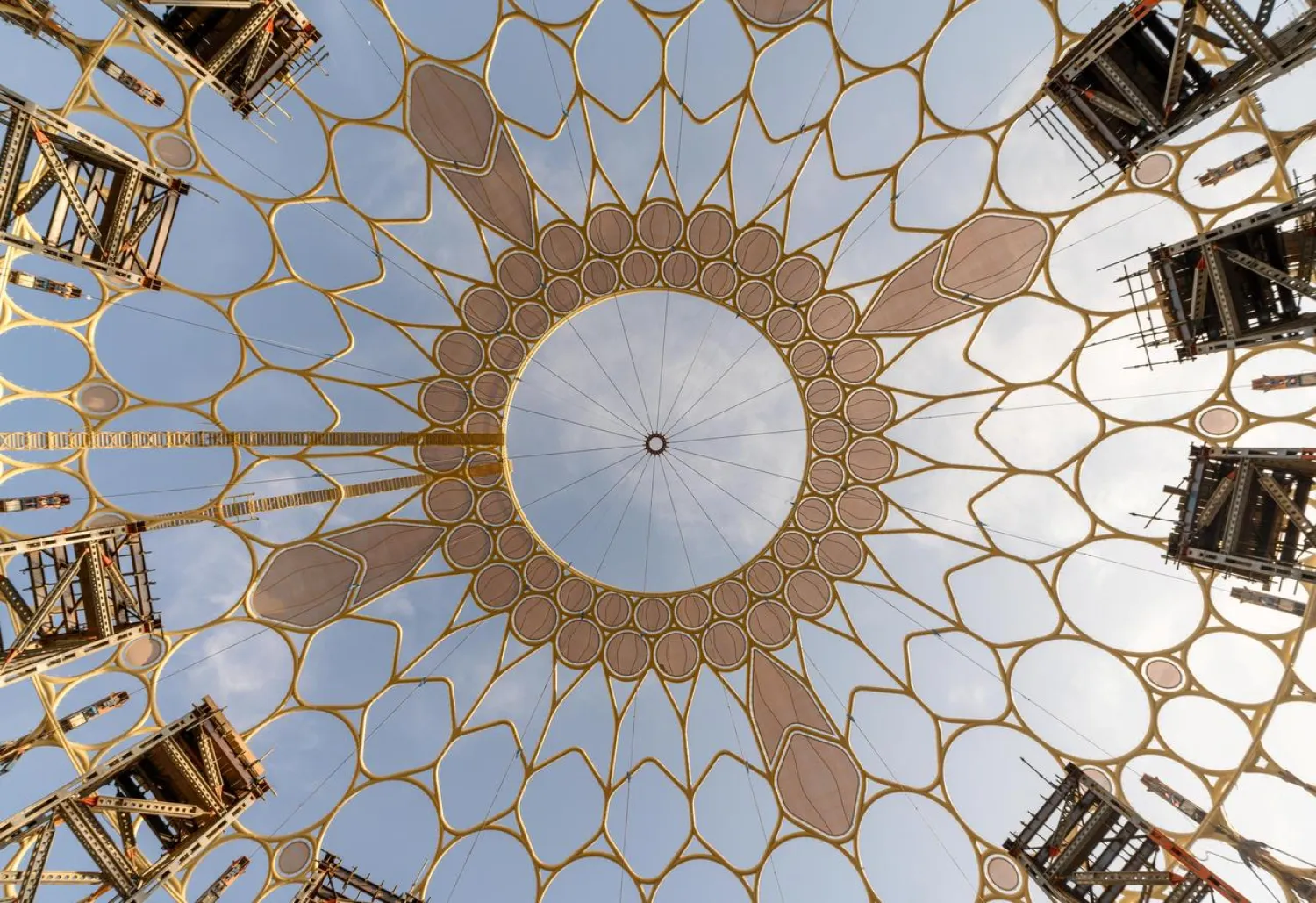
A view shows the Expo 2020 Dome in Dubai, UAE, in this undated picture obtained September 19, 2019. (Expo 2020 - Reuters)
Organizers of Expo 2020, a multi-billion-dollar world trade fair originally scheduled to open in Dubai in October, on Monday recommended a one-year postponement due to the coronavirus pandemic.
Dubai had hoped to attract some 25 million visits to the six-month event and many of its economic forecasts are pinned to the mammoth gathering.
"Many countries have been significantly impacted by COVID-19 and they have therefore expressed a need to postpone the opening of Expo 2020 Dubai by one year," Expo 2020 Dubai director general Reem al-Hashimi said.
"The UAE and Expo 2020 Dubai have listened. And in the spirit of solidarity and unity, we supported the proposal to explore a one-year postponement."
Dubai has little of the oil riches of neighboring emirates like Abu Dhabi, and its vital property, tourism and trade sectors had already been badly weakened in recent years.
Expo organizers, participating countries and the Paris-based Bureau International des Expositions (BIE) -- the governing body which awards the event -- had agreed to investigate shifting the mega-event.
"We look forward to welcoming the world, which we are certain will only come out of this pressing challenge stronger, and more resilient than it ever was," Hashimi added.
A final decision on postponement will be made by the BIE, but its Secretary General Dimitri Kerkentzes welcomed the recommendations.
"The UAE´s decision to support a one-year postponement demonstrates pragmatism, openness, and commitment to delivering an Expo that lives up to our shared ambition," he said.
Dubai has already scrapped a string of cultural and entertainment events in recent weeks over the spread of the deadly disease.
"The decision to postpone (Expo 2020) comes at a crucial juncture when the economy is tipped to fall into a recession," said M.R. Raghu, head of research at Kuwait Financial Centre (Markaz).
"SMEs (small and medium-sized enterprises), hospitality, tourism and retail sectors that are already reeling under the twin impact of low oil prices and (the) coronavirus outbreak hoped to recoup and recover lost business during the Expo period."
The United Arab Emirates has announced 611 cases of coronavirus, and five deaths. It has enforced extensive lockdown measures to curb the spread of the disease including an ongoing nighttime curfew.
Saudi Industry Minister Reviews Gold Processing Technologies at Tau-Ken Altyn Refinery in Kazakhstanhttps://english.aawsat.com/business/5282319-saudi-industry-minister-reviews-gold-processing-technologies-tau-ken-altyn
Saudi Minister of Industry and Mineral Resources Bandar Alkhorayef and other officials are seen during the tour of the gold refinery in Astana on Tuesday. (SPA)
TT
TT
Saudi Industry Minister Reviews Gold Processing Technologies at Tau-Ken Altyn Refinery in Kazakhstan
Saudi Minister of Industry and Mineral Resources Bandar Alkhorayef and other officials are seen during the tour of the gold refinery in Astana on Tuesday. (SPA)
Saudi Minister of Industry and Mineral Resources Bandar Alkhorayef visited the gold refinery operated by Tau-Ken Altyn in Kazakhstan's capital, Astana, on Tuesday.
The minister reviewed the technologies and processes used in gold processing and refining and met with Tau-Ken Altyn chief executive Arnur Aidarkhanov and chief economic and financial officer Ruslan Zhumagulov.
Discussions focused on opportunities for cooperation and the exchange of expertise in the mining and metals industries.
The minister received a briefing on the refinery's operations and its role in enabling Kazakhstan to refine gold domestically and enhance the value added from its mineral resources.
It highlighted the refinery's contribution to strengthening the country's gold and foreign exchange reserves, with the facility regarded as a strategic asset in Kazakhstan's precious metals sector.
Alkhorayef toured the refinery’s facilities, including its gold refining operations, processing units, and gold bullion production lines, which operate using advanced technologies and in accordance with the highest international standards.
He also reviewed the refinery’s accreditation by the London Bullion Market Association, which confirms that its products comply with internationally recognized standards in the global gold market.
The minister's tour was part of his official visit to Kazakhstan, which aims to strengthen economic ties between Riyadh and Astana and build effective partnerships in the mining and metals sectors.
Riyadh Air Eyes Gradual Expansion as New Aircraft Arrivehttps://english.aawsat.com/business/5282309-riyadh-air-eyes-gradual-expansion-new-aircraft-arrive
Riyadh Air Eyes Gradual Expansion as New Aircraft Arrive
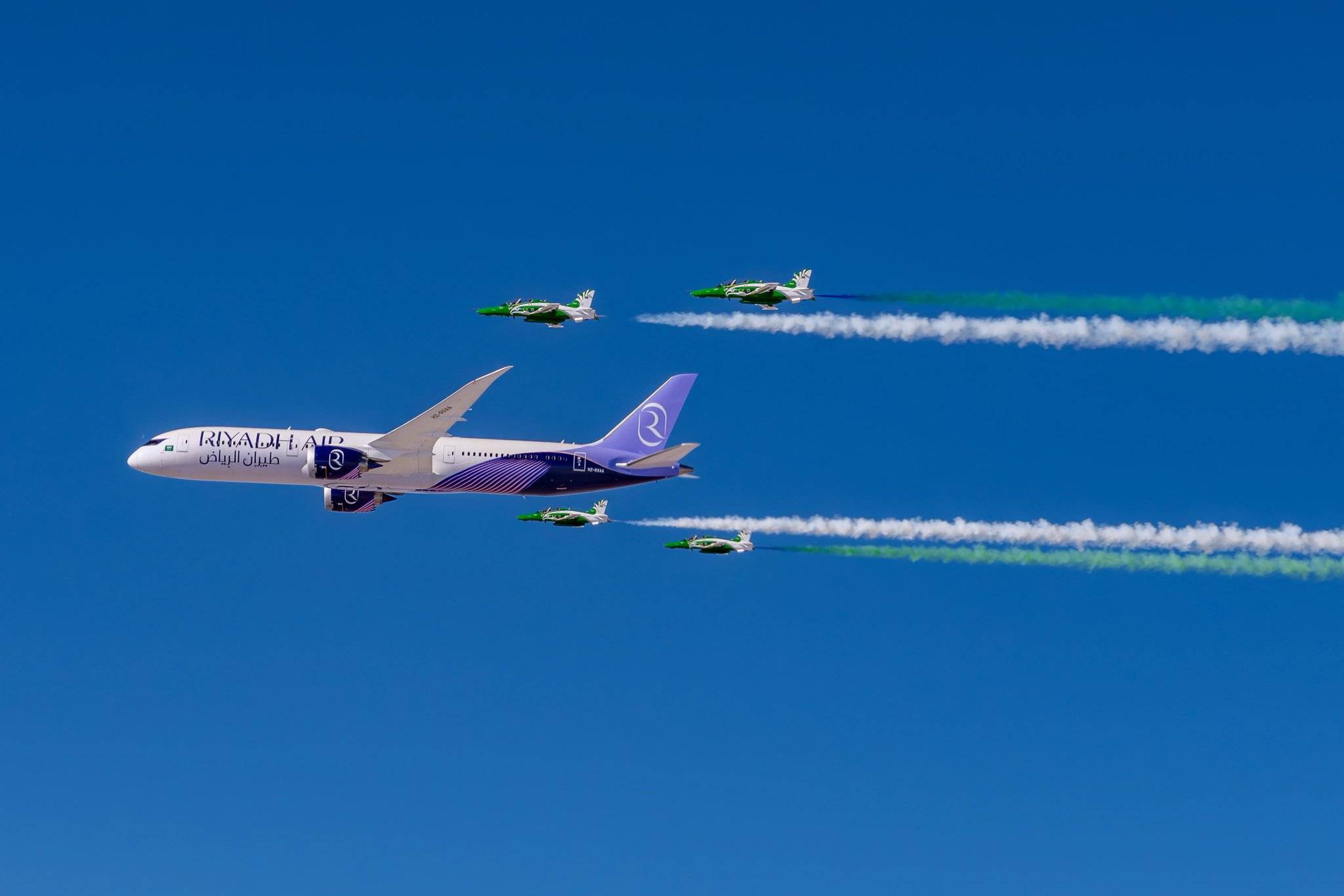
Riyadh Air’s new aircraft enters Saudi airspace (X)
Riyadh Air has completed its structural setup phase and has moved formally into operations, advancing a gradual, carefully planned expansion strategy built around rapid fleet growth and the approaching commercial launch of Saudi Arabia’s new national carrier.
The arrival of its third Boeing 787 Dreamliner in Riyadh, along with the official start of ticket sales for its first domestic and international destinations, marks a new stage for the airline as it prepares to build a growing network focused on expanding operating capacity and targeting high-demand global markets.
The steps put into practice the goals of Vision 2030, which seeks to turn Riyadh into a global logistics hub and a key link for air transport and luxury hospitality between continents.
Osamah Alnuaiser, senior vice president of marketing and corporate communications at Riyadh Air, said the arrival of the third aircraft was a “historic moment” for the company, coming days after it received its first two planes.
He said the milestone crowned more than three years of work since the signing of the first deals with Boeing, under a plan to build a fleet of more than 182 aircraft.
Speaking to Asharq Al-Awsat, Alnuaiser said the new carrier had moved from establishment to actual operations. He said the company had started intensive operational tests, including daily nonstop flights between Riyadh and London, to assess service and product quality and test its operating model before the full commercial launch.
Five destinations
Alnuaiser said the company had officially started selling tickets to five destinations - Jeddah, Cairo, Dubai, Madrid and Manchester - calling the move the beginning of a route network that will expand gradually in the coming period.
He said Riyadh Air was preparing to receive more aircraft in sequence over the coming months, supporting plans to expand destinations and increase operating capacity. The company is currently operating four daily flights between Riyadh and Jeddah, he said, as part of a strategy to strengthen air links between the Saudi capital and major economic and tourism centers worldwide.
Alnuaiser said the company was constantly studying new domestic and international destinations. The goal, he said, was not merely to increase flights but to diversify destinations and connect Riyadh with major capitals and cities, in line with the aim of turning the capital into a global aviation hub.
Innovation
Alnuaiser said innovation and leadership were central pillars of Riyadh Air’s strategy, both in passenger services and in the digital and operational experience the airline is seeking to deliver.
Asked about the challenges facing the global aviation sector, Alnuaiser said geopolitical events and supply chain disruptions were common challenges for airlines. Riyadh Air, he said, was focused on seizing opportunities and selecting markets with strong demand and promising growth prospects.
He said the company expected to have more than 11 aircraft before the end of this year, with monthly deliveries of Boeing 787 aircraft continuing, along with the start of Airbus A321 deliveries at year’s end. That, he said, would strengthen fleet diversity and operational flexibility.
The expansion comes as Riyadh Air accelerates preparations to launch commercial operations, as part of Saudi Arabia’s plans to strengthen the aviation sector and increase international air connectivity, in line with Vision 2030 targets to make the Kingdom a global transport and logistics hub.
Aircraft delivery ceremony
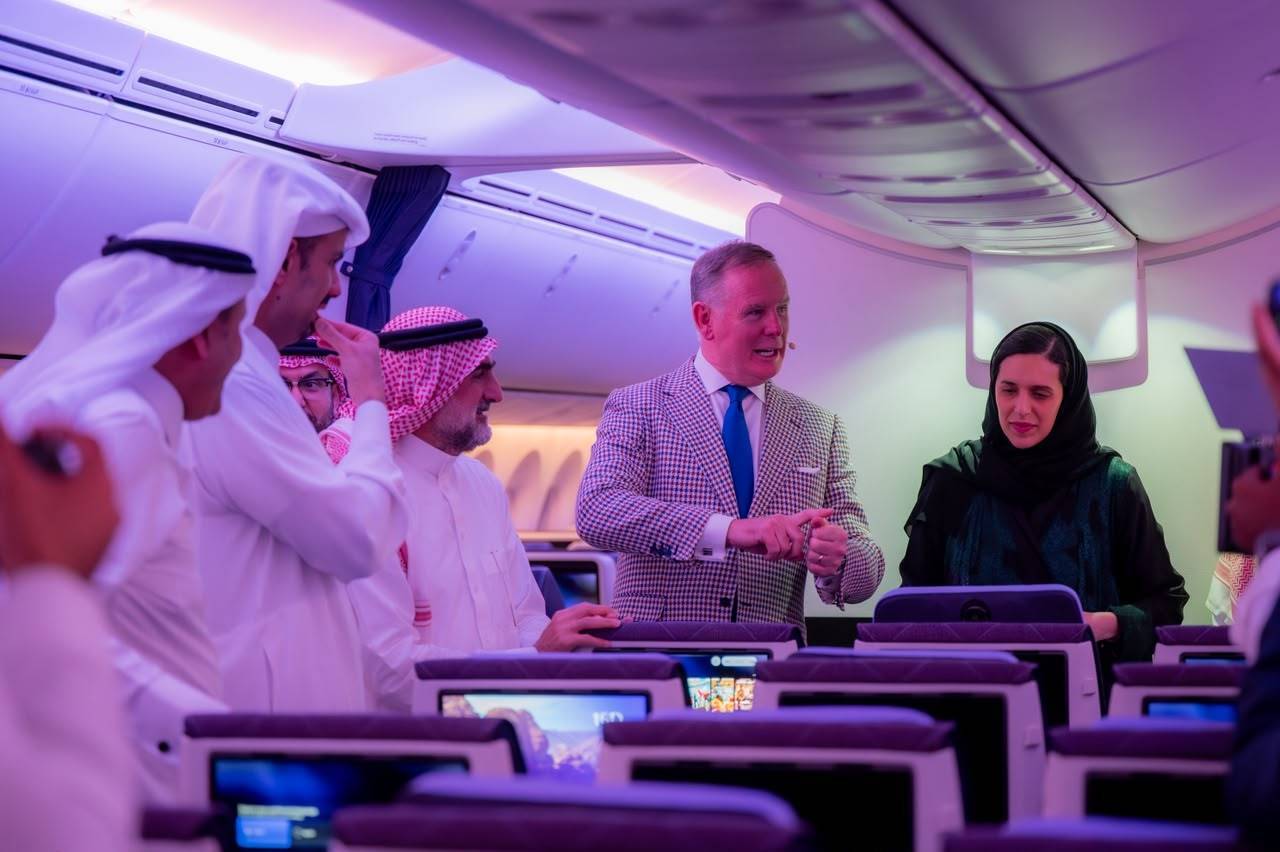
Saudi Arabia’s new carrier celebrated the delivery of the new aircraft at a special ceremony in Riyadh attended by several ministers and officials.
Yasir Al-Rumayyan, governor of the Public Investment Fund and chairman of Riyadh Air, said at the ceremony that the moment embodied Vision 2030’s goals of strengthening the Kingdom’s connection to the world and supporting economic diversification.
He said the new national carrier was moving to cement Saudi Arabia’s position as a global transport and logistics hub, while Riyadh Air continued to build a new model for air travel linking Riyadh with the world.
Al-Rumayyan and Douglas, along with other officials, are seen inside the cabin of the new plane (X)
Saudi Arabia as a global hub
As Riyadh Air approaches commercial operations, Saudi Arabia’s aviation sector is expanding rapidly, led by several national carriers. Saudia operates more than 530 flights a day to over 100 destinations worldwide, while flynas runs about 2,000 flights a week, or about 285 a day.
Riyadh Air has started trial operations with daily flights to London before expanding to other destinations, while flyadeal reaches 38 domestic and international destinations through a network of 159 air routes.
The origins of Riyadh Air
The Riyadh Air project grew out of a vision to establish a new national carrier that would support the goals of Vision 2030.
On March 12, 2023, Saudi Crown Prince Mohammed bin Salman announced the launch of Riyadh Air as a company wholly owned by the Public Investment Fund. The airline is intended to connect the Saudi capital with more than 100 destinations worldwide by 2030.
Raid Ismail, PIF’s head of direct investments for the Middle East and North Africa, said Riyadh Air had started where others had left off. He said the region had seen expansion in low-cost carriers over the past two decades, but had not seen the creation of a major integrated airline built on a modern model from the start.
According to available information, the company has focused since its establishment on technology, innovation and the customer experience, positioning itself as a key enabler of growth in Saudi Arabia’s tourism sector, stronger international air connectivity and higher visitor numbers.
Ismail said the new carrier aims to make Riyadh an attractive destination and a major transit point for travelers, helping connect the Saudi capital to global destinations and supporting access to major projects such as Qiddiya, Diriyah and Riyadh Season, as well as other tourism and development destinations across the Kingdom.
He said establishing a new company gave Riyadh Air greater flexibility to build a modern operating model based on digital technologies, sustainability and an improved passenger experience, which became one of the main foundations of the airline’s strategy from the project’s launch.
Riyadh Air has started trial operations with daily flights to London before expanding to other destinations (X)
Reviving the golden age of aviation
Riyadh Air’s strategy is to reshape the air travel experience by combining luxury services with modern digital technologies.
Chief Executive Officer of Riyadh Air Tony Douglas has said the new national carrier does not aim only to transport passengers, but to redefine the entire journey through digital innovation and seamless connectivity.
Douglas said the company pays close attention to the smallest details, drawing inspiration from the golden age of aviation, when air travel was part of a complete hospitality experience.
He said Riyadh Air aims to restore that concept by offering a refined, distinctive experience on the ground and in the air, thereby strengthening its position as a global player in luxury air travel.
According to officials, artificial intelligence will be a central part of the operating model, through digital services capable of personalizing the passenger experience, suggesting activities, events and suitable options during the journey, and providing a smooth digital experience that allows passengers to complete services easily and quickly.
Riyadh Air says it is targeting an existing market with strong demand that still needs more services and options. Douglas said Saudi Arabia’s young population and wide use of digital technologies provide a favorable environment for the company’s growth.
He said the new carrier would play an important role in supporting the Kingdom’s tourism goals by making it easier for visitors to reach Riyadh and other Saudi destinations, and by strengthening Saudi Arabia’s position on the global travel map.
Saudi Arabia, Türkiye Sign MoUs on Railway and Logistics Cooperation, Connecting Gulf with Europehttps://english.aawsat.com/business/5282307-saudi-arabia-t%C3%BCrkiye-sign-mous-railway-and-logistics-cooperation-connecting-gulf
Saudi Arabia, Türkiye Sign MoUs on Railway and Logistics Cooperation, Connecting Gulf with Europe
Al-Jasser and Uraloglu shake hands after signing the MoUs. (X)
Saudi Arabia and Türkiye have taken a major step toward forming a new regional logistics corridor that could reshape trade flows between the Gulf and Europe.
Saudi Transport and Logistics Services Minister Saleh bin Nasser Al-Jasser and Turkish Transport and Infrastructure Minister Abdulkadir Uraloglu signed two major memorandums of understanding on railway and logistics cooperation.
The agreements, along with other deals, point to a potential shift in international trade routes through a seamless land corridor linking the Gulf directly to Europe.
Uraloglu said in an official post on X that the memorandums, marked the start of a new phase of cooperation. He said they would strengthen the exchange of expertise and technical cooperation across areas ranging from logistics centers to modern applications.
He said both countries wanted to build railway cooperation on stronger, more sustainable foundations, particularly in technology, infrastructure, training, and human resources development.
He hoped the steps would deepen regional connectivity and support trade and development.
Al-Jasser had earlier said joint studies on a regional rail link between Saudi Arabia and Türkiye through Jordan and Syria were expected to be completed before the end of this year.
The project builds on existing infrastructure. Saudi Arabia’s national railway network already extends to the Jordanian border via the Al-Haditha crossing.
Route map
The latest push builds on routes that began to emerge after a previous agreement between the transport ministries of Türkiye, Syria, and Jordan. That agreement set a four- to five-year technical roadmap to rehabilitate damaged infrastructure.
The route would begin from Turkish networks connected to southern Europe, cross Syria for 350 km through routes in Aleppo and Damascus, reach Amman and the port of Aqaba, and then connect to Saudi Arabia’s network, which extends toward the rest of the Gulf and Oman on the Indian Ocean.
The plans are moving on two tracks.
The first is the quick activation of rail crossings between Ankara and Damascus to boost trade. The second is a long-term strategic link using fast freight trains to move containers directly from Gulf ports to the heart of Europe.
The route could cut commercial shipping time from 15 days to six days and lower costs by 20% to 30%. It would also provide supply chains with a secure land corridor that bypasses tense waterways, including the Strait of Hormuz and the Bab el-Mandab.
Damascus and Ankara
The wider strategy is moving in parallel with intensified activity along the Ankara Damascus line, aimed at securing the project’s northern corridors and preparing its infrastructure and banking systems before the launch of the continental link train.
Alongside the broader rail project, economic ties between Ankara and Damascus have entered a new phase.
Turkish Trade Minister Omer Bolat told the Anadolu City Economies Summit in the Turkish border city of Gaziantep that preparations had been completed to open the Islahiye railway crossing with Syria and that Türkiye was preparing to open the Nusaybin crossing.
He said work had also begun to study legislation that would allow Turkish banks and business institutions to open branches in Syrian cities.
Bolat outlined a plan to raise trade from $3 billion now to $5 billion in the near term and $10 billion by 2030.
Ankara’s top priority remained preserving the unity of the Syrian state and its national sovereignty, he stressed, adding that Türkiye had provided all possible diplomatic and economic support for stability in its neighbor.
Syrian Economy and Industry Minister Mohammad Nedal Alchaar presented the economic vision of what he called the “new Syria,” sending a direct message to Turkish investors and businesspeople.
He said they must target “long-term strategic partnerships aimed at building, not profit alone.”
Alchaar said Syria “today has a huge industrial opportunity that does not exist in many countries of the world, as an emerging country full of expertise and young talent.”
He said many Turkish companies had already begun operating on the ground, especially in Aleppo province, a historic industrial hub, while others were working to complete their licenses.
Alchaar said stronger economic growth in Damascus, as Ankara’s natural partner, would directly boost growth in both countries.
In the diplomatic framework shaping the emerging partnership, Turkish Ambassador to Damascus Nuh Yilmaz said the new phase rested entirely on a “win-win” principle.
He said lasting political stability in Syria would only come through renewed prosperity and economic recovery.
Yilmaz described Türkiye as “the main and safe gateway for Syrian products to global markets and Europe.” In return, he said, Syria is “the strategic and vital logistics corridor for Türkiye toward Middle Eastern markets and the depth of the Gulf.”
لم تشترك بعد
انشئ حساباً خاصاً بك لتحصل على أخبار مخصصة لك ولتتمتع بخاصية حفظ المقالات وتتلقى نشراتنا البريدية المتنوعة