

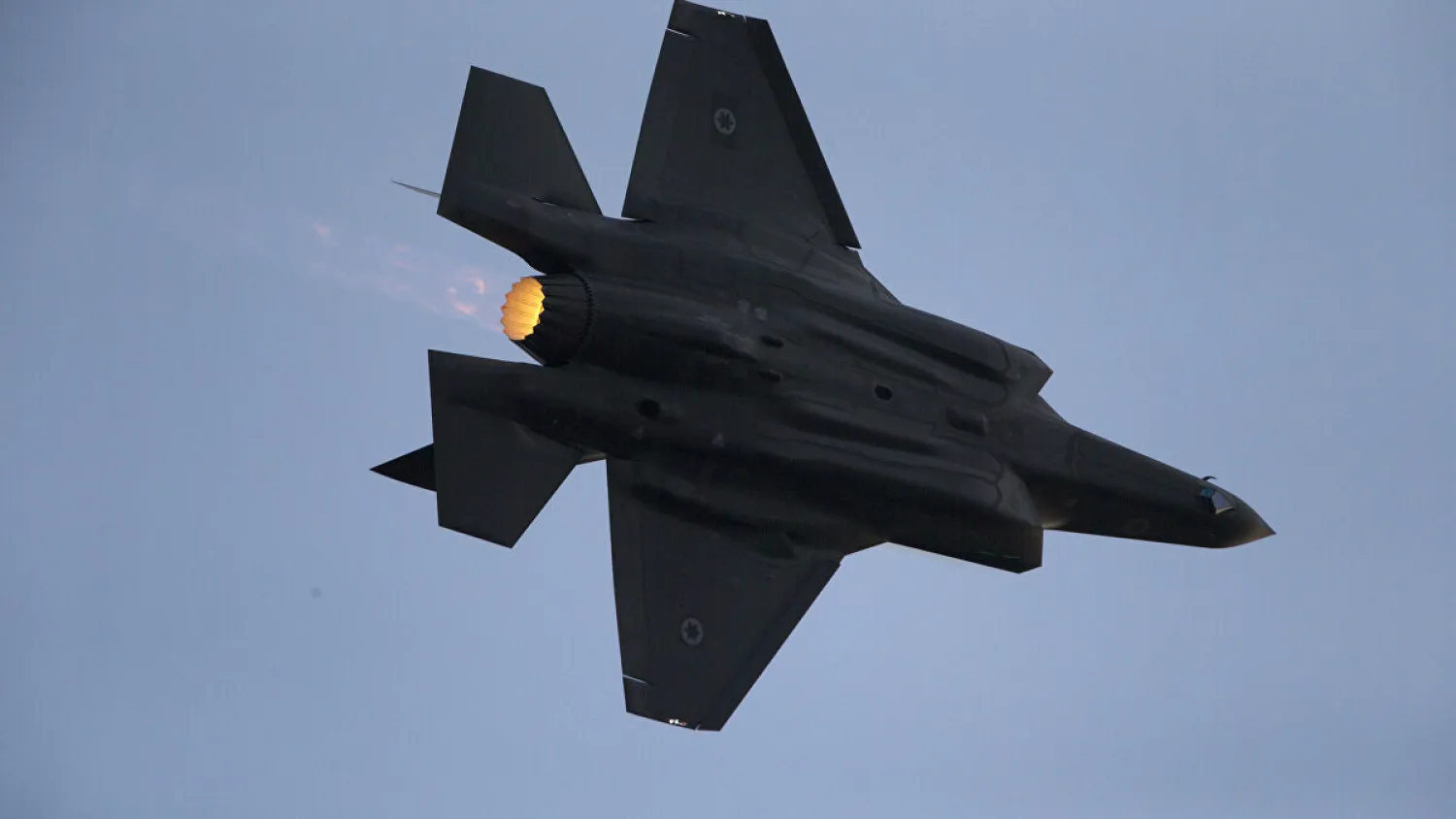

US, Israel Conclude Drills on Possible Iranian Attacks on Tel Aviv

An Israeli air force F-35 jet. (AP file photo)
TT

US, Israel Conclude Drills on Possible Iranian Attacks on Tel Aviv

An Israeli air force F-35 jet. (AP file photo)

The Israeli and US air forces concluded on Monday joint drills simulating measures when facing air threats and a possible Iranian missile attack on Israel.

An Israeli army spokesman said the goal of the exercise was to enhance cooperation in joint air defenses and counter missile threats.

The forces were trained in Negev desert on the F-35 stealth fighter jets and simulated scenarios in which they had to deal with both aerial threats and varying strategic threats from the ground.

The troops were trained on a scenario of US forces’ arrival in Israel and cooperating with the Israeli air defense system in protection missions, in case Israel was attacked by missiles and rocket-propelled grenades from several fronts.

The three-day exercise was conducted despite the coronavirus outbreak.

All contacts between the Israeli and US crew were done remotely through shared communication in the air and all flights were instructed using video conferencing, in light of concerns over the outbreak.

An Israeli army spokesman said that the exercise showed Israel’s close relationship with the US military and “increased the sharing of knowledge and study of the F-35’s capabilities and improves the operational capabilities of the Air Force.”

The spokesman said the Air Force continues to maintain full operational capabilities, and works in an emergency to continue to perform its mission of defending the country at all times.



Israel Deploys AI Agents Across Multiple Fronts

Technologists with the Israeli military’s Matzpen operational data and applications unit work at their stations, at an Israeli Army base in Ramat Gan, Israel. (Reuters)
TT

Israel Deploys AI Agents Across Multiple Fronts

Technologists with the Israeli military’s Matzpen operational data and applications unit work at their stations, at an Israeli Army base in Ramat Gan, Israel. (Reuters)

The Israeli Army has begun deploying “AI agents” to detect missile launchers, generate real-time aerial intelligence and sharpen strike speed and precision across multiple fronts, officials told Haaretz and the Yedioth Ahronoth newspaper on Tuesday.

“The pace, scope and precision of strikes — as well as their overall quality and volume — would not have been possible without human-machine integration and automated tools capable of synchronizing hundreds of actions simultaneously,” an Israeli official told Yedioth Ahronoth.

Such missions, he noted, would have been impossible for the Israeli army just a few years ago, or even months ago.

The senior military official said the army sees the technology as part of its future, with some such agents already in use in undisclosed systems.

According to Yedioth Ahronoth, Israel’s use of artificial intelligence in Operation Roaring Lion is unprecedented.

Integrated into command-and-control systems from the General Staff down, AI is helping the Air Force plan and coordinate strikes in Iran and Lebanon and assist with navigation
The newspaper said in recent weeks, AI has also helped generate real-time situational assessments across multiple theaters — a need underscored by lessons from the failures that led to the October 7 attacks.

One system, known as “Tashan,” is used by the Air Force to identify missile launchers in Iran, Lebanon and Yemen immediately after launches, allowing forces to quickly locate and destroy the source.

Meanwhile, another source told Haaretz on Tuesday that the Israeli military has for the first time confirmed an artificial intelligence infrastructure developed during the war in Gaza is now fully operational in current fighting in Iran and Lebanon.

The system, known internally as the Israeli army’s “Operational Data and AI Factory,” integrates sensor, video, text and audio data into a single real-time operational picture across the military.

A military official told Haaretz that the system is now in use throughout the army. It can process vast amounts of data, including inputs from sensors, as well as video, text and audio.

According to the official, the shift to this AI-based infrastructure creates a comprehensive operational picture of the military's forces, missions and threats – one that is accessible to all branches.

The system is designed to assist with attack planning, targeting and strikes. It also records and transcribes all wireless communications, and compiles real-time data on missile and drone launches and interceptions. This significantly improves both operational and defensive decision-making in a way that was previously unimaginable.

Haaretz has learned that the system is also involved in processing strike plans and targets – confirming for the first time that the infrastructure plays a role in offensive operations, not just defense.

In Lebanon, military sources say, similar capabilities are being used to analyze video feeds from cameras deployed across the sector, identifying people and objects and generating real-time alerts.

Another system, “Lohem” (Fighter), assists commanders – particularly in the Air Force – in planning and synchronizing strikes.

The Israeli army says several AI-based defensive systems are also operational. These include “Rom,” which detects drones and UAVs; “Spatial Control,” which alerts ground forces to rocket and anti-tank fire; and “Tashan,” which identifies launches and impact points and locates the source of fire.

AI has also been integrated into Israel's national alert system, enabling predictions of where interception debris may fall.

The newspaper said a central component of the system is “MapIt,” a platform that displays real-time, three-dimensional operational data to commanders. It has learned that over the past year, the military has developed an additional layer on top of “MapIt,” consolidating all data streams into a single operational map.


Iran’s Fractured Leadership is Struggling to Coordinate, Officials Say

A member of the Iranian security forces stands guard next to a banner honoring former Iranian supreme leader Ali Khamenei, in Tehran, Iran, 30 March 2026. EPA/ABEDIN TAHERKENAREH
TT

Iran’s Fractured Leadership is Struggling to Coordinate, Officials Say

A member of the Iranian security forces stands guard next to a banner honoring former Iranian supreme leader Ali Khamenei, in Tehran, Iran, 30 March 2026. EPA/ABEDIN TAHERKENAREH

Washington: Ronen Bergman, Adam Goldman, Julian Barnes

The US-Israeli war against Iran has fractured the Iranian government, complicating its ability to make decisions and coordinate larger retaliatory attacks, according to officials familiar with US and Western intelligence assessments.

Several dozen Iranian leaders and their deputies have been killed since the war began four weeks ago. Those who survive have had difficulty communicating and are unable to meet in person, for fear of having their calls intercepted by the United States or Israel and being targeted in an airstrike.

While Iran’s security and military agencies continue to function, the government’s ability to plan new strategies or policies has been weakened.

The Trump administration has said a new government is in charge in Iran and has pressed it to make a quick deal. But the more degraded Iranian government decision making becomes, the more difficult it will be for it to negotiate with American envoys or make significant concessions.

With different leaders in place, Iranian negotiators may have little knowledge about what their government is willing to concede, or even whom precisely to ask.

What is more, American officials say hard-liners within the Iranian Revolutionary Guards Corps have become more influential in Iran, exerting more power than the religious leadership nominally in charge.

But whether someone emerges to make a deal, and whether that person can persuade other officials to agree to it, is far from clear.

Former American officials say Iran will make a deal when it suffers enough economic pain from the war. While the damage has been severe, Iran may not yet feel as though it is losing, according to current and former officials.

On Monday, US President Donald Trump threatened to expand the war if a deal was not quickly reached, suggesting that US forces might try to take Kharg Island, Iran’s main hub for oil exports.

Iran’s compromised communications have caused confusion and paranoia among the surviving government leaders, who fear that their calls and messages are being intercepted by Israeli intelligence, officials say.

As a result, they have been reluctant to make calls, according to officials briefed on Western intelligence assessments.

Israel began the war with a strike on the leadership compound that killed Iran’s supreme leader, Ali Khamenei, and much of the national security leadership.

A number of lower-level officials seen by the United States as more pragmatic were also killed in the strike, US officials said.

Trump himself made reference in interviews that potential candidates to lead Iran had been killed.

The attack severed many connections between security, military and civilian policymakers, according to Western officials and others briefed on government assessments.

It is unclear how much control the new supreme leader, Mojtaba Khamenei, is exerting over the government. He has not been seen in public, and US and Israeli intelligence agencies believe he was wounded during the war.

Some intelligence officials believe that Khamenei may be more of a figurehead, and that the surviving leadership of the Revolutionary Guards is making the decisions.

A senior US military official said Iranian command and control has been badly degraded by American and Israeli strikes.

Still, the official and a senior intelligence official said, before the war Iran built a decentralized control system that allows local commanders in different regions of the country to make their own strike decisions, even in the absence of direct day-to-day orders from Tehran.

The United States is targeting those local commanders, the senior military official said.

Nevertheless, Iran has proved it can still launch substantial offensive strikes.

But the retaliatory attacks have not been as large, or as effective, as they might have been because of the problems in the Iranian government. Given the decimation of its leadership, former US officials say, Iran has been unable to launch larger barrages of missiles that could more easily overwhelm defenses. Instead, regional commands have had to muster counterattacks without coordinating with one another.

Trump has expressed frustration with what he has portrayed as mixed messaging from the Iranian leadership.

“The Iranian negotiators are very different and ‘strange,’” Trump wrote on social media on Thursday. “They are ‘begging’ us to make a deal, which they should be doing since they have been militarily obliterated, with zero chance of a comeback, and yet they publicly state that they are only ‘looking at our proposal.’”

Over the weekend, Trump said the campaign of airstrikes had resulted in new leadership in Iran and again claimed progress in talks.

“It’s a whole different group of people,” Trump said on Sunday. “So I would consider that regime change, and frankly, they’ve been very reasonable.”

In a social media post on Monday, Trump offered optimistic assessments of the current government but also threatened to expand the war by targeting energy and civilian infrastructure. He said that if a deal was not reached shortly, and if the Strait of Hormuz remained closed, he would attack Iran’s electrical generation plants, oil wells and desalination plants.

People briefed on intelligence assessments said Trump’s frustration reflected the inability of the current Iranian government to coordinate a response and make a decision about the American peace proposals.

Israeli officials have said the communication problems in Iran are not dissimilar to the problems with hostage negotiations during the Gaza war. In Gaza, offers from the United States and Israel went to Hamas leaders in Qatar, and then were conveyed in written notes to leaders in Gaza, a time-consuming process that introduced confusion.

The New York Times


Trump Says Military Could End Iran Offensive in 2 to 3 Weeks

FILE - Rescue workers search for survivors in the rubble after a strike in southern Tehran, Iran, March 13, 2026. (AP Photo/Sajjad Safari, File)
TT

Trump Says Military Could End Iran Offensive in 2 to 3 Weeks

FILE - Rescue workers search for survivors in the rubble after a strike in southern Tehran, Iran, March 13, 2026. (AP Photo/Sajjad Safari, File)

US President Donald Trump has said the military could end its Iran offensive in two to three weeks and will shift responsibility for the Strait of Hormuz to countries that rely on it for oil and shipping.

Trump said the US “will not have anything to do with” what happens next in the vital waterway that has been closed by Iran. Instead, he told reporters on Tuesday, the responsibility for keeping the strait open will rest with countries that rely on it.

The Israeli military said it carried out strikes on Wednesday on Tehran, where Iranian state broadcaster IRIB reported blasts in several areas.

A brief military statement said Israeli forces had "completed a wide-scale wave of strikes targeting infrastructure sites of the Iranian terror regime in Tehran.”

Israel also said early Wednesday it struck a plant supplying Iran’s regime with fentanyl, a powerful synthetic opioid, to allegedly use in a chemical weapons program. Iran acknowledged the strike on Tofigh Daru factory, but insisted it only supplied “hospital drugs” used in medical operations.

The strike happened Tuesday, both the Israelis and the Iranians said.

Iranian Foreign Minister Abbas Araghchi posted a picture of the factory in Tehran, writing on X: “The war criminals in Israel are now openly and unashamedly bombing pharmaceutical companies.”