


Turkey May Toughen Virus Measures, Groups Urge Release of Political Detainees

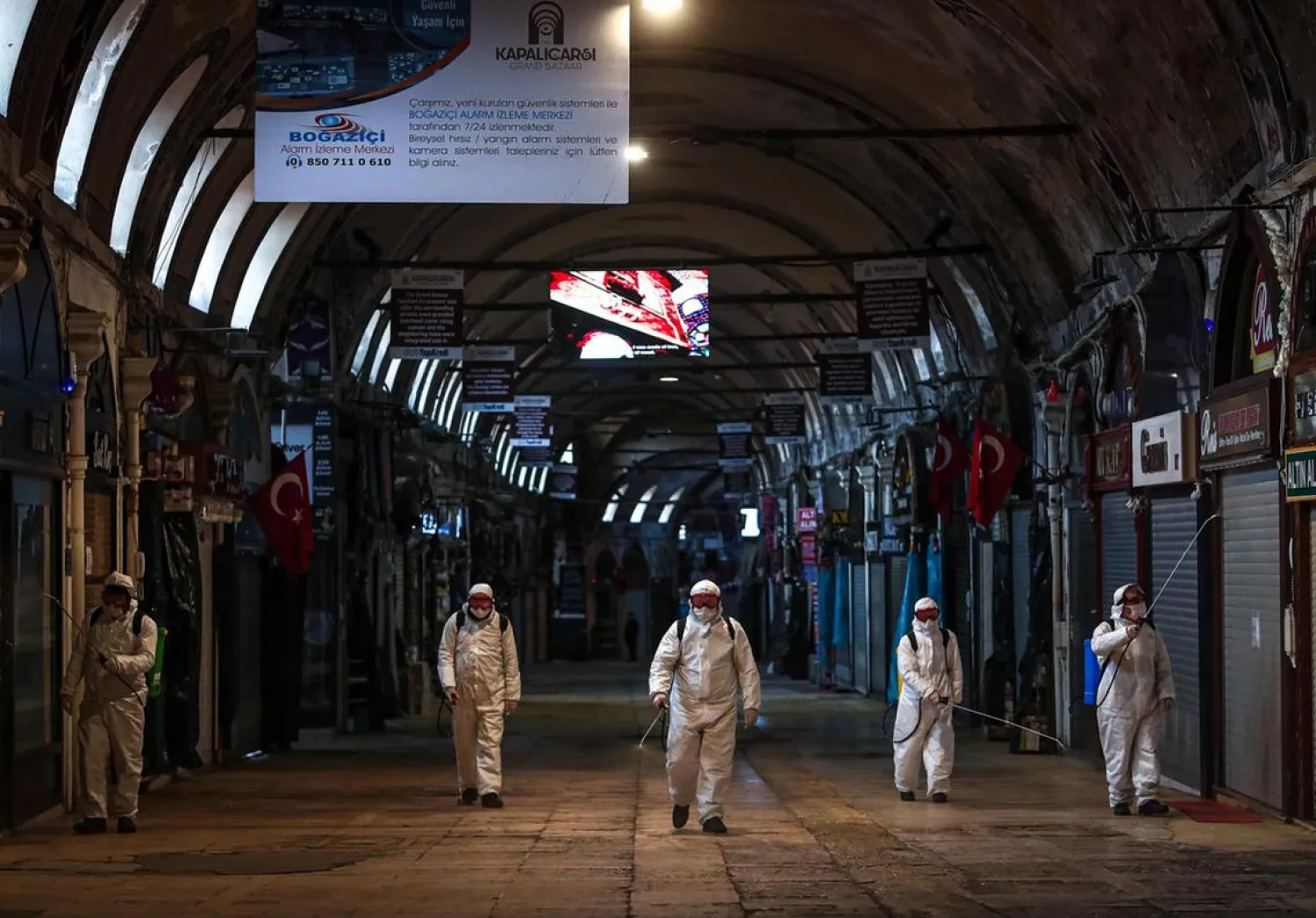
Employees disinfect streets and shops inside Istanbul's famous Grand Bazaar to prevent the spread of coronavirus. (EPA)
TT

Turkey May Toughen Virus Measures, Groups Urge Release of Political Detainees

Employees disinfect streets and shops inside Istanbul's famous Grand Bazaar to prevent the spread of coronavirus. (EPA)

Turkey will step up containment measures if the coronavirus outbreak grows and people ignore a "voluntary" quarantine, President Recep Tayyip Erdogan said on Wednesday, as the country's top doctor warned of strains on hospitals and pushed for action.

The Turkish Medical Association (TTB), which has criticized what it says is a lack of government readiness and transparency as cases surged over the last three weeks, has been among those pressing Ankara to adopt and enforce a stay-at-home order.

Turkey has reported 13,500 cases so far, the 10th highest number worldwide, and 214 deaths. The government has urged people to stay at home, halted flights, limited domestic travel, shut schools, bars and cafes and suspended mass prayers and sports fixtures.

But it has stopped short of announcing a full lockdown in an effort to cushion the economic disruption.

"We are determined to continue production and exports," Erdogan told a meeting of provincial leaders of his ruling AK Party in a televised video conference.

"We won't need further measures if all our citizens keep themselves in a voluntary quarantine. However, we may have to take much more advanced measures if the pandemic spreads and our citizens don't stay at home," he said.

In Istanbul, Turkey's largest city where infections are the highest, the mayor has pushed for a lockdown to slow the spread of the virus because millions of people are still going to work each day.

‘Tip of the iceberg’

There are more than 2,000 coronavirus patients in hospitals in Istanbul including more than 200 in intensive care, with more than 100 medical staff infected so far, the TTB said, citing its own provincial data through March 30.

Hospitals in the city of 16 million people lack enough masks, gloves, goggles and other equipment and could face a severe lack of beds if the outbreak spreads, it said.

"This is surely the tip of the iceberg," TTB Chairman Sinan Adiyaman said in an interview.

"Every person in the public and private sector must stay at home unless it is essential they go out," he told Reuters, adding that this would mean granting them "certain social rights (including) paid leave".

"Layoffs must absolutely be banned. Every worker's social rights must be protected this way to ensure they stay at home apart from mandatory cases," he said.

The government has announced a 100-billion lira ($15 billion) package to support the economy that includes some wage protection for workers, though many, including in the vast tourism sector, are not covered.

The TTB's office in Izmir, Turkey's third largest city, complained of "great secrecy" surrounding the 700 or so coronavirus patients there. It said doctors were struggling to access patient data and that not enough was being done to keep diagnosed and suspected cases separated. ($1 = 6.6909 liras)

Political prisoners

Separately, Turkish academics, journalists and rights groups are demanding that a planned release of tens of thousands of prisoners to stem the spread of the coronavirus should not exclude inmates whose only crime, they say, has been to challenge the authorities.

The AK Party proposed a bill on Tuesday that would temporarily free around 45,000 prisoners. A similar number would be released permanently under a separate part of the legislation aimed at reducing prison overcrowding.

The proposed bill does not cover those convicted of terrorism charges - potentially excluding many thousands of people caught up in a purge which followed a failed military coup against Erdogan in 2016.

“The state wants to release the ones who committed a crime against citizens while keeping the ones who questioned its authoritarianism behind bars,” the campaigners said.

“When lives are at stake, there can be no discrimination based on beliefs or ideologies,” they said in a statement signed by 281 people, including writers.

Many prisoners were “on the threshold of coronavirus catastrophe” due to cramped conditions, they said.

Turkey has arrested thousands of academics, lawyers, journalists, civil servants and members of the military it says were supporters of US-based cleric Fethullah Gulen, who it blames for the coup attempt. Gulen denies any involvement.

Many Kurdish activists and politicians the state says have links to the banned Kurdistan Workers’ Party (PKK) are also in jail.

There are about 300,000 prisoners in Turkey’s crowded jails. The government has been working on reforms to ease pressure on the system, and expanded its proposals in light of the growing coronavirus outbreak which has infected more than 13,000 people.

Omer Faruk Gergerlioglu, parliamentarian from the Peoples’ Democratic Party (HDP), said some 50,000 people were convicted or in jail pending trial on terrorism charges, including members of the PKK and Gulen’s network, as well as journalists and others jailed on what he said were “thought crimes”.

Erdogan’s government has defended the crackdown, saying it reflected the scale of the security challenges Turkey faced.

Gergerlioglu said a former mayor from the party, who was jailed last year, was released from prison and placed on house arrest on Tuesday after being diagnosed with coronavirus.

“The coronavirus outbreak has started spreading in prisons. There are still no serious measures. If mass deaths begin in prisons, it will be too late, even if the law passes,” he said.

The Justice Ministry has said no cases have been determined in prisons and that necessary measures are being taken. Last week, prosecutors launched an investigation into Gergerlioglu after he said a prisoner had been diagnosed with the virus.



Sweden Jails Syrian Man for Life over 2012-2013 War Crimes

Police patrol at the scene of a shooting at an office of Israeli military technology firm Elbit Systems in Gothenburg on October 10, 2024.  Photo by Adam Ihse/TT / various sources / AFP) / Sweden OUT
Police patrol at the scene of a shooting at an office of Israeli military technology firm Elbit Systems in Gothenburg on October 10, 2024. Photo by Adam Ihse/TT / various sources / AFP) / Sweden OUT
TT

Sweden Jails Syrian Man for Life over 2012-2013 War Crimes

Police patrol at the scene of a shooting at an office of Israeli military technology firm Elbit Systems in Gothenburg on October 10, 2024.  Photo by Adam Ihse/TT / various sources / AFP) / Sweden OUT
Police patrol at the scene of a shooting at an office of Israeli military technology firm Elbit Systems in Gothenburg on October 10, 2024. Photo by Adam Ihse/TT / various sources / AFP) / Sweden OUT

A Swedish court on Monday sentenced a 55-year-old man to life in jail for his role in war crimes during the Syrian civil war in 2012 and 2013.

The court found that the man was guilty of participating in a shooting against a peaceful protest in July 2012 in the Damascus suburb of Yarmouk, where several demonstrators were killed, it said in a statement.

It also found that he had served at a roadblock set up by the Syrian government in the same area from December 2012 to July 2013, where "a very large number of civilians" had been arrested and taken away to be tortured and in some cases killed.

According to the court, both offences happened as part of the Syrian civil war, triggered by popular discontent with the rule of longtime leader Bashar al-Assad.

"The district court has found the offences to be aggravated because they were directed at a large number of civilians and several people have died and been injured," judge Hampus Lilja said, explaining this had warranted the life sentence.

The man, who denied the charges, was born in Yarmouk, left Syria in 2013 and was granted asylum in Sweden, according to court documents viewed by AFP. He then gained Swedish citizenship in 2017.

The court noted that the trial had taken 54 days and that a large number of people had been called as both plaintiffs and witnesses.

Sweden has adopted a principle of universal jurisdiction, which allows it to try cases of serious crimes against international law regardless of where the offences took place.


Rights Group Says Gaza Flotilla Activists Facing Abuse in Israel Jail

Brazilian activist Thiago Avila gestures upon his arrival at a court in Ashkelon on May 3, 2026.(Photo by Ilia YEFIMOVICH / AFP)
TT

Rights Group Says Gaza Flotilla Activists Facing Abuse in Israel Jail

Brazilian activist Thiago Avila gestures upon his arrival at a court in Ashkelon on May 3, 2026.(Photo by Ilia YEFIMOVICH / AFP)

Two foreign activists from a Gaza-bound flotilla who have been detained in Israeli prison are facing psychological abuse, death threats and poor detention conditions, a rights group representing them said Monday.

"Thiago Avila (one of the activists) reported being subjected to repeated interrogations lasting up to eight hours. Interrogators have explicitly threatened him, stating he would either be 'killed' or 'spend 100 years in jail'," rights group Adalah, whose attorneys visited both activists in their detention Monday, said in statement.

Adalah added that a court would decide Tuesday whether to further extend Spanish national Saif Abu Keshek and Brazilian Avila's detention.


US Denies Iran Struck a Military Vessel during New Effort to Reopen Strait of Hormuz

Vessels in the Strait of Hormuz near Bandar Abbas, Iran, May 4, 2026. Amirhosein Khorgooi/ISNA/WANA (West Asia News Agency) via REUTERS
TT

US Denies Iran Struck a Military Vessel during New Effort to Reopen Strait of Hormuz

Vessels in the Strait of Hormuz near Bandar Abbas, Iran, May 4, 2026. Amirhosein Khorgooi/ISNA/WANA (West Asia News Agency) via REUTERS

The US military on Monday denied claims that Iran struck a Navy vessel as US forces now offer to guide commercial ships through the Strait of Hormuz, where hundreds have been stuck since the Iran war began. Tehran over the past two months has attacked some vessels and blocked others that don’t receive its authorization.

The US military’s Central Command also said two American-flagged merchant ships have “successfully transited through the Strait of Hormuz" and that that Navy guided-missile destroyers in the Arabian Gulf are helping to restore commercial shipping traffic.

The statement on X said the destroyers transited the Strait of Hormuz “in support of Project Freedom” and that the merchant ships are "safely headed on their journey." It did not say when the Navy ships arrived or when the merchant vessels departed.

Meanwhile, Iranian news agencies had earlier claimed that Iran struck a US vessel near an Iranian port southeast of the strait, accusing it of “violating maritime security and navigation norms.” The reports said the vessel was forced to turn back.

Also, Iran's state television reported that the Iranian navy fired cruise missiles, rockets and combat drones near US destroyers crossing the Strait of Hormuz on Monday,

It said the navy had identified US destroyers in the Strait of Hormuz and fired multiple warning shots, adding, "following the Zionist American destroyers' disregard for the initial warning, the Navy issued a warning shot by firing cruise missiles, rockets, and combat drones around the aggressor enemy vessels".