


Scramble for Virus Supplies Strains Global Solidarity

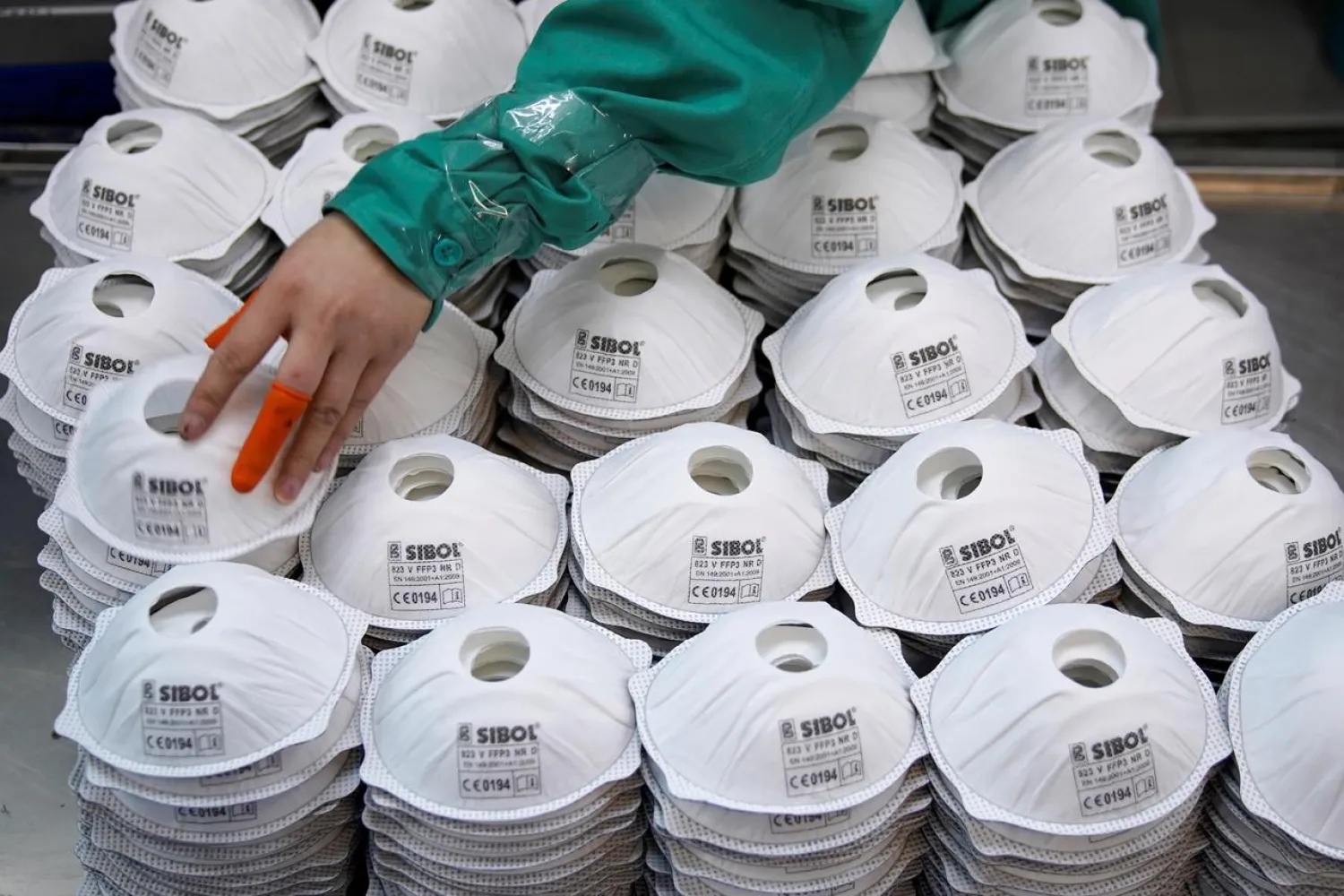
Masks are seen on a production line manufacturing masks at a factory in Shanghai, China January 31, 2020. (Reuters)
TT

Scramble for Virus Supplies Strains Global Solidarity

Masks are seen on a production line manufacturing masks at a factory in Shanghai, China January 31, 2020. (Reuters)

San Marino needed medical masks. Badly.

The tiny republic, wedged next to what would be two of Italy’s hardest-hit provinces in the COVID-19 outbreak, had already registered 11 deaths by March 17 — a sizeable number in a country of just 33,000, and a harbinger of worse to come. So authorities sent off a bank transfer to a supplier in Lugano, Switzerland, to pay for a half-million masks, to be shared with Italian neighbors.

The next day, the truck returned, empty. The company was refusing to provide the masks.

Said Dr. Gabriele Rinaldi, director of San Marino's Health Authority: “It was a very bitter lesson.’’

It’s not clear whether the mask supplier, which was not identified, refused to deliver because another customer offered more. But what is clear is that the oft-proclaimed solidarity among nations waging battle against the pandemic has been tested — if not shattered — by national and corporate self-interest.

A health official in France's hard-hit eastern region said US officials swooped in at a Chinese airport to spirit away a planeload of masks that France had ordered.

"On the tarmac, the Americans arrive, take out cash and pay three or four times more for our orders, so we really have to fight," Dr. Jean Rottner, an emergency room doctor in Mulhouse, told RTL radio.

The US Embassy in Paris on Friday insisted that no one from the federal government bought masks destined for France. President Donald Trump has suggested, however, that states get their own medical equipment to fight the virus, setting off a mad scramble among state officials.

France, meanwhile, has laid claim to supplies within its borders. In Lyon, inside the main southern European distribution facility of the Swedish medical supply company Molnlycke, were millions of masks that France was reluctant to let go for export.

“We recognize that France has imposed an export ban for face masks and this ban was just extended,” said Jenny Johansson, the company’s global manager for corporate communications. She declined to comment on reports that France ultimately allowed a million masks apiece to go to Spain and Italy.

“However, this is not only about France,” she said, according to The Associated Press. “We see government restrictions across most countries in which we are active.”

The European Union, a bloc of 27 nations built upon open borders and markets, has tried to temper this every-country-for-itself free-for-all.

The day after San Marino’s health minister publicly lamented the rejected acquisition, Switzerland enacted an ordinance obliging companies to seek government authorization to export protective medical devices. But Swiss embassy political attache Lorenza Faessler noted that the ordinance specifically exempts the EU and several other countries in Europe, including San Marino.

In any case, Faessler on Wednesday acknowledged that confusion and complexities mark the frantic scramble to acquire vital supplies like masks. “Brussels tried to regulate” this commerce, she said, but many countries have gone their own way.

The EU's internal market commissioner, Thierry Breton, told the Italian daily Corriere della Sera that progress had been made in dealing with exports of medical equipment by France, Germany and some other nations.

“At the moment, only Poland and Slovakia are keeping the ban, but we’re discussing it, and a solution will be reached,’’ Breton was quoted as saying.

Meanwhile, Spain and Italy, which together have over one-half of the world's 54,000 coronavirus deaths, are increasingly taking steps to restrict the flow of supplies.

Four days after Italy’s first COVID-19 case surfaced in northern Italy in late February, Civil Protection agency chief Angelo Borrelli signed an ordinance banning any export of medical supplies unless he personally approved an exception.

As the daily number of infections in Italy grew by the dozens, then hundreds, then thousands, many nations blocked exports to keep their own medical supplies production within their borders, said Agostino Miozzo, director general of international relations for Italy’s Civil Protection agency.

“We found ourselves in extreme difficulty in acquiring” medical supplies, he said.

Last month, Italian customs police seized some 800,000 masks and disposable gloves that were about to be sent to Switzerland.

Spain has launched three weekly flights to China to directly ferry home medical supplies. Spanish Health Minister Salvador Illa has called China’s medical supply market “crazy.” Italy, too, has taken to using military planes to fly in masks and respirators from China and elsewhere, minimizing the risks that supplies will be diverted or seized by third countries.

The United States, which has twice as many infections as any other nation now, is also moving supplies like thermometers, gowns, masks and gloves via air bridge, notably from Asia and Central America, according to the US agency FEMA.

Massachusetts Gov. Charlie Baker took an unconventional approach in the scramble for supplies in his state: He called on the New England Patriots, the American football team.

The team’s private plane landed in Boston from China on Thursday evening carrying more than a million masks. Baker secured the N95 masks from Chinese manufacturers but had no way of getting them to the US without the assist from the team.

After some incidents in which the flow of materials were blocked, countries have tried to make amends for what they say were missteps.

Last month, Czech Foreign Minister Tomas Petricek, apologizing to Italy, said the Italians were being given 110,000 masks and thousands of respirators to compensate for those mistakenly seized in a raid on a warehouse in the Czech town of Lovosice.

The devices had been donated by China’s Red Cross for the Chinese community in Italy. The raid had been launched to break up what Czech Interior Minister Jan Hamacek called an “immoral” scheme to jack up the prices a company was charging the Prague government.

Recently, Tunisia accused Italy of blocking a shipment of alcohol used to make hand-cleansing gel. Trade Minister Mohamed Sellini later backtracked.

“I didn’t say Italy. I said it was hijacked at sea," the minister insisted, adding, “All of the European Union is living in a state of hysteria.”



UK PM's Top Aide Quits over Mandelson-Epstein Scandal

FILE PHOTO: British Prime Minister Keir Starmer talks with Britain's ambassador to the United States Peter Mandelson during a welcome reception at the ambassador's residence on February 26, 2025, in Washington, DC, US. Carl Court/Pool via REUTERS/File Photo
TT

UK PM's Top Aide Quits over Mandelson-Epstein Scandal

FILE PHOTO: British Prime Minister Keir Starmer talks with Britain's ambassador to the United States Peter Mandelson during a welcome reception at the ambassador's residence on February 26, 2025, in Washington, DC, US. Carl Court/Pool via REUTERS/File Photo

British Prime Minister Keir Starmer's chief of staff, Morgan McSweeney, quit on Sunday, saying he took responsibility for advising Starmer to name Peter Mandelson as ambassador to the US despite his known links to Jeffrey Epstein.

After new files revealed the depth of the Labour veteran's relationship with the late sex offender, Starmer is facing what is widely seen as the gravest crisis of his 18 months in power over his decision to send Mandelson to Washington in 2024, Reuters reported.

The loss of McSweeney, 48, a strategist who was instrumental in Starmer's rise to power, is the latest in a series of setbacks, less than two years after the Labour Party won one of the largest parliamentary majorities in modern British history.

With polls showing Starmer is hugely unpopular with voters after a series of embarrassing U-turns, some in his own party are openly questioning his judgment and his future, and it remains to be seen whether McSweeney's exit will be enough to silence critics.

The files released in the US on January 30 sparked a police investigation for misconduct in office over indications that Mandelson leaked market-sensitive information to Epstein when he was a government minister during the global financial crisis in 2009 and 2010.

In a statement, McSweeney said: "The decision to ⁠appoint Peter Mandelson was wrong. He has damaged our party, our country and trust in politics itself.
"When asked, I advised the Prime Minister to make that appointment and I take full responsibility for that advice."

The leader of the opposition Conservative Party, Kemi Badenoch, said the resignation was overdue and that "Keir Starmer has to take responsibility for his own terrible decisions".

Nigel Farage, head of the populist Reform UK party, which is leading in the polls, said he believed Starmer's time would soon be up.

Starmer has spent the last week defending McSweeney, a strategy that could prompt further questions about his own judgment. In a statement on Sunday, Starmer said it had been "an honor" working with him.

Many Labour members of parliament had blamed McSweeney for the appointment of Mandelson and the damage caused by the publication of the exchanges between Epstein ⁠and Mandelson. Others have said Starmer must go.

One Labour lawmaker, speaking on condition of anonymity, said McSweeney's resignation had come too late: "It buys the PM time, but it's still the end of days."

Starmer sacked Mandelson as ambassador in September over his links to Epstein.

The government agreed last week to release virtually all previously private communications between members of his government from the time when Mandelson was being appointed.

That release could come as early as this week, creating a new headache for Starmer just as he hopes to move on. If previously secret messages about how London planned to approach its relationship with Donald Trump are made public, it could damage Starmer's relationship with the US President.

McSweeney had held the role of chief of staff since October 2024, when he was handed the job following the resignation of Sue Gray after a row over pay and donations.

Starmer on Sunday appointed his deputy chiefs of staff, Jill Cuthbertson and Vidhya Alakeson, to serve as joint acting chiefs of staff.


Iran Sentences Nobel Laureate Narges Mohammadi to 7 More Years in Prison

(FILES) A handout photo provided by the Narges Mohammadi Foundation on October 2, 2023 shows an undated, unlocated photo of Iranian rights campaigner Narges Mohammadi. (Photo by Handout / NARGES MOHAMMADI FOUNDATION / AFP)
TT

Iran Sentences Nobel Laureate Narges Mohammadi to 7 More Years in Prison

(FILES) A handout photo provided by the Narges Mohammadi Foundation on October 2, 2023 shows an undated, unlocated photo of Iranian rights campaigner Narges Mohammadi. (Photo by Handout / NARGES MOHAMMADI FOUNDATION / AFP)

Iran sentenced Nobel Peace Prize laureate Narges Mohammadi to over seven more years in prison after she began a hunger strike, supporters said Sunday.

Mohammadi’s supporters cited her lawyer, who spoke to Mohammadi.

The lawyer, Mostafa Nili, confirmed the sentence on X, saying it had been handed down Saturday by a Revolutionary Court in the city of Mashhad. Such courts typically issue verdicts with little or no opportunity for defendants to contest their charges.

“She has been sentenced to six years in prison for ‘gathering and collusion’ and one and a half years for propaganda and two-year travel ban,” he wrote, according to The Associated Press.

She received another two years of internal exile to the city of Khosf, some 740 kilometers (460 miles) southeast of Tehran, the capital, the lawyer added.

Supporters say Mohammadi has been on a hunger strike since Feb. 2. She had been arrested in December at a ceremony honoring Khosrow Alikordi, a 46-year-old Iranian lawyer and human rights advocate who had been based in Mashhad. Footage from the demonstration showed her shouting, demanding justice for Alikordi and others.

Supporters had warned for months before her December arrest that Mohammadi, 53, was at risk of being put back into prison after she received a furlough in December 2024 over medical concerns.

While that was to be only three weeks, Mohammadi’s time out of prison lengthened, possibly as activists and Western powers pushed Iran to keep her free. She remained out even during the 12-day war in June between Iran and Israel.

Mohammadi still kept up her activism with public protests and international media appearances, including even demonstrating at one point in front of Tehran’s notorious Evin prison, where she had been held.

Mohammadi had been serving 13 years and nine months on charges of collusion against state security and propaganda against Iran’s government.

She also had backed the nationwide protests sparked by the 2022 death of Mahsa Amini, which have seen women openly defy the government by not wearing the hijab.

Mohammadi suffered multiple heart attacks while imprisoned before undergoing emergency surgery in 2022, her supporters say. Her lawyer in late 2024 revealed doctors had found a bone lesion that they feared could be cancerous that later was removed.

“Considering her illnesses, it is expected that she will be temporarily released on bail so that she can receive treatment,” Nili wrote.

However, Iranian officials have been signaling a harder line against all dissent since the recent demonstrations. Speaking on Sunday, Iranian judiciary chief Gholamhossein Mohseni-Ejei made comments suggesting harsh prison sentences awaited many.

“Look at some individuals who once were with the revolution and accompanied the revolution," he said. "Today, what they are saying, what they are writing, what statements they issue, they are unfortunate, they are forlorn (and) they will face damage.”


Nigeria's President to Make a Sate Visit to the UK in March

Nigeria’s President Bola Tinubu gives a joint statement with Brazil’s President Luiz Inacio Lula da Silva, at the Planalto presidential palace, in Brasilia, Brazil, Aug. 25, 2025. (AP Photo/Eraldo Peres, File)
TT

Nigeria's President to Make a Sate Visit to the UK in March

Nigeria’s President Bola Tinubu gives a joint statement with Brazil’s President Luiz Inacio Lula da Silva, at the Planalto presidential palace, in Brasilia, Brazil, Aug. 25, 2025. (AP Photo/Eraldo Peres, File)

Nigeria’s president is set to make a state visit to the UK in March, the first such trip by a Nigerian leader in almost four decades, Britain’s Buckingham Palace said Sunday.

Officials said President Bola Tinubu and first lady Oluremi Tinubu will travel to the UK on March 18 and 19, The AP news reported.

King Charles III and Queen Camilla will host them at Windsor Castle. Full details of the visit are expected at a later date.

Charles visited Nigeria, a Commonwealth country, four times from 1990 to 2018 before he became king. He previously received Tinubu at Buckingham Palace in September 2024.m

Previous state visits by a Nigerian leader took place in 1973, 1981 and 1989.

A state visit usually starts with an official reception hosted by the king and includes a carriage procession and a state banquet.

Last year Charles hosted state visits for world leaders including US President Donald Trump, French President Emmanuel Macron and German President Frank-Walter Steinmeier.