


Eric Cantona and 'the Hooligan': The Impact of the Kung-Fu Kick 25 Years On

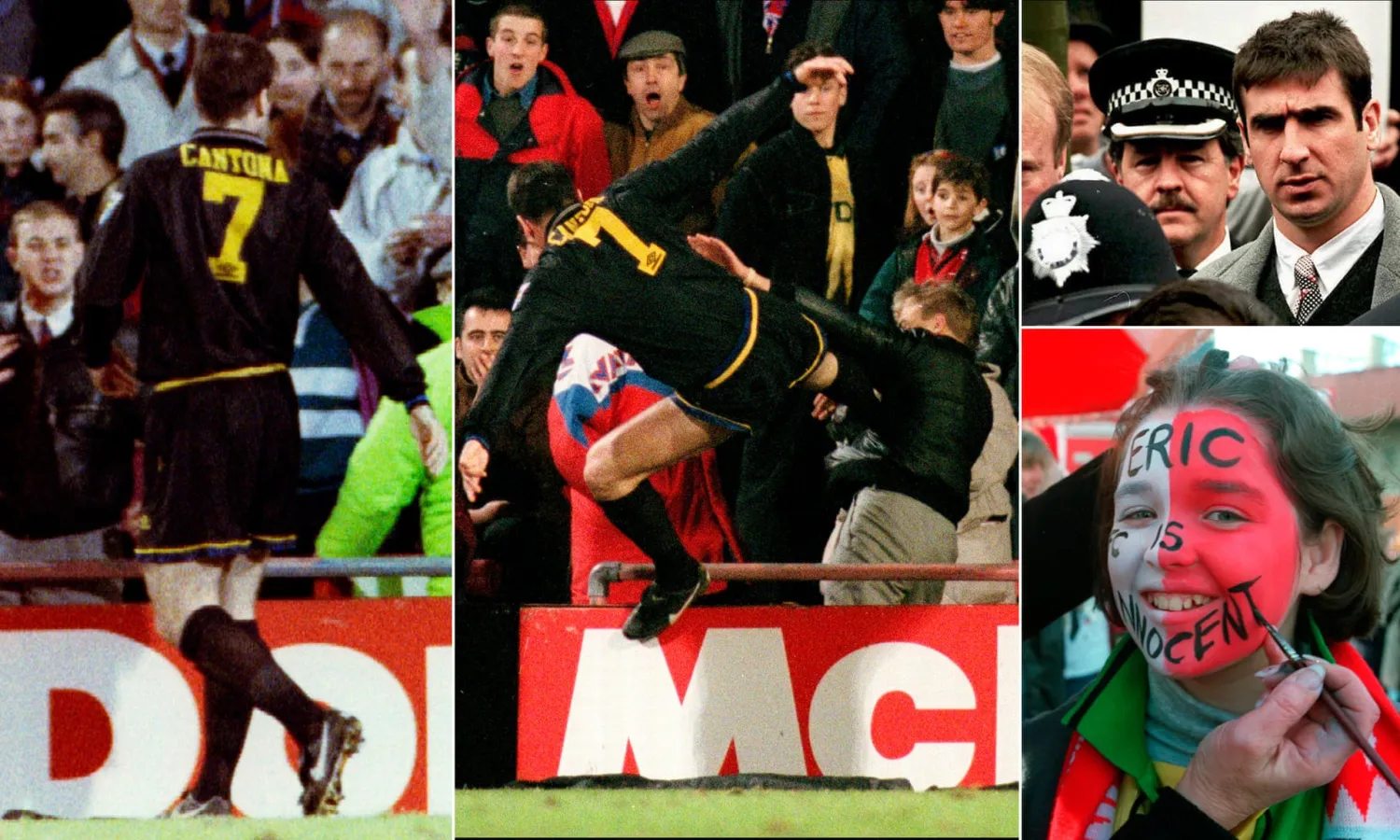
Matthew Simmons launches his tirade, Eric Cantona distributes some retribution, the Frenchman departs Croydon Crown Court and a fan shows her support. Composite: Reuters; Action Images; AFP/Getty; Allsport
TT

Eric Cantona and 'the Hooligan': The Impact of the Kung-Fu Kick 25 Years On

Matthew Simmons launches his tirade, Eric Cantona distributes some retribution, the Frenchman departs Croydon Crown Court and a fan shows her support. Composite: Reuters; Action Images; AFP/Getty; Allsport

Eric Cantona scored 82 goals for Manchester United. He won four league titles and two Doubles, and was a catalyst for the most successful period in the club’s history. None of that will keep him warmest in his dotage. “My best moment? I have a lot of good moments but the one I prefer is when I kicked the hooligan.”

Cantona always refers to Matthew Simmons, with a delightful, absent-minded contempt, as “the hooligan”. It’s a neat way of dehumanizing the gobby fan he dealt with when he tried to kick racism out of football on 25 January 1995. Twenty-five years later, the footage and images of his kung-fu kick retain an exhilarating power. It was the definitive example of what Alex Ferguson called Cantona’s “defiant charisma”. His defiance that night defined his career, and also his life.

The first half of the match at Crystal Palace was on the malodorous side of a stinker. With an ABU (Anyone But United) culture developing fast, United and particularly Cantona were becoming a target for what Roy Keane called “the part-time hard men” of clubs such as Norwich, Swindon and Palace; players who were somewhere between roughhouse and shithouse. There were some heavy, unpunished tackles from Richard Shaw and Chris Coleman on Cantona and Andy Cole, which prompted a polite inquiry – “no yellow cards, then?” – from Cantona to the referee, Alan Wilkie, and a livelier one from Ferguson at half-time: “Why don’t you do your fucking job!”

He did it four minutes into the second half, punishing Cantona’s vigilante kick at Shaw with a contented flourish of the red card. “There’s the morning headlines!” said the BBC commentator Clive Tyldesley. He had no idea. Cantona lingered on the pitch for a while before turning his collar down, like a man getting out of his work clothes, and walking down the touchline with the kitman Norman Davies. You know the rest.

Simmons assumed he could charge down the front and shout “fuck off back to France you French motherfucker” with impunity. Cantona’s re-education program – a flying kick before a seriously underrated roundhouse right – disabused him of this notion. “You know, you meet thousands of people like him,” said Cantona of Simmons. “If I’d met that guy on another day, things may have happened very differently even if he had said exactly the same things. Life is weird like that.”

Cantona has also spoken of wanting to give others – in this case, United fans – a vicarious thrill. It was an instinctive demonstration of a desire to do things that others did not have the opportunity or balls to do. His greatest virtue was that he had no edit function between instinct and action. Something told him to do it, so he did it. “The most important thing for me is that I was who I was,” he said. “I was myself!” Discussions over who is the greatest Premier League player get more boring by the day, yet only the envious or ignorant would suggest there has been another player with a richer personality. In 1994-95, Alan Shearer famously dealt with the pressure of a title race by creosoting his fence; Cantona jumped over a fence with a kung-fu kick.

It was the second of his trinity of JFK moments at United – signing and retiring being the others, though you could make a case for a few more. Most footballers do well to have one in their lives. Cantona’s nature was such that behavior that would seem ostentatious in others was entirely natural in him. That stemmed from a non-negotiable honesty and curiosity about life and his own nature. “Eric had a unique personality,” said Gary Neville, “and didn’t give a stuff what anyone else thought of him.”

The incident died down fairly quickly on the night. The game continued and Davies calmed an initially murderous Cantona down with cups of tea in the dressing-room. What is sometimes forgotten is that there were huge numbers of people, including Ferguson and many of the United fans at Selhurst Park, who either did not realize exactly what had happened, or did not appreciate how enormous the fallout would be. At the end of the match, the primary emotion was frustration at dropping two points to a poor Palace side, with Gareth Southgate’s grubby equalizer compromising the almost comical joy of David May’s first goal for United.

Ferguson had been so busy reorganizing United that he genuinely did not see the incident. He caught the tail end and thought Cantona had been dragged into the crowd as he walked past. The language used by everyone after the game, even the police, was sufficiently ambiguous that Ferguson left for Manchester none the wiser. Even when he got home and his son Jason hinted that the apocalypse was in the post, Ferguson decided to go to bed and face it in the morning. He couldn’t sleep and finally watched the video around 5am.

His initial instinct was that Cantona had to be sacked and the United board agreed. But the solicitor Maurice Watkins counseled that such an act could prejudice any legal case and the club waited until the Thursday evening to discuss things further at a Manchester hotel. By then Ferguson was coming round to the idea of him staying and from that moment he offered his player unconditional protection. Cantona was banned until the end of the season and fined the maximum two weeks’ wages, just £10,800.

The moral panic was already in full swing and United were criticized for taking a full 36 hours to ban Cantona. The Mirror described it as “the night football died of shame”, with a back-page headline: “Is this the end for the madman?” An Express headline read: “Absolute thuggery in front of the children.” The won’t-somebody-think-of-the-children attitude was laughably prevalent; The BBC Nine O’Clock News, on which Cantona was the lead story, even interviewed a load of schoolkids about it. Alex Stepney said Sir Matt Busby would have sacked him. Brian Clough said he would have “cut his balls off”.

The reaction was not entirely negative. While most journalists went straight for their high horse, the Independent’s Richard Williams said, only partly in jest, that, “Eric Cantona’s only mistake was to stop hitting him. The more we discovered about Mr Simmons, the more Cantona’s assault looked like the instinctive expression of a flawless moral judgement.” On Fantasy Football League, Nick Hancock – usually a staunch ABU – said it was “comfortably the best thing that’s happened this season – it was absolutely brilliant”. Most players privately had no problem with what Cantona had done. Ian Wright later said he felt “jealous”.

It soon became apparent that Cantona had overwhelming support among United supporters. The actor Ed Norton once said he would find it hard to care for people who didn’t like the film Fight Club. A bit pretentious, sure, but you know what he means. The response to Cantona’s kick – among fans of other clubs, not just United – was a similar litmus test. Nike stood by Cantona and made play of the incident in posters and a memorable advert in which he apologized for his “terrible mistakes” and “unacceptable behavior”: only scoring one goal in a famous 5-0 win against Manchester City, missing a chance against Newcastle and only scoring twice at Wembley in the 1994 FA Cup final.

You can probably imagine the sanctimonious reaction to an advert like that today. There was still an unprecedented hysteria in 1995 but though the breadth of the coverage was the same, the depth was not. In his season diary, Ferguson reckoned the kick was shown 93 times on television over the next two days. “That’s more repeats than the films of the JFK shooting,” he said. In 2020, it would probably be shown 93 times an hour.

Back then, if you wanted, it was easy to avoid the nonsense. Faux outrage was a minority sport, mainly because, with the information superhighway in its infancy, most people did not have the chance to partake in a public place. You had the papers, teletext, radio and the news bulletins. That was about it. And although there were still plenty of cranks and trolls and toxic liberals about, there was less narcissism and brains were not washed quite as easily. There were no #PrayForSimmons hashtags, or online petitions for Cantona to be deported. Social networking meant going to the game.

In late February the FA extended Cantona’s ban to 1 October, leaving Ferguson and Watkins feeling, not for the last time, that United had been stitched up by the FA. A non-league player who broke a fan’s jaw during the same season received a two-week ban. During the hearing, according to the head of the FA David Davies, Cantona apologized to, among others, “the prostitute who shared my bed last night”. Davies says it went straight over the heads of at least two of the disciplinary commission.

Cantona was in court a month later, the day after United’s 3-0 win at home to Arsenal. A group of United fans went straight from the game to London in a minibus that was paid for by the Channel 4 show The Big Breakfast. They appeared live on the show, singing Eric The King – which had been released as a single – and even I’m In The Mood For Dancing by the Nolans, who were also on the show. Then they headed to Croydon Magistrates Court, where Cantona and Paul Ince, who pleaded not guilty to assaulting a Palace fan and was later acquitted, were due in court. They thought they were there for a supportive sing-song; instead they became unofficial spokesmen to the world’s media when Cantona was given two weeks in prison.

The sentence was inevitably overturned on appeal a week later. Cantona, knowing he had to say something to the press, started asking Watkins questions about seagulls and trawlers, scribbling his thoughts on a piece of paper. Then came his famous, disdainful address: “When the seagulls” – theatrical pause for a swig of water – “follow the trawler, it’s because they think sardines will be thrown into the sea. Thank you.” Watkins says he often wonders what happened to that bit of paper; it’s one of the great lost pieces of United memorabilia. In 2014, the Hollywood actor Shia LaBeouf copied Cantona’s phrase and walked out of a hostile press conference for the film Nyphomaniac.

Cantona’s life had become sufficiently difficult – he also punched an ITN reporter who filmed his pregnant wife wearing a bikini during a break in the Caribbean, an act which barely anyone criticized – that a move to Inter seemed inevitable. Ferguson was resigned to it. Some of the most important moments in United’s history were influenced by Cathy Ferguson and this was another. “It’s not like you to give up so easily,” she said, “particularly against the establishment.”

Ferguson went to Paris to woo Cantona. He avoided the press – who he had tipped off himself “amid the enjoyment of good food and wine” at a book launch the night before – by going out the back door of his hotel and whizzing around Paris on a Harley-Davidson with Cantona’s adviser. They met in a restaurant that the owner had closed for the purpose and, no doubt amid the enjoyment of good food and wine, Ferguson spent the evening persuading Cantona to stay at his spiritual home.

It’s interesting to wonder what would have happened had Cantona left. No Double in 1995-96, certainly; and although the Class of 92 were too good to ultimately be denied glory, they would have been set on such a different path that 1998-99 would surely have been too early for the Treble. “Those hours spent in Eric’s company in that largely deserted restaurant,” said Ferguson, “added up to one of the more worthwhile acts I have performed in this stupid job of mine.”

The act Cantona perpetrated at Selhurst Park might have been his most worthwhile of all. It was the most important moment in a relationship between players and fans so enduring and spiritual as to be almost without comparison. He was already a United legend. On 25 January 1995, he became immortal.

(The Guardian)


Ballon d'Or Winner Dembele Still Searching for a Home in France Team

Football - FIFA World Cup 2026 - Group I - France v Senegal - New York/New Jersey Stadium, East Rutherford, New Jersey, US - June 16, 2026 France's Ousmane Dembele in action. (Reuters)
TT

Ballon d'Or Winner Dembele Still Searching for a Home in France Team

Football - FIFA World Cup 2026 - Group I - France v Senegal - New York/New Jersey Stadium, East Rutherford, New Jersey, US - June 16, 2026 France's Ousmane Dembele in action. (Reuters)

If Ousmane Dembele arrived at the World Cup hoping his last two club seasons would finally establish him as one of the cornerstones of Didier Deschamps' France side, the tournament's opening match has instead reinforced a familiar question - where exactly does he fit in this team?

For all his success with Paris St Germain, where he reinvented himself as a central creative force and one of Europe's most influential forwards, Dembele remains a player searching for his place in the national team. France's 3-1 victory over Senegal ‌offered another illustration ‌of the dilemma.

While Les Bleus produced enough attacking quality ‌to ⁠ease past the ⁠African side, Dembele again struggled to make himself indispensable in an attack that increasingly appears to revolve around Kylian Mbappe and Michael Olise.

The emergence of Olise has complicated Dembele's quest to become France's attacking leader. The Bayern Munich playmaker has quickly developed an understanding with Mbappe, combining between the lines and helping drive many of France's most dangerous moves.

That connection has left Dembele operating largely on the right ⁠flank, a role that contrasts sharply with the freedom he ‌enjoyed at PSG this season. In Paris, he ‌drifted inside, dictated attacks and became the focal point of the European champions' offensive ‌play. With France, he found himself wider on Tuesday, leaving room for the ‌explosive Mbappe-Olise duo.

At a time when Mbappe and Olise appear to be forming the attacking partnership around which France are building their title challenge, Dembele is still trying to define his own role.

"The key question is what to do with Ousmane Dembele," Bixente Lizarazu, ‌a 1998 World Cup winner, told French sports daily L'Equipe.

"How do you position him to get the best out ⁠of him and ⁠bring out the Dembele we've seen at PSG? So far, whether in the warm-up games or in this opening match, we haven't seen him play with his usual freedom. After a game like this, he'll be sitting there wondering what more he can do."

Dembele has never entered a major tournament in better form, yet rarely has his place in the team seemed less obvious.

Deschamps continues to trust his ability to unbalance opponents and create danger, but the challenge facing the France coach is becoming increasingly clear. It is no longer about finding room for Dembele in the starting lineup, but about finding a role that allows the Ballon d'Or winner to become as influential for France as he has been for PSG.

If he can't, the 29-year-old could end up sitting on the bench.


FIFA Hydration Breaks Spark Backlash, Blamed for Killing Momentum at the World Cup

Football - FIFA World Cup 2026 - Group J - Austria v Jordan - San Francisco Bay Area Stadium, Santa Clara, California, US - June 16, 2026 Austria coach Ralf Rangnick speaks to players during a hydration break. (Reuters)
TT

FIFA Hydration Breaks Spark Backlash, Blamed for Killing Momentum at the World Cup

Football - FIFA World Cup 2026 - Group J - Austria v Jordan - San Francisco Bay Area Stadium, Santa Clara, California, US - June 16, 2026 Austria coach Ralf Rangnick speaks to players during a hydration break. (Reuters)

Curaçao fans went wild. The Germans were in shock.

Livano Comenencia had scored a goal for the smallest nation by population to ever qualify for the World Cup against four-time champion Germany.

At 1-1 in Houston a famous upset looked possible.

Then came the hydration break.

Curaçao lost the initiative, conceding two goals before halftime in what eventually became a 7-1 defeat to the Germans.

“I actually felt sorry for them,” former England striker Alan Shearer told The Rest is Football podcast. “They scored and then it was maybe 30 seconds after that it stopped. So it’s killed their momentum.”

FIFA’s new hydration breaks midway through each half — a novelty for this World Cup — were introduced to help players deal with the summer heat in the United States, Canada and Mexico. But critics say they’re having unintended consequences, ruining the flow of the game and giving coaches a chance to tactically shift momentum in their team’s favor.

While player welfare is a real concern with temperatures expected to exceed 90 F (32 C) in the hottest World Cup venues, some say the hydration breaks are just an excuse for broadcasters to go to commercials in the middle of the game.

“We’re in America, right? So, it’s like it is it’s like it’s a timeout,” former Ireland international Roy Keane said on The Overlap, a podcast that he co-hosts with long-time Manchester United teammate Gary Neville. “We love football because of the pace of the game ... what it’s doing is stopping the flow of the game, the momentum.”

A chance for coaches to huddle with the players

Rather than players merely taking on fluids, coaches have been seizing the opportunity to pass on in-game tactical instructions that would normally not be possible. And early indications are that it is having an effect.

“You can use the break to tell the players what they need to improve or what is good or what they should do better,” Netherlands coach Ronald Koeman said. “So you can use it in different ways to your advantage, and this is what we will be doing.”

In eight of the first 16 games, there were goals scored within 10 minutes of the rehydration break.

Curaçao never recovered after the restart against Germany.

Morocco paid the price against Brazil in New Jersey, having dominated the game from the start and scored just before the first break. Less that 10 minutes after play resumed the game was level with Vinicius Junior equalizing.

Canada, the US, Australia, Scotland, Sweden and Iran have all benefited with goals soon after the break.

Momentum maps have shown how games have shifted after the new stoppages in play.

The hydration breaks also affect the experience of fans watching the games at stadiums. There were boos from the crowd on the first hydration break in the game Tuesday between Iraq and Norway in Foxborough, Massachusetts.

Breaks will be implemented regardless of the weather

Referees pause the games 22 minutes into each half, with players given three minutes to rehydrate.

FIFA stipulated that the breaks would occur regardless of the weather, venue or location, meaning the Spain vs. Cape Verde match in Atlanta on Monday was interrupted despite being under a roof and in an air-conditioned stadium.

The governing body said it was to “ensure equal conditions for all teams, in all matches.”

Spain coach Luis de la Fuente said the breaks make sense in “extreme” heat conditions but questioned whether they were necessary at every match.

“Pause, freshen up and continue. Tomorrow, when the temperature that we’ll have in this stadium is chill, maybe these breaks are not so needed, but we need to abide by the rules," he said.

Norway coach Staale Solbakken agreed.

“I can understand it when it’s like it’s been in Greensboro (North Carolina), when it’s been 35 degrees (95 Fahrenheit) and a really hot climate and there’s a bit of vibration in the air – then I think it’s fine. But I don’t like it otherwise. I think it’s unnecessary," he said.

Broadcasters cutting to commercials

Aside from the sporting impact on games, the stoppages have been criticized for damaging the spectacle for fans, with broadcasters using the opportunity to take commercial breaks.

In the United States, Fox immediately goes to commercials during the hydration breaks. Telemundo, a Spanish-language US broadcaster, does not.

Unlike in US professional sports like baseball, basketball and football, commercial breaks have not been a common feature in football except during the half-time break.

“Every time going to a commercial is a bit ... not really (something) that I like,” said Netherlands captain Virgil van Dijk, who watched World Cup games on TV before the Dutch began their campaign with a 2-2 draw against Japan. “I think for the neutral watchers on TV it’s also not great.”

France coach Didier Deschamps, however, said this is the changing face of football.

“It’s not two half times, it is four quarter times basically that we’ve got. This is what’s been decided and so the players and the coaches adapt to this new reality,” he said.

It is not known if FIFA will implement hydration breaks at all future World Cups, but the English Football Association said it was unlikely to be in place for the European Championship, hosted by the UK and Ireland in 2028.


Bernardo Silva Joins Real Madrid on 2-year Deal Following Manchester City Exit

Manchester City's Bernardo Silva speaks during a farewell ceremony after his last match for the club after a Premier League soccer match between Manchester City and Aston Villa in Manchester, England, Sunday, May 24, 2026. (AP Photo/Alastair Grant)
TT

Bernardo Silva Joins Real Madrid on 2-year Deal Following Manchester City Exit

Manchester City's Bernardo Silva speaks during a farewell ceremony after his last match for the club after a Premier League soccer match between Manchester City and Aston Villa in Manchester, England, Sunday, May 24, 2026. (AP Photo/Alastair Grant)

Manchester City great Bernardo Silva has joined Real Madrid on a two-year contract, the Spanish club said on Wednesday.

The Portugal international is one of the most decorated players in City’s history, winning many major trophies including six Premier Leagues and one Champions League. He made 460 appearances and scored 76 goals during a nine-year stint with the club.

In his final season in the north of England, Silva won both the English League Cup and the FA Cup. He is currently playing at the World Cup with Portugal.

His trophy haul includes three FA Cups, five League Cup successes, three Community Shields, a FIFA Club World Cup and a UEFA Super Cup winner’s medal.

“Real Madrid C. F. and Bernardo Silva have reached an agreement for him to become a Real Madrid player for the next two seasons, until June 30, 2028,” The Associated Press quoted Madrid as saying in a statement.

The 31-year-old midfielder joined from Monaco in 2017.
