


Security Council to Meet on Coronavirus Amid 2 Competing Texts

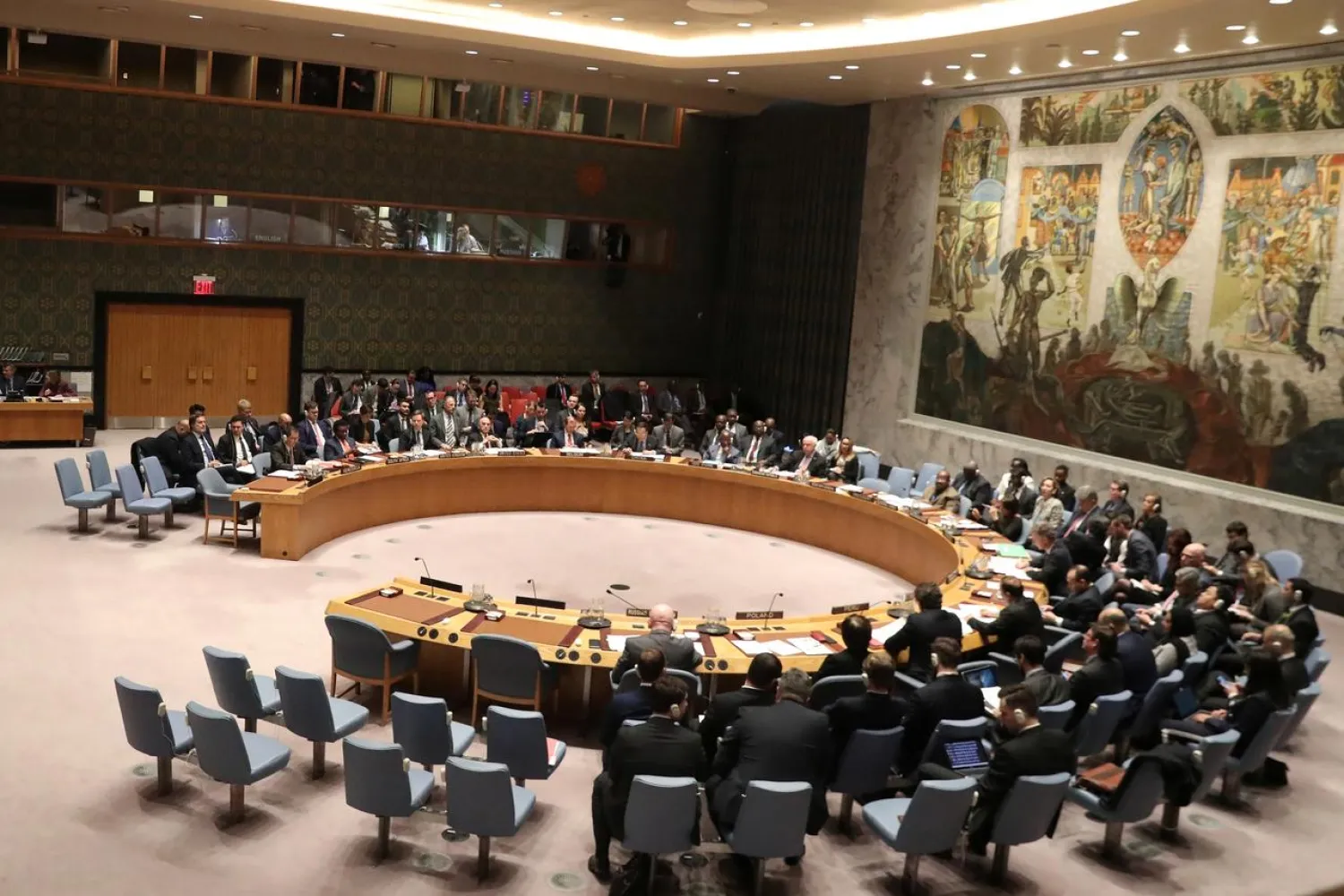
FILE PHOTO: Members of the United Nations Security Council gather during a meeting about the situation in Venezuela, in New York, US, February 26, 2019. REUTERS/Shannon Stapleton
TT

Security Council to Meet on Coronavirus Amid 2 Competing Texts

FILE PHOTO: Members of the United Nations Security Council gather during a meeting about the situation in Venezuela, in New York, US, February 26, 2019. REUTERS/Shannon Stapleton

After weeks of disagreement -- especially between the United States and China -- the UN Security Council will meet Thursday to discuss the coronavirus pandemic for the first time.

Led by Tunisia and Germany, nine of the council's 10 non-permanent members requested the closed-door meeting -- a video conference to maintain social distancing -- last week, fed up with the body's inaction over the unprecedented global crisis.

Talks are moving in the right direction, diplomats said, and Washington is no longer insisting UN language refer to the virus as coming from China, which had infuriated Beijing.

Secretary-General Antonio Guterres is expected to focus on efforts to fight the pandemic, peacekeeping missions and fostering unity between the non-permanent members (Tunisia, Germany, Belgium, Indonesia, Vietnam, South Africa, Niger, the Dominican Republic, Saint Vincent and the Grenadines and Estonia) and the five permanent ones.

There are two competing texts up for debate.

One, spearheaded by Tunisia on behalf of the 10 non-permanent members and obtained by AFP, calls for "an urgent, coordinated and united international action to curb the impact of COVID-19" and urges an immediate global ceasefire on humanitarian grounds.

The draft says the pandemic is “a threat to humanity and to international peace and security.”

That draft resolution has been in development since March 30, though a vote on it is not yet scheduled.

The second text, proposed by France, focuses on Guterres' call last month to cease all hostilities around the world as part of a "humanitarian pause" to fight the pandemic.

That one has so far only had input from the permanent members (Russia, the US, China, France and the United Kingdom), which diplomats from non-permanent countries told AFP has been "very frustrating."

Efforts to convene a meeting have been stymied by the hospitalization of British Prime Minister Boris Johnson and Chinese reticence to participate without first setting a clear agenda.

A Western ambassador, speaking anonymously, said the two blocs needed each other.

"The permanent cannot pass a text without the voices of the non-permanent, the non-permanent cannot impose a text on the permanent because they have a veto. We must necessarily agree and we will try to 'hear'," they said.

In the Security Council, at least nine votes out of 15 are necessary to adopt a resolution, without a veto of one of the five permanent members.

Last Thursday, the UN General Assembly approved a resolution calling for "international cooperation" and "multilateralism" in the fight against COVID-19, in the first response by the international body since the outbreak began.

The resolution, approved by consensus, also stresses "the need for full respect for human rights" and that "there is no place for any form of discrimination, racism and xenophobia in the response to the pandemic."



Russia: Man Suspected of Shooting Top General Detained in Dubai

An investigator works outside a residential building where the assassination attempt on Russian Lieutenant General Vladimir Alexeyev took place in Moscow, Russia February 6, 2026. REUTERS/Anastasia Barashkova
TT

Russia: Man Suspected of Shooting Top General Detained in Dubai

An investigator works outside a residential building where the assassination attempt on Russian Lieutenant General Vladimir Alexeyev took place in Moscow, Russia February 6, 2026. REUTERS/Anastasia Barashkova

Russia's Federal Security Service (FSB) said on Sunday that the man suspected of shooting top Russian military intelligence officer Vladimir Alexeyev in Moscow has been detained in Dubai and handed over to Russia.

Lieutenant General Vladimir Alexeyev, deputy head of the GRU, ⁠Russia's military intelligence arm, was shot several times in an apartment block in Moscow on Friday, investigators said. He underwent surgery after the shooting, Russian media ⁠said.

The FSB said a Russian citizen named Lyubomir Korba was detained in Dubai on suspicion of carrying out the shooting.

Russian Foreign Minister Sergei Lavrov accused Ukraine of being behind the assassination attempt, which he said was designed to sabotage peace talks. ⁠Ukraine said it had nothing to do with the shooting.

Alexeyev's boss, Admiral Igor Kostyukov, the head of the GRU, has been leading Russia's delegation in negotiations with Ukraine in Abu Dhabi on security-related aspects of a potential peace deal.


Factory Explosion Kills 8 in Northern China

Employees work on an electric vehicle (EV) production line at the Volkswagen Anhui factory in Hefei, Anhui province, China, February 4, 2026. REUTERS/Florence Lo
TT

Factory Explosion Kills 8 in Northern China

Employees work on an electric vehicle (EV) production line at the Volkswagen Anhui factory in Hefei, Anhui province, China, February 4, 2026. REUTERS/Florence Lo

An explosion at a biotech factory in northern China has killed eight people, Chinese state media reported Sunday, increasing the total number of fatalities by one.

State news agency Xinhua had previously reported that seven people died and one person was missing after the Saturday morning explosion at the Jiapeng biotech company in Shanxi province, citing local authorities.

Later, Xinhua said eight were dead, adding that the firm's legal representative had been taken into custody.

The company is located in Shanyin County, about 400 kilometers west of Beijing, AFP reported.

Xinhua said clean-up operations were ongoing, noting that reporters observed dark yellow smoke emanating from the site of the explosion.

Authorities have established a team to investigate the cause of the blast, the report added.

Industrial accidents are common in China due to lax safety standards.
In late January, an explosion at a steel factory in the neighboring province of Inner Mongolia left at least nine people dead.


Iran Warns Will Not Give Up Enrichment Despite US War Threat

Traffic moves through a street in Tehran on February 7, 2026. (Photo by ATTA KENARE / AFP)
TT

Iran Warns Will Not Give Up Enrichment Despite US War Threat

Traffic moves through a street in Tehran on February 7, 2026. (Photo by ATTA KENARE / AFP)

Iran will never surrender the right to enrich uranium, even if war "is imposed on us,” its foreign minister said Sunday, defying pressure from Washington.

"Iran has paid a very heavy price for its peaceful nuclear program and for uranium enrichment," Abbas Araghchi told a forum in Tehran.

"Why do we insist so much on enrichment and refuse to give it up even if a war is imposed on us? Because no one has the right to dictate our behavior," he said, two days after he met US envoy Steve Witkoff in Oman.

The foreign minister also declared that his country was not intimidated by the US naval deployment in the Gulf.

"Their military deployment in the region does not scare us," Araghchi said.