

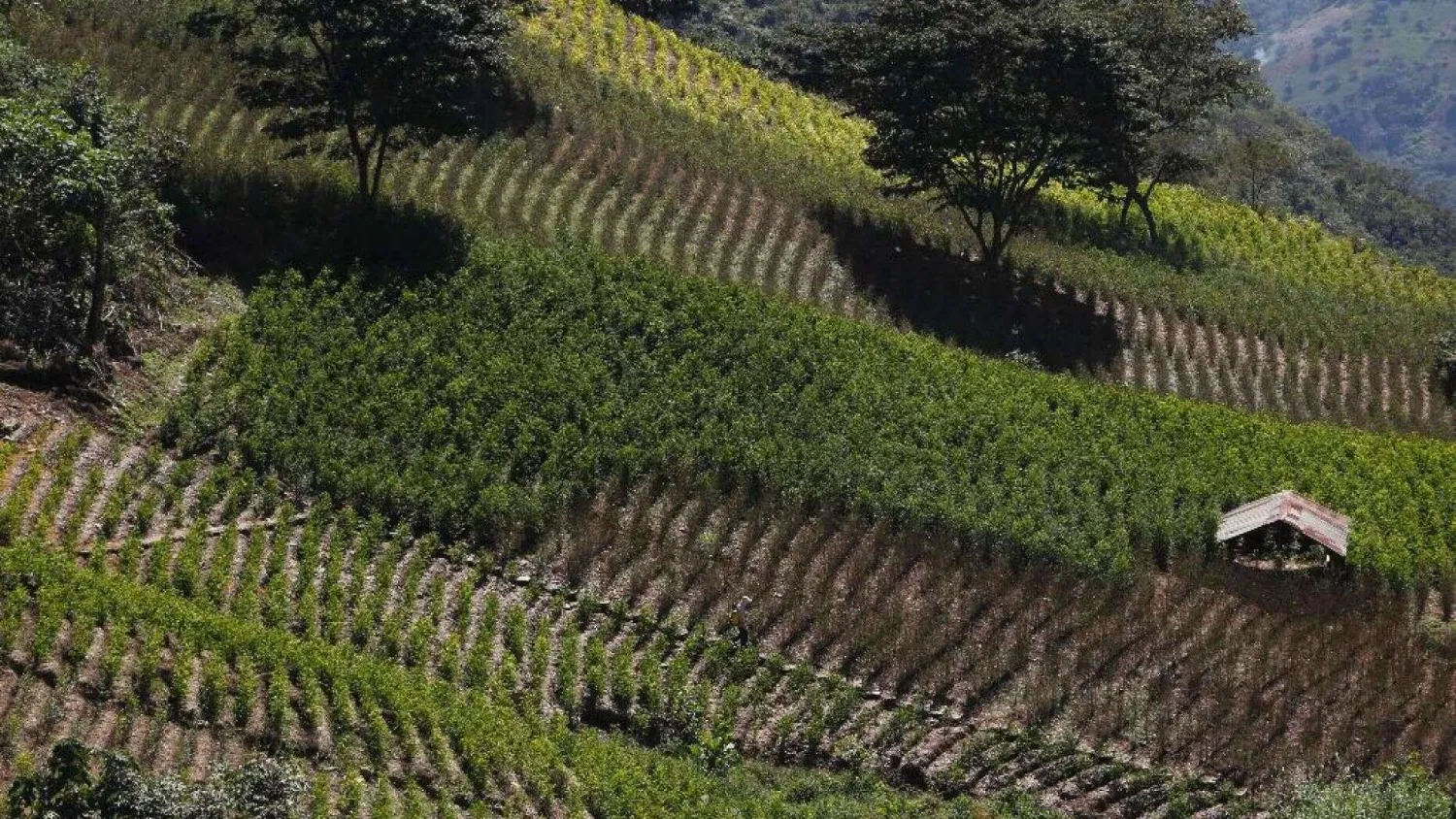

Agriculture Existed in Bolivia 10,000 Years Ago

This June 7, 2015 file photo shows a coca farm in Huancane, Bolivia. (AP Photo/Juan Karita, File)
TT

Agriculture Existed in Bolivia 10,000 Years Ago

This June 7, 2015 file photo shows a coca farm in Huancane, Bolivia. (AP Photo/Juan Karita, File)

A new region of Bolivia has joined the small list of places where crop cultivation first got started in the ancient world. According to the latest issue of the Nature journal, an international team including researchers from the UK, Switzerland, Bolivia, and Brazil unearthed signs that these spots were used to grow cassava and squash a little over 10,000 years ago in islands rising a few feet above the surrounding wetlands in the savannah forests northern Bolivia.

Many of these forest islands, as researchers call them, are thought to be the remnants of human habitation from the early and mid-Holocene Epoch, extending over the last 11,700 years.

In a report published on the Science Alert website, Archaeologist Jose Iriarte, from the University of Exeter in the UK said: "That's impressive, as this timing places them some 8,000 years earlier than scientists had previously found evidence in the southwestern corner of the Amazon basin. The study adds these Bolivian islands to four other regions in China, the Middle East, and Central America, as the oldest places that witnessed agricultural practices in the world."

Archaeologists, geographers, and biologists have argued for many years that southwestern Amazonia was a probable center of early plant domestication because many important cultivars like manioc, squash, peanuts and some varieties of chili pepper and beans are genetically very close to wild plants living here. The study provides evidence that Bolivia was one of these centers.

The team extracted sediment samples from these islands. Further analysis revealed tiny bits of phytolith – structures made of silica that are known to form inside the cells of plants, and get left behind after they decay. These phytoliths can also tell scientists which plant they came from. Using radiocarbon dating techniques, the team was able to work out when these crops were being grown. The researchers found that manioc were cultivated 10,350 years ago, and squash 10,250 years ago.

Senior author and earth scientist Umberto Lombardo from the University of Bern in Switzerland said: "The evidence we have found shows the inhabitants of the area were not just tropical hunter-gatherers, but colonizers who cultivated plants. This opens the door to suggest that they already ate a mixed diet when they arrived in the region."




British Baker’s Criticism of Mexican ‘Ugly’ Bread Triggers Social Media Outrage

Bolillos, a traditional Mexican bread, sit for sale at a street stand in Mexico City, Thursday, Dec. 18, 2025. (AP Photo/Marco Ugarte)
TT

British Baker’s Criticism of Mexican ‘Ugly’ Bread Triggers Social Media Outrage

Bolillos, a traditional Mexican bread, sit for sale at a street stand in Mexico City, Thursday, Dec. 18, 2025. (AP Photo/Marco Ugarte)

A blunt critique of Mexican bread by a British baker sparked a cascade of social media outrage, ultimately leading to a public apology.

In an interview for a food-themed podcast that resurfaced online, Richard Hart, the co-founder of Green Rhino bakery in Mexico City and a well-known figure in international baking circles, said Mexicans “don’t really have much of a bread culture,” adding that “they make sandwiches on these white, ugly rolls that are pretty cheap and industrially made.”

His comments quickly rippled across Instagram, TikTok and X, with many Mexicans accusing him of being dismissive and insulting of Mexico’s traditional breads.

What began as a dispute over bread soon ignited a national debate over food identity — not only over who defines Mexican culinary traditions, but also over the growing influence of foreigners in a capital already tense from a surge of US expatriates and tourists, according to AP.

Social media was soon flooded with memes, reaction videos, and passionate defenses of Mexican bread.

Users took to social media to praise everyday staples — from the crusty bolillos used for tortas to the iconic conchas found in neighborhood bakeries.

In many cases, these simple street foods act as a uniting factor across social groups and classes, and often cut to the core of the country’s cultural identity.

While wheat bread was introduced to Mexico during the colonial period, the classic food staple evolved into a distinct national tradition, blending European techniques with local tastes and ingredients. Today, small neighborhood bakeries remain central to daily life in cities and towns, serving as social hubs as well as food sources.

The incident prompted many to question why a foreign entrepreneur would publicly disparage a staple so deeply embedded in Mexican life. For many, Hart’s remarks echoed long-standing frustrations over foreign chefs and restaurateurs receiving disproportionate prestige, as well as concerns over gentrification in the capital.

“Don’t mess with the bolillo,” warned one viral post on X.

As criticism mounted, Hart issued a public apology on Instagram, saying his comments were poorly phrased and did not show respect for Mexico and its people. He acknowledged the emotional response and said he didn’t behave as a “guest.”

“I made a mistake,” Hart said in his statement. “I regret it deeply.”


High-speed Passenger Train Kills 7 Elephants in India

Elephants are used to clear logs and debris in a village affected by flooding in Pidie Jaya, Aceh province, Indonesia, Monday, Dec. 8, 2025. (AP Photo/Ahyar Tarmizi)
TT

High-speed Passenger Train Kills 7 Elephants in India

Elephants are used to clear logs and debris in a village affected by flooding in Pidie Jaya, Aceh province, Indonesia, Monday, Dec. 8, 2025. (AP Photo/Ahyar Tarmizi)

Seven wild Asiatic elephants were killed and a calf was injured when a high-speed passenger train collided with a herd crossing the tracks in India's northeastern state of Assam early Saturday, local authorities said.

The train driver spotted the herd of about 100 elephants and used the emergency brakes, but the train still hit some of the animals, Indian Railways spokesman Kapinjal Kishore Sharma told The Associated Press.

Five train coaches and the engine derailed following the impact, but there were no human casualties, Sharma said.

Veterinarians carried out autopsies on the dead elephants, which were to be buried later in the day.

The accident site is a forested area around 125 kilometers southeast of Assam’s capital city of Guwahati. Railway tracks in the state are frequented by elephants, but Indian Railways said in a statement the accident location wasn't a designated elephant corridor.

The Rajdhani Express train, traveling from Sairang in Mizoram state bordering Myanmar, was bound for the national capital of New Delhi with 650 passengers onboard when it hit with elephants.

“We delinked the coaches which were not derailed, and the train resumed its journey for New Delhi. Around 200 passengers who were in the five derailed coaches have been moved to Guwahati in a different train,” Sharma said.

Speeding trains hitting wild elephants is not rare in Assam, which is home to an estimated 7,000 wild Asiatic elephants, one of the highest concentrations of the pachyderm in India. Since 2020, at least a dozen elephants have been killed by speeding trains across the state.

Wild elephants often stray into human habitations this time of year, when rice fields are ready for harvesting.


Winter at Tantora Festival Kicks Off in AlUla

The 2025–2026 season features a diverse array of immersive experiences - SPA
TT

Winter at Tantora Festival Kicks Off in AlUla

The 2025–2026 season features a diverse array of immersive experiences - SPA

The Winter at Tantora Festival launched yesterday in AlUla Governorate and will run until January 10, 2026, marking the beginning of the winter season with a rich program that celebrates the region’s deep-rooted agricultural and historical heritage.

The festival derives its name from the Tantora, a traditional mudbrick sundial located in the heart of AlUla’s Old Town. For centuries, local farmers and residents relied on this stone marker to tell time, manage water distribution rights, and signal the start of the winter planting season, SPA reported.

The 2025–2026 season features a diverse array of immersive experiences. "Old Town Nights" offers an atmospheric evening of heritage storytelling and fine dining at the historic AlUla Fort, while the "AlManshiyah Carnival" creates a festive space for families with traditional games and parades.

Music remains a central pillar of the festival, with performances set against AlUla’s most iconic backdrops. The "Shorfat Tantora" (Tantora Balconies) series brings live music to the rooftops of the AlJadidah Arts District, while major concerts are scheduled at the Maraya mirrored hall and the Thanaya open-air amphitheater.

These events are part of the broader AlUla Moments calendar, supporting the goals of Saudi Vision 2030 to highlight the Kingdom's heritage and establish AlUla as a premier global destination.