


Doctors and Nurses Suffered as Iran Ignored Virus Concerns

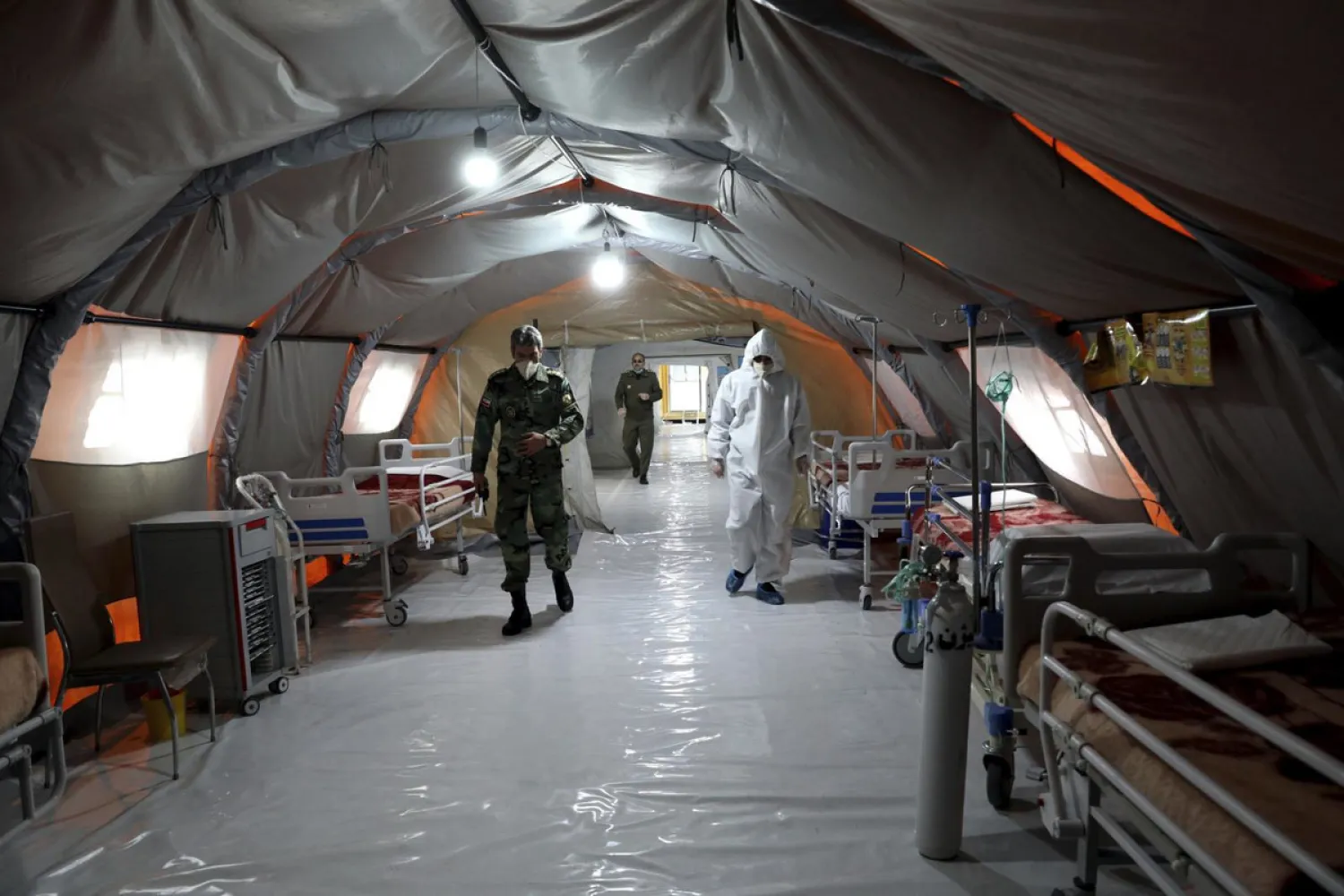
In this March 26, 2020 file photo, Iranian army soldiers work in a temporary 2,000-bed hospital for coronavirus patients set up by the army at the International Exhibition Center in northern Tehran, Iran. Dozens of medical staffers have died of COVID-19 in Iran. Doctors and nurses and other staffers have been hard hit. During the first 90 days of the virus outbreak alone, about one medical staffer died each day. (AP Photo/Ebrahim Noroozi, File)
TT

Doctors and Nurses Suffered as Iran Ignored Virus Concerns

In this March 26, 2020 file photo, Iranian army soldiers work in a temporary 2,000-bed hospital for coronavirus patients set up by the army at the International Exhibition Center in northern Tehran, Iran. Dozens of medical staffers have died of COVID-19 in Iran. Doctors and nurses and other staffers have been hard hit. During the first 90 days of the virus outbreak alone, about one medical staffer died each day. (AP Photo/Ebrahim Noroozi, File)

They are regarded as heroes, their fallen colleagues as martyrs. But for doctors and nurses still dealing with Iran´s growing number of coronavirus infections, such praise rings hollow.

While crippling sanctions imposed by the US government left the country ill-equipped to deal with the fast-moving virus, some medical professionals say government and religious leaders bear the brunt of the blame for allowing the virus to spread -- and for hiding how much it had spread.

Those medical workers say they were defenseless to handle the contagion. And as a result, doctors and nurses in Iran have been hard hit by the virus. During the first 90 days of the virus outbreak alone, about one medical staffer died each day and dozens became infected.

"We are heading fast toward a disaster," said a young Isfahan doctor who has been working tirelessly, checking dozens of suspected coronavirus patients before referring them to hospitals.

It is no secret that Iran has been hit hard by the coronavirus. Official government figures show that around 100,000 people were infected by the virus and around 6,500 have died. But a report by the research arm of Iran´s parliament said the number of cases could be eight to 10 times higher, making it among the hardest-hit countries in the world. The report said the number of deaths could be 80% higher than official numbers from the health ministry, about 11,700.

The Iranian government is currently reporting a decline in the number of COVID-19 infections and deaths in many areas, even though local authorities are expanding cemeteries in places like Tehran where the municipal council said it had to add 10,000 new graves to its largest cemetery, Behshet e-Zahra.

Interviews with more than 30 medical professionals and a review of communications by doctors on messaging apps and other documents by an Associated Press reporter in Cairo revealed many previously unreported details. The reporting paints a fuller picture of the roots and extent of the country´s disjointed response as the deadly virus spread throughout the population.

In the beginning, medical staffers faced the outbreak with very limited equipment. Some washed their own gowns and masks or sterilized them in regular ovens. Others wrapped their bodies in plastic bags they bought at the supermarket.

The makeshift equipment didn´t help. Further complicating the situation, the health ministry said millions of pieces of protective gear ordered by the agency were stolen and diverted to the black market.

The result: dozens of medical professionals without adequate protection died along with their patients.

Iran´s leaders, several medical professionals said, delayed telling the public about the virus for weeks, even as hospitals were filling up with people suffering from symptoms linked to the virus. And even as doctors and other experts were warning the Iranian president to take radical action, the government resisted, fearing the impact on elections, national anniversaries, and economy.

"They wanted to send people to the streets," said a Mazandaran-based nurse and activist.

One doctor interviewed by The Associated Press - who, like all medical workers interviewed for this story, spoke only on the condition that they not be named for fear of persecution - said he and his colleagues were even discouraged from using protective equipment. He said government officials claimed wearing masks would cause panic.

The country´s supreme leader, Ayatollah Ali Khamenei, proclaimed on March 10 that the doctors, nurses, and medical staffers who died in the fight against the coronavirus in Iran were "martyrs." Pictures of deceased doctors have been placed alongside those of soldiers who were killed in the bloody Iran-Iraq war in the 1980s, which claimed the lives of a million Iranians and Iraqis.

"They are normalizing death," a Tehran-based health consultant said.

A list compiled by a group of Iranian doctors found that a total of 126 medical staffers have died since the virus was first reported, mostly in the provinces of Gilan and Tehran, while over 2,070 contracted the virus. The AP verified 100 of the deaths by piecing together scattered news reports in local media outlets, statements from health institutions, and social media messages of condolences.

Health Ministry spokesman Kianoush Jahanpour acknowledged the deadly toll of COVID-19 on the medical profession in Iran, telling the AP the total number of deaths is 107. Jahanpur said 470 had tested positive for the virus. But he placed the blame on the US. "Remember this is a country under sanctions," he said. Iran has maintained throughout the crisis that its own industries made enough protective material to fight the virus.

Iran reported its first two cases on Feb. 19 in the city of Qom - 140 kilometers (88 miles) south of Tehran and home of highly revered Shiite shrines. It would become the epicenter of the outbreak.

The announcement apparently was made under some duress. A doctor there named Mohammed Molei filmed himself next to his bedridden brother, insisting that his brother be tested for the virus. That coincided with a visit by a health ministry delegation to the city.

But doctors interviewed by the AP say that before the official announcement, they started to see cases with the same symptoms as the novel coronavirus and warned the national health ministry that it needed to take action.

Some doctors shared with the AP letters sent to the ministry. The doctors at first said they attributed the respiratory problems among patients and deaths to the H1N1 flu. Days later, they started to call for testing for H1N1 and other diseases to rule them out; the rate of infections and deaths seemed unusually high.

Through channels on the Telegram messaging service, they exchanged data. They reached out to the health ministry and proposed a set of recommendations and actions. At the top of the list: a quarantine, and restricting travel and flights with China. But it would be another two weeks before the government took action.

"We gave a lot of information to the government through letters and communication channels," said a Mazandaran-based activist and doctor. He said he and other medical professionals were ignored by government officials.

Two days after announcing the first cases, Iran held its parliamentary elections where thousands lined up to vote. That same day, doctors in Gilan - one of the worst-hit areas in Iran - appealed to the governor for help, saying their hospitals were flooded with patients amid a shortage of masks and other protective equipment.

"The health personnel of the province are exposed to a huge threat," a letter sent by the doctors read.

But government officials played down the danger of the virus, calling the physicians´ plea for a quarantine "medieval" and floating unfounded conspiracy theories that the US created the coronavirus to promote a fear-mongering campaign.

The feared paramilitary Revolutionary Guard kept health facilities under tight control and medical statistics were treated as top secret, the medical staffers said.

Death certificates were not recording the coronavirus as the cause of deaths - either because not all severe cases were tested or just for the sake of keeping the numbers down. Thousands of unaccounted deaths were attributed to secondary causes like "heart attack" or "respiratory distress."

And a doctor in Tehran said the health ministry gave orders not to refer critical cases to hospitals to be tested for the virus - to keep the numbers low, she said.

"We suppose they (want to) say they´re doing good," she said.

A Tehran-based radiologist said that he had access to medical files of patients at different Tehran hospitals. The reports include CT scans and blood tests that pointed to the coronavirus. But tests were not done.

"These are 40% of the cases," he said, "It´s just difficult to prove."

"The number of real patients with COVID-19 in Iran, from the beginning ... until today is much more than what has been reported," he said, echoing similar sentiments by most medical workers interviewed by the AP.

He estimated that the numbers are three to four times higher than the figures released by the government.

"The authorities believe they are doing great and they try to keep things out of spotlight," a medical scholar said.

Clinics and hospitals became hubs of infection, even as parliamentary elections and national celebrations went on:

- In Khorasan, the head of the medical science school which oversees hospitals receiving corona patients, Ali Asghar, told a local news agency that a total of 600 people died between Feb. 19 and April 4. The government number through March 22 was 42.

- In Golestan, AbdolReza Fazel, a top health official, told local media that 230 had died though April 2, while the government recorded just 10 cases.

- In Isfahan, Tahererh Changiz, the head of the medical school, told the IMNA news agency that the total number of deaths reached 400; the official figure was just 87.

- According to one health official and two doctors, the total deaths in Gilan have surpassed 1,300 so far. The last breakdown provided by the government on March 22 said the total did not exceed 200.

"Gilan wasn´t ready at all," said one physician there. "It was a catastrophe."

Said another doctor: "The first weeks, the system has collapsed," with patients sleeping in the corridors and doctors forced to make painful choices. A nurse at Shafa Hospital in the provincial capital of Rasht said ventilators were removed from dying patients to let others live.

"Death certificates were written before they died," the nurse said with a hoarse voice. On the death certificates, the doctor scribbled, "heart attack" or "respiratory distress" as a cause of death.

"It was my worst day in my life when they cut the oxygen. After work, when I went back home, I could do nothing but crying," she said.

A psychologist in Tehran told the AP that many medical staffers were traumatized. Images of the dying patients left them with a deep sense of guilt, suicide thoughts, and panic attacks, he said.

He recalled one nurse who had a recurring nightmare of burying her parents alone. Another said she dreamt of looking into a telescope, anticipating with horror a meteoric strike.

ICU doctor Gol Rezayee appeared in a March 29 video that went viral on social media as he tried, but failed to revive a dying patient´s heart.

On Telegram, he wrote the last words he exchanged with the victim. "Doctor, if I die, tell my husband to take care of the kids," he recalled the woman saying. "He is careless and naughty."

Rezayee said he responded: "It´s just like a cold. You will live 120 years." Hours later, the woman was dead.

Medical professionals also watched as their own colleagues succumbed to the virus.

As the outbreak in Rasht unfolded during the last week of February, patients packed the clinic of the city´s most popular physician, Moammad Bakhshalizadeh, who often treated the poor for free, set up the first association for physicians in the province and volunteered during the war with Iraq.

As the virus spread, the 66-year-old doctor examined an average of 70 patients each day, largely without protective gear.

A week after Iran officially announced the first two official cases in Qom, Bakhshalizadeh developed a fever and had trouble breathing. Initial tests for coronavirus were inconclusive. Another test showed that his lungs were turning white.

He later drove himself to several hospitals until he found one with an empty bed.

Four days later, on March 7, he died.


UK PM's Top Aide Quits over Mandelson-Epstein Scandal

FILE PHOTO: British Prime Minister Keir Starmer talks with Britain's ambassador to the United States Peter Mandelson during a welcome reception at the ambassador's residence on February 26, 2025, in Washington, DC, US. Carl Court/Pool via REUTERS/File Photo
TT

UK PM's Top Aide Quits over Mandelson-Epstein Scandal

FILE PHOTO: British Prime Minister Keir Starmer talks with Britain's ambassador to the United States Peter Mandelson during a welcome reception at the ambassador's residence on February 26, 2025, in Washington, DC, US. Carl Court/Pool via REUTERS/File Photo

British Prime Minister Keir Starmer's chief of staff, Morgan McSweeney, quit on Sunday, saying he took responsibility for advising Starmer to name Peter Mandelson as ambassador to the US despite his known links to Jeffrey Epstein.

After new files revealed the depth of the Labour veteran's relationship with the late sex offender, Starmer is facing what is widely seen as the gravest crisis of his 18 months in power over his decision to send Mandelson to Washington in 2024, Reuters reported.

The loss of McSweeney, 48, a strategist who was instrumental in Starmer's rise to power, is the latest in a series of setbacks, less than two years after the Labour Party won one of the largest parliamentary majorities in modern British history.

With polls showing Starmer is hugely unpopular with voters after a series of embarrassing U-turns, some in his own party are openly questioning his judgment and his future, and it remains to be seen whether McSweeney's exit will be enough to silence critics.

The files released in the US on January 30 sparked a police investigation for misconduct in office over indications that Mandelson leaked market-sensitive information to Epstein when he was a government minister during the global financial crisis in 2009 and 2010.

In a statement, McSweeney said: "The decision to ⁠appoint Peter Mandelson was wrong. He has damaged our party, our country and trust in politics itself.
"When asked, I advised the Prime Minister to make that appointment and I take full responsibility for that advice."

The leader of the opposition Conservative Party, Kemi Badenoch, said the resignation was overdue and that "Keir Starmer has to take responsibility for his own terrible decisions".

Nigel Farage, head of the populist Reform UK party, which is leading in the polls, said he believed Starmer's time would soon be up.

Starmer has spent the last week defending McSweeney, a strategy that could prompt further questions about his own judgment. In a statement on Sunday, Starmer said it had been "an honor" working with him.

Many Labour members of parliament had blamed McSweeney for the appointment of Mandelson and the damage caused by the publication of the exchanges between Epstein ⁠and Mandelson. Others have said Starmer must go.

One Labour lawmaker, speaking on condition of anonymity, said McSweeney's resignation had come too late: "It buys the PM time, but it's still the end of days."

Starmer sacked Mandelson as ambassador in September over his links to Epstein.

The government agreed last week to release virtually all previously private communications between members of his government from the time when Mandelson was being appointed.

That release could come as early as this week, creating a new headache for Starmer just as he hopes to move on. If previously secret messages about how London planned to approach its relationship with Donald Trump are made public, it could damage Starmer's relationship with the US President.

McSweeney had held the role of chief of staff since October 2024, when he was handed the job following the resignation of Sue Gray after a row over pay and donations.

Starmer on Sunday appointed his deputy chiefs of staff, Jill Cuthbertson and Vidhya Alakeson, to serve as joint acting chiefs of staff.


Iran Sentences Nobel Laureate Narges Mohammadi to 7 More Years in Prison

(FILES) A handout photo provided by the Narges Mohammadi Foundation on October 2, 2023 shows an undated, unlocated photo of Iranian rights campaigner Narges Mohammadi. (Photo by Handout / NARGES MOHAMMADI FOUNDATION / AFP)
TT

Iran Sentences Nobel Laureate Narges Mohammadi to 7 More Years in Prison

(FILES) A handout photo provided by the Narges Mohammadi Foundation on October 2, 2023 shows an undated, unlocated photo of Iranian rights campaigner Narges Mohammadi. (Photo by Handout / NARGES MOHAMMADI FOUNDATION / AFP)

Iran sentenced Nobel Peace Prize laureate Narges Mohammadi to over seven more years in prison after she began a hunger strike, supporters said Sunday.

Mohammadi’s supporters cited her lawyer, who spoke to Mohammadi.

The lawyer, Mostafa Nili, confirmed the sentence on X, saying it had been handed down Saturday by a Revolutionary Court in the city of Mashhad. Such courts typically issue verdicts with little or no opportunity for defendants to contest their charges.

“She has been sentenced to six years in prison for ‘gathering and collusion’ and one and a half years for propaganda and two-year travel ban,” he wrote, according to The Associated Press.

She received another two years of internal exile to the city of Khosf, some 740 kilometers (460 miles) southeast of Tehran, the capital, the lawyer added.

Supporters say Mohammadi has been on a hunger strike since Feb. 2. She had been arrested in December at a ceremony honoring Khosrow Alikordi, a 46-year-old Iranian lawyer and human rights advocate who had been based in Mashhad. Footage from the demonstration showed her shouting, demanding justice for Alikordi and others.

Supporters had warned for months before her December arrest that Mohammadi, 53, was at risk of being put back into prison after she received a furlough in December 2024 over medical concerns.

While that was to be only three weeks, Mohammadi’s time out of prison lengthened, possibly as activists and Western powers pushed Iran to keep her free. She remained out even during the 12-day war in June between Iran and Israel.

Mohammadi still kept up her activism with public protests and international media appearances, including even demonstrating at one point in front of Tehran’s notorious Evin prison, where she had been held.

Mohammadi had been serving 13 years and nine months on charges of collusion against state security and propaganda against Iran’s government.

She also had backed the nationwide protests sparked by the 2022 death of Mahsa Amini, which have seen women openly defy the government by not wearing the hijab.

Mohammadi suffered multiple heart attacks while imprisoned before undergoing emergency surgery in 2022, her supporters say. Her lawyer in late 2024 revealed doctors had found a bone lesion that they feared could be cancerous that later was removed.

“Considering her illnesses, it is expected that she will be temporarily released on bail so that she can receive treatment,” Nili wrote.

However, Iranian officials have been signaling a harder line against all dissent since the recent demonstrations. Speaking on Sunday, Iranian judiciary chief Gholamhossein Mohseni-Ejei made comments suggesting harsh prison sentences awaited many.

“Look at some individuals who once were with the revolution and accompanied the revolution," he said. "Today, what they are saying, what they are writing, what statements they issue, they are unfortunate, they are forlorn (and) they will face damage.”


Nigeria's President to Make a Sate Visit to the UK in March

Nigeria’s President Bola Tinubu gives a joint statement with Brazil’s President Luiz Inacio Lula da Silva, at the Planalto presidential palace, in Brasilia, Brazil, Aug. 25, 2025. (AP Photo/Eraldo Peres, File)
TT

Nigeria's President to Make a Sate Visit to the UK in March

Nigeria’s President Bola Tinubu gives a joint statement with Brazil’s President Luiz Inacio Lula da Silva, at the Planalto presidential palace, in Brasilia, Brazil, Aug. 25, 2025. (AP Photo/Eraldo Peres, File)

Nigeria’s president is set to make a state visit to the UK in March, the first such trip by a Nigerian leader in almost four decades, Britain’s Buckingham Palace said Sunday.

Officials said President Bola Tinubu and first lady Oluremi Tinubu will travel to the UK on March 18 and 19, The AP news reported.

King Charles III and Queen Camilla will host them at Windsor Castle. Full details of the visit are expected at a later date.

Charles visited Nigeria, a Commonwealth country, four times from 1990 to 2018 before he became king. He previously received Tinubu at Buckingham Palace in September 2024.m

Previous state visits by a Nigerian leader took place in 1973, 1981 and 1989.

A state visit usually starts with an official reception hosted by the king and includes a carriage procession and a state banquet.

Last year Charles hosted state visits for world leaders including US President Donald Trump, French President Emmanuel Macron and German President Frank-Walter Steinmeier.
