


Is the Gravity-Defying Manchester United Brand Facing a Fall Back to Earth?

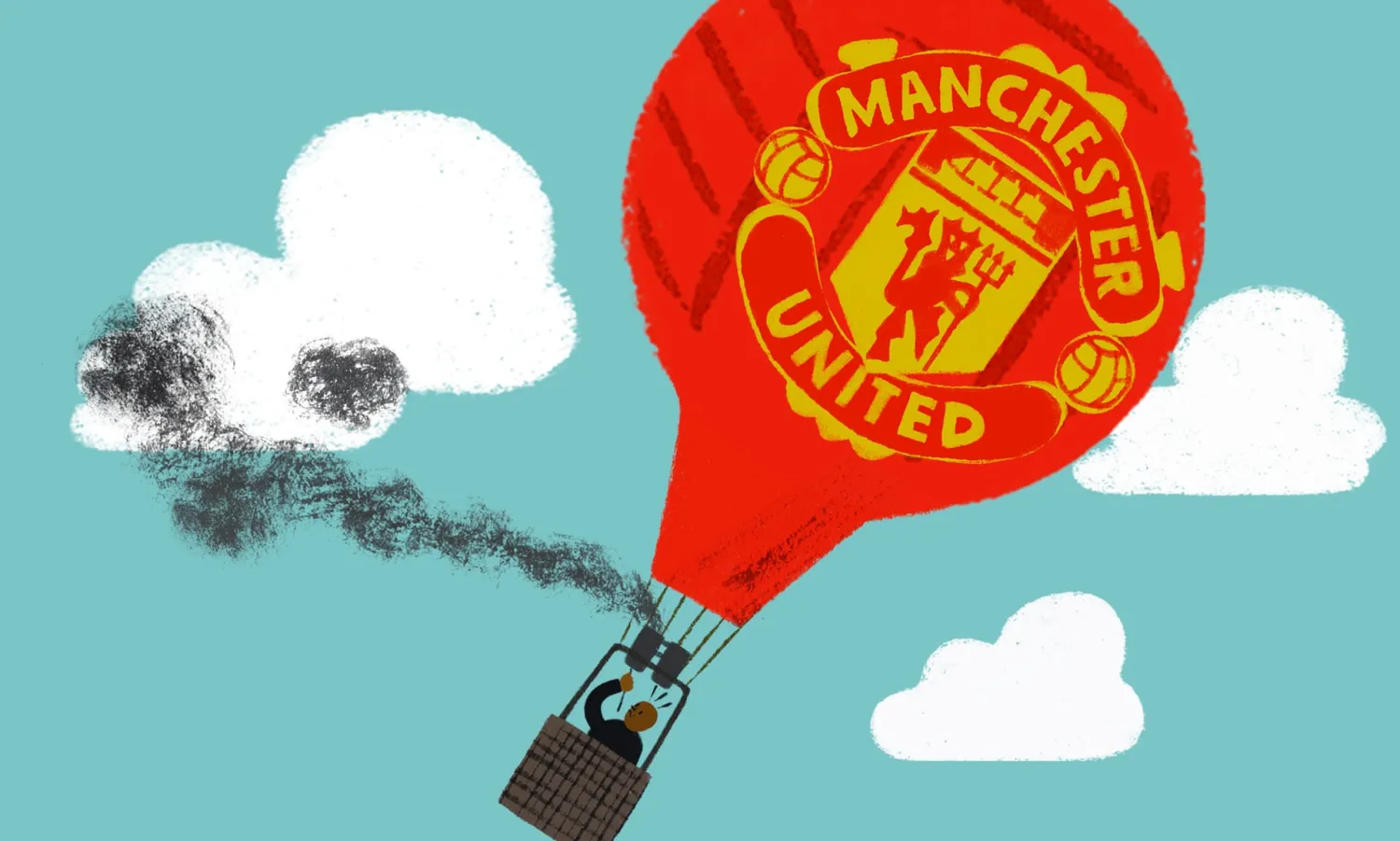
‘Manchester United’s commercial arm has been hanging on to a rising balloon.’
Illustration: Robin Hursthouse/The Guardian
‘Manchester United’s commercial arm has been hanging on to a rising balloon.’ Illustration: Robin Hursthouse/The Guardian
TT

Is the Gravity-Defying Manchester United Brand Facing a Fall Back to Earth?

‘Manchester United’s commercial arm has been hanging on to a rising balloon.’
Illustration: Robin Hursthouse/The Guardian
‘Manchester United’s commercial arm has been hanging on to a rising balloon.’ Illustration: Robin Hursthouse/The Guardian

What’s your favorite bit of non-football-football so far? In my opinion the best new sub-genre to emerge is pictures of José Mourinho delivering vegetables.

You don’t have to go looking for them. They just turn up on your social media feed or on the click-bar beneath a news story. Handsome, crinkly José carrying a box of lettuce across the tenement threshold. José in a surgical mask distributing radishes to elderly war heroes. José off-camera giving a secret briefing against the fucking artichoke guy who isn’t pulling his weight (premium content: subscribers only).

It is a wonderful piece of casting against type, and our good fortune that this keeps happening in places where photographers are present. Perhaps in time an Inspirational José charity calendar could be produced. José, shirtless, delivers a baby calf. José laughs with orphans on a seaside teacup ride. José poses in a landmine helmet, England’s rose steering us through these dark, unmonetized, content-poor times.

Probably this is just me. But in fairness, it has been slim pickings out there. The suspension of the match program is one thing. The most notable co-casualty of the plague times is the absence of the endless football-style content that rides alongside: the lifestyle, the brand, the lucrative sense of belonging, a definition of football that has allowed certain Premier League clubs to state, with supporting commercial evidence, that they have a billion fans around the world, that they are in fact too big to fail.

It is easy to forget this side of the business has also been scythed off at the knees. Right now eyeballs are no longer eyeballing. Clicks are unclicked. Needs, desires and disposable income are focused elsewhere. And the absence of this shadow industry is perhaps just as significant, at least for those clubs that rely on it to an unusual degree.

At which point, enter Manchester United. Or rather, enter “Manchester United”. For the past seven years the endless growth of the United brand has been one of sport’s gravity-defying miracles, a marvel of the age. How do you kill this thing? How do you stop it rising and spreading? Throw what you like at it. A full season of migraine-inducing Mourinho death-ball. A foul-tempered home defeat to a peppy Southampton on a freezing afternoon inside a clanky rain-drenched stadium followed by a half an hour of finger-jabbing post-match bile. It makes no difference. Switch the channel and Manchester United plc are still announcing record revenues, still bathing in an apparently insatiable appetite for its red-shirted commercial voodoo.

And yet, there are no miracles really. Nobody really knows what the short-, medium- or long-term future might hold. What is certain is this is a stress test of something unprecedented. United’s commercial arm has been breathtakingly successful at monetizing the era-building of the previous 20 years. They have been hanging on to a rising balloon, £400m in debt but still clawing in cash to keep the engines thrumming forward.

No other club is set up quite like this. It is a model predicated on constant growth, constant momentum. What happens when it crashes? More to the point, does this actually have to be a bad thing? So far there have been attempts to suggest large debts and reduced income isn’t a problem. Perhaps correctly so. It has been pointed out by people who know this world that United have such ready access to credit they can simply borrow more without it being a problem. There is also a suggestion the reliance on commercial income actually puts them in a better place than other clubs. This version of the future states that the Official Brassiere Partner model is a huge advantage, a diversification of income to insulate the club against the absence of actual football.

Does this sound convincing? The mathematics are certainly fascinating. One detailed projection in the Daily Mail has United losing £116m in commercial, TV and matchday revenue if the season is canceled now, the most of any club. But why not more?

The notion sponsors will keep propping this up is untested. There is already talk elsewhere of discounts. United’s “partners” are taking huge hits of their own. Those contracts will have force majeure clauses, or be open to frustration principles under common law. The Glazer family’s own main business is based on vast areas of physical retail space in the US. Good luck with that one. Excess commercial deals, endless sloshing cash: this just isn’t going to be there any more.

This is an industry-wide problem. But United are the most extreme debt-loaded commercial model out there, a buy-to-let landlord in the middle of a rent revolt. Wages topped £300m last year. Encouragingly, debt repayments are a mere £26m. But still: extend the match-staging restrictions into next season and the losses start to become vertiginous. Ever wondered why there is such an urgency to resume playing? Why we have Project Restart looming, a strangely menacing prospect that sounds less like a “festival of football”, more like a doomed 1980s burglar rehabilitation initiative. The clubs need the money.

Who knows, some kind of correction might be a good thing. It is no secret the Glazers are terrible owners from one perspective. Fantastic for the commercial operation, yes, but there is no love here, no sense of sporting soul, no real interest in the intangible things – collectivism, sporting culture, coherent long-term planning – that built this super-club in the first place.

This is an ownership that has ridden a rising tide, squatting on the shoulders of a grand old footballing institution. Many have wondered how United will ever escape this cycle of vampiric, debt-loaded ownership. In practice the only way is to become less attractive, less endlessly fecund. Contraction, brand collapse, revolution: whatever happens there will always be a Manchester United. In the meantime, here’s your earthquake.

(The Guardian)


Hospital: Vonn Had Surgery on Broken Leg from Olympics Crash

This handout video grab from IOC/OBS shows US Lindsey Vonn crashing during the women's downhill event at the Milano Cortina 2026 Winter Olympic Games on February 8, 2026. (Photo by Handout / various sources / AFP)
TT

Hospital: Vonn Had Surgery on Broken Leg from Olympics Crash

This handout video grab from IOC/OBS shows US Lindsey Vonn crashing during the women's downhill event at the Milano Cortina 2026 Winter Olympic Games on February 8, 2026. (Photo by Handout / various sources / AFP)

Lindsey Vonn had surgery on a fracture of her left leg following the American's heavy fall in the Winter Olympics downhill, the hospital said in a statement given to Italian media on Sunday.

"In the afternoon, (Vonn) underwent orthopedic surgery to stabilize a fracture of the left leg," the Ca' Foncello hospital in Treviso said.

Vonn, 41, was flown to Treviso after she was strapped into a medical stretcher and winched off the sunlit Olimpia delle Tofane piste in Cortina d'Ampezzo.

Vonn, whose battle to reach the start line despite the serious injury to her left knee dominated the opening days of the Milano Cortina Olympics, saw her unlikely quest halted in screaming agony on the snow.

Wearing bib number 13 and with a brace on the left knee she ⁠injured in a crash at Crans Montana on January 30, Vonn looked pumped up at the start gate.

She tapped her ski poles before setting off in typically aggressive fashion down one of her favorite pistes on a mountain that has rewarded her in the past.

The 2010 gold medalist, the second most successful female World Cup skier of all time with 84 wins, appeared to clip the fourth gate with her shoulder, losing control and being launched into the air.

She then barreled off the course at high speed before coming to rest in a crumpled heap.

Vonn could be heard screaming on television coverage as fans and teammates gasped in horror before a shocked hush fell on the packed finish area.

She was quickly surrounded by several medics and officials before a yellow Falco 2 ⁠Alpine rescue helicopter arrived and winched her away on an orange stretcher.


Meloni Condemns 'Enemies of Italy' after Clashes in Olympics Host City Milan

Demonstrators hold smoke flares during a protest against the environmental, economic and social impact of the Milano-Cortina 2026 Winter Olympics in Milan, Italy, February 7, 2026. REUTERS/Kevin Coombs
TT

Meloni Condemns 'Enemies of Italy' after Clashes in Olympics Host City Milan

Demonstrators hold smoke flares during a protest against the environmental, economic and social impact of the Milano-Cortina 2026 Winter Olympics in Milan, Italy, February 7, 2026. REUTERS/Kevin Coombs

Italian Prime Minister Giorgia Meloni has condemned anti-Olympics protesters as "enemies of Italy" after violence on the fringes of a demonstration in Milan on Saturday night and sabotage attacks on the national rail network.

The incidents happened on the first full day of competition in the Winter Games that Milan, Italy's financial capital, is hosting with the Alpine town of Cortina d'Ampezzo.

Meloni praised the thousands of Italians who she said were working to make the Games run smoothly and present a positive face of Italy.

"Then ⁠there are those who are enemies of Italy and Italians, demonstrating 'against the Olympics' and ensuring that these images are broadcast on television screens around the world. After others cut the railway cables to prevent trains from departing," she wrote on Instagram on Sunday.

A group of around 100 protesters ⁠threw firecrackers, smoke bombs and bottles at police after breaking away from the main body of a demonstration in Milan.

An estimated 10,000 people had taken to the city's streets in a protest over housing costs and environmental concerns linked to the Games.

Police used water cannon to restore order and detained six people.

Also on Saturday, authorities said saboteurs had damaged rail infrastructure near the northern Italian city of Bologna, disrupting train journeys.

Police reported three separate ⁠incidents at different locations, which caused delays of up to 2-1/2 hours for high-speed, Intercity and regional services.

No one has claimed responsibility for the damage.

"Once again, solidarity with the police, the city of Milan, and all those who will see their work undermined by these gangs of criminals," added Meloni, who heads a right-wing coalition.

The Italian police have been given new arrest powers after violence last weekend at a protest by the hard-left in the city of Turin, in which more than 100 police officers were injured.


Liverpool New Signing Jacquet Suffers 'Serious' Injury

Soccer Football - Ligue 1 - RC Lens v Stade Rennes - Stade Bollaert-Delelis, Lens, France - February 7, 2026  Stade Rennes' Jeremy Jacquet in action REUTERS/Benoit Tessier
Soccer Football - Ligue 1 - RC Lens v Stade Rennes - Stade Bollaert-Delelis, Lens, France - February 7, 2026 Stade Rennes' Jeremy Jacquet in action REUTERS/Benoit Tessier
TT

Liverpool New Signing Jacquet Suffers 'Serious' Injury

Soccer Football - Ligue 1 - RC Lens v Stade Rennes - Stade Bollaert-Delelis, Lens, France - February 7, 2026  Stade Rennes' Jeremy Jacquet in action REUTERS/Benoit Tessier
Soccer Football - Ligue 1 - RC Lens v Stade Rennes - Stade Bollaert-Delelis, Lens, France - February 7, 2026 Stade Rennes' Jeremy Jacquet in action REUTERS/Benoit Tessier

Liverpool's new signing Jeremy Jacquet suffered a "serious" shoulder injury while playing for Rennes in their 3-1 Ligue 1 defeat at RC Lens on Saturday, casting doubt over the defender’s availability ahead of his summer move to Anfield.

Jacquet fell awkwardly in the second half of the ⁠French league match and appeared in agony as he left the pitch.

"For Jeremy, it's his shoulder, and for Abdelhamid (Ait Boudlal, another Rennes player injured in the ⁠same match) it's muscular," Rennes head coach Habib Beye told reporters after the match.

"We'll have time to see, but it's definitely quite serious for both of them."
Liverpool agreed a 60-million-pound ($80-million) deal for Jacquet on Monday, but the 20-year-old defender will stay with ⁠the French club until the end of the season.

Liverpool, provisionally sixth in the Premier League table, will face Manchester City on Sunday with four defenders - Giovanni Leoni, Joe Gomez, Jeremie Frimpong and Conor Bradley - sidelined due to injuries.
