


Recovery Hopes Revive World Stock Markets

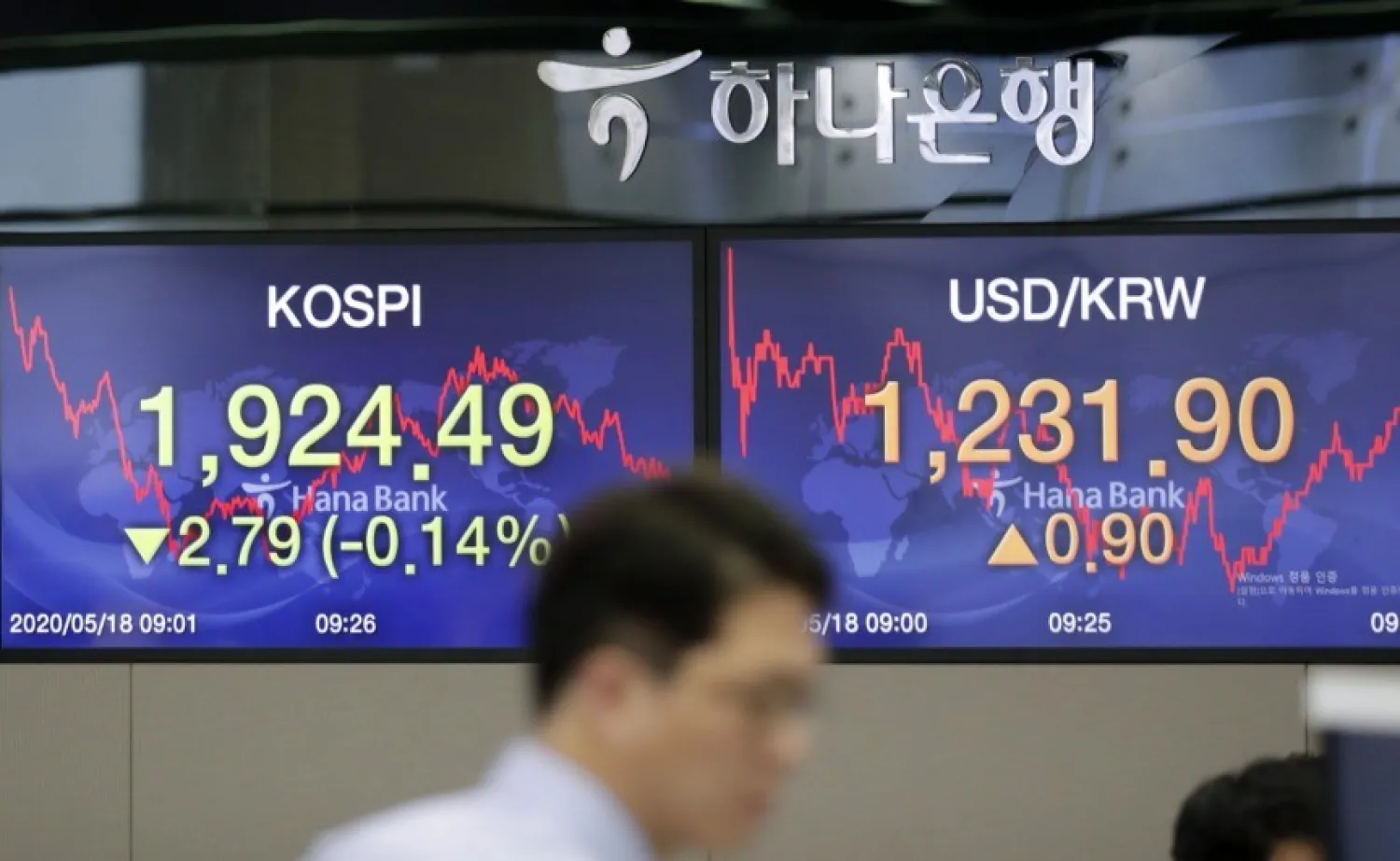
A currency trader walks near the screens showing the Korea Composite Stock Price Index (KOSPI), left, and the foreign exchange rate between US dollar and South Korean won at the foreign exchange dealing room in Seoul, South Korea, Monday, May 18, 2020. (AP Photo/Lee Jin-man)
TT

Recovery Hopes Revive World Stock Markets

A currency trader walks near the screens showing the Korea Composite Stock Price Index (KOSPI), left, and the foreign exchange rate between US dollar and South Korean won at the foreign exchange dealing room in Seoul, South Korea, Monday, May 18, 2020. (AP Photo/Lee Jin-man)

Global stock markets and US futures rebounded Monday from losses last week after the head of the US Federal Reserve expressed optimism that the American economy might start to recover this year from the coronavirus pandemic.

London and Frankfurt pushed higher, while benchmarks in Shanghai, Tokyo, Hong Kong, and Australia advanced.

That came despite Japan´s announcement that its economy contracted in the first quarter and the Trump administration´s decision to step up a technology conflict with Beijing by tightening restrictions on Chinese tech giant Huawei.

Investors appear to be looking past the outbreak to a recovery despite rising infection numbers in the United States, Brazil, and some other countries. Forecasters warn the latest market buoyancy might be premature and a return to normal could be some way off.

Market sentiment "will likely remain fragile" as investors weigh government stimulus plans against rising US-Chinese tension and poor economic data, said Riki Ogawa of Mizuho Bank in a report.

In Europe, the FTSE 100 in London gained 2.4% to 5,936 and the DAX in Frankfurt advanced 2.9% to 10,766. France's CAC 40 rose 2.2% to 4,373.

On Wall Street, futures for the S&P 500 index and the Dow industrials were up 1.6% and 1.7%, respectively. On Friday, US stocks turned in their biggest weekly loss in nearly two months.

In Asia, the Shanghai Composite Index rose 0.2% to 2,875.42 and Tokyo´s Nikkei 225 gained 0.5% to 20,133.73. The Hang Seng in Hong Kong advanced 0.6% to 23,934.77.

The Kospi in Seoul was 0.5% higher at 1,937.11 and Australia´s S&P-ASX 200 gained 1% to 5,460.50. India´s Sensex lost 2.6% to 30,310.56. Markets in New Zealand and Southeast Asia advanced.

Federal Reserve Chair Jerome Powell expressed optimism Sunday the US economy can begin to rebound in the second half, assuming the coronavirus doesn´t erupt in a second wave. He said a full recovery won´t likely be possible before the arrival of a vaccine.

That appeared to encourage investors who are looking for signs of when global economies might return to normal.

In an interview with CBS´s "60 Minutes," Powell said the US economy was fundamentally healthy before the virus forced widespread business shutdowns and tens of millions of layoffs. Once the outbreak has been contained, he said, the economy should be able to rebound "substantially."

The US downturn was the result of an external event instead of problems such as the financial instabilities that led to the 2008 crisis, which may mean "we can get back to a healthy economy fairly quickly," Powell said.

Powell and Treasury Secretary Steven Mnuchin are due to appear Thursday before a Senate panel to report on recovery efforts.

"Expect policymakers to strike a more cautious tone, emphasizing that we are not out of the woods yet and that there will be more stimulus in the offing," Stephen Innes of AxiCorp said in a report.

Meanwhile, Japan´s government reported Monday the world´s third-largest economy contracted by 0.9% in the three months ending in March compared with the previous quarter.

That "sharp fall" suggests there is "much worse to come" in the current quarter, Tom Learmouth of Capital Economics said in a report.

The White House added to trade uncertainty by tightening restrictions on Huawei Technologies Ltd. American officials say Huawei, one of the biggest makers of smartphones and network equipment, is a security risk, which the company denies.

Washington said non-US companies that make processor chips for Huawei must obtain permission to use American technology, a move that threatens to disrupt sales. Huawei warned earlier that additional US sanctions on the company might trigger Chinese government retaliation against American enterprises.

In energy markets, benchmark US crude gained $2.78 to $32.21 per barrel in electronic trading on the New York Mercantile Exchange. The contract rose $1.87 to $29.43 on Friday. Brent crude, used to price international oils, advanced $2.08 to $34.58 per barrel in London. It rose $1.37 the previous session to $32.50.

The dollar gained to 107.24 yen from Friday´s 107.08 yen. The euro declined to $1.0816 from $1.0828.



Aljadaan: Emerging Markets Account for 70% of Global Growth

Al-Jadaan speaking to the attendees at the "AlUla Conference for Emerging Market Economies" (Asharq Al-Awsat
TT

Aljadaan: Emerging Markets Account for 70% of Global Growth

Al-Jadaan speaking to the attendees at the "AlUla Conference for Emerging Market Economies" (Asharq Al-Awsat

Saudi Minister of Finance Mohammed Aljadaan stressed Sunday that the world economy is going through a “profound transition,” saying emerging markets and developing economies now account for nearly 60 percent of the global Gross Domestic Product (GDP) in purchasing power terms and over 70 percent of global growth.

In his opening remarks at the AlUla Conference for Emerging Market Economies, organized by the Saudi Ministry of Finance and the IMF in AlUla, the minister said these economies have become an increasingly important driver of global growth with their share of global economy more than doubling since 2010.

“Today, the 10 emerging economies in the G20 alone account for more than half of the world growth. Yet, they face a more complex and fragmented environment, elevated debt levels, slower trade growth and increasing exposure to geopolitical shocks.”

“Unfortunately, more than half of low income countries are either in or at the risk of debt distress. At the same time global trade growth has slowed at around half of what it was pre the pandemic,” Aljadaan added.

The Finance Minister stressed that the Saudi experience over the past decade has reinforced three lessons that may be relevant to the discussions at the two-day conference, which brings together a select group of ministers and central bank governors, leaders of international organizations, leading investors and academics.

“First, macroeconomic stability is not the enemy of growth. It is actually the foundation,” he said.

“Structural reforms deliver results only when institutions deliver. So there is no point of reforming ... if the institutions are unable to deliver,” he stated.

Finally, he said that “international cooperation matters more, not less, in a fragmented world.”


Georgieva from AlUla: Growth Still Lacks Pre-pandemic Levels

Kristalina Georgieva speaking to attendees at the second edition of the AlUla Conference for Emerging Market Economies (Asharq Al-Awsat)
TT

Georgieva from AlUla: Growth Still Lacks Pre-pandemic Levels

Kristalina Georgieva speaking to attendees at the second edition of the AlUla Conference for Emerging Market Economies (Asharq Al-Awsat)

International Monetary Fund (IMF) Managing Director Kristalina Georgieva said Sunday that world growth still lacks pre-pandemic levels, expressing concern as she expected more shocks amid high spending and rising debt levels in many countries.

Georgieva spoke at the AlUla Conference for Emerging Market Economies, organized by the Saudi Ministry of Finance and the IMF in AlUla.

The two-day conference brings together a select group of ministers and central bank governors, leaders of international organizations, leading investors and academics to deliberate on policies to global stability, prosperity, and multilateral collaboration.

Georgieva said that the conference was launched last year in recognition of the growing role of emerging market economies in a world of sweeping transformations.

“I came out of this gathering .... With a sense of hope for the pragmatic attitude and determination to pursue good policies and build strong institutions,” she said.

Georgieva stressed that “good policies pay off,” and said that growth rates across emerging economies reached four percent this year, exceeding by a large margin those of advanced economies that are around 1.5 percent.


Saudi Arabia’s flynas, Syrian Civil Aviation Authority Partner to Launch 'flynas Syria'

The new airline will operate commercial air transport services in accordance with approved regulations and standards (flynas)
TT

Saudi Arabia’s flynas, Syrian Civil Aviation Authority Partner to Launch 'flynas Syria'

The new airline will operate commercial air transport services in accordance with approved regulations and standards (flynas)

Saudi budget carrier flynas has signed an agreement with the Syrian General Authority of Civil Aviation and Air Transport to establish a new commercial airline under the name "flynas Syria," with operations scheduled to begin in the fourth quarter of 2026.

Saturday’s agreement comes within the framework of bilateral cooperation between Saudi Arabia and Syria, as well as the strategic investment agreements between the two countries, coordinated with the Saudi Ministry of Investment and the Syrian General Authority of Civil Aviation and Air Transport.

The new airline will operate commercial air transport services in accordance with approved regulations and standards, meeting the highest safety and aviation security requirements. All licensing and operational procedures will be completed in coordination with the relevant authorities.

The carrier will be established as a joint venture, with 51% ownership held by the Syrian General Authority of Civil Aviation and Air Transport and 49% by flynas.

The new airline will operate flights to several destinations across the Middle East, Africa, and Europe. This expansion aims to bolster air traffic to and from Syria, enhance regional and international connectivity, and meet growing demand for air travel.

"This step is part of our commitment to supporting high-quality cross-border investments. The aviation sector is a key enabler of economic development, and the establishment of 'flynas Syria' serves as a model for constructive investment cooperation,” said Saudi Minister of Investment Khalid Al-Falih.

“This partnership enhances economic integration and market connectivity and supports development goals by advancing air transport infrastructure, ultimately serving the mutual interests of both nations and promoting regional economic stability,” he added.

President of the Syrian General Authority of Civil Aviation and Air Transport Omar Hosari also stated that the establishment of flynas Syria represents a strategic step within a comprehensive national vision aimed at rebuilding and developing Syria's civil aviation sector on modern economic and regulatory foundations.

“This will be achieved while balancing safety requirements, operational sustainability, investment stimulation, and passenger services. The partnership reflects the state's orientation toward smart cooperation models with trusted regional partners, ensuring the transfer of expertise, the development of national capabilities, and the enhancement of Syria's air connectivity with regional and international destinations, in line with global best practices in the air transport industry."

flynas Chairman Ayed Al-Jeaid stated that the company continues to pursue strategies aimed at growth and international expansion, describing the agreement as a historic milestone in the company's journey and a promising investment model in partnership with Syria.

flynas CEO Bander Al-mohanna said the step represents a qualitative leap in the company's strategy and financial performance, highlighting the transfer of the company's low-cost aviation experience to the Syrian market to support regional and international air connectivity.

flynas currently operates 23 weekly flights from Riyadh, Jeddah, and Dammam to Damascus, including two daily direct flights from Riyadh, one daily flight from Jeddah, and two weekly flights from Dammam.

The airline made history on June 5, 2025, by adding the Syrian capital to its network, becoming the first Saudi carrier to resume scheduled flights to Damascus.