


World Virus Cases Top 6 Mln as Leaders Disagree on Pandemic Response

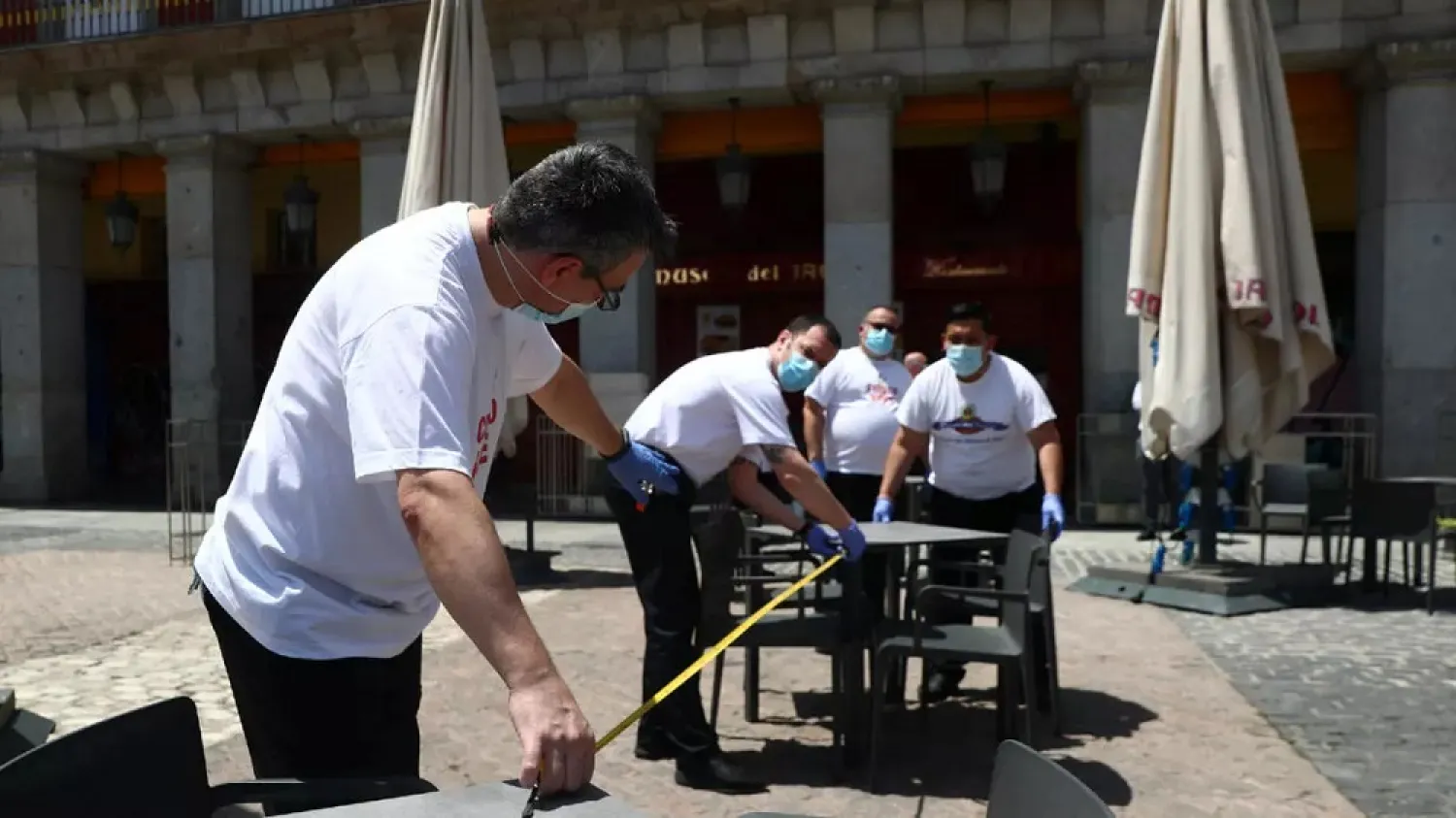
Workers use measuring tape to check social distancing as they set up a terrace, amid the coronavirus outbreak, in Madrid, Spain, May 24, 2020. (Reuters)
TT

World Virus Cases Top 6 Mln as Leaders Disagree on Pandemic Response

Workers use measuring tape to check social distancing as they set up a terrace, amid the coronavirus outbreak, in Madrid, Spain, May 24, 2020. (Reuters)

The number of coronavirus cases worldwide topped six million Sunday, with Brazil registering another record surge in daily infections as divisions deepened on how to deal with the pandemic.

Latin American countries are bracing for difficult weeks ahead as the disease spreads rapidly across the region, even as much of the world exits lockdowns that have wrecked economies and stripped millions of their jobs.

In Brazil -- the epicenter of South America's outbreak with nearly 500,000 confirmed cases, lagging only behind the United States -- disagreement among leaders over lockdown measures has hampered efforts to slow the virus as the number of fatalities in the country nears 30,000.

President Jair Bolsonaro, who fears the economic fallout from stay-at-home measures will be worse than the virus, has berated governors and mayors for imposing what he calls "the tyranny of total quarantine."

As the global death toll from the pandemic surpassed 368,000, US President Donald Trump's decision to permanently cut funding to the World Health Organization has been broadly criticized.

The number of confirmed cases worldwide is more than six million, according to an AFP tally.

"Now is the time for enhanced cooperation and common solutions," the European Union said in a statement, adding: "Actions that weaken international results must be avoided."

Trump initially suspended funding to the WHO last month, accusing it of not doing enough to curb the early spread of the virus and being too lenient with China, where COVID-19 emerged late last year.

On Friday, he moved to make that decision permanent in a major blow to the agency. The US is the WHO's biggest contributor, supplying $400 million last year.

German Health Minister Jens Spahn said the "disappointing" decision was a setback for global health.

Richard Horton, editor of The Lancet medical journal, said it was "madness and terrifying both at the same time."

Lockdown eases

As the virus progresses at different speeds around the globe, there has been pressure in many countries to lift crippling lockdowns, despite experts' warnings of a possible second wave of infections.

In Britain, which is set to begin lifting its lockdown on Monday, senior advisors to the government warned that it was moving too quickly.

"COVID-19 spreading too fast to lift lockdown in England," tweeted Jeremy Farrar, a member of the government's Scientific Advisory Group for Emergencies.

India said Saturday it would begin relaxing the world's biggest lockdown in stages from early June, even as it marked another record daily rise in infections.

Iran meanwhile announced that collective prayers would resume in mosques, despite infections ticking back upwards in the region’s hardest-hit country.

Jerusalem's Al-Aqsa mosque compound -- the third-holiest site in Islam after Makkah and Madinah in Saudi Arabia -- reopened to worshippers on Sunday.

With infection numbers falling in many of Europe's most affected countries, the push to restart economies was gaining steam.

Italy's Leaning Tower of Pisa reopened on Saturday, while in Paris, parks and the famed Galeries Lafayette department store flung open their doors.

In Austria, hotels and cinemas were allowed to take in customers, provided they wear masks.

"It is very important that things return to normal," film buff Rotraud Turanitz said at Vienna's historic Admiral Kino cinema on trendy Burggasse.

Across the Atlantic, the US capital Washington resumed outdoor dining, while on the West Coast, restaurants and hair salons in Los Angeles reopened.

New York City, the worst-hit American city with about 21,500 coronavirus deaths, is on track to begin reopening the week of June 8.

The overall US death toll has topped 103,000 out of more than 1.7 million cases of the virus.

Global sport has also started to rev back into action, with Austria announcing it will host Formula One's delayed season-opener on July 5, and the NBA eyeing a July 31 return.

Britain approved the return of domestic competitive sport on June 1 -- with no fans present.

Sri Lanka's cricket team will resume training Monday under strict health measures.

Economies shattered

But the economic damage from weeks of lockdowns continues to pile up, with Chile and Peru securing credit lines worth billions from the IMF.

India's economy grew at its slowest pace in two decades in the first quarter, while Canada, Brazil, France and Italy also saw their GDP figures shrink ahead of an expected worldwide recession.

As the virus hits the world's poor particularly hard, Pope Francis called for a "more just and equitable society" in the post-coronavirus world and for people to act to "end the pandemic of poverty."

"Without food donations, I'll have to fight harder for my family to survive," said motorcycle taxi driver Thanapat Noidee in the tiny hut he shares with his wife and children in Bangkok, reported AFP.

Even the animal world has not been left untouched by the pandemic.

Gibraltar has banned tourists from touching the British enclave's famous Barbary macaques over fears they could spread coronavirus.

Singapore's beloved otters meanwhile have been popping up in unexpected places during the city-state's lockdown, but their increasingly daring antics have angered some and even sparked calls for a cull.

"I simply don't understand anyone who could not like them. They are really cute," said 35-year-old Singaporean Pam Wong.



US Vice President Vance Heads to Armenia, Azerbaijan to Push Peace, Trade

US Vice President JD Vance speaks during the Critical Minerals Ministerial at the State Department in Washington, DC, US, February 4, 2026. (Reuters)
TT

US Vice President Vance Heads to Armenia, Azerbaijan to Push Peace, Trade

US Vice President JD Vance speaks during the Critical Minerals Ministerial at the State Department in Washington, DC, US, February 4, 2026. (Reuters)

US Vice President JD Vance will visit Armenia and Azerbaijan this week to push a Washington-brokered peace agreement that could transform energy and trade routes in the strategic South Caucasus region.

His two-day trip to Armenia, which begins later on Monday, comes just six months after the Armenian and Azerbaijani leaders signed an agreement at the White House seen as the first step towards peace after nearly 40 years of war.

Vance, the first US vice president to visit Armenia, is seeking to advance the Trump Route for International Peace and Prosperity (TRIPP), a proposed 43-kilometre (27-mile) corridor that would run across southern Armenia and give Azerbaijan a direct route to its exclave ‌of Nakhchivan ‌and in turn to Türkiye, Baku's close ally.

"Vance's visit should ‌serve ⁠to reaffirm the ‌US's commitment to seeing the Trump Route through," said Joshua Kucera, a senior South Caucasus analyst at Crisis Group.

"In a region like the Caucasus, even a small amount of attention from the US can make a significant impact."

The Armenian government said on Monday that Vance would hold talks with Prime Minister Nikol Pashinyan and that both men would then make statements, without elaborating.

Vance will then visit Azerbaijan on Wednesday and Thursday, the White House has said.

Under the agreement signed last year, ⁠a private US firm, the TRIPP Development Company, has been granted exclusive rights to develop the proposed corridor, with Yerevan ‌retaining full sovereignty over its borders, customs, taxation and security.

The ‍route would better connect Asia to Europe ‍while - crucially for Washington - bypassing Russia and Iran at a time when Western countries are ‍keen on diversifying energy and trade routes away from Russia due to its war in Ukraine.

Russia has traditionally viewed the South Caucasus as part of its sphere of influence but has seen its clout there diminish as it is distracted by the war in Ukraine.

Securing US access to supplies of critical minerals is also likely to be a key focus of Vance's visit.

TRIPP could prove a key transit corridor for the vast mineral wealth of ⁠Central Asia - including uranium, copper, gold and rare earths - to Western markets.

CLOSED BORDERS, BITTER RIVALS

In Soviet times the South Caucasus was criss-crossed by railways and oil pipelines until a series of wars beginning in the 1980s disrupted energy routes and shuttered the border between Armenia and Türkiye, Azerbaijan's key regional ally.

Armenia and Azerbaijan were locked in bitter conflict for nearly four decades, primarily over the mountainous region of Nagorno-Karabakh, an internationally recognized part of Azerbaijan that broke away from Baku's control as the Soviet Union fell apart in 1991.

Azerbaijan and Armenia fought two wars over Karabakh before Baku finally took it back in 2023. Karabakh's entire ethnic Armenian population of around 100,000 people fled to Armenia. The two neighbors have made progress in recent months on normalizing relations, including restarting ‌some energy shipments.

But major hurdles remain to full and lasting peace, including a demand by Azerbaijan that Armenia change its constitution to remove what Baku says contains implicit claims on Azerbaijani territory.


Adviser to Iran's Supreme Leader to Visit Oman on Tuesday

FILED - 06 February 2009, Bavaria, Munich: Ali Larijani, then chairman of the Iranian parliament, speaks at the 45th Munich Security Conference in Munich. Photo: Andreas Gebert/dpa
TT

Adviser to Iran's Supreme Leader to Visit Oman on Tuesday

FILED - 06 February 2009, Bavaria, Munich: Ali Larijani, then chairman of the Iranian parliament, speaks at the 45th Munich Security Conference in Munich. Photo: Andreas Gebert/dpa

Ali Larijani, an adviser to Iran's Supreme Leader Ali Khamenei, will visit Oman accompanied by a delegation on Tuesday, the ‌semi-official Tasnim news ‌agency reported ‌on ⁠Monday.

American and ‌Iranian diplomats held indirect talks in Oman last week, aimed at reviving diplomacy amid a US ⁠naval buildup near Iran and ‌Tehran's vows ‍of a ‍harsh response if ‍attacked.

"During this trip, (Larijani) will meet with high-ranking officials of the Sultanate of Oman and discuss the latest regional ⁠and international developments and bilateral cooperation at various levels," Tasnim said.

The date and venue of the next round of talks are yet to be announced.


Russia’s Lavrov Sees No ‘Bright Future’ for Economic Ties with US

06 February 2026, Russia, Moscow: Russian Foreign Minister Sergei Lavrov gives a press conference following a meeting with Organization for Security and Cooperation in Europe (OSCE) Chairperson-in-Office Ignazio Cassis, head of Switzerland's Federal Department of Foreign Affairs, Federal Councilor of the Swiss Confederation, and OSCE Secretary General Feridun Sinirlioglu at the Russian Foreign Ministry's Reception House. (Sofya Sandurskaya/TASS via ZUMA Press/dpa)
TT

Russia’s Lavrov Sees No ‘Bright Future’ for Economic Ties with US

06 February 2026, Russia, Moscow: Russian Foreign Minister Sergei Lavrov gives a press conference following a meeting with Organization for Security and Cooperation in Europe (OSCE) Chairperson-in-Office Ignazio Cassis, head of Switzerland's Federal Department of Foreign Affairs, Federal Councilor of the Swiss Confederation, and OSCE Secretary General Feridun Sinirlioglu at the Russian Foreign Ministry's Reception House. (Sofya Sandurskaya/TASS via ZUMA Press/dpa)

Russia remains open for cooperation with the United States but is not hopeful about economic ties despite Washington's ongoing efforts to end the Ukraine war, Russian Foreign Minister Sergei Lavrov said in an interview published on Monday.

Speaking to Russia-based media outlet TV BRICS, ‌Lavrov cited what ‌he called the ‌United ⁠States' declared ‌aim of "economic dominance".

"We also don't see any bright future in the economic sphere," Lavrov said.

Russian officials, including envoy Kirill Dmitriev, have previously spoken of the prospects for a major restoration ⁠of economic relations with the United States as ‌part of any eventual Ukraine ‍peace settlement.

But although ‍President Donald Trump has also ‍spoken of reviving economic cooperation with Moscow and has hosted his Russian counterpart Vladimir Putin on US soil since returning to the White House, he has imposed further onerous sanctions on Russia's vital ⁠energy sector.

Lavrov also cited Trump's hostility to the BRICS bloc, which includes Russia, China, India, Brazil and other major developing economies.

"The Americans themselves create artificial obstacles along this path (towards BRICS integration)," he said.

"We are simply forced to seek additional, protected ways to develop our financial, economic, logistical and ‌other projects with the BRICS countries."