

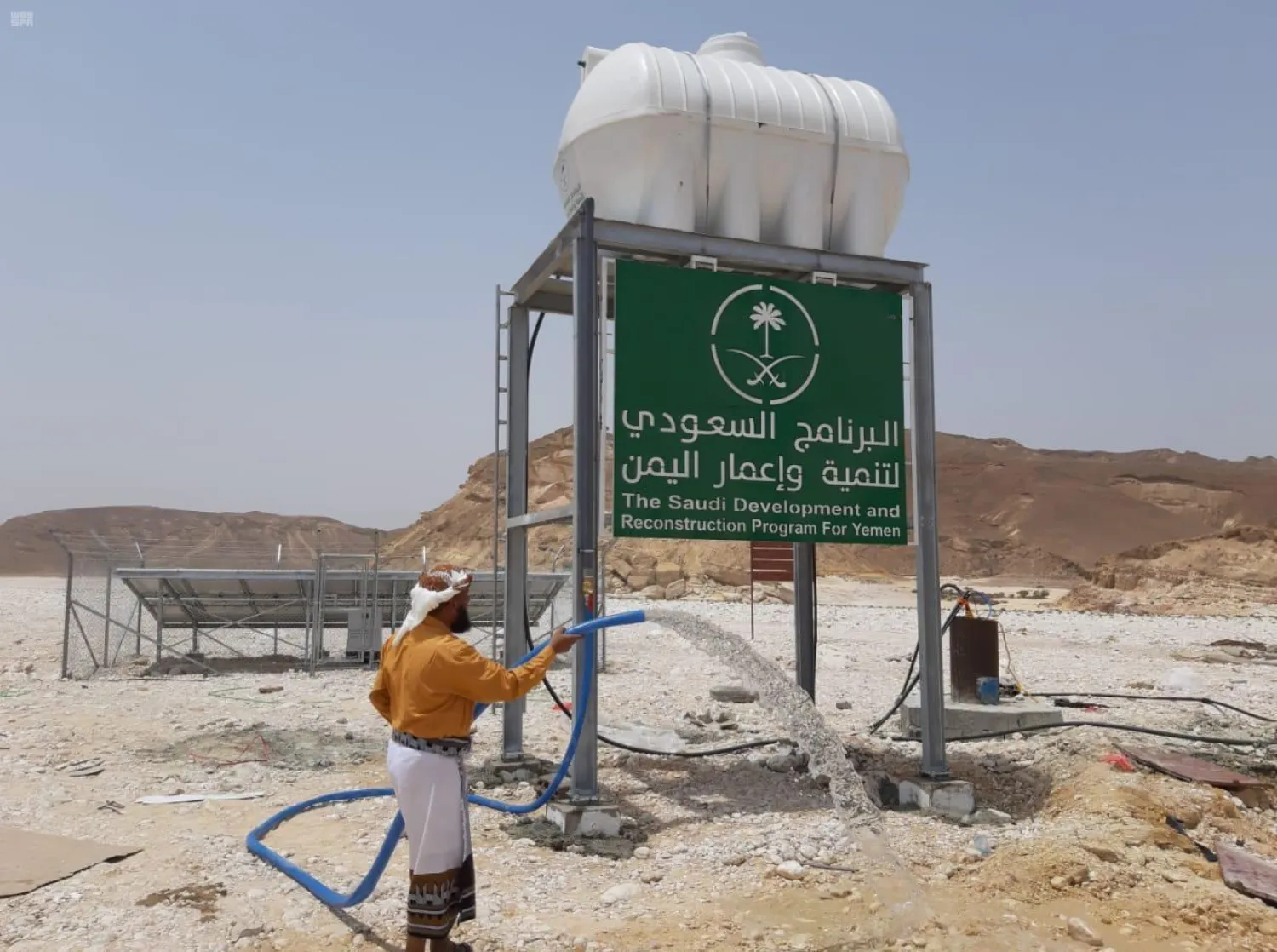

SDRPY: Empowering Communities, Enhancing Lives

The Saudi Development and Reconstruction Program for Yemen has developed hundreds of projects in Yemen. (SPA)
TT

SDRPY: Empowering Communities, Enhancing Lives

The Saudi Development and Reconstruction Program for Yemen has developed hundreds of projects in Yemen. (SPA)

The Saudi Development and Reconstruction Program for Yemen (SDRPY) was established by royal decree in 2018 as a strategic initiative aimed at providing economic and development support across all sectors in Yemen, contributing to the improvement of infrastructure and basic services available to the Yemeni people, creating job opportunities, and fostering economic growth. As of April 2020, SDRPY had launched 175 projects in partnership with 51 Yemeni companies across Yemen in support of healthcare, education, water, sanitation and hygiene (WASH), agriculture and fisheries, electricity and energy, transportation and government entities, thus expanding employment opportunities, building capacity and transferring knowledge.

“The program was founded on the principle that sustainable development is a force for stability, security, peace and – ultimately – prosperity,” says Saudi Ambassador to Yemen Mohammed bin Saeed Al Jabir, who is the general supervisor of SDRPY. “We believe SDRPY forms the cornerstone of a comprehensive solution to the current situation in Yemen, and we’re passionate about working alongside our Yemeni brothers and sisters to help improve living standards.”

SDRPY reconstruction operations are designed to increase access to basic services while strengthening and expanding the entities and infrastructure that make these services available. By carefully assessing essential needs at the local level, the program can focus on making the biggest positive difference possible to daily life.

“The key strength of SDRPY lies in knowledge, know-how, know-what and progressive learning,” says Dr. Adil Al-Qusadi, director of strategy and planning at the program, adding that SDRPY embodies Saudi Arabia’s special relationship with Yemen and long-standing partnership – historical, cultural and economic.

“Our knowledge of the Republic’s developmental needs is greater than that of any other developmental actor,” says Al-Qusadi. “As we mobilize that knowledge, deploying best practices in sustainable development with particular attention to the most vulnerable so that we ‘leave no one behind,’ we maximize the impact of developmental aid on all levels and reinforce our thought leadership in development in Yemen, today and tomorrow.”

SDRPY is responding to short- and medium-term needs at the same time as it contributes to long-term sustainability. The program supplies tractors to farmers and fishing boats to fishermen, but it also erects greenhouses and trains farmers in their effective year-round operation. SDRPY distributes supplies and furniture to existing schools, but it also renovates and builds schools to ensure a proper learning environment, and supplies means of transport to make it easier for students to attend class. SDRPY has delivered and installed modern medical equipment and ambulances to hospitals and health centers, but it has also trained Yemeni medical professionals, as well as constructing new clinics and hospital units to expand capacity.

“The program puts the interests of Yemenis first, identifying needs in close partnership with local authorities and residents,” says Dr. Hala Alsaleh, director of developmental programs, pointing out that, as Yemenis take the lead in project implementation, the capacity of Yemen’s most valuable resource – its people – is built.

“SDRPY builds on the mutually beneficial Saudi-Yemeni relationship, empowering Yemeni communities to drive the wheel of development more effectively,” she adds. “A big part of this is the empowerment of women.”

In addition to projects in the above sectors, SDRPY’s work includes emergency response and rescue operations during natural disasters, such as cyclones and floods. In the course of the three-month “Beautiful Aden” environmental sanitation and hygiene campaign in Yemen’s provisional capital, Aden, launched in the fourth week of March and conducted alongside the Cleaning and Improvement Fund of Aden (CIFA), SDRPY work crews have served as first responders during lethal flooding. SDRPY immediately began directing field teams to assess damage, open roads, remove floodwater, repair electricity networks and provide equipment to alleviate the distress of local residents. The program administered two workstreams in cooperation with the Yemeni government: first, urgent intervention to open routes for relief convoys delivering aid to the affected population and withdrawing water from flooded areas with tankers and pumps; second, provision of new generators and repair of existing generators to restore electricity supplies.

During the period of April 21-25 alone, the campaign removed 1,583 cubic meters of flood waste. As of April 25, the total volume of waste cleared from Aden’s streets and neighborhoods stood at 8,857 tons, equal to 25,083 cubic meters. The lethality of the floods highlighted the importance of the “Beautiful Aden” campaign’s goals, which included reducing health risks from environmental and visual pollution and helping to curb the spread of epidemics and disease, dangers heightened by the flood disaster.

“The ‘Beautiful Aden’ campaign is an example of Saudis and Yemenis working side by side to improve public services and the quality of daily life,” says Ambassador Al Jabir. “A key goal of SDRPY is empowering communities to take the lead in development in Yemen.”



Head of Arab World Institute in Paris Resigns over Epstein-linked tax Fraud Probe

(FILES) France's former culture minister and president of Paris's famed Arab World Institute (AWI), Jack Lang, poses on January 28, 2013 in Paris. (Photo by Martin BUREAU / AFP)
TT

Head of Arab World Institute in Paris Resigns over Epstein-linked tax Fraud Probe

(FILES) France's former culture minister and president of Paris's famed Arab World Institute (AWI), Jack Lang, poses on January 28, 2013 in Paris. (Photo by Martin BUREAU / AFP)

France’s former Culture Minister Jack Lang has resigned as head of a Paris cultural center over alleged past financial links to convicted sex offender Jeffrey Epstein that prompted a tax investigation.

Lang was summoned to appear at the French Foreign Ministry, which oversees the Arab World Institute, on Sunday, but he submitted his resignation.

He is the highest-profile figure in France impacted by the release of Epstein files on Jan. 30 by the US Department of Justice, known for his role as a culture minister under Socialist President François Mitterrand in the 1980s and 1990s.

The Foreign Ministry confirmed his resignation Saturday evening.

The financial prosecutors' office said it had opened an investigation into Lang and his daughter, Caroline, over alleged “aggravated tax fraud laundering.”

French investigative news website Mediapart reported last week on alleged financial and business ties between the Lang family and Jeffrey Epstein through an offshore company based in the US Virgin Islands in the Caribbean Sea.

Jack Lang's name was mentioned more than 600 times in the Epstein files, showing intermittent correspondence between 2012 and 2019. His daughter was also in the released files.

Foreign Minister Jean-Noël Barrot has “taken note” of Lang's resignation and began the process to look for his successor, the foreign ministry said.
Lang headed the Arab World Institute since 2013.


Lebanon PM Pledges Reconstruction on Visit to Ruined Border Towns

This handout picture released by the Lebanese Government Press Office shows Lebanon's Prime Minister Nawaf Salam being showered with confetti as he is received by locals during a tour in the heavily-damaged southern village of Dhayra near the border with Israel on February 7, 2026. (Lebanese Government Press Office / AFP)
TT

Lebanon PM Pledges Reconstruction on Visit to Ruined Border Towns

This handout picture released by the Lebanese Government Press Office shows Lebanon's Prime Minister Nawaf Salam being showered with confetti as he is received by locals during a tour in the heavily-damaged southern village of Dhayra near the border with Israel on February 7, 2026. (Lebanese Government Press Office / AFP)

Lebanese Prime Minister Nawaf Salam visited heavily damaged towns near the Israeli border on Saturday, pledging reconstruction.

It was his first trip to the southern border area since the army said it finished disarming Hezbollah there, in January.

Swathes of south Lebanon's border areas remain in ruins and largely deserted more than a year after a US-brokered November 2024 ceasefire sought to end hostilities between Israel and the Iran-backed group.

Lebanon's government has committed to disarming Hezbollah, and the army last month said it had completed the first phase of its plan to do so, covering the area between the Litani River and the Israeli border about 30 kilometers (20 miles) further south.

Visiting Tayr Harfa, around three kilometers from the border, and nearby Yarine, Salam said frontier towns and villages had suffered "a true catastrophe".

He vowed authorities would begin key projects including restoring roads, communications networks and water in the two towns.

Locals gathered on the rubble of buildings to greet Salam and the delegation of accompanying officials in nearby Dhayra, some waving Lebanese flags.

In a meeting in Bint Jbeil, further east, with officials including lawmakers from Hezbollah and its ally the Amal movement, Salam said authorities would "rehabilitate 32 kilometers of roads, reconnect the severed communications network, repair water infrastructure" and power lines in the district.

Last year, the World Bank announced it had approved $250 million to support Lebanon's post-war reconstruction, after estimating that it would cost around $11 billion in total.

Salam said funds including from the World Bank would be used for the reconstruction and rehabilitation projects.

The second phase of the government's disarmament plan for Hezbollah concerns the area between the Litani and the Awali rivers, around 40 kilometers south of Beirut.

Israel, which accuses Hezbollah of rearming, has criticized the army's progress as insufficient, while Hezbollah has rejected calls to surrender its weapons.

Despite the truce, Israel has kept up regular strikes on what it usually says are Hezbollah targets and maintains troops in five south Lebanon areas.

Lebanese officials have accused Israel of seeking to prevent reconstruction in the heavily damaged south with repeated strikes on bulldozers, excavators and prefabricated houses.

Visiting French Foreign Minister Jean-Noel Barrot on Friday said the reform of Lebanon's banking system needed to precede international funding for reconstruction efforts.

The French diplomat met Lebanon's army chief Rodolphe Haykal on Saturday, the military said.


Over 2,200 ISIS Detainees Transferred to Iraq from Syria, Says Iraqi Official

 One of the American buses transporting ISIS fighters, according to a security source from the Syrian Democratic Forces, heads from Syria towards Iraq, in Qamishli, Syria, February 7, 2026. (Reuters)
One of the American buses transporting ISIS fighters, according to a security source from the Syrian Democratic Forces, heads from Syria towards Iraq, in Qamishli, Syria, February 7, 2026. (Reuters)
TT

Over 2,200 ISIS Detainees Transferred to Iraq from Syria, Says Iraqi Official

 One of the American buses transporting ISIS fighters, according to a security source from the Syrian Democratic Forces, heads from Syria towards Iraq, in Qamishli, Syria, February 7, 2026. (Reuters)
One of the American buses transporting ISIS fighters, according to a security source from the Syrian Democratic Forces, heads from Syria towards Iraq, in Qamishli, Syria, February 7, 2026. (Reuters)

Iraq has so far received 2,225 ISIS group detainees, whom the US military began transferring from Syria last month, an Iraqi official told AFP on Saturday.

They are among up to 7,000 ISIS detainees whose transfer from Syria to Iraq the US Central Command (CENTCOM) announced last month, in a move it said was aimed at "ensuring that the terrorists remain in secure detention facilities".

Previously, they had been held in prisons and camps administered by the Kurdish-led Syrian Democratic Forces (SDF) in northeast Syria.

The announcement of the transfer plan last month came after US envoy to Syria Tom Barrack declared that the SDF's role in confronting ISIS had come to an end.

Saad Maan, head of the security information cell attached to the Iraqi prime minister's office, told AFP on Saturday that "Iraq has received 2,225 terrorists from the Syrian side by land and air, in coordination with the international coalition", which Washington has led since 2014 to fight IS.

He said they are being held in "strict, regular detention centers".

A Kurdish military source confirmed to AFP the "continued transfer of ISIS detainees from Syria to Iraq under the protection of the international coalition".

On Saturday, an AFP photographer near the Kurdish-majority city of Qamishli in northeastern Syria saw a US military convoy and 11 buses with tinted windows.

- Iraq calls for repatriation -

ISIS seized swathes of northern and western Iraq starting in 2014, until Iraqi forces, backed by the international coalition, managed to defeat it in 2017.

Iraq is still recovering from the severe abuses committed by the extremists.

In recent years, Iraqi courts have issued death and life sentences against those convicted of terrorism offences.

Thousands of Iraqis and foreign nationals convicted of membership in the group are incarcerated in Iraqi prisons.

On Monday, the Iraqi judiciary announced it had begun investigative procedures involving 1,387 detainees it received as part of the US military's operation.

In a statement to the Iraqi News Agency on Saturday, Maan said "the established principle is to try all those involved in crimes against Iraqis and those belonging to the terrorist ISIS organization before the competent Iraqi courts".

Among the detainees being transferred to Iraq are Syrians, Iraqis, Europeans and holders of other nationalities, according to Iraqi security sources.

Iraq is calling on the concerned countries to repatriate their citizens and ensure their prosecution.

Maan noted that "the process of handing over the terrorists to their countries will begin once the legal requirements are completed".