Tunisia’s Speaker Pleads for Calm Before Vote of No Confidence Session

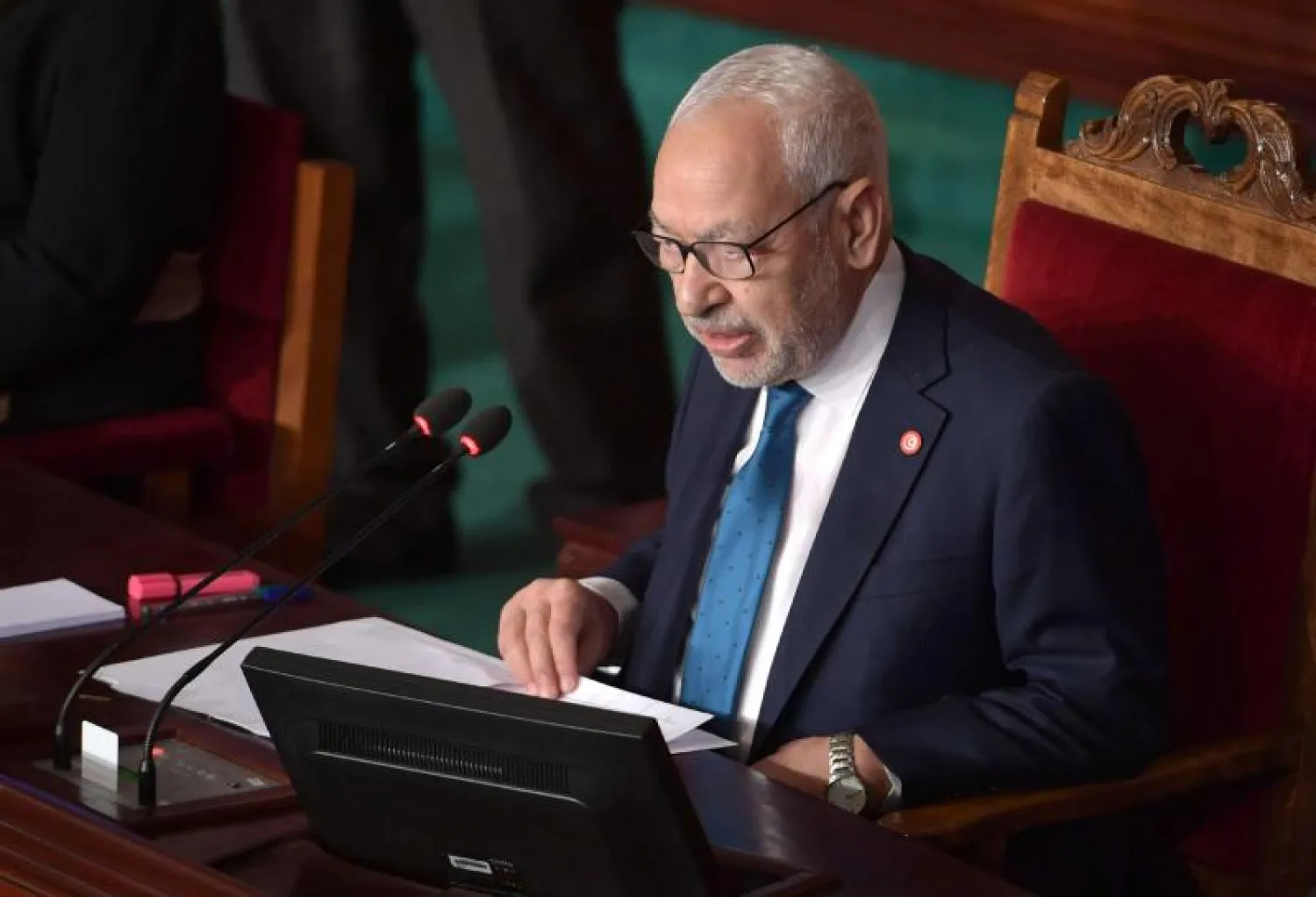
Tunisian Speaker Rached Ghannouchi attending a plenary session. (File picture: AFP)
TT

Tunisia’s Speaker Pleads for Calm Before Vote of No Confidence Session

Tunisian Speaker Rached Ghannouchi attending a plenary session. (File picture: AFP)

Tunisian Speaker Rached Ghannouchi has urged political parties from across the political spectrum for calm before a parliamentary session scheduled for Wednesday.

The Speaker told Tuesday's general session that after the successful democratic and political transition in Tunisia, it is necessary to address the needs of the society’s marginalized groups to achieve much-needed development.

The opposition parties, namely Free Destourian Party, wants to include a vote in Wednesday’s session to withdraw confidence from Ghannouchi over his blunders in joining regional axes.

However, Ennahda movement, which is headed by Ghannouchi, describes the session as a call to “discuss the limit of parliamentary diplomacy.”

Ghannouchi is criticized for his recent phone call with head of the Libyan Government of National Accord (GNA) Fayez al-Sarraj to congratulate him on capturing al-Watiya military airbase.

The Secretary-General of Tunisian General Labor Union (UGTT) Noureddine Taboubi said that the real crisis in the country is the lack of trust between the authority and the people.

During the inauguration of the Union’s executive office, Taboubi criticized the country’s weak social structure in light of the coronavirus outbreak.

He described the government of Elyes Fakhfakh as “an austerity cabinet” that will harm the most vulnerable social classes.

Taboubi stated that official data on the economic situation in Tunisia “has nothing to do with reality”, because the actual figures are very shocking.

During his recent meeting with PM Fakhfakh, Taboubi urged the cabinet to reveal the truth to Tunisians.

Ruling coalition parties have succeeded in formulating a unified stance before Wednesday’s parliament session, announcing that they reject all forms of chaos and attempts to jeopardize political stability.

Head of the Democratic Current Party Hisham al-Ajbouni said that withdrawing confidence from the speaker is not possible and that his party’s rapprochement with the Free Destourian is unlikely.

The Democratic Current has 41 votes in the parliament and brings together parties like the People's Movement, and some independent figures.

The head of Tahya Tounes bloc, Mustafa bin Ahmed, denied coordinating with the Free Destourian on withdrawing confidence from Ghannouchi.

He pointed out that the parliamentary bloc will also address Tunisia’s international relations, referring to Ghannouchi’s visit to Turkish President Recep Tayyip Erdogan, and the phone call with Sarraj.

Ennahda movement hinted that it might call for a government reshuffle and expand the ruling coalition.

Bin Ahmed described the government coalition as “fragile,” saying it hasn’t been able to achieve harmony.


Head of Arab World Institute in Paris Resigns over Epstein-linked tax Fraud Probe

(FILES) France's former culture minister and president of Paris's famed Arab World Institute (AWI), Jack Lang, poses on January 28, 2013 in Paris. (Photo by Martin BUREAU / AFP)
TT

Head of Arab World Institute in Paris Resigns over Epstein-linked tax Fraud Probe

(FILES) France's former culture minister and president of Paris's famed Arab World Institute (AWI), Jack Lang, poses on January 28, 2013 in Paris. (Photo by Martin BUREAU / AFP)

France’s former Culture Minister Jack Lang has resigned as head of a Paris cultural center over alleged past financial links to convicted sex offender Jeffrey Epstein that prompted a tax investigation.

Lang was summoned to appear at the French Foreign Ministry, which oversees the Arab World Institute, on Sunday, but he submitted his resignation.

He is the highest-profile figure in France impacted by the release of Epstein files on Jan. 30 by the US Department of Justice, known for his role as a culture minister under Socialist President François Mitterrand in the 1980s and 1990s.

The Foreign Ministry confirmed his resignation Saturday evening.

The financial prosecutors' office said it had opened an investigation into Lang and his daughter, Caroline, over alleged “aggravated tax fraud laundering.”

French investigative news website Mediapart reported last week on alleged financial and business ties between the Lang family and Jeffrey Epstein through an offshore company based in the US Virgin Islands in the Caribbean Sea.

Jack Lang's name was mentioned more than 600 times in the Epstein files, showing intermittent correspondence between 2012 and 2019. His daughter was also in the released files.

Foreign Minister Jean-Noël Barrot has “taken note” of Lang's resignation and began the process to look for his successor, the foreign ministry said.
Lang headed the Arab World Institute since 2013.


Lebanon PM Pledges Reconstruction on Visit to Ruined Border Towns

This handout picture released by the Lebanese Government Press Office shows Lebanon's Prime Minister Nawaf Salam being showered with confetti as he is received by locals during a tour in the heavily-damaged southern village of Dhayra near the border with Israel on February 7, 2026. (Lebanese Government Press Office / AFP)
TT

Lebanon PM Pledges Reconstruction on Visit to Ruined Border Towns

This handout picture released by the Lebanese Government Press Office shows Lebanon's Prime Minister Nawaf Salam being showered with confetti as he is received by locals during a tour in the heavily-damaged southern village of Dhayra near the border with Israel on February 7, 2026. (Lebanese Government Press Office / AFP)

Lebanese Prime Minister Nawaf Salam visited heavily damaged towns near the Israeli border on Saturday, pledging reconstruction.

It was his first trip to the southern border area since the army said it finished disarming Hezbollah there, in January.

Swathes of south Lebanon's border areas remain in ruins and largely deserted more than a year after a US-brokered November 2024 ceasefire sought to end hostilities between Israel and the Iran-backed group.

Lebanon's government has committed to disarming Hezbollah, and the army last month said it had completed the first phase of its plan to do so, covering the area between the Litani River and the Israeli border about 30 kilometers (20 miles) further south.

Visiting Tayr Harfa, around three kilometers from the border, and nearby Yarine, Salam said frontier towns and villages had suffered "a true catastrophe".

He vowed authorities would begin key projects including restoring roads, communications networks and water in the two towns.

Locals gathered on the rubble of buildings to greet Salam and the delegation of accompanying officials in nearby Dhayra, some waving Lebanese flags.

In a meeting in Bint Jbeil, further east, with officials including lawmakers from Hezbollah and its ally the Amal movement, Salam said authorities would "rehabilitate 32 kilometers of roads, reconnect the severed communications network, repair water infrastructure" and power lines in the district.

Last year, the World Bank announced it had approved $250 million to support Lebanon's post-war reconstruction, after estimating that it would cost around $11 billion in total.

Salam said funds including from the World Bank would be used for the reconstruction and rehabilitation projects.

The second phase of the government's disarmament plan for Hezbollah concerns the area between the Litani and the Awali rivers, around 40 kilometers south of Beirut.

Israel, which accuses Hezbollah of rearming, has criticized the army's progress as insufficient, while Hezbollah has rejected calls to surrender its weapons.

Despite the truce, Israel has kept up regular strikes on what it usually says are Hezbollah targets and maintains troops in five south Lebanon areas.

Lebanese officials have accused Israel of seeking to prevent reconstruction in the heavily damaged south with repeated strikes on bulldozers, excavators and prefabricated houses.

Visiting French Foreign Minister Jean-Noel Barrot on Friday said the reform of Lebanon's banking system needed to precede international funding for reconstruction efforts.

The French diplomat met Lebanon's army chief Rodolphe Haykal on Saturday, the military said.


Over 2,200 ISIS Detainees Transferred to Iraq from Syria, Says Iraqi Official

 One of the American buses transporting ISIS fighters, according to a security source from the Syrian Democratic Forces, heads from Syria towards Iraq, in Qamishli, Syria, February 7, 2026. (Reuters)
One of the American buses transporting ISIS fighters, according to a security source from the Syrian Democratic Forces, heads from Syria towards Iraq, in Qamishli, Syria, February 7, 2026. (Reuters)
TT

Over 2,200 ISIS Detainees Transferred to Iraq from Syria, Says Iraqi Official

 One of the American buses transporting ISIS fighters, according to a security source from the Syrian Democratic Forces, heads from Syria towards Iraq, in Qamishli, Syria, February 7, 2026. (Reuters)
One of the American buses transporting ISIS fighters, according to a security source from the Syrian Democratic Forces, heads from Syria towards Iraq, in Qamishli, Syria, February 7, 2026. (Reuters)

Iraq has so far received 2,225 ISIS group detainees, whom the US military began transferring from Syria last month, an Iraqi official told AFP on Saturday.

They are among up to 7,000 ISIS detainees whose transfer from Syria to Iraq the US Central Command (CENTCOM) announced last month, in a move it said was aimed at "ensuring that the terrorists remain in secure detention facilities".

Previously, they had been held in prisons and camps administered by the Kurdish-led Syrian Democratic Forces (SDF) in northeast Syria.

The announcement of the transfer plan last month came after US envoy to Syria Tom Barrack declared that the SDF's role in confronting ISIS had come to an end.

Saad Maan, head of the security information cell attached to the Iraqi prime minister's office, told AFP on Saturday that "Iraq has received 2,225 terrorists from the Syrian side by land and air, in coordination with the international coalition", which Washington has led since 2014 to fight IS.

He said they are being held in "strict, regular detention centers".

A Kurdish military source confirmed to AFP the "continued transfer of ISIS detainees from Syria to Iraq under the protection of the international coalition".

On Saturday, an AFP photographer near the Kurdish-majority city of Qamishli in northeastern Syria saw a US military convoy and 11 buses with tinted windows.

- Iraq calls for repatriation -

ISIS seized swathes of northern and western Iraq starting in 2014, until Iraqi forces, backed by the international coalition, managed to defeat it in 2017.

Iraq is still recovering from the severe abuses committed by the extremists.

In recent years, Iraqi courts have issued death and life sentences against those convicted of terrorism offences.

Thousands of Iraqis and foreign nationals convicted of membership in the group are incarcerated in Iraqi prisons.

On Monday, the Iraqi judiciary announced it had begun investigative procedures involving 1,387 detainees it received as part of the US military's operation.

In a statement to the Iraqi News Agency on Saturday, Maan said "the established principle is to try all those involved in crimes against Iraqis and those belonging to the terrorist ISIS organization before the competent Iraqi courts".

Among the detainees being transferred to Iraq are Syrians, Iraqis, Europeans and holders of other nationalities, according to Iraqi security sources.

Iraq is calling on the concerned countries to repatriate their citizens and ensure their prosecution.

Maan noted that "the process of handing over the terrorists to their countries will begin once the legal requirements are completed".