

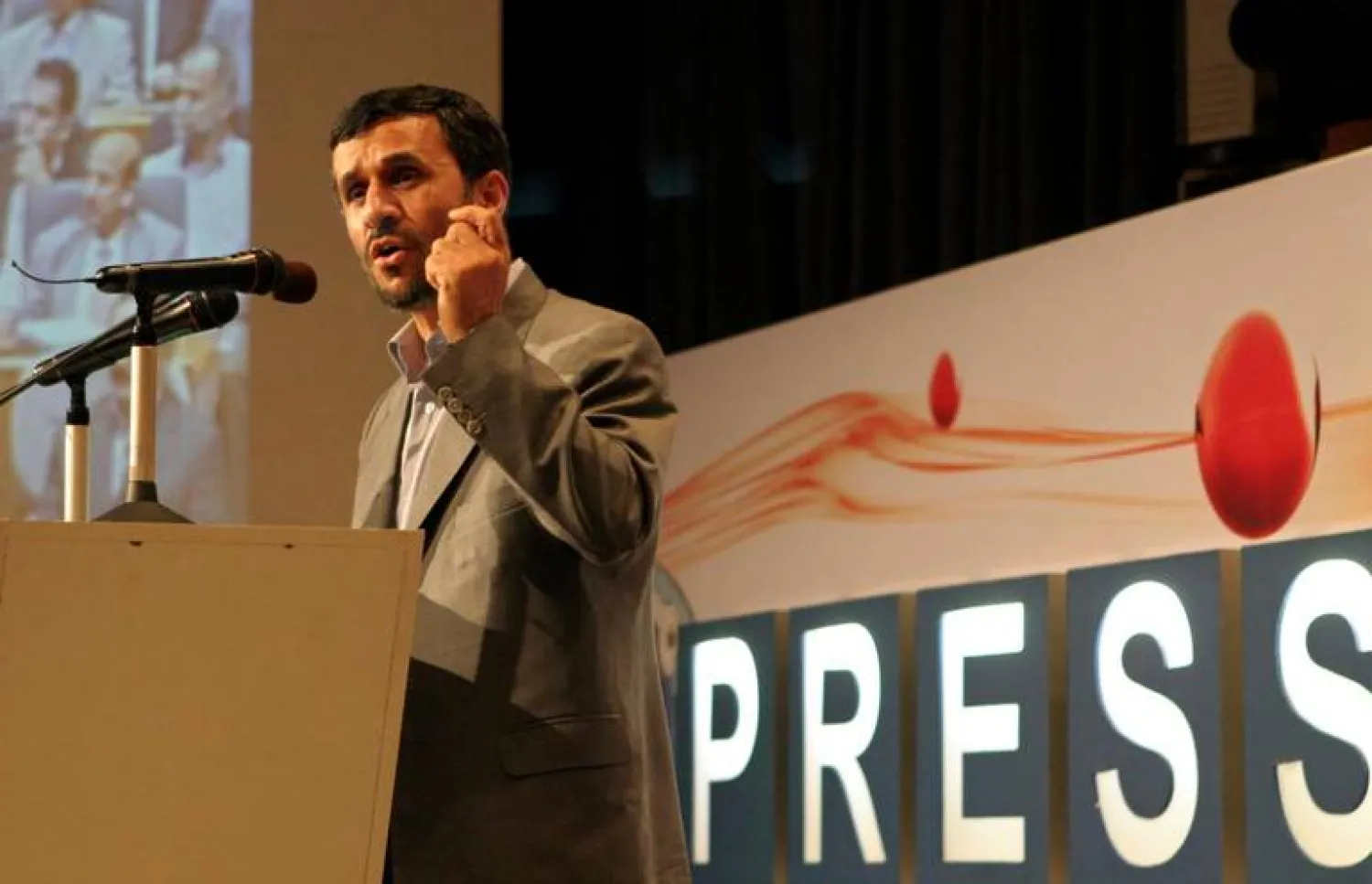

Iran TV Airs 355 Coerced Confessions Over Decade to Intimidate Activists

In this July 2, 2007, file photo, the then President Mahmoud Ahmadinejad delivers his speech during inauguration ceremony for Iran's first English-language channel, Press TV, as its logo is seen in background, in Tehran, Iran. (AP Photo/Vahid Salemi, File)
TT

Iran TV Airs 355 Coerced Confessions Over Decade to Intimidate Activists

In this July 2, 2007, file photo, the then President Mahmoud Ahmadinejad delivers his speech during inauguration ceremony for Iran's first English-language channel, Press TV, as its logo is seen in background, in Tehran, Iran. (AP Photo/Vahid Salemi, File)

Iranian state television has broadcast the suspected coerced confessions of at least 355 people over the last decade as a means to both suppress dissent and frighten activists in the Islamic Republic on behalf of security services, according to a report released Thursday.

The study published by Justice for Iran and the International Federation for Human Rights outlined cases of prisoners being coached into reading from white boards, with state television correspondents ordering them to repeat the lines while smiling.

Others recounted being beaten, threatened with sexual violence, and having their loved ones used against them to extract false testimonies later aired on news bulletins, magazine-style shows, and programs masquerading as documentaries, the report said.

The number of those filmed likely is even higher as some say their coerced confessions have yet to air, while others may not have been immediately accessible to researchers, said Mohammad Nayyeri, co-director of Justice for Iran.

"They always live with that fear of when it´s going to happen," Nayyeri told The Associated Press. "So that fear itself in those cases is not less than the fear and the anguish and pain of those whose confessions have been broadcast."

Emails sent to Islamic Republic of Iran Broadcasting, the state television, and radio firm, could not be delivered. Iran's mission to the United Nations did not respond to a request for comment.

Under Iranian law, only the state can own and operate television and radio stations. Satellite dishes, though prevalent across Tehran, remain illegal. YouTube and other Western video streaming services are blocked. That leaves many watching IRIB across its multiple national and provincial stations.

While state TV channels remain a major force across much of the Mideast, IRIB particularly appears influenced by state security agencies like Iran's Intelligence Ministry, its military, and the intelligence arm of the country's paramilitary Revolutionary Guard.

"IRIB operates as a media hub that links a vast network of security, intelligence, military, and judicial organizations," the report said. "IRIB is not simply a media organization and by no means an independent one, but rather an organ of state suppression that uses the tools of mass communication."

That translates to a focus on Iranian military production and exercises to airing confessions long criticized by Europe and the US, as well as human rights groups.

Washington sanctioned a bank supporting IRIB in November 2018 and later its director, Abdulali Ali-Asgari. The US Treasury says IRIB "routinely broadcasts false news reports and propaganda, including forced confessions of political detainees." US prosecutors even allege an IRIB staffer recruited a former US Air Force intelligence analyst for the Guard.

However, sanctions on IRIB itself have been waived every six months since being imposed by the Obama administration in 2013, in part over what the State Department has described as "Iran´s commitment to ensure that harmful satellite interference does not emanate from its territory."

The use of televised, coerced confessions dates back to the chaotic years immediately after Iran's 1979 Islamic Revolution. State television aired confessions by suspected members of communist groups, insurgents, and others. Even Mehdi Bazargan, Iran's first prime minister after the revolution, warned at one point he could be detained and put on television "repeating things like a parrot."

There have been a number of famous cases of aired coerced confessions, like that of Newsweek correspondent Maziar Bahari, who got British regulators to revoke the license for Iranian state television English-language arm Press TV over airing his.

The report by Justice for Iran and the International Federation for Human Rights describes in detail the case of Maziar Ebrahimi, who later said Intelligence Ministry officials tortured him and 11 others into giving coerced confessions falsely claiming they assassinated nuclear scientists on behalf of Israel.

"Even after confessing to the assassination of the Iranian nuclear scientists, Ebrahimi was still tortured and pressurized to take responsibility for another unsolved case of the explosion in the missile factory in Mallard," the report said.

Ebrahimi later was freed and left Iran for Germany. After the BBC's Persian service reported on his story, Iranian government spokesman Ali Rabiei in August called the Ebrahimi's torture "unprofessional" and said those responsible would be held accountable.

To date, there has been no public announcement of such a reckoning taking place.

But there are many more, according to the report, including those who have yet to see their confessions broadcast. Those sheer numbers over the last decade came as a surprise to Nayyeri and other researchers.

"It was because of the sheer shock of the numbers that we decided to give it more attention," he said. "You put them together and then, only then, you see how huge the problem is. It is not just every now and then. No, this is systematic. This is continuous."

Russian Envoy to Join Ukraine Talks in Miami

Burned electric water heaters lie at the site of a warehouse of home appliances which was hit during an overnight Russian drone strike, amid Russia's attack on Ukraine, in Odesa, Ukraine December 16, 2025. Press service of the State Emergency Service of Ukraine in Odesa region/Handout via REUTERS
TT

Russian Envoy to Join Ukraine Talks in Miami

Burned electric water heaters lie at the site of a warehouse of home appliances which was hit during an overnight Russian drone strike, amid Russia's attack on Ukraine, in Odesa, Ukraine December 16, 2025. Press service of the State Emergency Service of Ukraine in Odesa region/Handout via REUTERS

Russian envoy Kirill Dmitriev said on Saturday he was heading to Miami, where another round of talks to settle the Ukraine war is set to take place.

Ukrainian and European teams were also in the sunny American city for the negotiations mediated by Donald Trump's envoy Steve Witkoff and the US president's son-in-law Jared Kushner.

Trump's envoys have pushed a plan in which the United States would offer security guarantees to Ukraine, but Kyiv will likely be expected to surrender some territory, a prospect resented by many Ukrainians.

However, US Secretary of State Marco Rubio on Friday promised not to force Ukraine into any agreement, saying "there's no peace deal unless Ukraine agrees to it". He added that he may join the talks on Saturday in Miami, his hometown.

Dmitriev wrote in an X post that he was "on the way to Miami," adding a peace dove emoji and attaching a short video of a morning sun shining through clouds on a beach with palms.

"As warmongers keep working overtime to undermine the US peace plan for Ukraine, I remembered this video from my previous visit -- light breaking through the storm clouds," he added.

Russian and European involvement in the talks marks a step forward from an earlier stage, when the Americans held separate negotiations with each side in different locations, AFP reported.

However, it is unlikely Dmitriev would hold direct talks with Ukrainian and European negotiators as relations between the two sides remain extremely strained.

Moscow, which sent troops into Ukraine in February 2022, argues that Europe's involvement in the talks would only hinder the process and tends to paint the continent's leaders as pro-war.

The weekend talks come after President Vladimir Putin vowed to press ahead with his military offensive in Ukraine, hailing Moscow's battlefield gains nearly four years into his war in an annual news conference on Friday.

Russia announced on Saturday it had captured two villages in Ukraine's Sumy and Donetsk regions, further grinding through the country's east in costly battles.

Meanwhile, the death toll in Ukraine's Black Sea Odesa region from an overnight Russian ballistic missile strike on port infrastructure rose to eight, with almost three dozen people wounded in the attack.

At the same time, Ukraine claimed to have destroyed two Russian fighter jets at an airfield in occupied Crimea, according to the security service SBU.

Putin ordered a full-scale invasion of Ukraine in February 2022, describing it as a "special military operation" to demilitarize the country and prevent the expansion of NATO.

Kyiv and its European allies say the war, the largest and deadliest on European soil since World War II, is an unprovoked and illegal land grab that has resulted in a tidal wave of violence and destruction.


8 Dead, Dozens Wounded in Russian Strike on Ukraine's Odesa Port

A firefighter works at the site of a Russian missile and drone strike, amid Russia's attack on Ukraine, in Odesa region, Ukraine in this handout picture released December 20, 2025. Press service of the State Emergency Service of Ukraine in Odesa region/Handout via REUTERS
TT

8 Dead, Dozens Wounded in Russian Strike on Ukraine's Odesa Port

A firefighter works at the site of a Russian missile and drone strike, amid Russia's attack on Ukraine, in Odesa region, Ukraine in this handout picture released December 20, 2025. Press service of the State Emergency Service of Ukraine in Odesa region/Handout via REUTERS

Eight people were killed and 27 wounded in a Russian missile strike on port infrastructure in Odesa, southern Ukraine, late on Friday, Ukraine’s Emergency Service said Saturday morning.

Some of the wounded were on a bus at the epicenter of the overnight strike, the service said in a Telegram post. Trucks caught fire in the parking lot, and cars were also damaged.

The port was struck with ballistic missiles, said Oleh Kiper, the head of the Odesa region.

Elsewhere, Ukrainian forces hit a Russian warship and other facilities with drones, Ukraine’s General Staff said in a statement Saturday.

The nighttime attack on Friday hit the Russian warship “Okhotnik,” according to the statement posted to the Telegram messaging app.

The ship was patrolling in the Caspian Sea near an oil and gas production platform, The Associated Press reported. The extent of the damage is still being clarified, the statement added.

A drilling platform at the Filanovsky oil and gas field in the Caspian Sea was also hit. The facility is operated by Russian oil giant Lukoil. Ukrainian drones also struck a radar system in the Krasnosilske area of Crimea, which Russia illegally annexed from Ukraine in 2014.


Satellite Imagery Shows ‘Recent Activity’ at Iran Nuclear Facility

An inspector of the International Atomic Energy Agency sets up surveillance equipment at a uranium conversion facility in Iran in 2005. Photograph: Mehdi Ghasemi/AP
TT

Satellite Imagery Shows ‘Recent Activity’ at Iran Nuclear Facility

An inspector of the International Atomic Energy Agency sets up surveillance equipment at a uranium conversion facility in Iran in 2005. Photograph: Mehdi Ghasemi/AP

New satellite imagery shows recent activity at the Natanz nuclear facility that was damaged during June's 12-day war with Israel, according to the US-based Institute for Science and International Security (ISIS).

During the June conflict, the IAEA confirmed Israeli strikes hit Iran's Natanz underground enrichment plant.

The think tank said the satellite imagery from December 13 show panels placed on top of the remaining anti-drone structure at the Pilot Fuel Enrichment Plant (PFEP), providing cover for the damaged facility.

It suggested the new covering allows Iran to examine or retrieve materials from the rubble while limiting external observation.

The Natanz uranium enrichment facility, located some 250 km south of the Iranian capital Tehran, is one of Iran's most important and most controversial nuclear facilities in the Middle East.

Although the facility “likely held several kilograms of highly enriched uranium,” ISIS stressed that such material is “not negligible” in the broader context of Iran’s nuclear capabilities.

While PFEP shows renewed activity, ISIS said it has not observed similar signs at other major nuclear sites, including the underground Fordow facility also damaged in June by airstrikes.

Inspections
On December 15, IAEA chief Rafael Grossi has reiterated that Iran must allow inspectors access to the three key nuclear facilities that enrich uranium and were hit by the US and Israeli airstrikes last June.

Speaking to RIA Novosti, Grossi said the agency’s activities in Iran are very limited. “We are only allowed to access sites that were not hit.”

In October, the head of the UN nuclear watchdog told AP that Iran does not appear to be actively enriching uranium but that the agency has recently detected renewed movement at the country’s nuclear sites.

Grossi said that despite being unable to fully access Iranian nuclear sites, inspectors have not seen any activity via satellite to indicate that Tehran has accelerated its production of uranium enriched beyond what it had compiled before the 12-day war with Israel in June.

“However, the nuclear material enriched at 60% is still in Iran,” Grossi said in an interview at the United Nations headquarters in New York.

“And this is one of the points we are discussing because we need to go back there and to confirm that the material is there and it’s not being diverted to any other use,” he added, “This is very, very important.”

Iran’s Foreign Minister Abbas Araghchi said on December 8 that resuming the agency’s inspections is currently not possible because “there is no protocol or guideline” for inspecting facilities he described as “peaceful.”

ISIS reported on October 3 that new satellite imagery shows that Iran is ongoing construction efforts at a mountainous area just south of the Natanz enrichment site known as Kuh-e Kolang Gaz La, or Pickaxe Mountain.

On Sept. 26, The Washington Post said according to a review of satellite imagery and independent analysis, Iran has increased construction at a mysterious underground site in the months since the US and Israel pummeled its main nuclear facilities, suggesting Tehran has not entirely ceased work on its suspected weapons program and may be cautiously rebuilding.
