

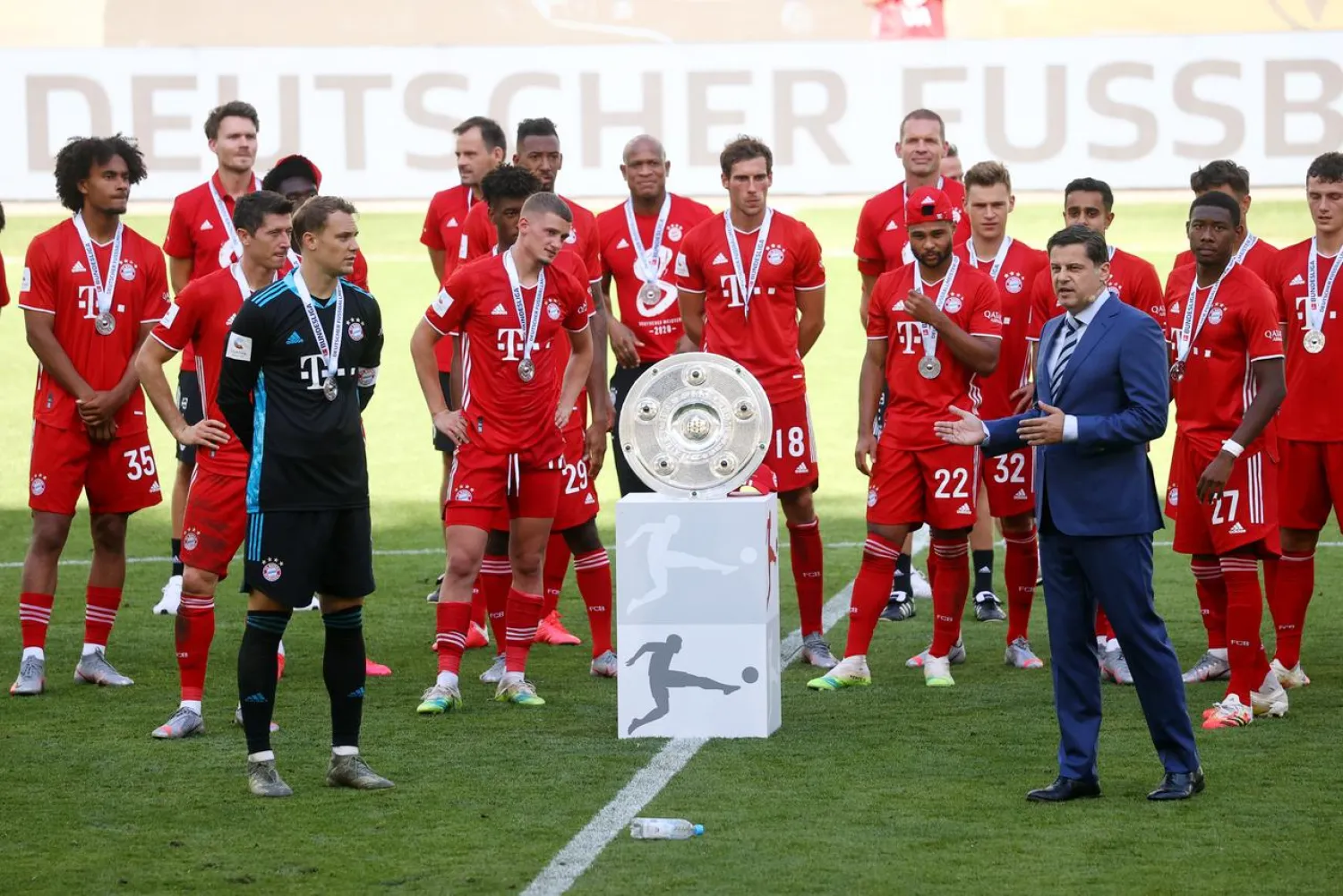

How Germany Did it: Completing the Football Season in Europe

Bayern Munich players during the trophy presentation after claiming the Bundesliga title, June 27, 2020. (Reuters)
TT

How Germany Did it: Completing the Football Season in Europe

Bayern Munich players during the trophy presentation after claiming the Bundesliga title, June 27, 2020. (Reuters)

There was a trophy, there were medals and there were commemorative T-shirts. Only the fans were missing as Bayern Munich celebrated its title Saturday and the Bundesliga breathed a sigh of relief. The restart plan worked.

“This isn’t the Bundesliga that we wanted or that we love, but it was the only Bundesliga that was possible,” league CEO Christian Seifert said.

When the Bundesliga restarted on May 16, it was more than a month ahead of other major European leagues. The June 27 finish leaves Bayern Munich and Leipzig with weeks of free time before the Champions League returns in August.

The Bundesliga's virus testing and medical protocols formed a blueprint for other leagues and sports around the world. Unlike most other European countries, Germany also restarted the women's league, won by Wolfsburg.

A season like no other
The games were eerie as players’ shouts echoed off empty concrete terraces and the colorful fan displays were gone. Borussia Dortmund set the tone on the first day back when its players lined up to salute the empty “Yellow Wall,” usually one of Europe’s loudest and best-known fan section.

The results were much like any other recent season. Bayern recovered from early-season troubles to win its eighth straight title with two games to spare, then held a muted party in private without players' families. Dortmund fought hard with an exciting young team, but fell short.

The coronavirus brought pain to some players, at least indirectly. Injuries were more common after the long break from training and second-division club Dynamo Dresden had to play eight games in 22 days after positive coronavirus tests delayed its return to action.

“Do you think that anyone in the league spent a single second thinking about what's going on in our heads?” Dresden player Chris Lowe said in a tearful, expletive-filled televised interview railing against the German league last week.

Now Bayern and Leipzig face weeks without games before the Champions League resumes in August, though Bayern still has a cup final on July 4 against Bayer Leverkusen. There is also a two-leg promotion-relegation playoff that has yet to be played.

Virus testing
Almost immediately after suspending the league on March 13, Germany quietly began preparing for the restart.

It helped that Germany was a world leader in ramping up its coronavirus testing. That meant that the league could use as many as 25,000 coronavirus tests to finish the season without putting a serious dent in the country's testing capability.

The deputy head of Germany's main public health body was opposed, saying tests should be saved only for people suspected of having the virus.

At one stage the restart looked in doubt after positive tests for players or staff at first-division club Cologne and second-division teams Dresden and Erzgebirge Aue. Polls consistently showed most Germans were opposed to the restart. Detailed planning by the league for testing and training helped convince key politicians.

The league has stopped publishing testing figures though no top-division team has reported an infection since the league resumed.

The only confirmed case of a player missing a Bundesliga game because of coronavirus was when veteran Werder Bremen striker Claudio Pizarro was quarantined following a positive test for his daughter, as he later told the local Weser Kurier newspaper. He was not found to have the virus.

Injuries abound
The restart was accompanied by a rash of minor injuries, mostly strains of players' soft tissue. That left Borussia Dortmund fielding a less-than-ideal starting lineup in its title-deciding 1-0 loss to Bayern when Jadon Sancho and Emre Can were only fit enough to come off the bench as substitutes.

Bundesliga players spent less time training at home than their counterparts in England or Spain because of Germany's quick move to socially distanced training in groups.

Some used the break to shake off injuries and return fully fit. Top scorer Robert Lewandowski, his Bayern teammate Kingsley Coman and Leipzig midfielder Kevin Kampl all made an impact after returning to fitness in the spring.

Obedient fans
German police, like those in England and elsewhere, feared fans would gather around stadiums and spread the coronavirus.

When Dortmund hosted local rival Schalke on the first day back on May 16, a few curious locals in club colors wandered by but soon left. A group of about 10 Polish warehouse workers constituted the largest crowd as they posed for photos in front of a club logo and played keep-ups with a ball.

There was no repeat from the Bundesliga's brief experiment with empty-stadium games before the shutdown, when hundreds of Borussia Mönchengladbach supporters chanted outside their team's stadium during a win over Cologne.

Instead, German fans have mostly followed the rules and watched at home, as shown by record audiences for broadcaster Sky on the first weekend back. Bayern's title win also didn't prompt the kind of street partying seen in England after Liverpool's long-awaited championship.

TV rights fall
Germany found itself leading the way commercially too. It was the first big European league trying to limit the financial damage to its TV deals during the pandemic.

Nearly two decades of soaring TV rights values ground to a halt with the new domestic broadcast packages signed Monday worth 4.4 billion euros ($5 billion) over four seasons from 2021-25. That's about 60 million euros ($67.7 million) less per season than the current agreement.

Bayern CEO Karl-Heinz Rummenigge said other leagues will soon feel the pain. “If you look at the problems that are still unresolved with the TV broadcasters in, for example, England, Italy or Spain, then we can still be very satisfied here in Germany,” Rummenigge said Tuesday in a video on the club's LinkedIn page.

Italy’s Serie A expects to launch a TV rights tender in September for the period 2021-24. The English Premier League and Spanish league are both heading into talks on new domestic TV rights cycles from 2022.

Dividing a smaller TV-rights deal between the same number of teams is causing tension in Germany. Many smaller clubs want a more even split and fewer advantages for teams who finish high up the table.



‘Don’t Jump in Them’: Olympic Athletes’ Medals Break During Celebrations

Gold medalists team USA celebrate during the medal ceremony after the Team Event Free Skating of the Figure Skating competitions at the Milano Cortina 2026 Winter Olympic Games, in Milan, Italy, 08 February 2026. (EPA)
TT

‘Don’t Jump in Them’: Olympic Athletes’ Medals Break During Celebrations

Gold medalists team USA celebrate during the medal ceremony after the Team Event Free Skating of the Figure Skating competitions at the Milano Cortina 2026 Winter Olympic Games, in Milan, Italy, 08 February 2026. (EPA)

Handle with care. That's the message from gold medalist Breezy Johnson at the Milan Cortina Winter Olympics after she and other athletes found their medals broke within hours.

Olympic organizers are investigating with "maximum attention" after a spate of medals have fallen off their ribbons during celebrations on the opening weekend of the Games.

"Don’t jump in them. I was jumping in excitement, and it broke," women's downhill ski gold medalist Johnson said after her win Sunday. "I’m sure somebody will fix it. It’s not crazy broken, but a little broken."

TV footage broadcast in Germany captured the moment biathlete Justus Strelow realized the mixed relay bronze he'd won Sunday had fallen off the ribbon around his neck and clattered to the floor as he danced along to a song with teammates.

His German teammates cheered as Strelow tried without success to reattach the medal before realizing a smaller piece, seemingly the clasp, had broken off and was still on the floor.

US figure skater Alysa Liu posted a clip on social media of her team event gold medal, detached from its official ribbon.

"My medal don’t need the ribbon," Liu wrote early Monday.

Andrea Francisi, the chief games operations officer for the Milan Cortina organizing committee, said it was working on a solution.

"We are aware of the situation, we have seen the images. Obviously we are trying to understand in detail if there is a problem," Francisi said Monday.

"But obviously we are paying maximum attention to this matter, as the medal is the dream of the athletes, so we want that obviously in the moment they are given it that everything is absolutely perfect, because we really consider it to be the most important moment. So we are working on it."

It isn't the first time the quality of Olympic medals has come under scrutiny.

Following the 2024 Summer Olympics in Paris, some medals had to be replaced after athletes complained they were starting to tarnish or corrode, giving them a mottled look likened to crocodile skin.


African Players in Europe: Ouattara Fires Another Winner for Bees

Football - Premier League - Newcastle United v Brentford - St James' Park, Newcastle, Britain - February 7, 2026 Brentford's Dango Ouattara celebrates scoring their third goal with Brentford's Rico Henry. (Reuters)
TT

African Players in Europe: Ouattara Fires Another Winner for Bees

Football - Premier League - Newcastle United v Brentford - St James' Park, Newcastle, Britain - February 7, 2026 Brentford's Dango Ouattara celebrates scoring their third goal with Brentford's Rico Henry. (Reuters)

Burkina Faso striker Dango Ouattara was the Brentford match-winner for the second straight weekend when they triumphed 3-2 at Newcastle United.

The 23-year-old struck in the 85th minute of a seesaw Premier League struggle in northeast England. The Bees trailed and led before securing three points to go seventh in the table.

Last weekend, Ouattara dented the title hopes of third-placed Aston Villa by scoring the only goal at Villa Park.

AFP Sport highlights African headline-makers in the major European leagues:

ENGLAND

DANGO OUATTARA (Brentford)

With the match at Newcastle locked at 2-2, the Burkinabe sealed victory for the visitors at St James' Park by driving a left-footed shot past Magpies goalkeeper Nick Pope to give the Bees a first win on Tyneside since 1934. Ouattara also provided the cross that led to Vitaly Janelt's headed equalizer after Brentford had fallen 1-0 behind.

BRYAN MBEUMO (Manchester Utd)

The Cameroon forward helped the Red Devils extend their perfect record under caretaker manager Michael Carrick to four games by scoring the opening goal in a 2-0 win over Tottenham after Spurs had been reduced to 10 men by captain Cristian Romero's red card.

ISMAILA SARR (Crystal Palace)

The Eagles ended their 12-match winless run with a 1-0 victory at bitter rivals Brighton thanks to Senegal international Sarr's 61st-minute goal when played in by substitute Evann Guessand, the Ivory Coast forward making an immediate impact on his Palace debut after joining on loan from Aston Villa during the January transfer window.

ITALY

LAMECK BANDA (Lecce)

Banda scored direct from a 90th-minute free-kick outside the area to give lowly Leece a precious 2-1 Serie A victory at home against mid-table Udinese. It was the third league goal this season for the 25-year-old Zambia winger. Leece lie 17th, one place and three points above the relegation zone.

GERMANY

SERHOU GUIRASSY (Borussia Dortmund)

Guirassy produced a moment of quality just when Dortmund needed it against Wolfsburg. Felix Nmecha's silky exchange with Fabio Silva allowed the Guinean to sweep in an 87th-minute winner for his ninth Bundesliga goal of the season. The 29-year-old has scored or assisted in four of his last five games.

RANSFORD KOENIGSDOERFFER (Hamburg)

A first-half thunderbolt from Ghana striker Koenigsdoerffer put Hamburg on track for a 2-0 victory at Heidenheim. It was their first away win of the season. Nigerian winger Philip Otele, making his Hamburg debut, split the defense with a clever pass to Koenigsdoerffer, who hit a shot low and hard to open the scoring in first-half stoppage time.

FRANCE

ISSA SOUMARE (Le Havre)

An opportunist goal by Soumare on 54 minutes gave Le Havre a 2-1 home win over Strasbourg in Ligue 1. The Senegalese received the ball just inside the area and stroked it into the far corner of the net as he fell.


Olympic Town Warms up as Climate Change Puts Winter Games on Thin Ice

 Milano Cortina 2026 Olympics - Alpine Skiing - Men's Team Combined Downhill - Stelvio Ski Centre, Bormio, Italy - February 09, 2026. Alexis Monney of Switzerland in action during the Men's Team Combined Downhill. (Reuters)
Milano Cortina 2026 Olympics - Alpine Skiing - Men's Team Combined Downhill - Stelvio Ski Centre, Bormio, Italy - February 09, 2026. Alexis Monney of Switzerland in action during the Men's Team Combined Downhill. (Reuters)
TT

Olympic Town Warms up as Climate Change Puts Winter Games on Thin Ice

 Milano Cortina 2026 Olympics - Alpine Skiing - Men's Team Combined Downhill - Stelvio Ski Centre, Bormio, Italy - February 09, 2026. Alexis Monney of Switzerland in action during the Men's Team Combined Downhill. (Reuters)
Milano Cortina 2026 Olympics - Alpine Skiing - Men's Team Combined Downhill - Stelvio Ski Centre, Bormio, Italy - February 09, 2026. Alexis Monney of Switzerland in action during the Men's Team Combined Downhill. (Reuters)

Olympic fans came to Cortina with heavy winter coats and gloves. Those coats were unzipped Sunday and gloves pocketed as snow melted from rooftops — signs of a warming world.

“I definitely thought we’d be wearing all the layers,” said Jay Tucker, who came from Virginia to cheer on Team USA and bought hand warmers and heated socks in preparation. “I don’t even have gloves on.”

The timing of winter, the amount of snowfall and temperatures are all less reliable and less predictable because Earth is warming at a record rate, said Shel Winkley, a Climate Central meteorologist. This poses a growing and significant challenge for organizers of winter sports; The International Olympic Committee said last week it could move up the start date for future Winter Games to January from February because of rising temperatures.

While the beginning of the 2026 Olympic Winter Games in Cortina truly had a wintry feel, as the town was blanketed in heavy snow, the temperature reached about 40 degrees Fahrenheit (4.5 degrees Celsius) Sunday afternoon. It felt hotter in the sun.

This type of February “warmth” for Cortina is made at least three times more likely due to climate change, Winkley said. In the 70 years since Cortina first held the Winter Games, February temperatures there have climbed 6.4 degrees Fahrenheit (3.6 degrees Celsius), he added.

For the Milan Cortina Games, there's an added layer of complexity. It’s the most spread-out Winter Games in history, so Olympic venues are in localities with very different weather conditions. Bormio and Livigno, for example, are less than an hour apart by car, but they are separated by a high mountain pass that can divide the two places climatically.

The organizing committee is working closely with four regional and provincial public weather agencies. It has positioned weather sensors at strategic points for the competitions, including close to the ski jumping ramps, along the Alpine skiing tracks and at the biathlon shooting range.

Where automatic stations cannot collect everything of interest, the committee has observers — “scientists of the snow”— from the agencies ready to collect data, according to Matteo Pasotti, a weather specialist for the organizing committee.

The hope? Clear skies, light winds and low temperatures on race days to ensure good visibility and preserve the snow layer.

The reality: “It’s actually pretty warm out. We expected it to be a lot colder,” said Karli Poliziani, an American who lives in Milan. Poliziani was in Cortina with her father, who considered going out Sunday in just a sweatshirt.

And forecasts indicate that more days with above-average temperatures lie ahead for the Olympic competitions, Pasotti said.

Weather plays a critical role in the smooth running and safety of winter sports competitions, according to Filippo Bazzanella, head of sport services and planning for the organizing committee. High temperatures can impact the snow layer on Alpine skiing courses and visibility is essential. Humidity and high temperatures can affect the quality of the ice at indoor arenas and sliding centers, too.

Visibility and wind are the two factors most likely to cause changes to the competition schedule, Bazzanella added. Wind can be a safety issue or a fairness one, such as in the biathlon where slight variations can disrupt the athletes' precise shooting.

American alpine skier Jackie Wiles said many races this year have been challenging because of the weather.

“I feel like we’re pretty good about keeping our heads in the game because a lot of people are going to get taken out by that immediately,” she said at a team press conference last week. “Having that mindset of: it’s going to be what it’s going to be, and we still have to go out there and fight like hell regardless.”