


US Seeks to Seize Iran Gas Tankers Heading Toward Venezuela

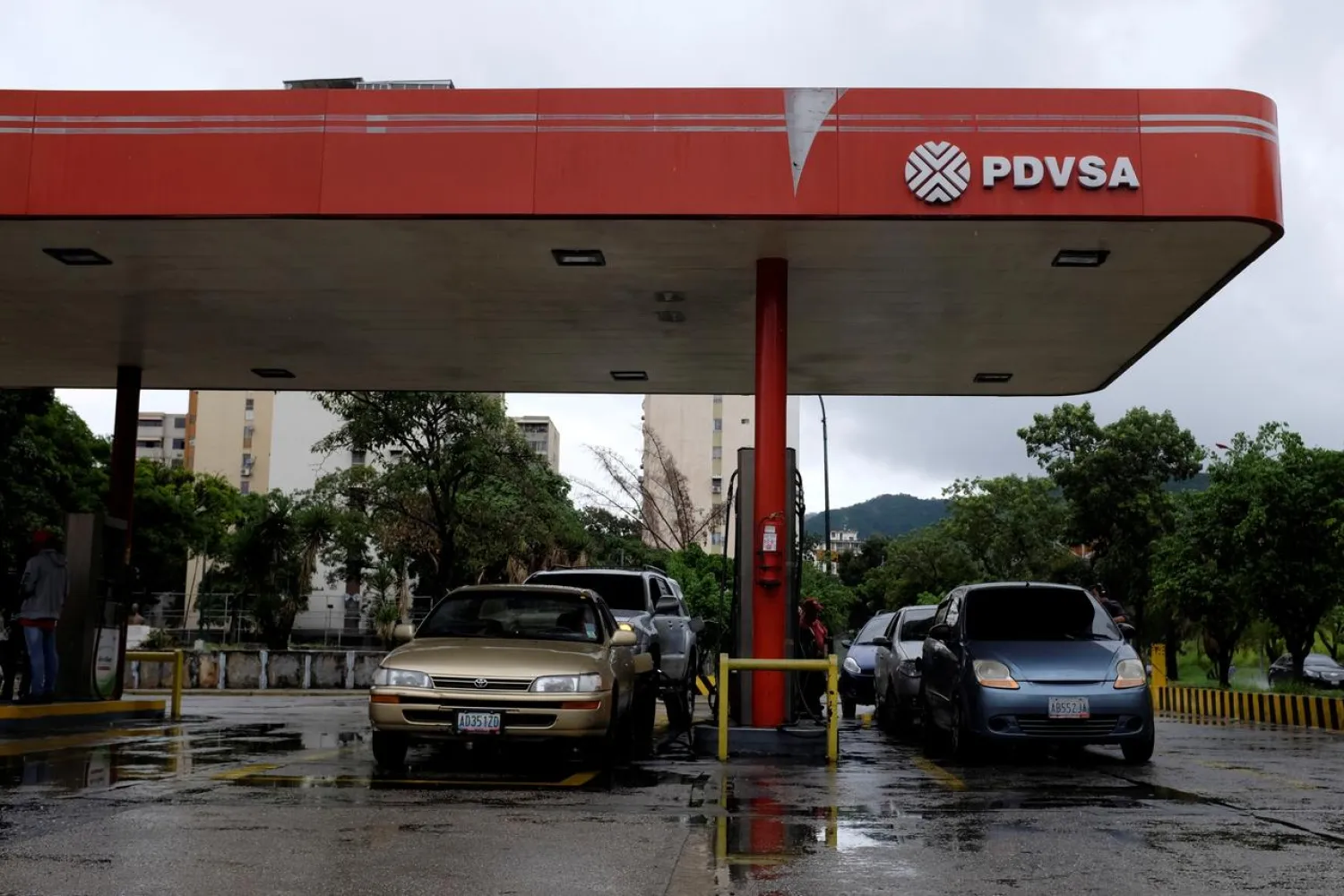
FILE PHOTO - Motorists line up for fuel at a gas station of the Venezuelan state-owned oil company PDVSA in Caracas, Venezuela September 24, 2018. REUTERS/Marco Bello
TT

US Seeks to Seize Iran Gas Tankers Heading Toward Venezuela

FILE PHOTO - Motorists line up for fuel at a gas station of the Venezuelan state-owned oil company PDVSA in Caracas, Venezuela September 24, 2018. REUTERS/Marco Bello

US federal prosecutors are seeking to seize four tankers sailing toward Venezuela with gasoline supplied by Iran, the latest attempt to disrupt ever-closer trade ties between the two heavily sanctioned anti-American allies, The Associated Press reported.

The civil-forfeiture complaint filed late Wednesday in the District of Columbia federal court says the sale was arranged by a businessman, Mahmoud Madanipour, with ties to Iran's Revolutionary Guard Corps, a US-designated foreign terrorist organization.

“The profits from these activities support the IRGC’s full range of nefarious activities, including the proliferation of weapons of mass destruction and their means of delivery, support for terrorism, and a variety of human rights abuses, at home and abroad,” prosecutor Zia Faruqui alleges in the complaint.

AP requested reaction from Iran’s mission to the United Nations but did not receive an immediate response.

The Trump administration has been stepping up pressure on ship owners to abide by sanctions against US adversaries like Iran, Venezuela and North Korea. In May, it issued an advisory urging the global maritime industry to be on the lookout for tactics to evade sanctions like dangerous ship-to-ship transfers and the turning off of mandatory tracking devices — both techniques used in recent oil deliveries to and from both Iran and Venezuela.

The campaign appears to be working.

On Thursday, the US Treasury Department lifted sanctions on eight vessels that were recently found to have transported Venezuelan crude. The move followed an attempted auction Wednesday by federal marshals in Houston of 100,000 barrels of gasoline seized from a Greek-managed ship whose owner suspected the cargo was heading toward Venezuela. None of the five parties at the auction agreed to the minimum $2.5 million bid.

As commercial traders increasingly shun Venezuela, Nicolas Maduro's socialist government has been increasingly turning to Iran.

In May, Maduro celebrated the arrival of five Iranian tankers delivering badly needed fuel supplies to alleviate shortages that have led to days-long gas lines even in the capital, Caracas, which is normally spared such hardships. Despite sitting atop the world's largest crude reserves, Venezuela doesn't produce enough domestically-refined gasoline and has seen its overall crude production plunge to the lowest in over seven decades amid the ongoing crisis and fallout from US sanctions.

We are “two rebel nations, two revolutionary nations that will never kneel down before US imperialism,” Maduro said at the time.

“Venezuela has friends in this world, and brave friends at that.”

The flotilla’s arrival angered the Trump administration, which struck back by sanctioning the five Iranian captains of the vessels.

The four tankers named in the complaint filed Wednesday — the Bella, Bering, Pandi and Luna — are currently transporting to Venezuela 1.1 million barrels of gasoline obtained via risky ship-to-ship transfers, prosecutors allege. Of the four, the Bella is currently sailing near the Philippines, ship tracking data shows, while the Pandi appears to have turned off its satellite tracking system on June 29. The other two were last spotted in May — the Bering near Greece and the Luna sailing near Iran.

One of the companies involved in the shipment to Venezuela, the Avantgarde Group, was previously linked to the Revolutionary Guard and attempts to evade US sanctions, according to prosecutors. An affiliate of Avantgarde facilitated the purchase for the Revolutionary Guard of the Grace 1, a ship seized last year by Britain on US accusations that it was transporting oil to Syria.

Iran denied the charges and the Grace 1 was eventually released. But the seizure nonetheless triggered an international standoff in which Iran retaliated by seizing a British-flagged vessel.

According to the asset forfeiture complaint, an unnamed company in February invoiced Avantgarde for a $14.9 million cash payment for the sale of the gasoline aboard the Pandi. Nonetheless, a text message between Mandanipour and an unnamed co-conspirator suggest the voyage had encountered difficulties.

“The ship owner doesn't want to go because of the American threat, but we want him to go, and we even agreed We will also buy the ship,” according to the message, an excerpt of which was included in the complaint.



Netanyahu Skeptical of an Iran Breakthrough

Israel's Prime Minister Benjamin Netanyahu leaves after a meeting with US President Donald Trump at the White House February 11, 2026, in Washington, DC. (Photo by Brendan Smialowski / AFP)
TT

Netanyahu Skeptical of an Iran Breakthrough

Israel's Prime Minister Benjamin Netanyahu leaves after a meeting with US President Donald Trump at the White House February 11, 2026, in Washington, DC. (Photo by Brendan Smialowski / AFP)

Israeli Prime Minister Benjamin Netanyahu said he was skeptical that US nuclear talks with Iran will lead to a breakthrough but described his meeting with US President Donald Trump at the White House as “excellent.”

Speaking to reporters Thursday in Washington before boarding a plane to return to Israel, Netanyahu said Trump’s terms and Iran’s “understanding that they made a mistake the last time when they did not reach an agreement, may lead them to agree to conditions that will enable a good agreement to be reached.”

While he said he did “not hide my general skepticism” about any deal, he stressed that any agreement must include concessions about Iran’s ballistic missiles program and support for militant proxies.

He added that the conversation Wednesday with Trump, which lasted more than two hours, included a number of other subjects, including Gaza and regional developments but focused on the negotiations with Iran.


German Court Rejects Palestinian's Claim over Weapons Exports

A view shows the front of the Reichstag building, the seat of the German parliament, the Bundestag, in Berlin, Germany March 5, 2025. REUTERS/Annegret Hilse/File Photo
TT

German Court Rejects Palestinian's Claim over Weapons Exports

A view shows the front of the Reichstag building, the seat of the German parliament, the Bundestag, in Berlin, Germany March 5, 2025. REUTERS/Annegret Hilse/File Photo

Germany's highest court on Thursday threw out a case brought by a Palestinian civilian from Gaza seeking to sue the German government over its weapons exports to Israel.

The complainant, supported by the European Center for Constitutional and Human Rights (ECCHR), had been seeking to challenge export licences for German parts used in Israeli tanks deployed in Gaza.

After his case was rejected by lower courts in 2024 and 2025, he had appealed to the Federal Constitutional Court.

But the court in Karlsruhe dismissed the case, stating that "the complainant has not sufficiently substantiated that the specialized courts misjudged or arbitrarily denied a possible duty to protect him", AFP reported.

While Germany is obliged to protect human rights and respect international humanitarian law, this does not mean the state is necessarily obliged to take specific action on behalf of individuals, the court said.

"It is fundamentally the responsibility of the state authorities themselves to decide how they fulfil their general duty of protection," it added.

The ECCHR called the decision "a setback for civilian access to justice".

"The court acknowledges the duty to protect but only in the abstract and refuses to ensure its practical enforcement," said Alexander Schwarz, co-director of the NGO's International Crimes and Legal Accountability program.

"For people whose lives are endangered by the consequences of German arms exports, access to justice remains effectively closed," he said.

The ECCHR had been hoping for a successful appeal after the Constitutional Court ruled last year that Germany had "a general duty to protect fundamental human rights and the core norms of international humanitarian law, even in cases involving foreign countries".

In that case, two Yemenis had been seeking to sue Berlin over the role of the US Ramstein airbase in a 2012 drone attack.

The complainant was one of five Palestinians who initially brought their case against the German government in 2024.


2 Israelis Charged with Using Classified Military Information to Place Bets

The Israeli Iron Dome air defense system intercepts missiles during an Iranian attack on Tel Aviv, Israel, June 18, 2025. (AP Photo/Leo Correa, File)
TT

2 Israelis Charged with Using Classified Military Information to Place Bets

The Israeli Iron Dome air defense system intercepts missiles during an Iranian attack on Tel Aviv, Israel, June 18, 2025. (AP Photo/Leo Correa, File)

Two Israelis have been charged with using classified military information to place bets on how future events will unfold, Israeli authorities said Thursday, accusing the individuals of “serious security offenses.”

A joint statement by the Israeli Ministry of Defense, domestic security service Shin Bet and police said that a civilian and a reservist are suspected of placing bets on the US-based prediction market Polymarket on future military operations based on information that the reservist had access to, The AP news reported.

Israel’s Attorney General’s Office decided to prosecute the two individuals following a joint investigation by police, military intelligence and other security agencies that resulted in several arrests. The two face charges including bribery and obstruction of justice.

Authorities offered no details on the identity of the two individuals or the reservist's rank or position in the Israeli military but warned that such actions posed a “real security risk” for the military and the Israeli state.

Israel’s public broadcaster Kan had reported earlier that the bets were placed in June ahead of Israel’s war with Iran and that the winnings were roughly $150,000.

Israel's military and security services “view the acts attributed to the defendants very seriously and will act resolutely to thwart and bring to justice any person involved in the activity of using classified information illegally,” the statement said.

The accused will remain in custody until the end of legal proceedings against them, the Prosecutor's Office said.

Prediction markets are comprised of typically yes-or-no questions called event contracts, with the prices connected to what traders are willing to pay, which theoretically indicates the perceived probability of an event occurring.

Their use has skyrocketed in recent years, but despite some eye-catching windfalls, traders still lose money everyday. In the US, the trades are categorized differently than traditional forms of gambling, raising questions about transparency and risk.