

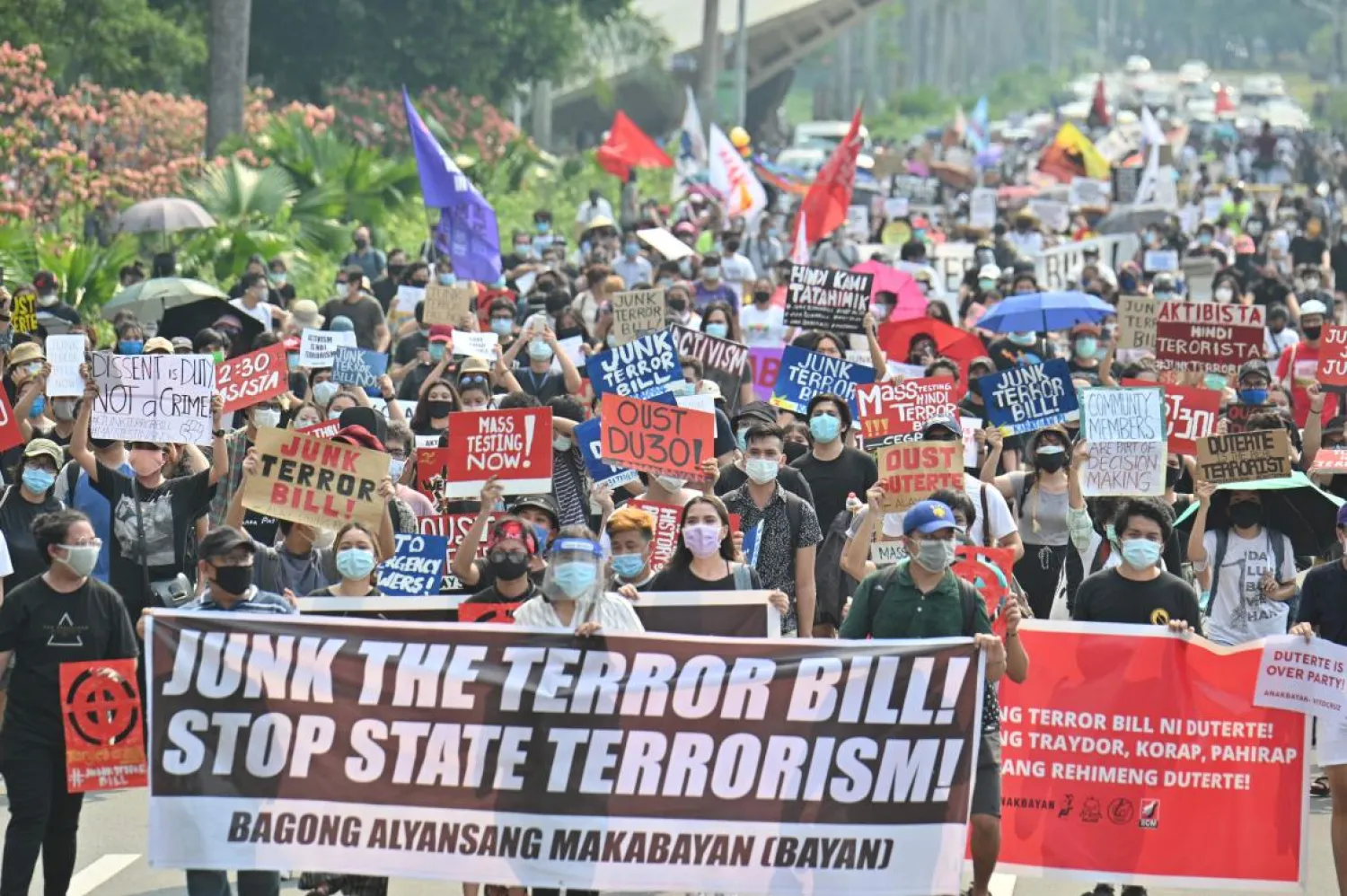

Philippines' Duterte Signs Anti-Terrorism Bill into Law

Philippine President Duterte signed a contentious anti-terrorism bill into law that critics fear will be used to silence dissent and give the government a new weapon to target opponents. (AFP)
TT

Philippines' Duterte Signs Anti-Terrorism Bill into Law

Philippine President Duterte signed a contentious anti-terrorism bill into law that critics fear will be used to silence dissent and give the government a new weapon to target opponents. (AFP)

Philippine President Rodrigo Duterte signed a contentious anti-terrorism bill into law Friday that critics fear will be used to silence dissent and give the government a new weapon to target opponents.

The legislation, which was approved by Congress last month and has been criticized by rights groups, enables Duterte to appoint a council that could order warrantless arrests of people it deems are terrorists.

It also allows for weeks of detention without charge, which the government argues is necessary to combat long-running communist and Islamist insurgencies.

"The signing of the... law demonstrates our serious commitment to stamp out terrorism, which has long plagued the country and has caused unimaginable grief and horror to many of our people," Duterte's spokesman Harry Roque said.

But activists say the definition of terrorism in the legislation is vague and could strengthen Duterte's campaign against critics. Some are already serving prison sentences or facing jail time after attacking his policies including his drug war that has killed thousands.

"Under Duterte's presidency, even the mildest government critics can be labelled terrorists," Amnesty International's Asia director Nicholas Bequelin said.

"This administration has effectively crafted a new weapon to brand and hound any perceived enemies of the state," he added.

"In the prevailing climate of impunity, a law so vague on the definition of 'terrorism' can only worsen attacks against human rights defenders."

The law defines terrorism as intending to cause death or injury, damage government or private property or use weapons of mass destruction to "spread a message of fear" or intimidate the government.

Suspects could be held up to 24 days without charge, which opponents allege violates a three-day limit set by the Philippine constitution.

Critics allege the legislation also strips away old safeguards, such as penalties against law enforcers for wrongful detention of suspects.

"By signing the anti-terrorism bill into law, President Duterte has pushed Philippines democracy into an abyss," said Phil Robertson, deputy Asia director for Human Rights Watch.

"The law threatens to significantly worsen the human rights situation in the Philippines, which has nosedived since the catastrophic 'war on drugs' began four years ago," Robertson added.

In a report last month, the UN human rights office said at least 8,663 people have been killed in the drug war with "near impunity" for offenders.

Government officials say alarm about the law is overblown, citing provisions that exempt "advocacy, protest, dissent, stoppage of work... not intended to cause death or serious physical harm".

Roque told AFP Duterte signed the bill without making any changes.


Russia: Man Suspected of Shooting Top General Detained in Dubai

An investigator works outside a residential building where the assassination attempt on Russian Lieutenant General Vladimir Alexeyev took place in Moscow, Russia February 6, 2026. REUTERS/Anastasia Barashkova
TT

Russia: Man Suspected of Shooting Top General Detained in Dubai

An investigator works outside a residential building where the assassination attempt on Russian Lieutenant General Vladimir Alexeyev took place in Moscow, Russia February 6, 2026. REUTERS/Anastasia Barashkova

Russia's Federal Security Service (FSB) said on Sunday that the man suspected of shooting top Russian military intelligence officer Vladimir Alexeyev in Moscow has been detained in Dubai and handed over to Russia.

Lieutenant General Vladimir Alexeyev, deputy head of the GRU, ⁠Russia's military intelligence arm, was shot several times in an apartment block in Moscow on Friday, investigators said. He underwent surgery after the shooting, Russian media ⁠said.

The FSB said a Russian citizen named Lyubomir Korba was detained in Dubai on suspicion of carrying out the shooting.

Russian Foreign Minister Sergei Lavrov accused Ukraine of being behind the assassination attempt, which he said was designed to sabotage peace talks. ⁠Ukraine said it had nothing to do with the shooting.

Alexeyev's boss, Admiral Igor Kostyukov, the head of the GRU, has been leading Russia's delegation in negotiations with Ukraine in Abu Dhabi on security-related aspects of a potential peace deal.


Factory Explosion Kills 8 in Northern China

Employees work on an electric vehicle (EV) production line at the Volkswagen Anhui factory in Hefei, Anhui province, China, February 4, 2026. REUTERS/Florence Lo
TT

Factory Explosion Kills 8 in Northern China

Employees work on an electric vehicle (EV) production line at the Volkswagen Anhui factory in Hefei, Anhui province, China, February 4, 2026. REUTERS/Florence Lo

An explosion at a biotech factory in northern China has killed eight people, Chinese state media reported Sunday, increasing the total number of fatalities by one.

State news agency Xinhua had previously reported that seven people died and one person was missing after the Saturday morning explosion at the Jiapeng biotech company in Shanxi province, citing local authorities.

Later, Xinhua said eight were dead, adding that the firm's legal representative had been taken into custody.

The company is located in Shanyin County, about 400 kilometers west of Beijing, AFP reported.

Xinhua said clean-up operations were ongoing, noting that reporters observed dark yellow smoke emanating from the site of the explosion.

Authorities have established a team to investigate the cause of the blast, the report added.

Industrial accidents are common in China due to lax safety standards.
In late January, an explosion at a steel factory in the neighboring province of Inner Mongolia left at least nine people dead.


Iran Warns Will Not Give Up Enrichment Despite US War Threat

Traffic moves through a street in Tehran on February 7, 2026. (Photo by ATTA KENARE / AFP)
TT

Iran Warns Will Not Give Up Enrichment Despite US War Threat

Traffic moves through a street in Tehran on February 7, 2026. (Photo by ATTA KENARE / AFP)

Iran will never surrender the right to enrich uranium, even if war "is imposed on us,” its foreign minister said Sunday, defying pressure from Washington.

"Iran has paid a very heavy price for its peaceful nuclear program and for uranium enrichment," Abbas Araghchi told a forum in Tehran.

"Why do we insist so much on enrichment and refuse to give it up even if a war is imposed on us? Because no one has the right to dictate our behavior," he said, two days after he met US envoy Steve Witkoff in Oman.

The foreign minister also declared that his country was not intimidated by the US naval deployment in the Gulf.

"Their military deployment in the region does not scare us," Araghchi said.
