


Taking a Knee Is Important but Football Must Do More on Racial Equality

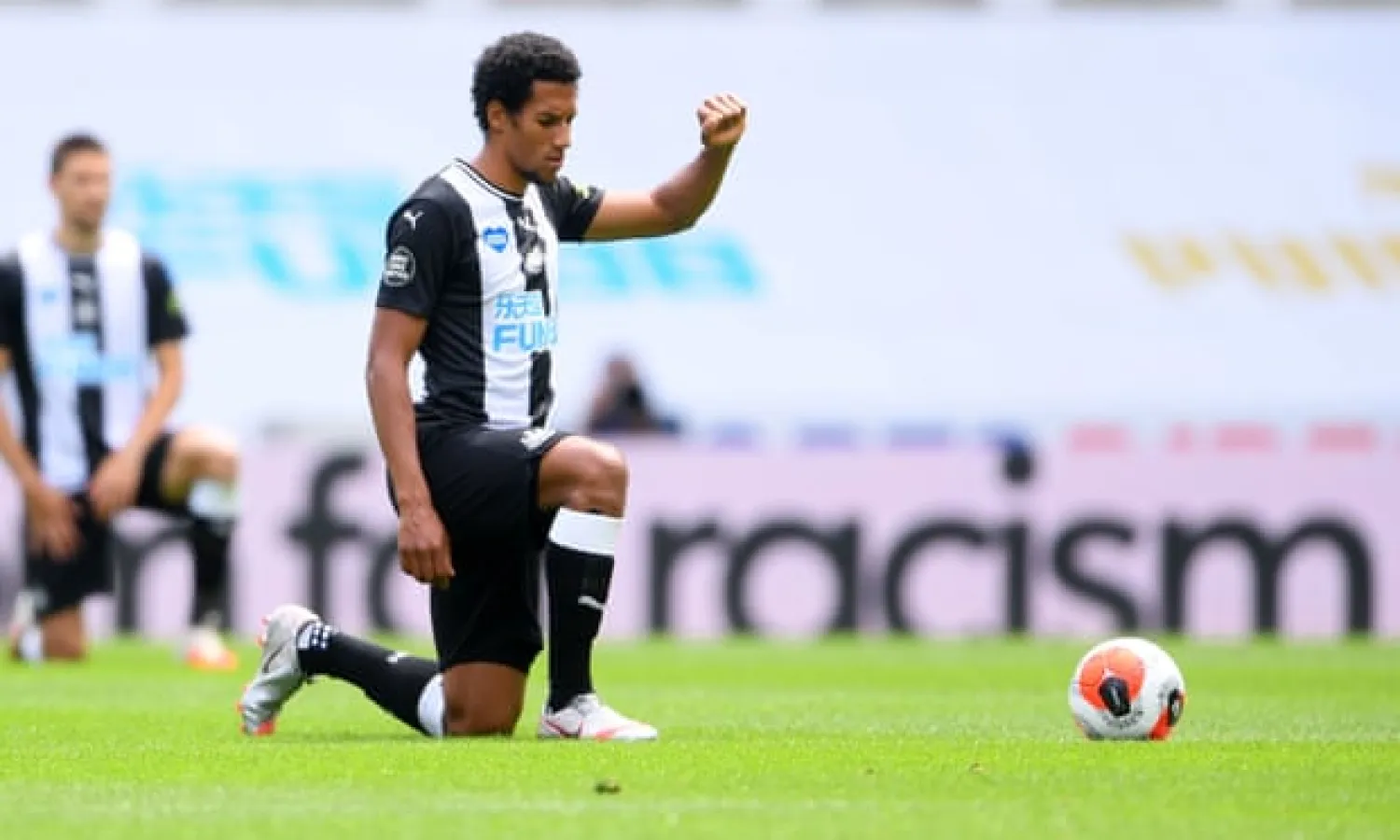
 Newcastle United midfielder Isaac Hayden takes a knee at the start of the Premier League match against Sheffield United at St James’ Park on Sunday. Photograph: Laurence Griffiths/AFP/Getty Images
Newcastle United midfielder Isaac Hayden takes a knee at the start of the Premier League match against Sheffield United at St James’ Park on Sunday. Photograph: Laurence Griffiths/AFP/Getty Images
TT

Taking a Knee Is Important but Football Must Do More on Racial Equality

 Newcastle United midfielder Isaac Hayden takes a knee at the start of the Premier League match against Sheffield United at St James’ Park on Sunday. Photograph: Laurence Griffiths/AFP/Getty Images
Newcastle United midfielder Isaac Hayden takes a knee at the start of the Premier League match against Sheffield United at St James’ Park on Sunday. Photograph: Laurence Griffiths/AFP/Getty Images

The Premier League has restarted with every player wearing a Black Lives Matter badge on his sleeve, and with those words replacing the names on their backs. At the start of each game every player, referee and member of staff has taken a knee. It has been incredibly powerful and moving and left me speechless, understanding that the eyes of the world were watching an unprecedented statement of unity against racism during what has been an unprecedented time.

As a symbolic gesture of support for the fight for racial equality it is a huge statement by the Premier League, for me the best league in the world and the strongest global football brand. But the gesture cannot distract us from the genuine work and significant change that still has to be done by the league and its clubs.

The fact is that 35% of the people on the pitch are black, but there is nowhere near the same percentage in executive, managerial or leadership positions. There are phrases that can be used to describe this situation that are heavy with politics and history, such as white privilege and white supremacy – but they accurately reflect the current situation in English football.

The old-fashioned stereotype of black men is that they are by nature strong, powerful athletes and the fact is that they are still not being trusted to manage budgets and people. These are ingrained prejudices and confronting them will be a lot more uncomfortable than sticking a badge on a sleeve, but without dealing with them the lack of diversity in Premier League dugouts and boardrooms will never change. The time to put the wheels of change into motion is now.

I believe in football meritocracy, but I also cannot accept that every single white person in a managerial or executive role in the game deserved to be appointed more than any single black person. There will be some people whose opportunities came because they are white and well connected. The statistics are embarrassing, and nothing will change unless what they reveal is accepted and confronted.

Last week the Professional Footballers’ Association released the results of an audit of the organisation, revealing precisely what proportion of employees at every level is black and calling on others to be equally transparent. Across the PFA about 30% of people are black and that’s the way it should be – the players’ union should reflect its membership. The Premier League should also reflect theirs.

I heard Jermain Defoe questioning whether it was worth him doing his coaching badges, because none of the black players he has looked up to in his life are working in management, leaving him feeling like the opportunities simply are not there for people like him. Gareth Southgate, Frank Lampard and Steven Gerrard walked into excellent coaching positions at the end of their playing careers, and while I would say they absolutely deserve them – they were great players and leaders, and would lose those jobs pretty quickly if they were failing – we must start confronting why black players find it so hard to take the same path.

The talent pool is enormous, and it isn’t just the 35% of players on Premier League pitches. Of the great Premier League managers of this century so far – Alex Ferguson, Arsène Wenger, José Mourinho, Pep Guardiola and Jürgen Klopp – most had unimpressive playing careers. Mourinho’s big break came as a translator, and I know there are intelligent black guys out there who can speak six languages and understand and love the game like Mourinho does. At what point do we also look beyond footballers? There will be fantastic black sports scientists and performance analysts, but if you’re not looking for a potential black Guardiola you’re not going to find one.

This is why I support something like the NFL’s Rooney rule. Put simply, no club should feel they must appoint a black manager, but they should be expected to engage with a wider range of people. There could be a target, perhaps that a third of candidates for managerial and executive roles have to come from black or other ethnic minority backgrounds. It’s not about handing anyone a job on a plate, it’s to do with fishing in a different sea to the one you’ve always fished in.

It is no different to the homegrown player rules, a quota that was brought in very quickly and without protest and had a massive impact: academy investment went up, academy managers felt it justified the work they were doing and were incentivised to work harder, young players at big clubs got more opportunities and recruitment practices changed. Now we need to create a policy that encourages the next generation of black coaches and executives to push themselves so they are competitive candidates when the time comes to go into management, rather than giving up because they don’t see the pathway.

Aston Villa, where I work as the sporting director for women’s football, are based in the most culturally diverse city in the country, and we have a chief executive in Christian Purslow who wants to engage that community. I am grateful for the position I’m in, and I would like to think I got the job based on a range of factors with the fact I am a black woman incidental, but the fact is I was given a fantastic opportunity, and I am now in a position to inspire another black person from the diverse community that we serve to go into football, or another club to take a chance on someone who doesn’t look the same as all the other sporting directors.

Nobody is asking for 20 black Premier League managers. I would just like to see a level of representation that is not embarrassing, that reflects the diversity on the pitch and the communities we serve across British society. The badge the players are wearing on their sleeves is not only a gesture of the Premier League’s solidarity, but also a signal that there is more work to do.

The Guardian Sport


Australia Humiliated by Ecuador in Davis Cup Qualifier

Tennis - Davis Cup - Qualifiers  - Ecuador v Australia - Quito Tenis y Golf Club, Quito, Ecuador - February 8, 2026 Team Ecuador celebrate winning the doubles match between Ecuador's Gonzalo Escobar and Diego Hidalgo, and  Australia's Rinky Hijikata and Jordan Thompson REUTERS/Cristina Vega
Tennis - Davis Cup - Qualifiers - Ecuador v Australia - Quito Tenis y Golf Club, Quito, Ecuador - February 8, 2026 Team Ecuador celebrate winning the doubles match between Ecuador's Gonzalo Escobar and Diego Hidalgo, and Australia's Rinky Hijikata and Jordan Thompson REUTERS/Cristina Vega
TT

Australia Humiliated by Ecuador in Davis Cup Qualifier

Tennis - Davis Cup - Qualifiers  - Ecuador v Australia - Quito Tenis y Golf Club, Quito, Ecuador - February 8, 2026 Team Ecuador celebrate winning the doubles match between Ecuador's Gonzalo Escobar and Diego Hidalgo, and  Australia's Rinky Hijikata and Jordan Thompson REUTERS/Cristina Vega
Tennis - Davis Cup - Qualifiers - Ecuador v Australia - Quito Tenis y Golf Club, Quito, Ecuador - February 8, 2026 Team Ecuador celebrate winning the doubles match between Ecuador's Gonzalo Escobar and Diego Hidalgo, and Australia's Rinky Hijikata and Jordan Thompson REUTERS/Cristina Vega

Australia slumped to their worst Davis Cup result under long-serving captain Lleyton Hewitt, suffering a 3-1 humiliation away to lowly Ecuador in the first round of qualifiers on Sunday.

With Australia's number one Alex De Minaur opting out of the tie in Quito, the 28-times champions crashed out when Rinky Hijikata and Jordan Thompson were beaten 7-6(5) 6-4 by Gonzalo Escobar and Diego Hidalgo in the decisive doubles rubber.

Lacking a player in the top 200, Ecuador set up their unlikely triumph on home clay by claiming ⁠both the opening singles rubbers on Saturday.

Alvaro Guillen Meza downed Hijikata in three sets before 257th-ranked Andres Andrade shocked world number 86 James Duckworth, also in three, Reuters reported.

Ecuador next face Britain in the second round of qualifiers in September.

With De Minaur leading the charge, Australia reached back-to-back finals in 2022-23 and ⁠the semi-finals in 2024.

However, the Ecuador shock continues the team's decline following their failure to reach the eight-nation Finals in 2025, Hewitt's 10th year in charge.

India's Dhakshineswar Suresh won both his singles matches and partnered Yuki Bhambri to victory in the doubles as India beat Netherlands 3-2 in Bengaluru.

The 25-year-old held his nerve under immense pressure in the final rubber against Guy de Ouden to win 6-4 7-6 (4) and guide India to the second round of qualifiers ⁠for the first time since the new Davis Cup format began in 2019.

“It’s just a different feeling when you’re playing for your country,” Suresh, who has a world ranking of 470, told the Davis Cup website after the win. “You are not playing for yourself, you’re playing for the whole nation."

India meet South Korea in the next round in September after the Koreans defeated Argentina 3-2. The United States beat Hungary 4-0 while Britain also secured a 4-0 win over Norway and Canada beat Brazil 3-2.


Saudi Arabia: RCU Partners with ASICS to Support Sports Development

The MoU was signed at the Cultural Oasis in AlUla. SPA
TT

Saudi Arabia: RCU Partners with ASICS to Support Sports Development

The MoU was signed at the Cultural Oasis in AlUla. SPA

Saudi Arabia’s Royal Commission for AlUla (RCU) has signed a Memorandum of Understanding (MoU) with ASICS, aimed at strengthening strategic cooperation to support the development of AlUla’s sports ecosystem and enhance talent pathways, in line with RCU’s long-term vision and future ambitions.

The MoU, signed at the Cultural Oasis in AlUla, establishes a framework for future collaboration through which RCU will explore opportunities to leverage ASICS’ technical, operational, and specialized advisory expertise across sports development and performance services, including assessment and analysis, to enhance the quality of sporting experiences in AlUla.

The cooperation includes joint efforts to support a more integrated sports ecosystem through initiatives that strengthen training environments, enhance athletic performance, and advance athlete development pathways and talent programs. RCU and ASICS will also explore opportunities to develop distinctive events and initiatives and attract regional and international competitions that contribute to AlUla’s growing profile on global sporting calendars.

The MoU further supports collaboration on community engagement through grassroots programs and social impact initiatives that encourage participation and wellbeing. It also enables exploration of digital enhancements that improve event delivery and participant engagement, including smarter registration, data management, and participant tracking for the AlUla Trail Race and other events across AlUla’s calendar.

This step is part of RCU’s ongoing efforts to develop the sports ecosystem in AlUla and increase community participation in sporting activities, in line with the objectives of Saudi Vision 2030 to advance the sports sector and enhance the quality of life.


Hospital: Vonn Had Surgery on Broken Leg from Olympics Crash

This handout video grab from IOC/OBS shows US Lindsey Vonn crashing during the women's downhill event at the Milano Cortina 2026 Winter Olympic Games on February 8, 2026. (Photo by Handout / various sources / AFP)
TT

Hospital: Vonn Had Surgery on Broken Leg from Olympics Crash

This handout video grab from IOC/OBS shows US Lindsey Vonn crashing during the women's downhill event at the Milano Cortina 2026 Winter Olympic Games on February 8, 2026. (Photo by Handout / various sources / AFP)

Lindsey Vonn had surgery on a fracture of her left leg following the American's heavy fall in the Winter Olympics downhill, the hospital said in a statement given to Italian media on Sunday.

"In the afternoon, (Vonn) underwent orthopedic surgery to stabilize a fracture of the left leg," the Ca' Foncello hospital in Treviso said.

Vonn, 41, was flown to Treviso after she was strapped into a medical stretcher and winched off the sunlit Olimpia delle Tofane piste in Cortina d'Ampezzo.

Vonn, whose battle to reach the start line despite the serious injury to her left knee dominated the opening days of the Milano Cortina Olympics, saw her unlikely quest halted in screaming agony on the snow.

Wearing bib number 13 and with a brace on the left knee she ⁠injured in a crash at Crans Montana on January 30, Vonn looked pumped up at the start gate.

She tapped her ski poles before setting off in typically aggressive fashion down one of her favorite pistes on a mountain that has rewarded her in the past.

The 2010 gold medalist, the second most successful female World Cup skier of all time with 84 wins, appeared to clip the fourth gate with her shoulder, losing control and being launched into the air.

She then barreled off the course at high speed before coming to rest in a crumpled heap.

Vonn could be heard screaming on television coverage as fans and teammates gasped in horror before a shocked hush fell on the packed finish area.

She was quickly surrounded by several medics and officials before a yellow Falco 2 ⁠Alpine rescue helicopter arrived and winched her away on an orange stretcher.
