


Colombia Offers Path to Civilian Life for Dissident Rebels

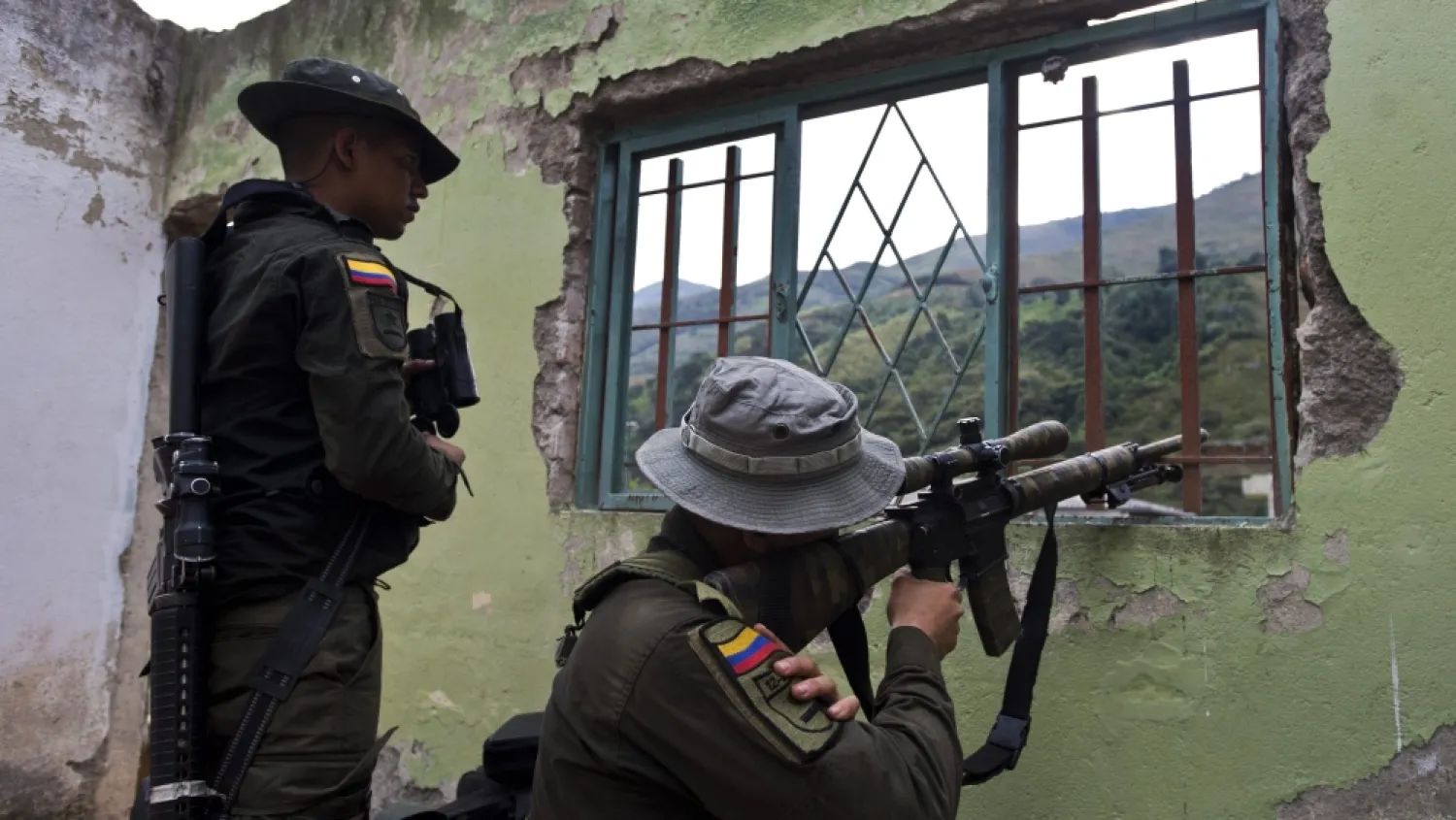
Colombia is offering rebels who have rejected the nation’s historic peace deal and remain in arms a path forward as civilians with conditions. (AFP)
TT

Colombia Offers Path to Civilian Life for Dissident Rebels

Colombia is offering rebels who have rejected the nation’s historic peace deal and remain in arms a path forward as civilians with conditions. (AFP)

Colombia is offering rebels who have rejected the nation’s historic peace deal and remain in arms a path forward as civilians if they agree to surrender their weapons and cooperate with any judicial proceedings against them.

The decree announced Wednesday is aimed at dissidents with the former Revolutionary Armed Forces of Colombia, as well as those who belong to three other groups – the Gulf Clan, the Pelusos and the Caparros.

In total the groups are estimated to have several thousand militants who continue to cause violence in conflict-ridden parts of the country.

“The state today is extending its hand,” said Miguel Ceballos, Colombia’s high commissioner for peace. “This is a moment in which saving lives, as all Colombians and all people on this planet know, should be the priority.”

The offer is similar to past government efforts aimed at convincing individual members of illegal armed groups to surrender rather than negotiate a collective peace deal, as was done with the Revolutionary Armed Forces in 2016, ending Latin America’s longest-running conflict.

The new decree does not include the National Liberation Army, whose leaders Tuesday proposed a bilateral 90-day ceasefire. Duque rejected that offer, instead calling on them to free all kidnapping victims and stop all criminal activity. Talks with the group fizzled in 2018 after a series of bombings against police.

“Our government will never cease to fulfill its constitutional obligation to confront criminality,” Duque wrote on Twitter. “The ELN is a terrorist group that has attacked with barbarity our country for decades.”

The new decree aimed at four groups heavily involved in the drug trade still requires rebels to go before the justice system, but offers immediate aid with food, housing, health care and education “to start a new life plan.”

Ceballos said penalties would be much higher for rebels like Seuxis Hernández, alias Jesús Santrich, and Luciano Marín, alias Iván Márquez, two guerrilla leaders who were key proponents of the peace accord but later opted to return to arms, accusing the state of betraying the deal.

“This is not a decree of forgiveness or amnesty,” he said.

Though not named, ELN rebels can still seek individual surrender under a 2003 law. The new measure was announced in April, but only became effective this week with a new decree outlining the specific steps rebels can take.

Violence still reigns in several parts of Colombia where coca crops have grown at record levels in recent years and the state has little presence. Over 100 social leaders have been killed thus far in 2020, according to Indepaz, a human rights monitoring organization. Prosecutors say illegal armed groups who see the activists as a threat to their territorial control are behind much of the bloodshed.

The presidential decree is likely aimed at low-ranking rebels who never signed on to the peace accord or have since fallen back into illegal activity, said Ariel Ávila, deputy director of the Peace and Reconciliation Foundation.

He said all of the groups in question have expanded in recent years, with the Revolutionary Armed Force of Colombia dissidents likely numbering around 2,500, many of whom are not likely to pursue the offer.

“For some who are feeling a lot of military pressure, perhaps,” he said. “For others, no.”


France Accuses Iran of ‘Repression’ in Sentence for Nobel Laureate

People cross an intersection in downtown Tehran, Iran, Monday, Feb. 9, 2026. (AP)
TT

France Accuses Iran of ‘Repression’ in Sentence for Nobel Laureate

People cross an intersection in downtown Tehran, Iran, Monday, Feb. 9, 2026. (AP)

France accused Iran on Monday of "repression and intimidation" after a court handed Nobel Peace Prize laureate Narges Mohammadi a new six-year prison sentence on charges of harming national security.

Mohammadi, sentenced Saturday, was also handed a one-and-a-half-year prison sentence for "propaganda" against Iran's system, according to her foundation.

"With this sentence, the Iranian regime has, once again, chosen repression and intimidation," the French foreign ministry said in a statement, describing the 53-year-old as a "tireless defender" of human rights.

Paris is calling for the release of the activist, who was arrested before protests erupted nationwide in December after speaking out against the government at a funeral ceremony.

The movement peaked in January as authorities launched a crackdown that activists say has left thousands dead.

Over the past quarter-century, Mohammadi has been repeatedly tried and jailed for her vocal campaigning against Iran's use of capital punishment and the mandatory dress code for women.

Mohammadi has spent much of the past decade behind bars and has not seen her twin children, who live in Paris, since 2015.

Iranian authorities have arrested more than 50,000 people as part of their crackdown on protests, according to US-based Human Rights Activists News Agency (HRANA).


Iran's Supreme Leader Urges Iranians to Show 'Resolve' against Foreign Pressure

Iran's supreme leader Ali Khamenei on (File Photo/Supreme Leader's website).
TT

Iran's Supreme Leader Urges Iranians to Show 'Resolve' against Foreign Pressure

Iran's supreme leader Ali Khamenei on (File Photo/Supreme Leader's website).

Iran's supreme leader Ali Khamenei on Monday called on his compatriots to show "resolve" ahead of the anniversary of the 1979 Islamic revolution this week.

Since the revolution, "foreign powers have always sought to restore the previous situation", Ali Khamenei said, referring to the period when Iran was under the rule of shah Reza Pahlavi and dependent on the United States, AFP reported.

"National power is less about missiles and aircraft and more about the will and steadfastness of the people," the leader said, adding: "Show it again and frustrate the enemy."


UK PM's Communications Director Quits

British Prime Minister Keir Starmer delivers a speech at Horntye Park Sports Complex in St Leonards, Britain, February 05, 2026. Peter Nicholls/Pool via REUTERS
TT

UK PM's Communications Director Quits

British Prime Minister Keir Starmer delivers a speech at Horntye Park Sports Complex in St Leonards, Britain, February 05, 2026. Peter Nicholls/Pool via REUTERS

British Prime Minister Keir Starmer's director of communications Tim Allan resigned on Monday, a day after Starmer's top aide Morgan McSweeney quit over his role in backing Peter Mandelson over his known links to Jeffrey Epstein.

The loss of two senior aides ⁠in quick succession comes as Starmer tries to draw a line under the crisis in his government resulting from his appointment of Mandelson as ambassador to the ⁠US.

"I have decided to stand down to allow a new No10 team to be built. I wish the PM and his team every success," Allan said in a statement on Monday.

Allan served as an adviser to Tony Blair from ⁠1992 to 1998 and went on to found and lead one of the country’s foremost public affairs consultancies in 2001. In September 2025, he was appointed executive director of communications at Downing Street.
